Help us protect the commons. Make a tax deductible gift to fund our work. Donate today!
“Public Interest Groups make Internet an Election Issue” by Russell McOrmond
Help us protect the commons. Make a tax deductible gift to fund our work. Donate today!
“Public Interest Groups make Internet an Election Issue” by Russell McOrmond
“When standards don’t apply” by David Becker
“Culture Warrior” by Sandy Starr
“Some Rights Reserved” by Wes Phillips
“How to use open source as a power marketing tool” by John Koening
Independent childrens recording artist Zak Morgan‘s second album was nominated for Grammy this year. The amazing part is that he is without any label backing: he produces his own albums, coordinates his own tours, and sells his CDs along the way. In this posting to CDBaby’s site, he tells the story of how he went from struggling musician to successful musician to Grammy-nominated musician. Long story short: it involves a lot of hard work and planning to get gigs and takes a lot of savings to pay for a professional production. [via Scott Andrew]

The photos of “underbunny” show an artful, somber view of the world and offer a glimpse into what it’s like to work at a mortuary. This photo in particular is quite powerful, telling the story of a life lived for 102 years. All the photos are available under a Creative Commons license, to boot.
Here’s an interesting blurb from the Stanford Report:
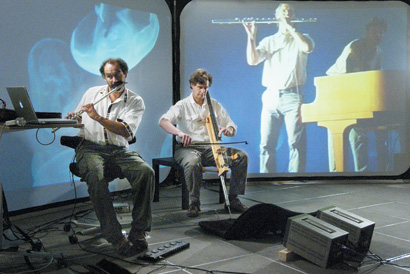
Music Professor Chris Chafe played his celleto with Berkeley musician Roberto Morales, left, in Wallenberg Hall during an intercontinental jam session June 18 that took advantage of sophisticated teleconference technology. Projected on the screen are Hogne Moe, left, and Oyvind Berg, who “virtually” joined the concert from the Royal Academy of Technolgy in Stockholm. The quartet played three improvisational concerts as part of the “Point 25” project (the title refers to the one-quarter-second delay of the Internet broadcast) sponsored, in part, by the Wallenberg Global Learning Network. Audience members in Stanford and Stockholm also were able to watch each other.
Does anyone know if the event was recorded?