I forgot to blog this last week when a friend pointed me to it: online music mag Earplug’s current issue blurbs the forthcoming WIRED CD and November issue. A taste of the punchy and deliciously accurate write-up:
The Creative Commons license is not a free-for-all: some of the artists permit only non-commercial sampling and sharing while others are open to all potential uses (with the exception of advertising placement). But the point Creative Commons makes is that there’s a difference between “all rights reserved” and “some rights reserved” — especially in the digital age — and artists should be free to make these decisions about their work for themselves.
New design for Creative Commons!
We’re happy to have launched our completely revamped and retooled website, at creativecommons.org. It’s a new direction towards simplicity and promoting the millions of license works found online today. We worked with Adaptive Path on tailoring the site along two major themes: Find to help you find works to listen to, look at, remix, and redistribute, and Publish to help publishing your photos, movies, and music with a license. We also introduced a bunch of pages around each type of major category, each with a customized search engine, links to archives and featured works, interviews, and help on publishing just that kind of content online. We’re launching with five of these areas, but more to come.
I’ll make a more in-depth post later this week explaining our results from user testing, how the new site is organized and why, and all the great people that helped out on it. For now, I’m happy to see the new site up after months of hard work by the entire team. The site has been up for just a few minutes and we’re still squashing bugs galore, so if you find any errors, or have any comments, feel free to comment here.
South African and Belgian draft licenses now available for comment
Two more countries join the International Commons discussion and drafting process today: South Africa and Belgium. Check out the drafts, subscribe to the lists, and congratulate your local Project Lead on making it all possible.
Open Copyright License Discussion to Start in Belgium
Creative Commons begins work with the
University of Namur’s cyberlaw research center to offer Belgian
versions of its “some rights reserved” copyright licenses
San Francisco, USA and Brussels, BELGIUM Oct.
19, 2004 Creative Commons, a nonprofit dedicated to building a body of
creative work free to share and build upon, announced today its plans
to create localized Belgian versions of its free tools.
Creative Commons copyright licenses, which are available at no charge from the group’s website (https://creativecommons.org),
allow authors and artists to mark their works as free to copy or
transform under certain conditions—to declare “some rights reserved,”
in contrast to the traditional “all rights reserved”—thus eliminating
undue legal friction.
Belgium joins thirteen other nations
in the draft and comment phase of adapting the Creative Commons
licenses. Nine nations today offer localized Creative Commons licenses,
and several dozen more are in the preliminary draft phase.
In
cooperation with the Centre for Research on Computer Law (CRID) at the
University of Namur, Creative Commons has worked to adapt the copyright
licenses for use under Belgian law. CRID
intellectual property experts Séverine Dusollier, Philippe Laurent, and
Loïc Bodson have produced the French language draft, and Mélanie Carly,
a researcher at the University of Leuven’s Center for Intellectual
Rights (CIR), will publish a Dutch language draft later this month.
“We
are honored to work with these two great institutions,“ said Lawrence
Lessig, Professor at Stanford Law School and Chairman of Creative
Commons.
The Belgian drafts are available for review and public comment at <https://creativecommons.org/projects/international/be>.
“We are thrilled to be join the International Commons and to contribute in bringing it to Belgium,” said Dusollier.
About Creative Commons
A
nonprofit founded in early 2002, Creative Commons promotes the creative
re-use of intellectual and artistic works—whether owned or in the
public domain—by empowering authors and audiences. It is sustained by
the generous support of the Center for the Public Domain, the John D.
and Catherine T. Mac Arthur? Foundation, the Omidyar Network Fund, and the Hewlett Foundation.
For general information, visit <https://creativecommons.org>.
About the Centre for Research on Computer Law (CRID) at the University of Namur
Founded in 1979 by Prof. Yves Poullet, the CRID, linked to the University of Namur, is a research centre dedicated to computer law and information law. The Objective of the CRID
is to foster the legal thinking in the field of cyberlaw and to create
awareness of the legal and social issues engendered by the use of new
technologies. 35 researchers are currently working on a broad range of
issues, from IPR, privacy, fundamental
rights to e-commerce, telecommunications law, use of technologies in
the medical sector, computer crime and contract law. The IPR Department is headed by Severine Dusollier.
For more information about CRID, visit .
Contact
Christiane Asschenfeldt (Berlin)
iCommons Coordinator, Creative Commons
christiane@creativecommons.org
Glenn Otis Brown (San Francisco)
Executive Director, Creative Commons
glenn@creativecommons.org
Dr. Severine Dusollier (Namur)
Project Lead Belgium, CRID
severine.dusollier@fundp.ac.be
Press Kit
https://creativecommons.org/presskit/
Creative Commons South Africa Drafts Now Available
The innovative nonprofit pairs with
South African experts to offer localized versions of its “some rights
reserved” copyright licenses soon
SAN FRANCISCO, USA AND JOHANNESBURG, SOUTH AFRICA —
October 19, 2004— Creative Commons, a nonprofit dedicated to building a
body of creative work free to share and build upon, announced today
that South Africa is the latest country to join its international
efforts. Creative Commons copyright licenses, which are available at no
charge from the group’s website (https://creativecommons.org),
allow authors and artists to mark their works as free to copy or
transform under certain conditions—to declare “some rights reserved,”
in contrast to the traditional “all rights reserved”—thereby enabling
others to access a growing pool of raw materials without legal
friction. South Africa joins twelve other nations in the draft phase of
adapting the Creative Commons licenses; another nine nations already
offer localized Creative Commons licenses.
Led by the Johannesburg-based LINK Centre,
Creative Commons South Africa plans to adapt the copyright licenses for
use under South African law and to build local engagement with and use
of Creative Commons-licensed content. Andrew Rens, a former lecturer at
Wits University Law School, is leading the legal aspects of the project
while Heather Ford, LINK Centre associate, directs the overall South African effort.
“South
Africa is well-placed to pioneer developments in the field of
intellectual property law,” said Ford. “Through the Treatment Action
Campaign we have had huge success in gaining access to cheaper HIV/AIDS drugs. More recently South Africa has helped to lead a ‘development agenda’ at WIPO which aims to use knowledge as a tool for empowerment, rather than to deepen existing divides.”
Rens
says that South Africa’s innovative constitution has resulted in
dramatic changes to many areas of law affecting the transmission of
ideas including freedom of expression and access to information a
development with potentially interesting consequences for the local
enforcement of copyright laws.
South Africa offers unique
opportunities and poses unique challenges for the Creative Commons
model. Since the demise of apartheid, South Africa has emerged from
global isolation as a model for democracy around the world. With one of
the world’s most progressive constitutions and a Bill of Rights that
stresses individual freedoms, it is also a leader in African policy
development, and a champion for the causes of the developing world.
South Africa is, nonetheless, still a divided society. A small,
wealthy, relatively sophisticated population lives side by side with
and a large, unskilled informal population. Only 4 million of the
nation’s 43 million residents are online.
To join the
discussion on the local ‘porting’ of the Creative Commons licenses and
help make some real change, go to South African website,: <http://za.creativecommons.org>, or view the South African drafts <https://creativecommons.org/projects/international/za/>.
More about the LINK Centre at the University of the Witwatersrand
The LINK Centre
is the leading information and knowledge hub providing training,
research and consultancy in the Information and Communications
Technology (ICT) arena in order to develop public, private, NGO and community-based capacity within the Southern African region.
The
institution focuses on capacity building in the public and private
sectors and development arenas through quality training, applied
research and consultancy services necessary to maximize the benefits of
the Information Society and economy.
For more information, see <http://link.wits.ac.za>.
About Creative Commons
A 501(c)(3)
nonprofit founded in early 2002, Creative Commons promotes the creative
re-use of intellectual and artistic works — whether owned or in the
public domain — by empowering authors and audiences. It is sustained by
the generous support of the Center for the Public Domain, the John D.
and Catherine T. Mac Arthur? Foundation, the Omidyar Network Fund, and the Hewlett Foundation.
For general information, visit <https://creativecommons.org>.
Contact
Heather Ford
Creative Commons South Africa
Ford.H@pdm.wits.ac.za
Phone: +27 11 717 3113
Cell: +27 82 872 7374
Andrew Rens
Creative Commons South Africa
andrewrens@yahoo.com
Glenn Otis Brown
Executive Director
Creative Commons
glenn@creativecommons.org
+1.415.336.1433
Press Kit
https://creativecommons.org/presskit/
A new site called P2P Politics is now live. The site enables anyone to select from a menu of video clips the ones that best express their view of the U.S. presidential elections, and then email links to those clips, along with a personalized message, to friends, family, and colleagues. It is like a cross between an online greeting-card service and a gallery of campaign advertisements, and all content is Creative Commons licensed and hosted at the Internet Archive. Learn more. (Like Creative Commons, the site is nonpartisan and seeking content from across the ideological spectrum; it looks as though their seed content is heavy on the incumbent, but they seem to be actively pursuing other viewpoints right off the bat.)
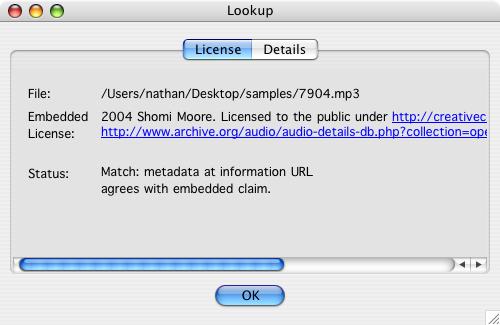
We have a long-standing specification for embedding licenses in MP3 audio files which requires two pieces of information: a license claim embeddded in the audio file, and verification metadata hosted on a web page. While command-line tools for looking up the verification metadata have been available for a while, we have lacked an easy, drag and drop solution for examining an embedded claim and whether or not it verifies. No more.
ccLookup is tool available for Mac OS X and Windows which allows you to drop an MP3 file onto the program icon or running window in order to verify the embedded claim, if any. Downloads are available here.
While ccLookup is a step in the right direction, there’s still work to be done. Ogg support would be nice, and I’m sure there are features I haven’t thought of. Have a comment, suggestion or idea? Email me at nathan@creativecommons.org and let me know.
New Website Puts 2004 Campaign Media in the People's Hands
P2P-Politics.org lets friends and colleagues share political videos with just a click, thanks to Creative Commons copyright licensing
SAN FRANCISCO, CA, USA —October 17, 2004—A new people-to-people website, P2P-Politics.org,
today announced a free service for sharing political expression online.
The site enables anyone to select from a menu of video clips the ones
that best express their view of the U.S. presidential elections, and
then email links to those clips, along with a personalized message, to
friends, family, and colleagues. Like a cross between an online
greeting-card service and a gallery of campaign advertisements, P2P-Politics.org makes everyday people broadcasters of political expression from across the spectrum.
The site launched today with 150 clips from http://MoveOn.org’s
“Bush-in-30-Seconds” contest. Because all entries to that contest are
under Creative Commons “some rights reserved” copyright licenses, their
reuse on P2P-Politics.org did not require the cumbersome process of rights-clearance.
The
site invites anyone to upload their own video clip, and it has invited
the Bush, Kerry, and Nader campaigns to contribute content to be
shared. So far, only the Kerry campaign has responded favorably to the
invitation, but organizers are optimistic that the other campaigns will
participate as well.
“Political ads have one purpose,” said
Lawrence Lessig, chairman of Creative Commons. “That is to elect the
candidate they support. With just over two weeks to go, we expect the
campaigns will be eager to help their supporters get the message out.”
The
ads are hosted by the Internet Archive, which hosts and serves files of
any size at no charge—provided they are under Creative Commons
licenses. P2P-Politics will curate content
to assure its appropriateness, and no content will be posted without
the authority of its copyright owner.
The site was built by
volunteers responding to a weblog post earlier this month. It was
designed by J Christopher Garcia and Aaron Swartz. It will be supported
through the election; afterwards, all content will remain at the
Internet Archive.
<http://p2p-politics.org>
About Creative Commons
A 501(c)(3)
nonprofit founded in early 2002, Creative Commons promotes the creative
re-use of intellectual and artistic works — whether owned or in the
public domain — by empowering authors and audiences. It is sustained by
the generous support of the Center for the Public Domain, the John D.
and Catherine T. Mac Arthur? Foundation, the Omidyar Network Fund, and the Hewlett Foundation.
For general information, visit <https://creativecommons.org>.
About the Internet Archive
The
Internet Archive is a 501©(3) public nonprofit that was founded to
build an “Internet library,” with the purpose of offering permanent
access for researchers, historians, and scholars to historical
collections that exist in digital format. Founded in 1996 and located
in the Presidio of San Francisco, the Archive has been receiving data
donations from Alexa Internet and others. In late 1999, the
organization started to grow to build more well rounded collections,
like its Open Source Music and Open Source Movies catalogs.
For more information, visit <http://archive.org>.
Contact
Glenn Otis Brown
Executive Director
Creative Commons
glenn@creativecommons.org
+1.415.336.1433
Press Kit
https://creativecommons.org/presskit/
MTV News blurbed the The WIRED CD today in anticipation of its release later this month.
Creative Commons in Canada and Spain
OPEN COPYRIGHT LICENSES OFFERED IN CANADA AND SPAIN
Creative Commons introduces its innovative copyright licenses to Canada and Spain; free legal tools available in two languages in each country
San Francisco, USA; Ottawa, Canada; and Barcelona, Spain — Oct. 11, 2004 — Creative Commons, a non-profit organization that provides an alternative to full copyright, recently unveiled localized versions of its innovative licensing system in Canada and Spain. The Creative Commons licenses afford authors and publishers an intermediate degree of protection over their photos, music, text, films, and educational materials — a “some rights reserved” copyright in contrast to the traditional “all rights reserved.”
With the announcement, Creative Commons now offers free legal tools in a total of ten country-specific versions. The organization already provides copyright licenses specific to Austrian, Brazilian, Dutch, Finnish, German, Japanese, U.S., and Taiwanese law, thanks to a global network of artists, lawyers, and technologists.
Staff at Creative Commons’ offices in San Francisco and Berlin worked with Ignasi Labastida i Juan, of the University of Barcelona, and Marcus Bornfreund, of the University of Ottawa’s law faculty, to adapt the standardized licenses for use under Spanish and Canadian law, respectively. The Spanish licenses are available in both Castilian Spanish and Catalan, and the Canadian licenses in both English and French.
Creative Commons released the new legal tools, which are available free of charge from the Creative Commons website, at conferences in Barcelona and Ottawa last week.
“We are honored to be able to work with these two great institutions,” says Glenn Otis Brown, Executive Director of Creative Commons. “Their translations and superb legal research have made possible two new sets of free legal tools, in four different languages, on two continents — in the same week.”
The global expansion of the Creative Commons project — which is chaired by Lawrence Lessig of Stanford University Law School — is one of the main priorities of the San Francisco-based organization this year.
“We look forward to adding more countries to the list during the remainder of the year,” says Christiane Asschenfeldt, the International Commons Coordinator, based in Berlin. “Thanks are due to the friends of Creative Commons around the world.”
About Creative Commons
A nonprofit corporation founded in 2001, Creative Commons promotes the creative re-use of intellectual and artistic works—whether owned or in the public domain—by empowering authors and audiences. It is sustained by the generous support of the Center for the Public Domain, the John D. and Catherine T. MacArthur Foundation, the Omidyar Network Fund, and the Hewlett Foundation.
For general information, visit https://creativecommons.org.
Contact
Christiane Asschenfeldt (Berlin), iCommons Coordinator, Creative Commons
Glenn Otis Brown (San Francisco), Executive Director, Creative Commons
press@creativecommons.org
Press Kit