We want to share a message regarding some learnings obtained after the 2023 Creative Commons Global Summit and meeting with our Mexican organizing committee and members of the local community.
Financial decisions related to the CC Summit were made by the CC team and not by the local Mexican Chapter. Specifically the cost of entry to the event, which proved to be high in relation to the contextual conditions of Mexico. Due to difficult fundraising conditions for many nonprofits in 2023, the CC team decided to keep the entrance fee higher, offer discounted rates, and scholarships for attendees. We wish to learn from this experience for future events, as it is clear that if we want to continue our value of global inclusion, it is necessary to create a new formula to eliminate access barriers for those who wish to attend our events.
Initially, the estimated cost for simultaneous translation provided to us was above our budget. For this reason, we hired SyncWords to provide live subtitles, human and automatic translations for each of the sessions and panels in the main auditorium. The translations could be accessed through the QR code that we had published in various places (this code provided access to a SyncWords page that displayed the subtitles and the translation). We also offered translation (English/Spanish) according to the needs of our attendees, with bilingual people available in each room and in the auditorium. However, as we began the event we recommended that it was imperative to have simultaneous audio translation to encourage dialogue and follow our value of global inclusion. We especially thank the Tlatolli Ollin Professional Interpretation and Translation Services cooperative, which won the challenge by providing excellent service in a short time.
No one in our Mexican Chapter should be held responsible for any decision, nor should their reputation be tarnished by decisions made during the Summit. After such big events, there are always lessons to be learned and one of them is how CC, as a small global non-profit, which has to raise funds every year to survive, can better support our local chapters that provide so much wisdom and experience.
I want to personally thank everyone involved in the CC Summit and we will continue to work to create a world where knowledge and creativity are accessible to everyone.
Sincerely,
Catherine
Español
Queremos compartir un mensaje referente a algunos aprendizajes obtenidos después de la Cumbre Global Creative Commons 2023 y de reunirnos con nuestro comité organizador mexicano y miembros de la comunidad local.
Las decisiones financieras relacionadas con la Cumbre CC fueron tomadas por el equipo de CC y no por el Capítulo Mexicano local. Específicamente el costo de la entrada al evento, el cual se consideró alto en relación a las condiciones contextuales de México. Debido a las difíciles condiciones de recaudación de fondos para muchas organizaciones sin fines de lucro en 2023, el equipo de CC decidió mantener la tarifa de entrada más alta, ofrecer tarifas con descuento, y becas para los asistentes. Deseamos aprender de esta experiencia para eventos futuros, ya que está claro que si queremos seguir nuestro valor de inclusión global, es necesario crear una nueva fórmula para eliminar barreras de acceso para aquellos que deseen asistir a nuestros eventos.
Inicialmente, el costo estimado para traducción simultánea se nos proporcionó por encima de nuestro presupuesto. Por tal motivo contratamos a SyncWords para realizar subtítulos, traducciones humanas y automáticas en vivo para cada una de las sesiones y paneles en el auditorio principal. Se podía acceder a las traducciones a través del código QR que habíamos publicado en varios lugares (dicho código proveía acceso a una página de SyncWords que mostraba los subtítulos y la traducción). También ofrecimos traducción (inglés/español) según las necesidades de nuestros asistentes, con personas bilingües disponibles en cada sala y en el auditorio. Sin embargo, al comenzar el evento decidimos que era imperativo contar con traducción de audio simultánea para fomentar el diálogo y seguir nuestro valor de inclusión global. Agradecemos especialmente a la cooperativa Tlatolli Ollin Servicios Profesionales de Interpretación y Traducción que aceptó el desafío brindando un excelente servicio en poco tiempo.
Nadie en nuestro Capítulo Mexicano debe ser responsabilizado por ninguna decisión, ni su reputación debe verse empañada por las decisiones tomadas durante la Cumbre. Después de eventos tan grandes, siempre hay lecciones que aprender y una de ellas es cómo CC, como una pequeña organización global sin fines de lucro, que tiene que recaudar fondos cada año para sobrevivir, puede apoyar mejor a nuestros capítulos locales que brindan tanta riqueza, sabiduría y experiencia.
Quiero agradecer personalmente a todos los involucrados en la Cumbre CC y continuaremos trabajando para crear un mundo donde el conocimiento y la creatividad sean accesibles para todos.
Atentamente,
Catherine
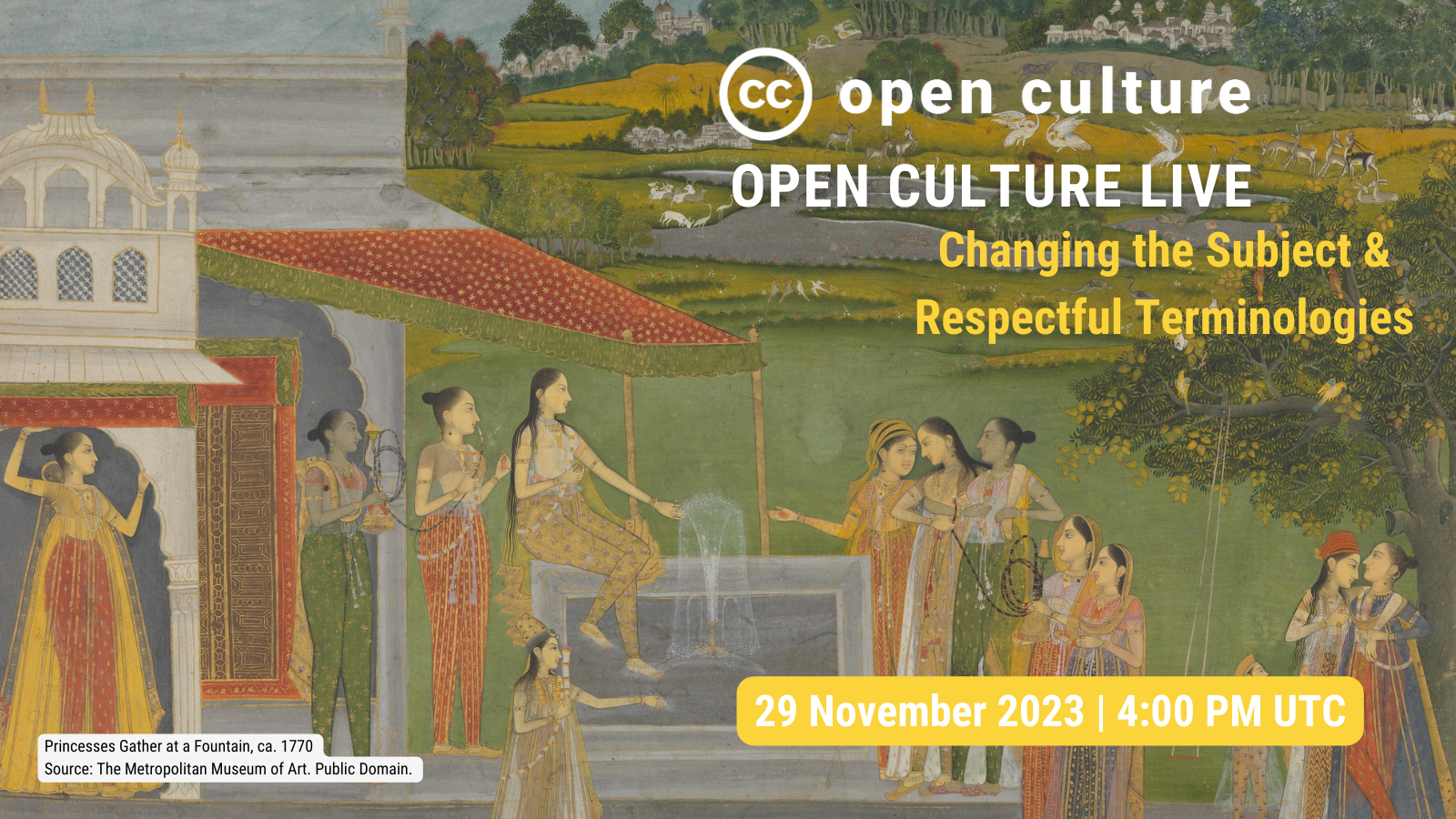
Open Culture Live Webinar: Changing the Subject & Respectful Terminologies
We are excited to host the second installment of Open Culture Live with our next conversation: Changing the Subject & Respectful Terminologies
29 November 2023 at 4:00 UTC
For centuries, cultural heritage institutions have been undertaking the work to document and catalog objects in their collections — sometimes this work suffers from a legacy of colonialism and discrimination in the way their collections are labeled and categorized. Some institutions are working to update these labels with more respectful terminology. Hear more from some of the changemakers working to update labels and metadata with more respectful terminologies during this CC panel.
As CC’s Open Culture team works to promote better sharing, we think it is important to address some of the key challenges and concerns that come along with promoting open access to cultural heritage. These challenges are not always simple to address, but they are important to ensuring that open access policies and practices go hand in hand with harm reduction, and do not perpetuate or amplify historic injustices.
Learn from the experts involved in addressing harmful labels in cultural heritage institutions in this conversation. We will ask the experts if any institutions serve as a good model for rethinking their labels, acknowledging that many are in the process of ongoing work. We will discuss where to start, how to think about some of the challenging decisions, why and how to preserve historical metadata, and how digital archival practices can support this work. We hope that this will provide a guide of some of the ways you might consider adopting better metadata practices and using more respectful terminologies in your collections.
The panel will feature:
Jill Baron, Dartmouth College
Marco Rendina, European Fashion Heritage Association
Oscar Ruben Cornejo Casares, Ph.D. Candidate in the Department of Sociology at Northwestern University
Amanda Figueroa, Platform Director, MHz Foundation
Carma Citrawati, Lecturer, Udayana University
With introductory remarks from Brigitte Vézina and moderation by Jocelyn Miyara.
Dave Hansen — Open Culture VOICES, Season 2 Episode 33
Dave talks about how many “institutions are on a mission to expose their collections to the world and make them available for everyone.” Dave sees this as a major evolution from a time not too long ago when it was only those with means who could access collections in any way.
Open Culture VOICES is a series of short videos that highlight the benefits and barriers of open culture as well as inspiration and advice on the subject of opening up cultural heritage. Dave is the Executive Director at Authors Alliance which is a non-profit focused on sharing work broadly with the public together with authors in the US.
Dave responds to the following questions:
What are the main benefits of open GLAM?
What are the barriers?
Could you share something someone else told you that opened up your eyes and mind about open GLAM?
Do you have a personal message to those hesitating to open up collections?
Closed captions are available for this video, you can turn them on by clicking the CC icon at the bottom of the video. A red line will appear under the icon when closed captions have been enabled. Closed captions may be affected by Internet connectivity — if you experience a lag, we recommend watching the videos directly on YouTube.
CC’s Key Insights from WIPO’s Meeting on Copyright
From 6 to 8 November 2023, Creative Commons (CC) participated remotely in the 44th session of the World Intellectual Property Organization (WIPO) Standing Committee on Copyright and Related Rights (SCCR). In this blog post, we look back on the session’s highlights on broadcasting, exceptions and limitations, and generative AI, from CC’s perspective.
As in previous sessions, our main objective was to drive copyright reform towards better sharing of copyright content in the public interest and in tune with the sharing possibilities of the digital environment. In this short session, we addressed the proposed broadcasting treaty and exceptions and limitations in our opening statement, as reported in the “Statements” information document (SCCR/44/INF/STATEMENTS).
Overall, we are rather satisfied with the session’s outcomes. On broadcasting, we remain concerned that discussions on the draft broadcasting treaty are being maintained on the agenda despite evidence of a clear stalemate in the discussions; we are nonetheless heartened by the acknowledged need to work towards a balanced approach on exceptions and limitations in the draft treaty.
On exceptions and limitations, we are pleased that the SCCR Secretariat has undertaken to prepare a detailed implementation plan for the Work Program on Exceptions and Limitations; in CC’s views, this plan should provide for open and transparent engagement opportunities and wide participation from civil society of which CC is a leading voice. It should notably allow for real progress on substantive issues to support meaningful access and use of cultural heritage for preservation and other legitimate purposes.
We also welcome the organization of a virtual panel discussion on cross-border uses of copyright works in the educational and research sectors open to all member states as well as observers. As an accredited observer, CC places high value on broad and inclusive participation to ensure balanced and diverse perspectives can be brought to the table for a constructive debate. We recall that licensing falls short of addressing the problems that libraries, museums, archives, educational and research institutions, as well as persons with disabilities, face on a daily basis. Licensing is not a substitute for robust, flexible, mandatory exceptions and limitations to empower those who teach, learn and research, those who share in and build upon cultural heritage, and people with disabilities.
We note Group B’s Proposal Information Session on Generative AI and Copyright (SCCR/44/8) and look forward to the Secretariat organizing an open, inclusive, and balanced session at the next SCCR under the item of Copyright in the Digital Environment. As we have stated at the WIPO Conversation on Generative AI and Intellectual Property last September, generative AI raises important issues and is having an enormous impact on creativity, the commons, and better sharing, i.e., sharing that is inclusive, equitable, reciprocal, and sustainable. Our consultations on the matter have revealed a wide variety of views among creators, AI developers, and other stakeholders in the commons. They have also shed light on the fact that copyright is but one lens through which to consider generative AI; what is more, it is a rather blunt tool that often leads to black-and-white solutions that fall short of harnessing all the diverse possibilities that generative AI offers for human creativity. Our interventions on copyright and generative AI in the United States and the European Union contexts attest to those nuanced views. We thus call on the Secretariat to ensure the session will offer a balanced and representative set of perspectives.
We look forward to participating in the Committee’s next session, to take place from April 15 to 19, 2024, and to bring our expertise on copyright, better sharing of cultural heritage, and generative AI in order to help create a fairer and more balanced international copyright system in the public interest.
→ To stay informed about our policy and open culture work:
Since our founding, we have sought out ways that new technologies can serve the public good, and we believe that generative AI can be a powerful tool to enhance human creativity and to benefit the commons. At the same time, we also recognize that it carries with it the risk of bringing about significant harm. We used this opportunity to explain to the Copyright Office why we believe that the proper application of copyright law can guide the development and use of generative AI in ways that serve the public and to highlight what we have learned from our community through the consultations we have held throughout 2023 and at our recent Global Summit about both the risks and opportunities that generative AI holds.
In this post we summarize the key point of our submission, namely:
AI training generally constitutes fair use
Copyright should protect AI outputs with significant human creative input
The substantial standard similarity should apply to Infringement by AI outputs
Creators should be able to express their preferences
Copyright cannot solve everything related to generative AI
AI training generally constitutes fair use
We believe that, in general, training generative AI constitutes fair use under current U.S. law. Using creative works to train generative AI fits with the long line of cases that has found that non-consumptive, technological uses of creative works in ways that are unrelated to the expressive content of those works are transformative fair uses, such as Authors Guild v. Google and Kelly v. Arriba Soft. Moreover, the most recent Supreme Court ruling on fair use, Andy Warhol Foundation v. Goldsmith, supports this conclusion. As we commented upon the decision’s release, the Warhol case focus on the specific way a follow-on use compares with the original use of a work indicates that training generative AI on creative works is transformative and should be fair use. This is because the use of copyrighted works for AI training has a fundamentally different purpose from the original aesthetic purposes of those works.
Copyright protection for AI outputs subject to significant human creative input
Additionally, we believe that developers of generative AI tools should not receive copyright protection over the outputs of those tools. Copyright law already provides enough incentives to encourage development of these tools by protecting code, and extending protection to their outputs is unnecessary to encourage innovation and investment in this space.
Infringement should be determined using the substantial similarity test
We believe that the substantial similarity standard that already exists in copyright law is sufficient to address where AI outputs infringe on other works. The debate about how copyright should apply to generative AI has often been cast in all-or-nothing terms — does something infringe on pre-existing copyrights or not? The answer to this question is certainly that generative AI can infringe on other works, but just as easily it may not. As with any other question about the substantial similarity between two works, these issues will be highly fact specific, and we cannot automatically say whether works produced by generative AI tools infringe or not.
Creators should be able to express their preferences
In general, we believe there is value in methods that enable individuals to to signal their preferences for how their works are shared in the context of generative AI. In our community consultations, we heard general support for preference signals, but there was no consensus in how best to do this. Opt-ins and opt-outs may be one way, but we do not believe they need to be required by US copyright law; instead, we would like to see voluntary schemes, similar to approaches to web scraping, which allow for standardized expression of these preferences without creating strict barriers to usage in cases where it may be appropriate.
Transparency is necessary to build trust — Copyright is only one lens through which to consider AI regulation
We urge caution and flexibility in any approach to regulating generative AI through copyright. We believe that copyright policy can guide the development of generative AI in ways that benefit all, but that overregulation or inappropriate regulation can hurt both the technology and the public. For example, measures that improve transparency into AI models can build trust in AI models by allowing outside observers to “look under the hood” to investigate how they work. But these measures should not be rooted in copyright law. Copyright is just one lens through which we can view generative AI, and it is ill equipped to deal with many of the social harms that concern us and many others. Attempting to use copyright to solve all of these issues may have unintended consequences and ultimately do more harm than good.
We are happy to see the Copyright Office seeking out guidance on these many difficult questions. We will have to wait to see what comes from this, but we will hope for the best, and continue to engage our community so we can more fully understand what role generative AI should play in building the commons and serving the public good.
Kyle K. Courtney — Open Culture VOICES, Season 2 Episode 32
Kyle believes that “the artistic and creative expressions of humanity is the best way to experience our human efforts” and open GLAM makes this a reality for much more than what you can see on a given day in a museum. Open GLAM also helps drive more digitization of collections around the world in an effort to make institutions more known.
Open Culture VOICES is a series of short videos that highlight the benefits and barriers of open culture as well as inspiration and advice on the subject of opening up cultural heritage. Kyle is a copyright advisor at Harvard library and helps people understand how material can be used in the library and online for users.
Kyle responds to the following questions:
What are the main benefits of open GLAM?
What are the barriers?
Could you share something someone else told you that opened up your eyes and mind about open GLAM?
Do you have a personal message to those hesitating to open up collections?
Closed captions are available for this video, you can turn them on by clicking the CC icon at the bottom of the video. A red line will appear under the icon when closed captions have been enabled. Closed captions may be affected by Internet connectivity — if you experience a lag, we recommend watching the videos directly on YouTube.
CC Licenses make it possible to share content legally and openly. Over the past 20 years, they have unlocked approximately 3 billion articles, books, research, artwork, and music. They’re a global standard and power open sharing on popular platforms like Wikipedia, Flickr, YouTube, Medium, Vimeo, and Khan Academy.
CC’s Legal Tools are a free and reliable public good. Yet most people are unaware that their infrastructure and stewardship takes a lot of money and work to maintain.
We need to secure immediate and long term funding for the CC licenses and CC0 public domain tool, which are key to building a healthy commons. We’re facing many challenges and threats to the commons–libraries are under attack, misinformation is rampant, and climate change threatens us all. CC is one of the few nonprofit, mission-driven organizations fighting to ensure we have a sound legal infrastructure backing open ecosystems, so that culture and knowledge are shared in order to foster understanding and find equitable solutions to our world’s most pressing challenges.
We need support from like-minded funders to champion sharing practices and tools that oppose the enclosure of the commons.
That’s why we’re launching the Open Infrastructure Circle (OIC) — an initiative to obtain annual or multi-year support from foundations, corporations, and individuals for Creative Commons’ core operations and license infrastructure.
With consistent funding, we can resolve “technical debts” (years of work we’ve had to put on hold due to underfunding!) and make the CC Licenses more user-friendly and accessible to our large, global community. The world has changed a lot since the CC Licenses were first created in 2002, and we want to ensure they stay relevant and easy to use going forward.
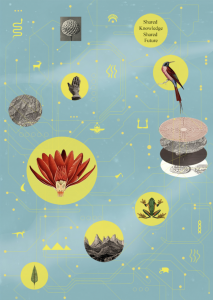
As part of our #20CC anniversary, last year we joined forces with Fine Acts to spark a global dialogue on what better sharing looks like in action. Our #BetterSharing collection of illustrations was the result — we gathered insights from 12 prominent open advocates around the world and tasked 12 renowned artists who embrace openness with transforming these perspectives into captivating visual pieces available under a CC license.
Each month throughout 2023, we will be spotlighting a different CC-licensed illustration from the collection on our social media headers and the CC blog. For November, we’re excited to showcase “Shared Knowledge, Shared Future” by Colombian illustrator, Luisa Brando. The piece, licensed under CC BY-SA 4.0, was inspired by a quote from Molly Van Houweling, former chair of CC’s Board of Directors:
“Better sharing for a brighter future means that the world is wrapped in a living connective tissue of shared knowledge, culture, and insights that spread joy and alleviate suffering.”
Meet the artist:
“Luisa Brando” used by permission of “TheGreats.co.”
Luisa Brando is dedicated to producing visual art and architecture projects sensitive to heritage conservation and dichotomies between nature and culture, tradition and development. Brando currently teaches at Universidad de los Andes (Bogotá), coordinates a Master Plan in Ibague, and continues her artistic work on the geopolitics, images and imaginations of water and other living beings.
Maarten Zeinstra — Open Culture VOICES, Season 2 Episode 31
Maarten believes that “Open GLAM is a necessity of a disbalanced copyright framework.” Maarten talks about how open access policies help institutions achieve their public missions. Open access policies in instutions provides good evidence that society and communities need access to cultural heritage to flourish.
Open Culture VOICES is a series of short videos that highlight the benefits and barriers of open culture as well as inspiration and advice on the subject of opening up cultural heritage. Maarten is an independent consultant and intellectual property lawyer who works with GLAM institutions on open access policies and implementing open information management systems.
Maarten responds to the following questions:
What are the main benefits of open GLAM?
What are the barriers?
Could you share something someone else told you that opened up your eyes and mind about open GLAM?
Do you have a personal message to those hesitating to open up collections?
Closed captions are available for this video, you can turn them on by clicking the CC icon at the bottom of the video. A red line will appear under the icon when closed captions have been enabled. Closed captions may be affected by Internet connectivity — if you experience a lag, we recommend watching the videos directly on YouTube.
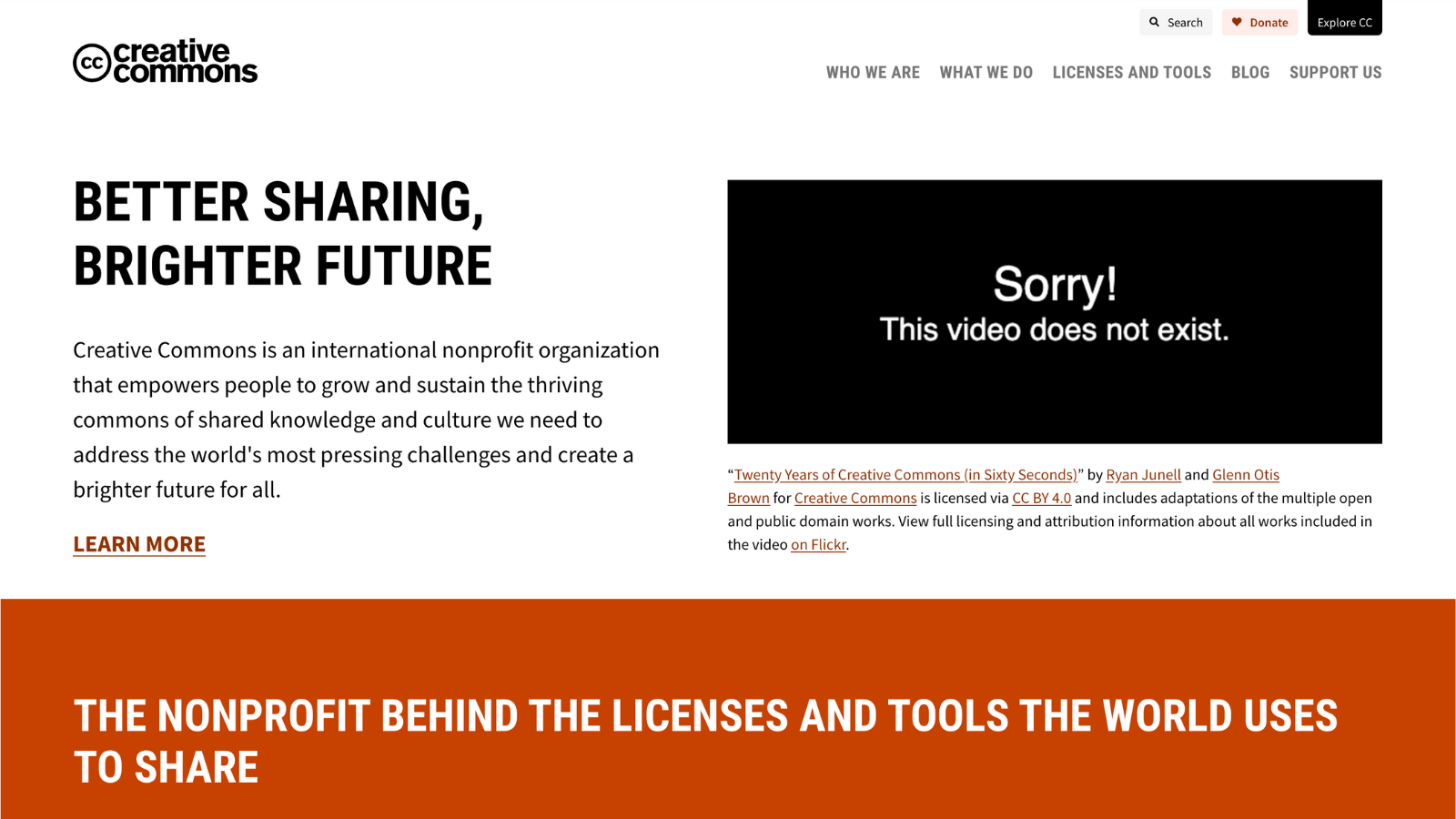
Visitors to the CC home webpage recently were welcomed by a big black box and the message “Sorry: This video does not exist.” In the spot where CC was showcasing a custom video made last year for CC’s 20th anniversary, there was now a stark error message, making it look like the CC website was broken.
After some investigation, CC learned that the copy of the video we had hosted on the Vimeo platform had been tagged with an automated copyright violation takedown notice. Anyone who has had this experience knows that typically a service will stop delivering content that automated processes have identified as violating copyright, and then it’s up to you as the account holder to prove you have rights to share the work, or modify it so it no longer triggers automated filters. Meanwhile, your content is missing and your website may look broken.
Almost a week later, Vimeo approved CC’s detailed appeal of the takedown and the video was back on our home webpage. It’s not always easy to figure out how to file an appeal for a takedown like this — in fact Vimeo’s appeal button led to a dead link, so it actually took us at CC extra time to even figure out how to file an appeal with Vimeo.
Robot justice may be blind, but there was plenty of irony in this takedown notice, delivered to an organization like CC that knows a bit about people’s freedom to share. Irony on top of irony: the specific content flagged for copyright infringement was a sample of a musical track from The Wired CD, perhaps the most famous collection of openly licensed music ever published.
Fortunately, CC had taken great care in the production of the video, carefully tracking attributions for every sound and image. In another dose of irony, there is no good way to display the rather lengthy attributions for this video on Vimeo, and so one must look to a different host — like Flickr — for the video to display the full attribution statement.
The internet may not have missed this specific version of a short video for a few days, but this small example demonstrates the stakes of automated systems that put the interests of big copyright ahead of everyone else’s. Even with the black and white “Sorry,” the message that “this video does not exist” betrays a vision of a world where copyright reigns supreme with little to no space left for uses based on fundamental freedoms, like the freedom of expression. Because the video does indeed still exist, not only on Vimeo, where it was merely locked in private mode, awaiting appeal, but also anywhere else it might live, like on Flickr, the Internet Archive, Wikimedia Commons, YouTube (which also has the video in private mode, pending CC’s appeal), or — if you have the resources — on your own internet hosting infrastructure.
CC was embedding the version of this video hosted on Vimeo on our home webpage because Vimeo embedding has some technical advantages, but one lesson here is never to put all your web hosting eggs in a single basket — if you have the time and resources to share open content in multiple places, your content is less likely to “not exist” due to the whims of any one host.
Another lesson is that good attribution practices are not only important to meet the requirements of open licensing — giving credit to upstream creators and guidance to downstream users — but also as a record of the multiple layers of rights and permissions within your work, ready for you to use when you get that unexpected copyright takedown notice or legal challenge. Because CC had taken such care with the attributions for this video, we were well-equipped to file a successful appeal with Vimeo.