Ada Lovelace Day: Pamela Samuelson
Today (March 24) is Ada Lovelace Day:
Ada Lovelace Day is an international day of blogging to draw attention to women excelling in technology.
Women’s contributions often go unacknowledged, their innovations seldom mentioned, their faces rarely recognised. We want you to tell the world about these unsung heroines. Entrepreneurs, innovators, sysadmins, programmers, designers, games developers, hardware experts, tech journalists, tech consultants. The list of tech-related careers is endless.
And includes tech lawyers. It seems highly appropriate for CC’s contribution to Ada Lovelace Day blogging be to highlight Pamela Samuelson, a giant in the field of law and technology, in particular copyright and technology.
Samuelson is Professor at the University of California at Berkeley with a joint appointment in the School of Information and the School of Law and co-directs the Berkeley Center for Law and Technology.
Also see our post on Samuelson’s copyright reform thinking and a video of her excellent keynote of last year’s Students for Free Culture Conference.
Creative Commons wins the 2008 Free Software Foundation Award for Project of Social Benefit!
Saturday at Libre Planet, the Free Software Foundation’s annual conference, Creative Commons was honored to receive the FSF’s Award for Projects of Social Benefit:
The FSF Award for Projects of Social Benefit is presented annually to a project that intentionally and significantly benefits society by applying free software, or the ideas of the free software movement, in a project that intentionally and significantly benefits society in other aspects of life.
Since its launch in 2001, Creative Commons has worked to foster a growing body of creative, educational and scientific works that can be shared and built upon by others. Creative Commons has also worked to raise awareness of the harm inflicted by increasingly restrictive copyright regimes.
Creative Commons vice president Mike Linksvayer accepted the award saying, “It’s an incredible honor. Creative Commons should be giving an award to the Free Software Foundation and Richard Stallman, because what Creative Commons is doing would not be possible without them.”
Congratulations also to Wietse Venema, honored with the Award for the Advancement of Free Software for his “significant and wide-ranging technical contributions to network security, and his creation of the Postfix email server.”
FSF president Stallman presented a plaque by artist Lincoln Read commemorating the award to Creative Commons.
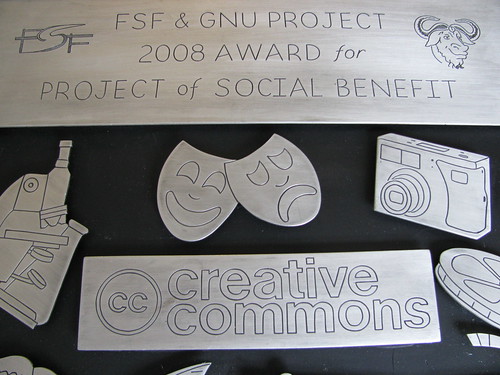
It is worth noting that the FSF Social Benefit Award’s 2005 and 2007 winners are Wikipedia and Groklaw both because it is tremendous to be in their company and as the former is in the process of migrating to a CC BY-SA license (thanks in large part to the FSF) and the latter publishes under a CC BY-NC-ND license.
Only last December CC was honored to receive an award from another of computing’s most significant pioneers, Doug Engelbart.
Thanks again to the Free Software Foundation and Richard Stallman. Please join us in continuing to celebrate the 25th anniversary of his founding of the free software movement. As Stallman would say, “Happy Hacking!”
Celebrate 100 Million CC Photos on Flickr with Joi Ito's Free Souls

Over the last couple of weeks we’ve been keeping a close eye on the number of CC licensed photos of Flickr. Our calculations now show that Flickr has surpassed 100 million CC licensed photos sometime during the day on Saturday, March 21st, 2009. As of Monday, we’re calculating the total number of CC licensed photos at 100,191,085.*
These photos have been used in hundreds of thousands of Wikipedia articles, blog posts, and even mainstream press pieces; all examples of new works that might not otherwise been created without our standardized public licenses. Flickr’s integration of CC licenses was one of the first and best; not only do they allow users to specify licenses per-photo, but they offer an incredible CC discovery page which breaks down searches for CC licensed materials by license. This means that you can look for all the photos of New York City licensed under Attribution and sorted by interestingness, to give an example.
As part of our celebration of Flickr passing this historic milestone, we are offering a dozen copies of Creative Commons CEO Joi Ito’s Free Souls book at our $100 donation level. Naturally, all of Joi’s photos are not only licensed under our most permissive Attribution license, but they’re also available on Flickr for download. By donating to Creative Commons today you can support the work that we do and receive one of the 1,024 copies of Joi’s limited edition book.
*We are linking to CSV files generated per-day based a simple scrape of Flickr’s CC portal. To generate the total number of licensed photos, we SUM()‘d the 2nd column of the CSV file. March 21st yielded approximately 99 million and March 22nd yielded over 100 million, hence our estimate that 100 million was passed sometime during the day on Saturday.
"RiP: A Remix Manifesto" Released, Online Remixing Through Kaltura

RiP: A Remix Manifesto, a community-driven documentary that focuses on copyright and remix culture (covered earlier here and here) is just beginning to creep out into theaters, having its U.S. premier last week at SXSW. While the film largely focuses on the story of Greg Gillis (Girl Talk) it includes interviews with a wide variety of figures, including both Lawrence Lessig and Cory Doctorow.
Perhaps most interesting is that the filmmakers have teamed up with open source video platform Kaltura (early coverage here) enabling anyone with a computer to remix the film only at opersourcecinema.org. All the footage of the film is released under a CC BY-NC license.
Open Ed Conference 2009 – Call for Proposals
It’s that time of year again! That is, time for planning the line-up for Open Ed 2009, the annual, international Open Education Conference, hosted this year by the University of British Columbia in breathtaking Vancouver, Canada. From the conference website (OpenEd 2009: Crossing the Chasm):
“The field of “open education” is in its second decade. There is ever more interest from new participants, with all the questions and challenges that such involvement brings. Existing projects must now address long-term issues of sustainability and accountability. And early adopters, who once made colleagues gape dumbfounded when they talked of freely sharing their content are asking a new generation of questions that induce unbelieving stares.
In recognition of the different needs of participants in these various stages of innovation in Open Ed, this year’s Call for Proposals is organized around these three broad “strands.” ”
The three strands are
1. Open Ed – Startup Camp
2. Open Ed – Sustaining Steps
3. Open Ed – The Future
For more information on the strands, see the Call for Papers. The deadline for your proposal is May 1, 2009, so you’ve got a month to brainstorm and submit your topic, project, or research. Thankfully, abstracts must be tweet-sized (150 characters or less) and all submissions (500 words or less) and presentations will be licensed CC BY.
Open Everything is April 18th in NYC

via John Britton’s blog:
Open Everything NYC will take place on Saturday 18 April 2009 at the UNICEF headquarters in the United Nations Plaza, NYC. The event will run the full day, registration will open at 8:00AM and things will be in full swing by 9:00AM.
The event will be 100% free and open to the public on a first come first serve basis, online pre-registration is required. The main hall can hold up to 250 guests.
The event will consist of two keynote presentations (one opening & one closing) each of about 1 hour in duration. In the time between the two keynotes attendees will be in control of the program (Barcamp style). There will be a number of conference rooms available for individuals to hold talks & discussions on topics they see fit. Past events have included topics such as Open Publishing, Open Education, Government Transparency, Open Access, Open Research Data, Creative Commons, Open Hardware, and more.
Check the official site for more information and the registration link.
Recovery.gov Following Whitehouse.gov's Lead
 Recovery.gov is the site that provides US citizens with the the ability to monitor the progress of the country’s recovery via the The American Recovery and Reinvestment Act. As with Whitehouse.gov, the Obama administration is presciently using our Attribution license 3.0 for all third party content on the site, while all of the original content site created by the federal government remains unrestricted by copyright and therefore in the public domain.
Feature Length Film "Two Fists One Heart" Releases CC-BY Licensesd Rushes For Fan Edits

Two Fists One Heart is a new family drama film from Australia, centered on the story of a young boxer. The film was released widely yesterday in theaters across Australia and to help promote the film, the producers have created a stand-alone site, Cut Your Own Scene, where fans can download rushes of the film for free under a CC BY license. This means that footage from the film can be put to any use as long as the source is acknowledged and there is a link back to the official movie page.
The idea to use CC for this footage came Bronwen Clune of Norg Media, an Australian media company, who had this to say on the motivation for the plan:
“It’s not often you get the ear of major film players and personally I have always thought creative commons is an underutilized concept in the film industry. I see this as an opportunity to prove in some way that the web and it’s culture of sharing and share-alike is a good thing for creative industries
[…]
the producer mentioned that they had a lot of great footage they weren’t able to use in the film – more than usual – and I suggested to him we not let it be wasted and we release it for anyone to mashup and play with. To me, the thought of footage being wasted and unused when someone could make something really creative with it was a real shame. There are so many people out there cutting great videos and posting them on YouTube, but the biggest barrier is often having the footage to play with. This way we could give them something to use – and the footage is what professional editors deal with – and promote the film at the same time – it was a win-win.”
As further incentive to use the footage, the five best scenes will be posted on the Two Fists One Heart promotional site. These scenes will be selected by Bill Russo, head of Editing at the AFTRS and the creative team from Two Fists One Heart. Russo will also personally give the winners editing advice in regards to both their specific clips and their careers in general.
We are looking for a fulltime accountant to work at the San Francisco office. Please email your applications by April 15, according to the instructions shown on the posting. Thank you!
Netlabel Concert Cycle in Santiago: Noa Noa 2.0
 Noa Noa 2.0 is an upcoming concert cycle for Chilean netlabels, organized by CC Chile‘s host institution, ONG Derechos Digitales, with support from the National Music Fund. This March through August, top netlabel musicians will take to the stage for free concerts in Santiago’s Bar Constitucion. All of the performances will be professionally recorded and made available on www.noanoa.cl under a Creative Commons license. Participants include several important Chilean netlabels, like the award-winning Pueblo Nuevo.
While new music models enjoy success around the world, Pueblo Nuevo’s Mika Martini explains:
Netlabels are particularly useful tools in countries like ours, away from the major global economical centers. It is quite different to have a traditional label in places such as England, United States or Mexico where, if you edit 500 copies of a disc, it will probably be possible sell them because the market is wider and more open. But in Chile, netlabels are useful to get known and begin a career, or to experiment with music in total freedom.
Netlabels are becoming increasingly popular, in part due to the frequent use of Creative Commons licenses to lower transaction costs and facilitate legal sharing and distribution.
CC Chile Project Lead and Noa Noa 2.0 organizer Claudio Ruiz has more information about the event.