Each of us in our humble way…
Ambient sound artist Gurdonark writes beautifully at the (unofficial) ccMixterblog on Virtuosos, Rock Stars and Remix Culture:
We all tend to make remixes more than we tend to discuss high-flown concepts–but my simple premise is that we should never forget that we are part of a conversation about permissive licensing and its virtue in advancing the cause of music. Only one person can be a Liszt or a Rachmaninoff. But each of us in our humble way can work, through voluntary licensing, to create a “creator-safe” zone for using samples and ‘pellas to share culture. Our modes may be hip-hop or electronica or rock (or ambient), but the point is the same–we advance a sharing economy, and the creative weight of history is with us, not against us.
Read the whole post … and listen to one of his tracks (Black-eyed Susan from Eerie Exchange Prairie Park licensed under CC BY).
National Cancer Institute to use Tranche Network to share data
From the Science Commons blog …
“The National Cancer Institute will soon be using Tranche to store and share mouse proteomic data from its Mouse Proteomic Technologies Initiative (MPTI). Tranche, a free and open source file sharing tool for scientific data, was one of the earliest testers of CC0. Many thanks to Tranche for providing us with such valuable early feedback on CC0.
From GenomeWeb News:
The MPTI collects tissue and serum measurements from mouse models of different types of cancers using analytical techniques such as mass spectrometry. Tranche researchers, along with University of Michigan researcher Philip Andrews, deposited nearly 1 terabyte of MPTI raw data into the Tranche network, where it can be shared between participating researchers.
The dataset is now being released in publicly accessible formats as well and is available to others in the research community. Because of the encryption used on the site, data on Tranche can be privately used by labs with access to the information until it is ready to be released to the public.
Congratulations to everyone over at Tranche and keep up the good work!”
CC and ccLearn at OCWC 2008 in Dalian, China
I just wrote a big post up on my appearance at the big Open Educational Resources conference OpenCourseWare Conference 2008 in Dalian. It is cut apart below:
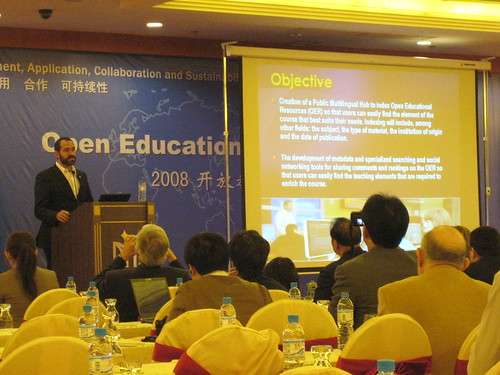
Jose speaking about Knowledge Hub at the Open Ed conference in Dalian, China, Photo by Tom Caswell
I just arrived back home in Guangzhou, China from the OpenCourseWare Conference in Dalian, China last weekend and met many great people (but don’t have the tolerance to write out the contents of my thoughts ;), had many fruitful discussions, and rocked out a good slide deck for ccLearn (and you!). Check out my presentation (or any of my presentations and here), “OER XinXai (NOW!).
The most fruitful part of the conference for me was interacting with Philip Schmidt, Victor from Hewlett Foundation, Chunyan Wang from CC Mainland China, and Stewart Cheifet from Internet Archive. Also, hearing about sustain-o-bility in all its forms as a major consideration for projects, and mentions of CC+, made me quite happy. It also served as a nice place to test out my Mandarin skills for the good or worse of things. Hopefully at the next conference there will be more time for discussion during the conference days.
I jumped up on stage to give a final call for participation to the ccLearn and OER regional meeting at iSummit July 29 – August 1 in order to increase participation by principals in the region. Let’s hope it worked!
After this conference, I directly headed to Beijing where I worked with CC Mainland China team on accelerating business development and assessing great projects which would be great to integrate Creative Commons licensing. If you have an organization in China or any jurisdiction and want to help in this process, check out the page CC Web Integration.
The next stop for me is to head to celebrate Lu’s 27th birthday on May 4th, then onto Japan to meet up Joi, Catharina, Fumi and more (ken!). Then back to Guangzhou, Beijing, then back to Guangzhou, then back in San Francisco May 21 through at least end of July as homebase. Cheers!
CC Guatemala enters public discussion
 Today CC Guatemala’s localized license draft enters the public discussion. The CC Guatemala team, lead by Renata Avila and hosted at the Universidad Francisco Marroquin’s New Media Center, has been working through the license porting process to produce a draft of CC BY-NC-SA adapted to Guatemalan law. As part of the public discussion, we invite the international community to join the discussion and share their comments on the draft, its English re-translation, and an explanation of substantive legal changes.
Thank you and congratulations to Legal Lead Renata Avila and her colleagues at CC Guatemala!
Rockefeller U. Press Uses CC Licenses to Reduce Permission Barriers
From the Science Commons blog, Thinh Nguyen on Rockefeller University Press’ recent announcement:
“Leading by example, the Rockefeller University Press has issued a bold challenge to other non-OA publishers to find new ways to strike a balance between sustainable publishing and advancing authors’ freedoms and the public interest. The Press adopted a new copyright policy that returns essential freedoms to authors and extends permissions to the public that are vital to advancing science. This new policy covers its journals, which include the prestigious Journal of Cell Biology, The Journal of Experimental Medicine and The Journal of General Physiology.
Under the policy, there are two license periods. An initial license, available during the first six month period after publication, permits sharing and reuse of the work, but prohibits distribution through mirror sites (whether commercial or non-commercial). After this six months, the Press grants the public a standard Creative Commons Attribution-Noncommercial-Share Alike 3.0 Unported License. These two licenses differ only in the mirroring prohibition clause — otherwise, the conditions are essentially similar. […]”
More after the jump …
Computers, Freedom, and Privacy: Technology Policy '08
Early Bird Registration is tomorrow, May 2, for the 18th annual Computers, Freedom, and Privacy (CFP) conference. This year, the conference is on Technology Policy—focusing on the technology policy priorities of the next administration. From CFP’s site:
“Technology Policy ’08 is an opportunity to participate in shaping those issues being made into laws and regulations and those technological infrastructures being developed. Policies ranging from spyware and national security, to ISP filtering and patent reform, e-voting to electronic medical records, and more will be addressed by expert panels of technologists, policymakers, business leaders, and activists.”
Technology policy affects open education as well, since OER uses computers and the internet as its mediums. ccLearn encourages you to take a look at the issues surrounding and being addressed by CFP ’08. The conference will be held at New Haven, CT from May 20-23. Even if you cannot attend in person, you can partake in the virtual discussion on their blog, facebook, or LinkedIn group. For information on how to register and to view the detailed program, visit their wiki page.
Welcome 2008 Summer of Coders
The call for submissions for Google Summer of Code 2008 has closed and I’m happy to announce that four students will be working on projects for Creative Commons this summer. In no particular order, they are:
Welcome to all; we’re looking forward to a productive, geeky summer.
Google has supported searching for Creative Commons licensed content through the usage rights portion of the advanced search interface for some time. Last week they took the next logical step by announcing on the Custom Search blog that you can now use the indexed license information to filter results in your own custom search engine.
Custom search engines allow you to create a search for a set of sites and host it on your site. This improvement allows you to further restrict your results to resources marked as under a Creative Commons license. The announcement also enumerates how Google looks for CC licenses, although content creators needn’t worry about that aspect — the HTML generated by the license engine contains all the bits you need; just copy and paste!
Thanks, Google!
Magnatune does good via the Amarok media player
Last July we mentioned that Magnatune, a record label known for pioneering open business models, had hired a developer to work on Amarok, a free software media player.
Today Magnatune founder John Buckman announced $11,570 in sales via Amarok, of which 10% is donated to support Amarok. This number could get much bigger as Amarok goes cross-platform, notes the Amarok blog:
With the greatly improved Magnatune integration in the upcoming Amarok 2, and the eventual release of Amarok 2 on Windows and Mac, it will be really interesting to see how far we can take this in the future. For now, I hope that the Amarok users will continue to buy music through Amarok, as it is a great way of supporting Amarok development, at the same time as supporting independent artists, who get a full 50% of the purchase price.
Buckman also announced that Magnatune would donate 10% of sales made through Rythmbox to support that free software media player.
Both media players enable a user to listen to music from Magnatune for free, and make it easy to buy — just like the Magnatune web site.
Congratulations to Magnatune, Amarok, and Rhythmbox for making a logical collaboration (open source and open content) a practical win-win for users (ready access to DRM-free, CC-licensed music), developers, artists, and the whole movement — it has been too long since last mentioning that it’s about discovery now.
Contest/Submission Reminders
There happen to be a couple awesome CC-oriented submission deadlines quickly approaching, and as such, a recap post seemed in order.
Entries for Monopoly Shuffle: A Remix Contest, which we discussed earlier here, are due May 1. That means you only have two days to create a piece of art that is built out of public domain and/or CC-licensed works and engages with the concepts of remixing, fair use, and the public domain. There are some great prizes to be had and submissions must be CC-licensed (preferably CC BY).
The deadline for submissions to the First Interdisciplinary Research Workshop on Free Culture CFP at iSummit’08 has been extended to May 3. As we noted earlier, this is a great opportunity for researchers who study the commons to interact and share ideas with their peers.
Finally, the deadline for the SELF Documentary Contest, in which participants are encouraged to produce a documentary about the creation of free knowledge and education in the digital era, is approaching on May 31. SELF, “an international project aiming to provide a platform for the collaborative sharing and creation of free educational and training materials on Free Software and Open Standards”, is holding the contest “to strengthen the SELF Platform, to centralise, transmit and enlarge the available knowledge on Free Software and Open Standards and to raise awareness and contribute to the building of critical mass for the use of Free Software and Open Standards.” Submissions must be released under a CC BY license or a Free Art license.