Help us protect the commons. Make a tax deductible gift to fund our work. Donate today!
On Monday 2 March 2026, Creative Commons (CC) and Internet Archive Europe, together with the support of Open Nederland, hosted an event entitled “Ensuring equitable access to heritage in the digital environment: A leading role for the Netherlands on the global stage.” In this blog post, we offer a recap of the dynamic discussions and share why they matter for CC.
Goal of the Event
The goal of the event was to bring together key actors from the Dutch heritage sector to celebrate the Netherlands’ pioneering efforts in opening up access to heritage collections. For over two decades, Dutch cultural heritage institutions (CHIs) have set the standard for equitable access to heritage that fosters imagination, creativity and innovation while deftly navigating the pitfalls that threaten access. With open heritage gaining momentum as a way to help address global challenges, the event was an opportunity to elevate Dutch good practices to the international level.
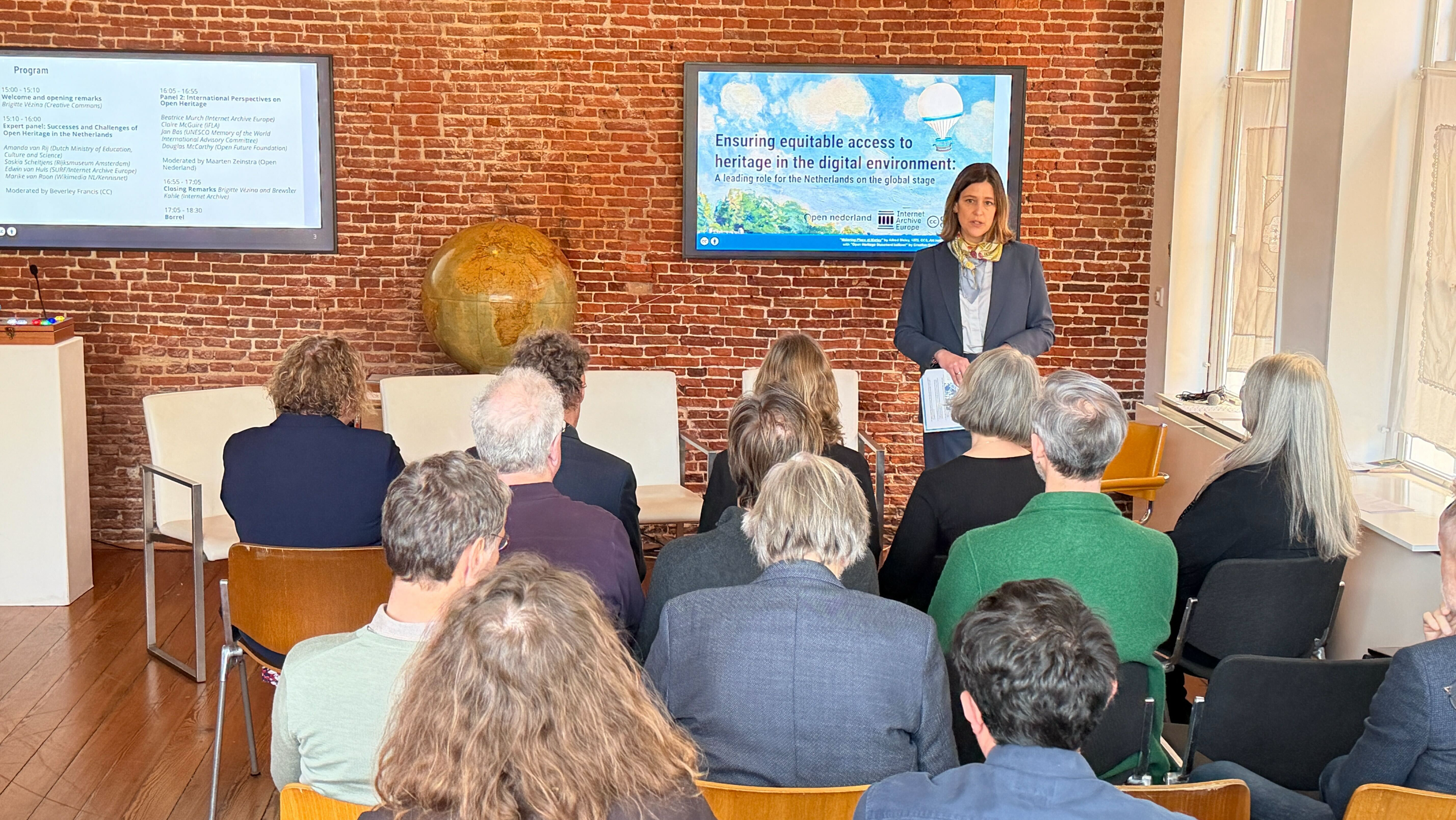
Opening Remarks
Brigitte Vézina, CC’s Director of Policy and Open Culture, kicked off the event by setting the scene. She presented CC’s work and CHIs’ use of CC licenses in relation to heritage and offered some background on the Open Heritage Coalition and Open Heritage Statement.
Panel I: Successes and Challenges of Open Heritage in the Netherlands
The first expert panel, moderated by Beverley Francis (CC), highlighted various experiences with open heritage in the Dutch context.
Amanda van Rij (Coordinating Legal Policy Advisor, Heritage and Arts Directorate, Ministry of Education, Culture and Science) presented the National Strategy on Digital Heritage (in Dutch) whose aim is to make digital heritage more easily accessible to everyone. She also introduced the Netwerk Digitaal Erfgoed (Digital Heritage Network or NDE) Manifesto, a document developed with funding from the Ministry, which had already been signed by over 200 institutions across the country. She also emphasized that digitization influences how our heritage is being created, disseminated, and experienced, and pointed out that a careful balance is needed between respecting intellectual property on the one hand and the public interest of access to our collective memory on the other.
Saskia Scheltjens (Head Research Services Department and Chief Librarian Rijksmuseum Research Library, Rijksmuseum Amsterdam) gave an account of the museum’s open heritage journey, which started during a “perfect storm,” as she put it, starting with the first digitized collection in 2011 and the creation of Rijkstudio in 2012. Her key takeaway was that, defying expectations, opening access to the digital collection did not drive visitors away (the Rijks, with 2.3 million visitors a year, is the 23rd most visited museum in the world). Quite the opposite, in fact, for with free and unfettered online access (1.8 million people visit the website every year), people could build a relationship with the collection, which then became better known. 2023 saw the completion of the digitization of its entire collection of one million objects, while the last few years underlined the need for a more nuanced approach to access. For example, dealing with restitutions made her realize a collection has more cultural and societal stakeholders than was understood a decade or so ago. She concluded by noting that making information and data available online aligned with the institution’s mission, in accordance with FAIR principles, and that this requires investing in quality, structure, and coherence to ensure a successful digital transformation and to uphold the public values of a fair knowledge ecosystem. She parted on inspiring words: “Innovation requires infrastructure.”
Edwin van Huis (Member of the Supervisory Board of SURF and of the Internet Archive Europe Advisory Board) spoke about his experience working with digital heritage at the Rijksmuseum Amsterdam, Netherlands Institute for Sound and Vision, and Naturalis Biodiversity Center (today, the latter two are Open Heritage Statement signatories). He said that the Netherlands had always been at the forefront of digital openness, especially open science and gave the example of DiSSCo, a Dutch-led initiative bringing 1.5 billion specimens, 5,000 scientists, 400+ institutions and 23 countries into 1 European collection. As the first Chair of the Netwerk Digitaal Erfgoed, he called for bringing the concept to the European level for greater impact.
Marike van Roon (Member of the Wikimedia Nederland Board) talked about Wikimedia projects and the fundamental values of openness, community and collaboration that underpin the widely successful free knowledge movement. She mentioned the many partners from the heritage sector that help make heritage more accessible on Wikipedia and Wikimedia Commons. Wikimedia projects, being grassroots initiatives, tend to work from the bottom up, leveraging the experience and expertise of volunteers who are willing to contribute to open heritage.
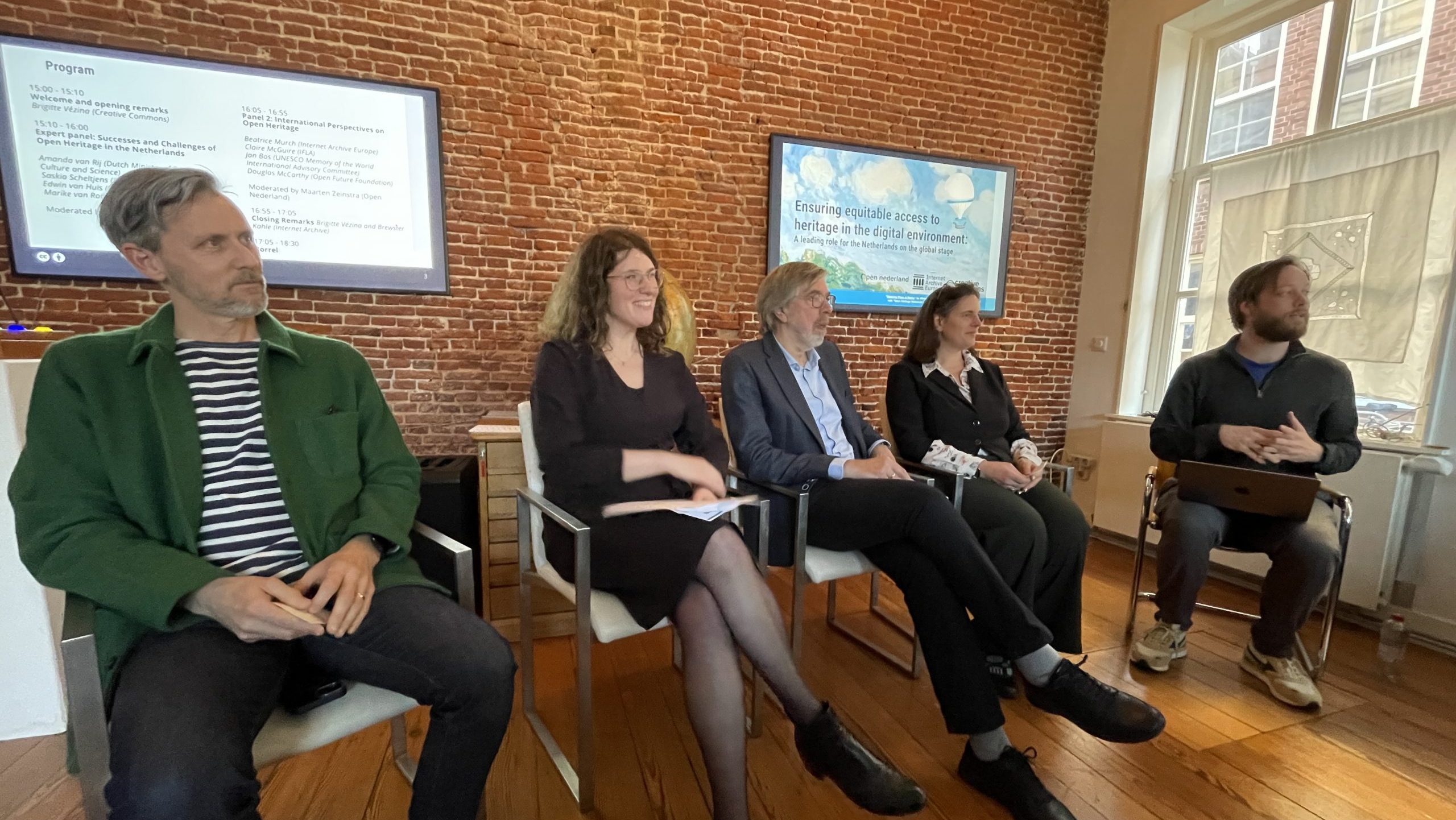
Panel II: International Perspectives on Open Heritage
The second expert panel, moderated by Maarten Zeinstra (Chair, Open Nederland), zoomed out from the national context to explore existing international initiatives and future opportunities.
Beatrice Murch (Program Manager at Internet Archive Europe) presented the Our Future Memory campaign, supported by the Internet Archive Europe and which aims to ensure the basic rights of memory institutions are respected in the digital world. She highlighted the alignment and complementarity between the campaign and the Open Heritage Statement, mapping how the rights outlined in the campaign are reflected in the language of the Statement. With more than 80 institutions worldwide already signatories, she called on more institutions across Europe to add their voice.
Claire McGuire (Policy and Advocacy Manager, International Federation of Library Associations & Institutions (IFLA)) shared insights from her experience as a member of the Open Heritage Coalition’s Statement Workspace (the Statement’s drafting committee). She explained that the Statement addressed issues well beyond copyright to tackle barriers to equitable and meaningful access to heritage, within the wider context of access to information. She recalled that having a global shared framework could be very useful and said that the Statement had a home at UNESCO, since international policy routinely influenced national and institutional policies. Given the very fragmented landscape of open heritage and patterns of regression and backsliding due to the uncertainties brought about by artificial intelligence, the need for global harmonization and cross-border collaboration is all the greater in order to establish a supportive environment for openness. She was convinced that the Open Heritage Statement would make a difference.
Jan Bos (Chair, UNESCO Memory of the World International Advisory Committee) provided a useful overview of the Memory of the World Program, initiated at UNESCO in 1992 to focus on the protection of documentary heritage, as well as of the 2015 Recommendation concerning the Preservation of, and Access to, Documentary Heritage Including in Digital Form. He drew several parallels between the Recommendation and the Open Heritage Statement, starting with the basic principles that form the bedrock of both instruments, including public domain access and open licensing. But while the 2015 Recommendation only deals with documentary heritage, the Statement includes all forms of heritage, and constitutes, therefore, a very valuable complement.
Douglas McCarthy (Senior Open Content Specialist, Open Future Foundation), the architect, together with Dr. Andrea Wallace, of the influential OpenGLAM survey, said that the Open Heritage Statement very clearly expressed the “why” behind the need to ensure access to heritage. He said that online heritage collections are the currency of relevance, engagement and education with global audiences, with a very large majority of people never visiting physical institutions. He acknowledged the positive growth curve in access to heritage online, thanks in part to the greater legal clarity brought about by Article 14 of the 2019 Directive on Copyright in the Digital Single Market in Europe, but reminded the audience that policies and practices were extremely fragmented and confusing because of weak or nonexistent compliance regimes. He shared that about 1700 CHIs around the world had released some data openly,corresponding to roughly 100 million objects, but gave examples of prominent Dutch institutions still erecting barriers to public domain heritage by perpetuating outdated business models. In his view, driving change comes down to individuals with the leadership and vision to experiment.
Closing remarks
Brigitte Vézina and Brewster Kahle (Digital Librarian, Internet Archive) offered concluding remarks to a rich conversation. Together, they reiterated how the Netherlands is poised to help set global standards for access and use of heritage and has a unique opportunity to leave a mark on the international law stage to enable access to heritage for education, to fight climate change, promote access for people with disabilities, and encourage creativity in all its forms.
More about the Open Heritage Statement
The Open Heritage Statement is a global call to action led by Creative Commons and the Open Heritage Coalition advocating for equitable access to public domain heritage in the digital environment and calling on stakeholders to remove unfair, unnecessary barriers to enable everyone to enjoy their fundamental right to participate in cultural life and solve the world’s biggest problems. It aims to stimulate a global conversation about the need to establish international standards for open heritage under the aegis of UNESCO.
What this means for CC
This event marked an important milestone in the advocacy and movement-building efforts of the Open Heritage Coalition, building on years of community work supported by CC, including the development of UNESCO’s 2019 Recommendation on Open Educational Resources and 2021 Recommendation on Open Science. Both rely on CC licenses and public domain tools to make knowledge open.
As an official NGO partner to UNESCO (consultative status), CC works towards UNESCO’s vision where education, culture, and science are equitably shared, based on the shared belief that openness can benefit everyone, everywhere.
Creative Commons provides critical infrastructure for open sharing, but the values behind our work matter more than the legal and technical details. The Open Heritage Statement is rooted in those values, eloquently describing why equitable access to heritage matters, and then laying out a set of principles and policy actions that put those values into practice. The Statement provides us with a compass in this effort; one shared across countries and communities.
CC event at UNESCO in April
This event was a prelude to an event Creative Commons is organizing in Paris in April. Entitled “How Can Equitable Access to Heritage Help Solve Global Challenges? An Exploratory Dialogue,” it will take place on Wednesday, 29 April, 2026, from 14:00 to 17:00, followed by a networking reception, at UNESCO House, in Paris, France. To secure your seat, register today: https://openheritagestatement.org/dialogue.
Posted 06 March 2026