The WIRED Concert: Cover Tunes
Another cool aspect of the WIRED show last week: Gil and Byrne both played a lot of covers. As Justin Cone’s award-winning Creative Commons film says, “Creativity always builds on the past . . .”
Among his originals, Gil also played:
–Cambalache (Enrique Santos Discepolo — a dark Argentine tango)
–Imagine (John Lennon)
–Three Little Birds (Bob Marley)
–No Woman No Cry (Bob Marley, with some Portuguese lyrics)
–Soy Loco Por Ti America (Caetano Veloso)
And Byrne covered:
–I Zimbra (this Talking Heads song isn’t technically a cover, but the lyrics are from a Dadaist “sound poem” by Hugo Ball from the 20s, so I’m counting it)
–One Rainy Wish (Jimi Hendrix — yes, Hendrix with a string section — fantastic!)
And together:
–Asa Branca (Gonzago & Teixeira)
–Don’t Fence Me In (Cole Porter)
Ah, if only sampling from other people’s songs were as simple as doing covers. Soon, it will be — for a handful of songs at least.
Speaking of independent film & copyright . . . Triggerstreet & Kevin Spacey
Flipping through Film Festival Today, I came across an article about actor Kevin Spacey‘s project Triggerstreet, an on-line community for indie filmmakers and screenwriters.
Now, I’m fairly new to this movie stuff, so Triggerstreet may be old news for all I know. But I was intrigued by what I read in the piece and saw on the site.
First, get this — the motivation behind the project, as described by Spacey’s business partner Dana Brunetti:
The idea came when I was working as Kevin’s assistant and he was always adamant that he wouldn’t be where he was if others hadn’t given him a leg up. He wanted to ensure that there was a way to keep the ‘pipeline’ open to undiscovered talent and the ‘over the fence’ submissions, but because he has become such a success, a lot of this is hindered by the litigious society we live in and the worry of being sued by accepting unsolicited work. A writer cannot submit a script to a lot of production companies because they will not accept them for this reason, so they do not see any talent or material out of the normal channels. . . .
The initial idea was simple: establish a way for those without Hollywood connections, but with a passion for screenwriting and filmmaking, to showcase their talent, and make it so that anyone on the inside can be exposed to this talent without the threat of lititation. . . . Our site is a platform for undiscovered talent to showcase one’s work and receive feedback from an unbiased audience.
Does that sound like a Creative Commons idea, or is it me?
The site boasts of 2300 short film uploads, 80,000 short film reviews, and 685,000 short film downloads. Like I said, I’m coming to this late, but I’m still interested in learning more. Any of you had experience with Triggerstreet?
On Friday the 24th I attended the final day of IFP New York‘s week-long conference on independent film.
I felt very lucky and humbled (frequent feelings lately) to be on an afternoon panel, “Responding to the Copyright Crisis,” with such heavies as Jonathan Taplin (producer of To Die For, Mean Streets, among other films); Marjorie Heins (founder of the Free Expression Policy Project); Jeff Levy-Hinte (producer of Thirteen and editor of When We Were Kings); Michael Donaldson (author of Clearance and Copyright); and Mark Nadel (author of, among many other pieces, the thought-provoking copyright article “The Overlooked Impact of Marketing“). David Bollier, author of the forthcoming Brand-Name Bullies, moderated.
After the panel, John Perry Barlow, who helped bring many people into the information debate back in the 1990s — even those of us who disagreed with him — waxed eloquent about the parallels between riparian rights (that’s water law) and copyright, and the connection between today’s information policy debate and current events around the world. He finished with a note of cautious optimism: “The dinosaurs are dying, there’s no doubt about that. But being locked in a dark closet with dying dinosaur doesn’t mean you’re going to come out okay. So we have to be brave.” It was a fitting, funny, and inspiring ending to the week.
WIRED CD: Stereophile coverage
From Stereophile magazine: “The November issue of Wired magazine will ship with a compilation CD intended to be shared by music fans . . .” (More.)
WIRED Concert and CD: A Study in Collaboration
My favorite part of the WIRED concert last week were the two songs Gilberto Gil and David Byrne performed together.
The first was called “Asa Branca,” a 1947 song penned by Luiz Gonzaga and Humberto Teixeira and based on a traditional Brazilian tune. Gil and Bryne traded verses in Portuguese and English as their percussionists rumbled like a mad river behind them.
The second was a Brazilian arrangement of Cole Porter’s commons-minded cowboy song, “Don’t Fence Me In”:
Oh, give me land, lots of land under starry skies above,
Don’t fence me in.
Let me ride through the wide open country that I love,
Don’t fence me in.
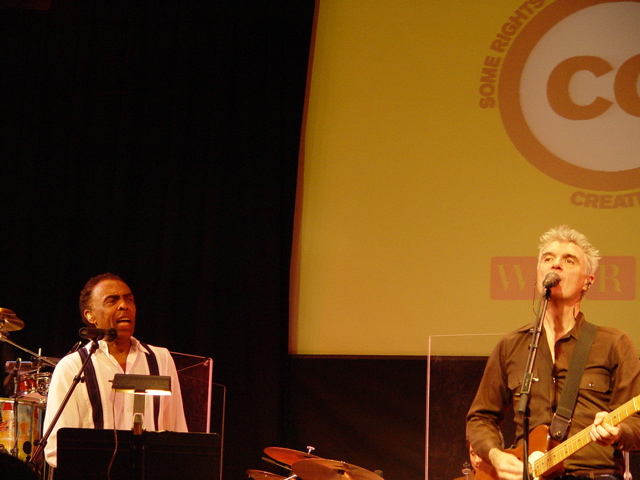
Photo by Yoon Son.
Both songs had the 1500-person crowd dancing, thanks to the tasty rhythms, yes, but also to the gesture: Musical superstars from North and South, jamming together, building earlier works into new creations, in real time. Lawyers on the sidelines and in the audience, where they belong. The big Creative Commons logo smiling overhead.
To me the two songs stand for the entire WIRED concert and its forthcoming CD. It has all been an exercise in joint authorship, a study in collaboration. Here’s a grossly oversimplified list of players (there are too many to list here):
The best part: the main collaboration is yet to come. That’s between you and the artists. Come October 26, you can jam with Gil and Byrne, and many more.
Creative Commons in New York
Last week was a little like The Muppets Take Manhattan, only with cameos by Gilberto Gil and David Byrne instead of Liza Manelli and Ed Koch. Converging from as far as Berlin, Portland, San Francisco, and Tokyo, the Creative Commons team ran wild in the streets of New York, leaving us little time to explain our exploits on our site. That’s a bit of an exaggeration, but in any case we’d like to share some of our experiences with you here soon. Stay tuned . . .
Wall Street Journal Article
The traditional academic journal publishing model has readers pay very steep fees for access. Open access publishers are challenging this model with a new one that allows free public access, with costs paid by submission fees. The sustainability of the open access has been the subject of much debate. We’ve linked to a Nature forum on the topic twice. (Public Library of Science and BioMed Central, two standard-bearers for open access publishing, each use Creative Commons licenses.)
Whether the “creator pays” model is sustainable for academic publishing or not, it is clear to me that is how much culture gets created. A few days ago an article in the San Francisco Chronicle, Venture capitalist rewrites the starving-author story, illustrates with an extreme case and in passing mentions that the venerable (and entirely subscription-funded) Kirkus Reviews is launching pay-to-be-reviewed ($350) service available to self publishers.
The only thing atypical about the wealthy author in the aforementioned article is that he’s spending lots of money to promote his novel. In the typical case the creator doesn’t have money for promotion but does bear the cost of creation — think self-published (and many “published”) authors, bands without commercial appeal, and artists with a day job of all sorts. They pay the costs of creation (and obtain its beneifts), perhaps as a labor of love, but it’s “creator pays” nonetheless.
Advocates of open access to academic journals were clever to call their model “open access” rather than “creator pays”. Artists who bear the costs of creation anyway ought to think about taking a bit of this cleverness and making their works explicitly “open access”. Could it be that there’s a way to do that? Surely anticlimactic for readers of this blog — get a Creative Commons license.
Dare I mention that with a Creative Commons license people can find your work and you can use the Internet Archive’s free service for hosting and bandwidth?
Byrne + Gil + WIRED + Creative Commons: Liberation France
More coverage of the forthcoming WIRED CD from Liberation, in France. (Rough translation of the headline: “Gil and Byrne release a CD that begs to be copied.”) The piece mentions the concert, a few of the artists from the CD, and other prominent Creative Commons licensors like Roger McGuinn and Robert Greenwald.
Gilberto Gil and David Byrne Concert: Wall Street Journal and New York Times
Fuller re-caps of the New York WIRED + Creative Commons concert with Gilberto Gil and David Byrne are on the way. (We’ve all just arrived back home after a very hectic and great week in the Big Apple.) For now, check out a couple of choice press accounts from the Wall Street Journal and the New York Times (reg. required).
As soon as we have reprint rights to these stories, you’ll find them here.