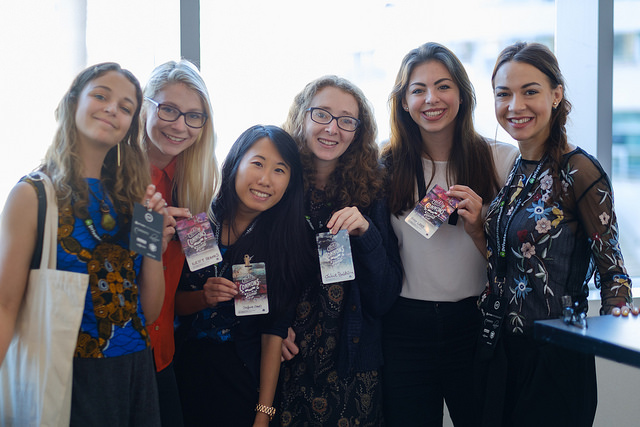
Kicking off the CC Certificates Beta
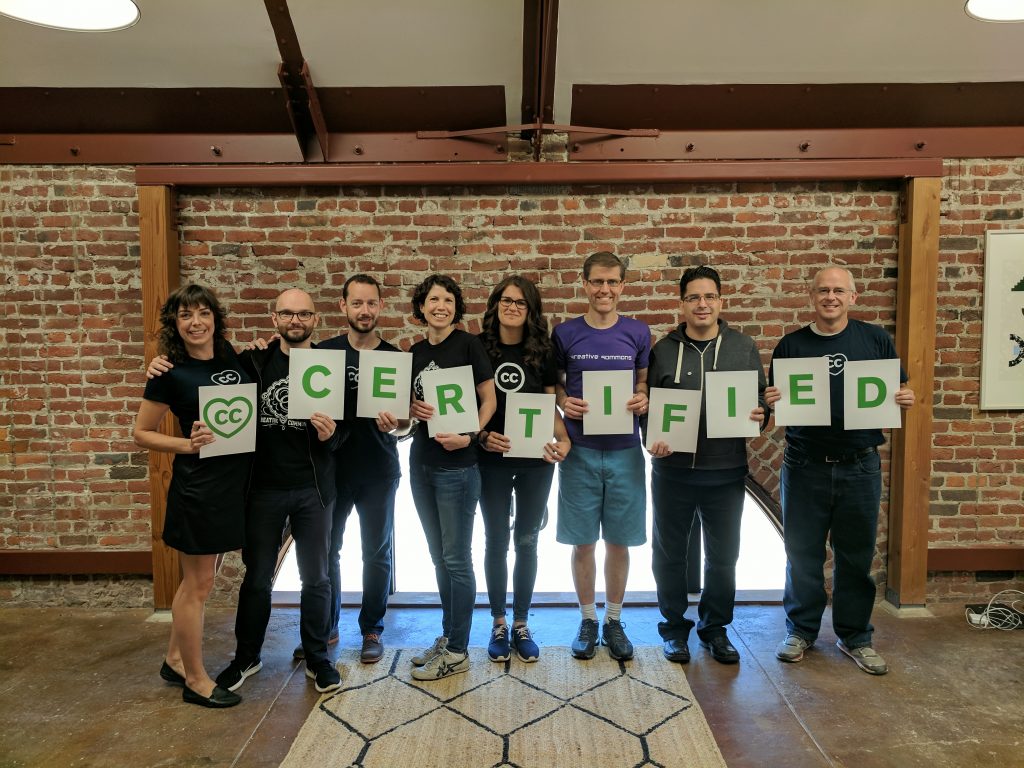
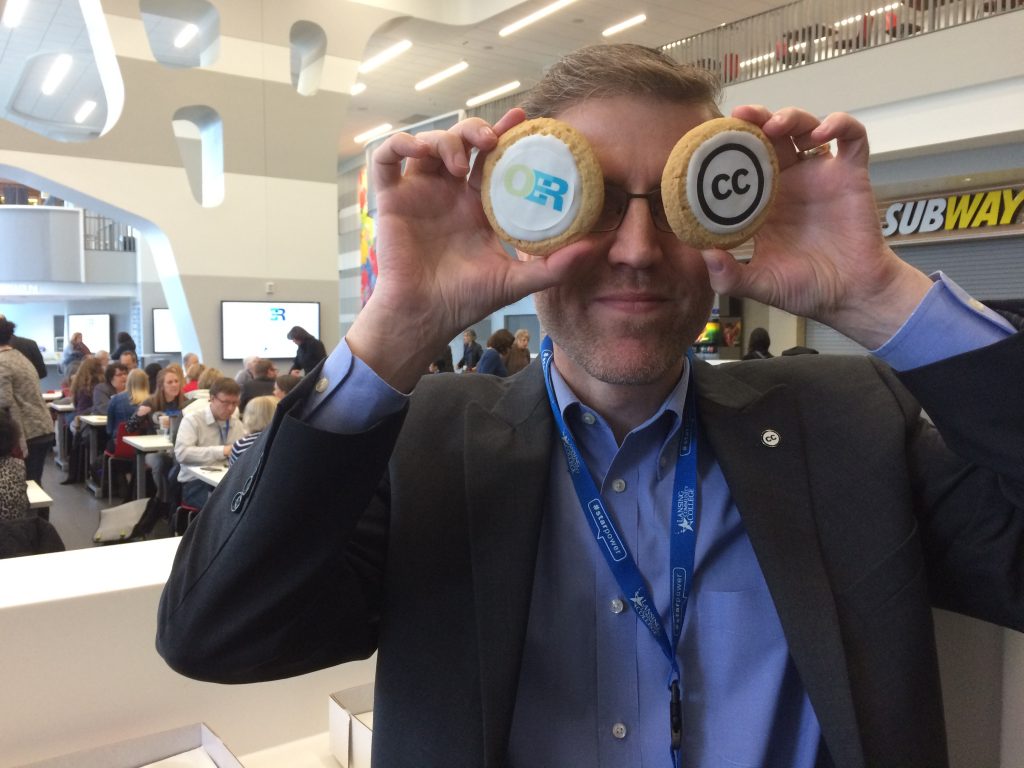
Today marks day one of the beta version of the Creative Commons Certificates program, a project designed to provide people the skills and expertise they need to implement and advocate for open licensing around the world. We are thrilled to have 50 remarkable people from nearly 20 countries in the beta cohort. The group includes: university librarians, Wikipedians, digital rights activists, educators from all levels, lawyers, and more. This diverse cohort with varying expertise will help us shape the CC Certificate program for its official launch later in 2018.
The beta will be led by David Wiley, a long-time CC fellow and all-around expert on all things open. The cohort is divided into two tracks — one for educators and one for librarians. The program will be run as a private online course on Canvas. The course content includes a mix of reading, videos, quizzes, and creative assignments staggered over a 12-week period. We’ll also be asking the cohort to give us weekly feedback on the course, so we can improve it as we go. At the end of the 12 weeks, the cohort will be the first people officially “CC Certified.”
The CC Certificates program has been under development for more than two years and involved extensive work by many on the CC staff and beyond. Special thanks to Paul Stacey, David Wiley, Alan Levine, Kelsey Merkley, Olga Belikov, Kamil Śliwowski, Diane Peters, Eric Steuer, Cable Green, Rob Myers, Jennie Rose Halperin, and Ryan Merkley for their work and leadership. Special thanks to the Gates Foundation and Institute for Museum and Library Services for their project support.
And of course, thank you to all of you in the beta cohort for taking time out of your busy lives to participate in this process and help us make the CC Certificates program as good as it can be when we open it to the world.
For news about the CC Certificates program as we prepare the official launch, please join the CC Newsletter.
Propose a session for the 2018 Global Summit!
The Call for Proposals for the Creative Commons Global Summit is now open! The deadline for submissions is January 23, 2018 at 11:59PM in the submitter’s timezone.
The Creative Commons Global Summit (CC Summit) is an annual conference that celebrates the culture of sharing, providing a space for open communities to collectively grow a vibrant, usable commons, powered by collaboration and gratitude.
Before you submit a proposal, please:
- Read the call for proposals carefully and make sure your idea aligns with the summit theme, goals, tracks, and categories.
- Decide on a title and short description for your session.
- Decide on the type of session, the amount of time you’ll need, whether you will co-present, equipment, outcomes, and ability to tailor the session to a diverse audience.
- You’ll also need to agree to openly license the session resources, and sign our Code of Conduct and Privacy Policy.
All this information (and much, much more) can be found on the call for proposals page for the CC Summit.
The 2018 CC Global Summit builds on Creative Commons’s renewed, strong, and growing network as a part of the global open movement. Many thanks to the 2018 Program Committee for their work on preparing this call for proposals..
We can’t wait to see what you propose and hope you will join us!
Support the kind of journalism we need today
I’ve been a teacher of media and journalism studies since 1984 at Palo Alto High School, and I consider Creative Commons to be an essential part of every student’s education. CC helps students unleash the power of storytelling to change the world and provides them with a toolkit for remix and reuse. It’s my passion to help inspire students with these tools for change.
Today we have ten publications (600+ students) for which students write stories about issues important to them. The publications focus on articles about music, art, travel, photography, foreign affairs, national affairs, sociology, psychology – just to mention a few. In addition, at Stanford some of my students have created
open journals. We could not do what we do without CC. It provides the resources that allows my students to build upon. Here are two examples of websites from the school:
C Magazine and
Verde Magazine. They are all student produced. Students learn to respect copyright and share and build upon that which is CC licensed. It also provides important resources for the professional press on a daily basis.
Courageous, well-researched, and timely journalism is desperately needed right now. We can’t write an algorithm to save our society — we’ll have to do it the hard way, by teaching and learning from each other and repairing the social fabric of trust through storytelling with integrity.
As Melody Kramer wrote last year in Poynter,
I see Creative Commons licensing as a smart way to distribute local or national content when the goal is maximum impact, or an audience spreading word that your content exists…When material is published under the license, smaller newsrooms can republish articles or media like photographs in full. Or, they can build on, localize or extend the reporting in some way.
We want you to join our global community and protect journalism by keeping it open – will you give $5 monthly to support?
Journalism can save our society, our communities, and the web, and CC tools help ensure those stories are carried as far as they can go, becoming a resource for everyone. I hope you’ll support Creative Commons, as their tools are so important to the kind of journalism we need today.
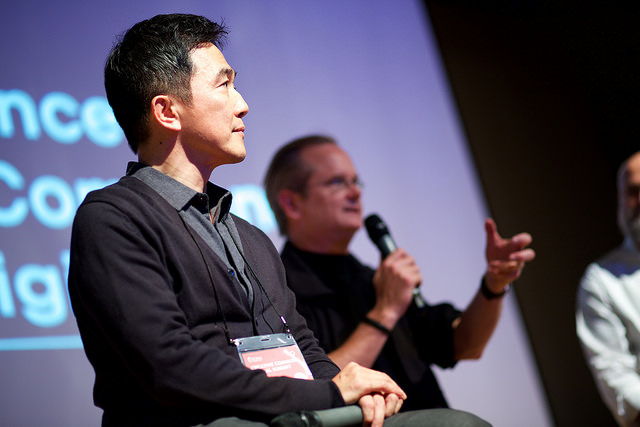
One of the most admired leaders of the global Creative Commons movement is turning the page on his latest chapter of service to the commons. Judge Jongsoo (Jay) Yoon has completed his term as a member of the Creative Commons Board of Directors, where he has served since 2013. Jay will now continue to support CC as a member of our Advisory Council.
Jay is currently in private practice, having previously served as a presiding judge at the Seoul Northern District Court. His interests center on social and legal issues related to intellectual property rights, personal information, internet governance, and IT. As a volunteer for CC, Jay’s work was crucial to the founding of CC Korea, one of the strongest chapters in the network. In 2015, Jay and the CC Korea team hosted the CC Summit in Seoul – bringing together 300 members of the CC community for what was our largest gathering to date. The CC community is indebted to Jay for his tireless work translating CC licenses, advocating for openness and sharing, and – especially – leading and mentoring the next generation of commoners in Asia and beyond.
In the words of former CC Chair and CEO Joi Ito, “Jay is a vital part of the CC soul — from judicial expertise to rock-and-roll guitarist to tireless service to infinite hope, cheer and humor to community organizer to sharp legal mind. Jay is truly my hero and a dear friend and colleague.”
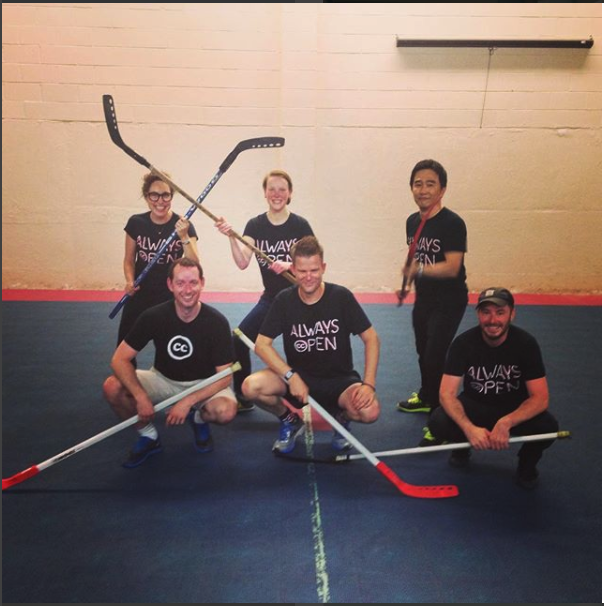
Jay is also a talented floor hockey player: The board beat the CC Staff in 2016’s staff vs board floor hockey game, Photo CC Staff, CC BY
“There are a handful of my most cherished memories about Creative Commons,” adds CC founder Lawrence Lessig. “Watching CC-Korea launch is among those few. To watch not just the energy and joy of everyone, but the inspiration that Judge Jay gave everyone, made me feel for certain just how wonderful was the thing we’ve all helped build. I will always think of the inspiration and energy of Jay; I will always be jealous of the karaoke. And I will always be hoping for another excuse to visit and watch the happiness he spreads everywhere, and that we were so lucky to share.”
The board has prepared a tribute to Jay in English and Korean, which is below. From all of us: thank you, Jay, for your service, your leadership, and your friendship.
———–
WHEREAS, the Board of Directors of Creative Commons, CC staff, and the worldwide CC network and community have benefitted invaluably from the enduring service, wisdom, and kindness of Director Jay Yoon,
WHEREAS, Jay was recruited to join the Creative Commons Board on account of his brilliance, warmth, modesty, and leadership, and has never failed to demonstrate those qualities;
WHEREAS, CC Korea, under Jay’s leadership, has taken on many creative and innovative projects, extended its interest into new and relevant areas, and welcomed the global CC community to Korea;
WHEREAS Jay has furthered the open education movement and supported a range of global CC initiatives, such as the OER copyright survey, translation of integral CC education documents, and the CC School of Open;
WHEREAS, Jay has inspired and mentored his colleagues to become visionary and committed members of the CC community, who serve as CC ambassadors in Korea and beyond;
WHEREAS, Jay is the embodiment of CC’s aspirations worldwide as an international organization, reach and inspiration, instilling joy in connection with sharing and collaboration, most demonstrably through his generous commitment and support in hosting the 2015 CC Global Summit in Seoul, Korea
WHEREAS, Jay exemplifies what is best about CC: collaboration, gratitude, excellence, and impact;
NOW THEREFORE BE IT RESOLVED, that the Board of Directors does hereby express its heartfelt gratitude for Jay’s extraordinary efforts, for the inspiration he has provided to us and the entire CC community, for the example he continues to set for our work, and for his friendship.
——-
Creative Commons 이사회, CC 직원들, 그리고 전세계 CC 네트워크와 커뮤니티 활동가들은 Jay의 끊임없는 헌신과 지혜와 배려를 통해 너무도 큰 도움을 받았습니다.
Jay는 현명함, 따뜻함, 겸손, 리더쉽을 높이 평가받아 CC 이사로 위촉되었으며 이사로 재직 중 언제나 그러한 자질을 보여주었습니다.
Jay의 리더쉽 하에, CC 코리아는 많은 창의적이고 혁신적인 프로젝트를 진행하고 또 그러한 관심을 새로운 관련 분야로 넓히기를 주저하지 않았으며 한국에 전세계 CC 활동가들을 초청하여 성공적으로 행사를 개최하였습니다.
Jay는 OER 운동을 확산해 나가고 OER 저작권 조사, 핵심 CC 교육 자료들의 번역, CC School of Open 프로젝트 등 CC에서 전세계적으로 추진한 다양한 국제 이니셔티브들을 지원하였습니다.
Jay가 스스로 귀감이 되고 때로는 조언을 아끼지 않음으로써 동료들이 CC 커뮤니티의 통찰력을 가진 헌신적인 일원이 될 수 있도록 하였고 이렇게 CC에 함께 하게 된 활동가들이 한국에서, 나아가 국제적으로도 CC를 알리는 사절이 되고 있습니다.
Jay는 국제 단체로서 CC가 전세계적으로 품고 있는 염원과 영향력과 영감의 표상으로, 공유와 협업에 담긴 기쁨을 전파해왔으며, 2015년 한국에서 CC Global Summit을 개최하면서 보여준 아낌없는 지원과 헌신을 통해 이점을 여실히 증명하였습니다.
Jay는 협업, 감사의 마음, 탁월함, 영향력 등 CC의 가장 훌륭한 요소들의 표본입니다.
이러한 이유로, CC 이사회는 이로써 Jay의 보기 드문 노력과, 그가 우리와 CC 커뮤니티 전체에 준 영감, 앞으로 CC 활동에 있어 계속 보여줄 본보기/모범과, 그의 우정에 대해 진심으로 감사를 표하는 바입니다.
아울러 이사회는 이로써 Jay Yoon을 CC Advisory Council 위원으로 위촉하여, 사임이나 해임, 그 밖의 다른 이유로 더이상 직을 수행할 수 없을 때까지 위원직을 수행하도록 의결하는 바입니다.
전 CC 이사들의 메시지
Larry Lessig:
“CC에 대해 소중하게 간직하고 있는 추억이 몇 가지 있는데, CC 코리아 출범 때의 추억이 그 중 하나다. 당시 들떠 있던 모든 사람들의 에너지와 기쁨 뿐만 아니라 Jay가 모든 이들에게 깊은 영감을 주는 모습을 지켜보면서, 우리 모두의 도움이 얼마나 멋진 결과물을 만들어 냈는지에 대해 확신을 느낄 수 있었다. 앞으로도 Jay가 주는 영감과 에너지를 늘 잊지 않고 생각할 것이고, 노래방의 흥을 늘 부러워할 것이다. 그리고 언제고 다시 한국을 찾아 그가 세상에 퍼뜨리는 행복을, 우리가 정말 감사하게도 나눌 수 있었던 그런 행복을 다시 볼 수 있는 기회가 있기를 늘 바랄 것이다.”
Joi Ito:
“Jay는 법률가적 전문성, 록밴드의 기타리스트, 지칠 줄 모르는 헌신, 무한한 희망, 에너지, 유머감각, 커뮤니티 지도자, 날카로운 법의식에 이르기까지, 여러 면에서 CC 정신의 핵심을 이루는 사람이다. Jay는 나의 영웅이자, 친애하는 벗이자, 동료다.”
The battle for the net continues after FCC erases net neutrality rules
An open internet is crucial for all creators, thinkers, and makers on the web
As expected, yesterday the Federal Communications Commission (FCC) voted along party lines to repeal the 2015 Open Internet Order that ensured net neutrality in the United States. Without net neutrality, broadband providers like Comcast and Verizon will have free reign to block or discriminate against content or applications that are carried over their networks.
In the preceding weeks, there was a huge outpouring across the web and in the streets in support of net neutrality. Creative Commons has always supported network neutrality. We joined thousands of organisations calling on everyone to make their voice heard to the FCC and Congress.
Though this vote feels dire, the fight to protect the open internet isn’t over. Even with yesterday’s vote, there are still ways through Congress or the courts that could restore net neutrality in the U.S.
A free and open internet is an essential utility of everyday life and Creative Commons licensing is only one factor in a healthy open internet ecosystem. A strong digital commons requires universal access to basic digital infrastructure, and enforceable rules that promote fair competition and freedom of information.
The FCC vote yesterday was a step in the wrong direction, and clearly antithetical to the wishes of the public. We stand in solidarity with countless internet users, creators, teachers, startups, and information-seekers who can only thrive with strong net neutrality protections. We’ll continue the fight for the open internet for all.
Network Strategy: the transition towards a new model
In June we shared our community plan to implement the new CC Network Strategy, showing the benefits of a new international structure with an enhanced Chapter model, working together at a global scale with the Network Platforms, and a new governance structure to support the network.
The Creative Commons network has always been one of the critical pieces of the success of the CC licenses. At the outset, CC was mostly a legal project trying to reach a global audience of users and creators. Years later, our community required new ways of working together, with projects and advocacy and education playing a bigger role, and enhanced means of communication and collaboration as central to the community. The new Network Strategy, written collaboratively by community members, was the primary outcome of a process for change and adaptation begun at the CC Summit in Seoul, in October, 2015.
Implementing the strategy properly, with all the needed infrastructure, has been a big task. While the first network grew organically over many years, this one is being designed deliberately on concrete timelines. It has involved our web dev staff, legal review, communications, and lots of work from the Advisory Group team. It has been more complex than anyone thought, but we’re proud of what we’ve done to bring it together. We want to get it right for all of you, and we think we’ve done significant work that will serve the network well, and avoid problems in the future.
What we have done:
- We created a suite of documentation for the Network Strategy transition.
- A Guide for vouching applicants. This document provides guidance about what to take into account at the moment of deciding to vouch for someone to join the Network
- A Guide for approving new members. This guides members of the Membership Council regarding criteria for approving already vouched applicants.
- Chapter Standards and Guidelines. This document provides a more detailed explanation of how Chapters should organize, indicating standards, responsibilities, membership, and examples of what else a Chapter can do.
- An updated Charter. Minor updates, but we improved the language of policies and established a better way to make future changes. We also created an official version available on the CC website.
- We built a brand-new network website and member application and management infrastructure. We have implemented BuddyPress as a backend to manage members and their applications, and we have been creating brand new plugins to support the entire process of application, vouching and approval within the website. This has been a massive project for design and development. We expect this to be the “door” for people who want to be connected with the CC community in any capacity (including membership). So, we are creating ways to make people feel welcomed and driving them to different ways to be engaged with CC.
- We massively updated Terms of services and Privacy Policies. This was an intended consequence of the new Strategy. We created brand new ToS for the Network website and also radically changed our entire Privacy Policy, not just to comply with the requirements of the whole memberships/vouching system, but also to update it after some years of use.
All of this work is vital, but it has required us to stretch our original timelines. We will now open up memberships a bit later, and will as a result also extend the time before the first GNC meeting to allow chapters to form, meet, and select their representatives. What we are doing here is massive and will significantly grow the network. We’re grateful for all your work and energy. We want to do everything right, and we prefer to launch with everything in place and to be ready to communicate to the world what we are doing, inviting all to be part of this process.
What’s next:
- We are shifting the timelines. We are finishing the design and backend of the Network website by mid-December. We start communicating more broadly in December and early January, and will open membership on January 15th. The window for the first Chapter meeting will be in March 2018.
- The first Global Network Council meeting will be after the Summit — it will not be during the summit, as we had initially imagined. We will use the Summit to advance the core work of Network Platforms and Working Groups, which are open to everyone, for community discussions and chapter meetups, and to engage new members. We will also use the Summit to advance into conversations about governance and the Network. We plan to have the first GNC meeting by May/June 2018.
The Global Summit will celebrate the CC Network and the affiliate teams that built the CC community we have today. It will be a great moment to celebrate what we achieved during all these years and what brings us together, as we move into the future. We expect this Summit to be a place to share ideas and strategies to improve -and fight for- the commons at a global scale.
The new timeline means we will have more time to prepare for this big change – more time to talk with your local peers, host more meetings and conferences, and maintain better and more impactful projects. From now to the Summit, we will continue supporting activities around the globe with our Activities Fund. We encourage you to keep advocating for openness in your communities and to consider joining the network as soon as we are “open” for members.
One week left to save the Internet

Net neutrality is under attack…again. On the day before the U.S. Thanksgiving holiday, Federal Communications Commission (FCC) Chairman Ajit Pai released a draft plan that would repeal net neutrality in the United States. Net neutrality is the principle that internet service providers (ISPs) should treat all online data the same, and not discriminate or charge different amounts for different audiences. Pai’s proposal—if passed—would completely repeal the 2015 rules set by the previous administration’s FCC. This means that internet service providers “will be free to experiment with fast and slow lanes, prioritize their own traffic, and block apps and services.” ISPs would be required to disclose when they are engaging in these types of activities. The FCC will vote on the proposal on 14 December.
In July we joined hundreds of organisations, thousands of online communities, and millions of internet users in calling on the FCC to protect net neutrality. We wrote:
There are over 1 billion CC-licensed works online, shared freely with anyone with access to the internet. The majority of these works are hosted on content platforms such as Wikipedia, YouTube, Internet Archive, Flickr, and Vimeo. What if you couldn’t access your favorite works because your ISP wants you to see instead content they’re getting paid to promote? What if the video that you created and uploaded online is slowed so others can’t watch it? We know that Creative Commons licensing is only one factor in a healthy open internet ecosystem. A strong digital commons requires universal access to basic digital infrastructure, and enforceable rules that promote fair competition and freedom of information.
The repeal of net neutrality rules in the United States would deal a massive blow to fundamental consumer protections, creativity and innovation, and information sharing online.
The threat to the open internet could not be more dire. Make your voice heard in support of net neutrality. Message and call Congress and attend an in-person protest on December 7.
Colombian appellate court affirms: Diego Gómez not guilty for sharing research paper online
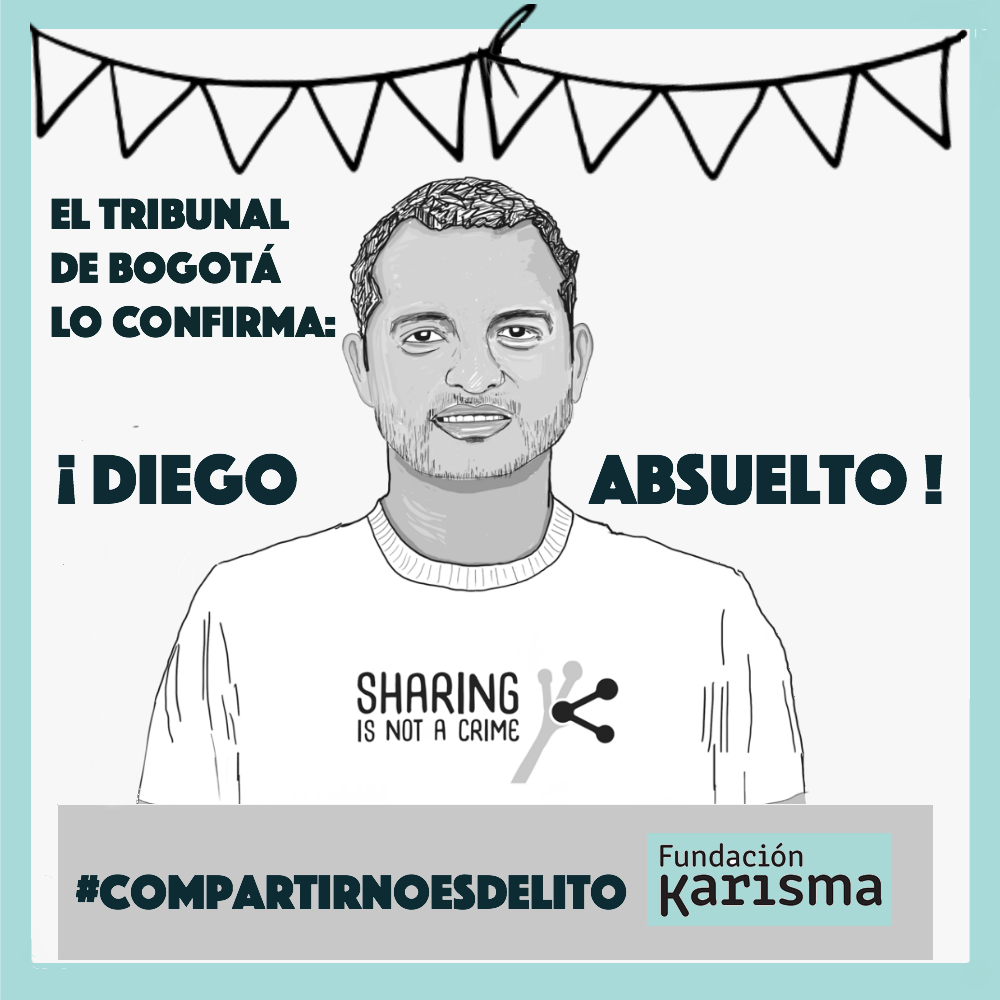
Yesterday we learned that the Tribunal de Bogotá—the Colombian appellate court—has affirmed the lower court’s acquittal of Diego Gómez.
Gómez is a scientist from Colombia who has been criminally prosecuted for the last three years for sharing an academic paper online. When Diego was a student in conservation biology in Colombia, he had poor access to many of the resources and databases that would help him conduct his research. He found and shared an academic paper online so that others could read and learn from it. Gómez didn’t get permission to reshare the article, and subsequently was prosecuted for copyright infringement. He faced up to eight years in prison, along with a substantial monetary fine.
In May 2017 Gómez was acquitted of criminal charges. But within days of the ruling, the article author’s lawyer appealed the decision, meaning that even after several years of criminal proceedings, Diego’s case continued to the appellate court.
Yesterday’s decision confirms the lower court’s ruling.
A global campaign—Compartir no es Delito (Sharing is not a Crime)—has been supporting Diego since 2014. The action was spearheaded by Colombian digital rights organisation Fundación Karisma.
Instead of prosecuting students for sharing knowledge, governments and communities should be encouraging the free exchange of scientific information by reinforcing positive norms around scholarship and collaboration, promoting open access to research, and eliminating out of control copyright remedies that serve no reasonable public interest purpose. Furthermore, we should encourage our governments to boost national legislation that promotes the release of public funded research results as open access.
You can read more about Diego’s case here, and learn about open access here.
Help us lead the charge: An open appeal to support Open Education
The “journey to open” looks different for all of us. For some, it’s the realization that we can access, modify and share educational resources for free; for others it’s about fundamentally changing the way we think about student learning, pedagogy, and ownership and control of the resources we use in schools, colleges and universities. For many of us, the choice to go open is a reflection of our principles, politics and values.
My journey to open was an actual journey. When I started as the Director of eLearning for the Washington State Community and Technical Colleges, I toured the state listening to students’ stories about their journeys to a degree and a better life. In my travels, I discovered that many students had to make difficult decisions related to the cost of their education. Students told me were forced to decide between buying a textbook and taking one more class, paying for their child’s doctor appointment, or fixing a broken car. The students I met were falling behind because of the high cost of textbooks; they asked me “how can I succeed in my class if I can’t afford the required resources?” I made it my mission to change how we use public funds to build, license, maintain and share education resources to ensure equal opportunity for all students, no matter their economic situation.
Education is a fundamental human right and essential for the exercise of all other human rights. Because we can share digital open educational resources (OER) for near $0, I believe we have a moral and ethical obligation to do so.
Will you chip in at $5 per month to ensure all students have the opportunity to learn?
As a taxpayer, I expect my government to ensure all publicly funded educational resources be openly licensed. People around the world expect the same – the public should have open access to the education and research resources it funds.
This year, Creative Commons helped:
- Bangladesh national government draft an open licensing policy
- European Union Erasmus+ program update its open licensing policy
- US Department of Education adopt an open license rule
- Global Book Alliance integrate open licensing policies into its funding proposals
- 30 national ministries of education adopt the 2017 Ljubljana OER Action Plan at the 2nd World OER Congress
- UN Environment Program draft an open licensing policy on research and educational resources.
- US State Department publish its Open Licensing Playbook for Federal Agencies
- The Commonwealth publish an “OER Policy Brief” for its ministers of education.
Only $5 per month will help us ensure that all publicly funded educational resources are publicly accessible.
At CC, we’re leading the charge for Open Education together with our mighty group of 620+ CC Open Education Platform members. We’re growing the number of open education leaders globally through training, mentorship and projects. For us, that means mainstreaming open education content, practices and policies, working with governments to make all publicly funded education resources openly licensed, co-leading the open education movement, and creating new production and procurement models that scale OER adoption.
I’m passionate about changing the education landscape – can you contribute?
Governments, public education institutions, educators and students need to fight for universal, inclusive and equitable education opportunities for all.
Help us lead the charge.
How can we make the world a better place?
What are the values that resonate the most for you in the Commons? Transparency? Innovation? Sharing? Gratitude? In today’s polarized political environment, how can we come together to champion values that we share, and make the world a better place?
I’ve repeated three truths to guide CC’s message, and I’d like to share them with you as this year comes to a close:
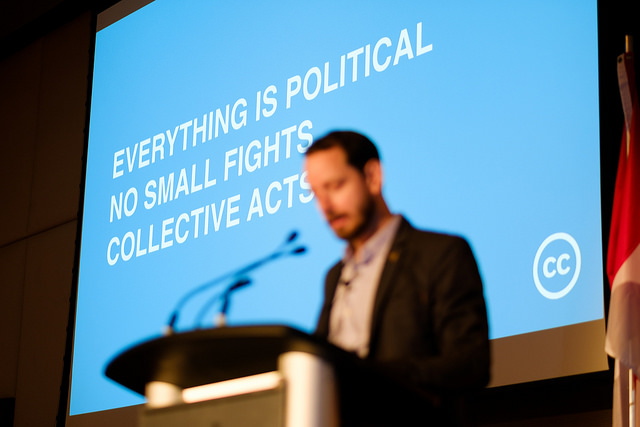
- Everything is political
- Pick big fights with your enemies, not small fights with your friends
- Collective acts are our collective power
These three concepts guide my work at CC – they’re how we build our communities through organized political action and how we pick our battles, from copyright and policy reform to open access to universal access to research and education.
But CC’s work is not only copyright policy and free content on the internet. Our community is where the real power of CC lives, and this year has shown that our work is only possible in collaboration with our Global Network of lawyers, academics, creators, copyfighters, librarians, educators, and makers of all types, in every sector. We’ve developed a brand new collaborative strategy to unleash that community, and we hope you’ll join us.
To build that momentum, we announced a number of incredible partnerships this year, from our landmark release of over 400,000 images with the Met Museum to the unveiling of #NEWPALMYRA, a tribute to our late friend Bassel Khartabil. In August, we joined with Wikimedia and Mozilla to fund a fellowship in his honor.
The need for collective action has never been greater and our work never more encompassing – that’s why I’m asking you to join us with a donation of any amount.
This year has been a year of record growth in the commons, but it’s also been a record year of growth for our movement. In April, we convened our biggest summit ever in Toronto. In collaboration with a 30 person volunteer program committee, we brought together 400 commoners from around the world, including 100 scholarship recipients. Five brilliant international women delivered memorable keynotes. In a time when good news feels hard to come by, our summit was a moment of hopefulness, gathering people from around the globe to share successes and discuss the future of our movement for equal access to knowledge. This year, we’ll be gathering from April 13-15, 2018, and we’d love to see you there.
Our movement is only growing stronger by the day, but we couldn’t have done it without your support.
I’m filled with gratitude for our community and hope that you step up to join in the next phase of our work, including updating our tools and licenses and launching our CC Certificates program to train librarians, educators, and others on CC, copyright, and open culture. We’ll be announcing new legal tools, new community empowerment programs, and even more partnerships in 2018. We can’t wait to share it all with you.
PS We’ll be launching even more ways to donate monthly to the commons. Only $5 per month will ensure our work continues. Can you join?
Donate now