Update and Next Steps on CC’s AI Community Consultation
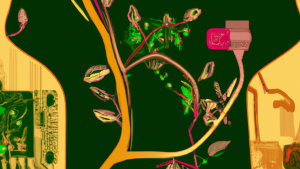
“Plant Circuits” by Creative Commons was generated by the DALL-E 2 AI platform with the text prompt “vines and digital circuit boards in the style of Erté.” CC dedicates any rights it holds to the image to the public domain via CC0.
We’re nearly halfway through 2023 and this year has already been an eventful one for generative artificial intelligence (AI), presenting unique challenges and opportunities for the Creative Commons (CC) community of creators who embrace open sharing.
From the community and beyond, we are seeing urgent demands for support in navigating AI’s implications for the commons.
CC has been hard at work developing our thoughts on the intersection of copyright and generative AI inputs and outputs. In February, we kicked off a public consultation with our community members and a wide range of stakeholders to learn about their thoughts on generative AI and to contemplate ways to move toward a positive future with this promising technology.
We believe AI can work in the public interest, and want to be part of the solution in navigating to that reality.
We use “artificial intelligence” and “AI” as shorthand terms for what we know is a complex field of technologies and practices, currently involving machine learning and large language models (LLMs). Using the abbreviation “AI” is handy, but not ideal, because we recognize that AI is not really “artificial” (in that AI is created and used by humans), nor “intelligent” (at least in the way we think of human intelligence).
What We Heard From You
We talked to creators, artists, publishers, policymakers, and legal experts. There are a wide variety of uses of these new tools, and just as wide a variety of points of view. As with previous technologies like the camera and Photoshop, generative AI is providing new tools for creativity, empowering both professionals and the public at large to make new works. At the same time, we listened to creators who worry about how their works are used to train AI and produce content that may compete with their works. For instance, if someone can generate works in the style of a previous artist, is that fair to the original artist? If people can use ChatGPT to get answers gleaned from Wikipedia without ever visiting Wikipedia, will Wikipedia’s commons of information continue to be sustainable?
Hearing these diverse voices helped reinforce and clarify our view that we need to think about a diverse set of solutions to support our strategy of better sharing in a world with AI. While we think it’s important that copyright continues to leave room for people to study and learn from past works to create new ones, including by analyzing past works using automated means, copyright is just one lens to think about AI. It’s still important to grapple with legitimate concerns about this technology and consider solutions that support responsible development and use.
Importantly, we heard interest in such solutions not just from creators, but also from developers of AI. With laws varying around the world and cases in the midst of active litigation, some developers are uncertain about whether and how to proceed in building AI. Moreover, regardless of what the law permits, some developers want to work with creators to find ways to respect creators’ wishes and support the commons through clear norms and technical solutions. For instance, we met with developers actively working on opt-in and opt-out solutions for creators regarding training of AI, and we talked to many developers who see using openly-licensed content for AI training as in line with their own aspirations and values.
We also spent time consulting with developers of open-source AI tools. Open source can help grow the commons, improve transparency in AI, and democratize access to the technology. At the same time, people have raised concerns about how open source may lower the barriers to harmful uses such as deepfakes or disinformation, and we’re starting to see proposed regulatory approaches that may go too far, hindering open approaches to AI. It is critical that, as an organization and a voice for the public interest, we continue to support appropriate regulations and practices that strike a balance among essential concerns, including open access, transparency, incentives for creativity, and protecting the commons and digital rights .
Additionally, we spent time talking to legal experts from academia and from private practice. Our thoughts about using AI in the public interest are rooted in our understanding of the legal frameworks involved and the way CC’s licenses and legal tools interact with them. We want the advice we share with our community and the policy approaches we advocate for to be informed by the most thoughtful analyses of the current and evolving legal situation, and we’ll provide further insights about AI and CC’s licenses in a future post. (For now, you can find additional details in our FAQ.)
What’s Coming Up for CC
With new developments in generative AI coming daily, and with increasing debate worldwide about how best to regulate AI, it is time for CC to look to the future and to consider our place in the ongoing conversation around generative AI.
We will continue to convene critical conversations and bring together stakeholders who may not typically sit across the table from each other. If you know of events where the CC community should be engaged, please share.
Upcoming opportunities to engage in-person on these topics include:
Expert roundtables in London in mid-July
Wikimania in Singapore in August
Convening in New York in September
Policy workshops in DC in September (to be confirmed)
CC Global Summit in Mexico City in October, with a specific focus on AI and the Commons, including participants from diverse communities around the world, not just people in the centers of power and privilege who already dominate conversations about AI
Additionally, anyone may join our community Copyright Platform and participate in its community advisory group on AI.
The CC team is dedicated to loud listening as we thoughtfully consider our stance and foster an exchange of ideas and knowledge.
Our consultation is not an end in itself. Knowledge exchange through convenings will inform our intentions, and guide our actions.
There are things we must do urgently to help bring clarity to our community and support for creators. We must:
Clarify how the legal structures supporting the commons, including CC licenses and legal tools, interact with generative AI today.
Empower creators, engaging even more deeply with those whose voices are being excluded from mainstream media coverage and policy debates. One question raised by creators rests on moral rights (non economic rights) which vary between jurisdictions, creating uncertainty over reuse.
Collaborate with builders and innovators who share our values and our vision for generative AI in the public interest, to develop, test, and potentially co-create solutions that tackle challenges like transparency, credit, consent, and choice.
Join us
Please join us on this journey of discovery through our platforms, community, network and in person at our Global Summit.
Participate in the CC Global Summit: Register to join us in Mexico City during 3–6 October 2023, where our theme will be AI and the commons.
Learn more about how CC licenses and legal tools intersect with AI inputs and outputs, and current understandings of the legal and regulatory landscapes.
Subscribe to our newsletter: Never miss an update or CC event! Subscribe to our mailing list and get all the latest CC news and invitations delivered straight to your inbox.
Follow us on social media: Keep up with all things CC by following us on your preferred social platform. We’re active on Facebook, Mastodon, LinkedIn, and Twitter.
Get involved with CC on slack: Engage directly with our team and fellow CC enthusiasts. Join our Slack community for real-time discussions and updates.
A Special Episode of the Open Culture Voices Series, Part 1
In this Special Episode of the Open Culture Voices series, CC hosts a conversation among five open culture experts from around the world.
Dr. Andrea Wallace, Professor, University of Exeter Law School, United Kingdom
Dr. Nkem Osuigwe, Director, African Library and Information Associations and Institutions, Nigeria
Medhavi Gandhi, Founder, The Heritage Lab, India
Evelin Heidel (Scann), Program Lead at Wikimedistas de Uruguay, Uruguay
Michael Peter Edson, founding Director, Museum of Solutions, USA/India
Topics addressed range from the fundamental issues surrounding open culture, its transformative impact, and the challenges it faces in a world undergoing profound changes.
The conversation takes place at a pivotal moment in the open culture movement: while 2022 saw the adoption of the MONDIACULT Declaration by UNESCO member states, which recognizes culture as a global public good, only 1% of the world’s cultural heritage institutions have open access policies. The experts reflect on whether open culture can fulfill its commitment to inclusive and global access to culture and participation in cultural life.
Some of the key points discussed in this episode include:
The disruptive impact of new technologies, such as generative AI, on the open culture ecosystem, raising concerns about sustainability, accessibility, and equity.
The need to sketch a blueprint for open culture and better sharing to guide the direction of open culture in the coming years.
The observation that the open movement has stalled and is at a crossroads, requiring a realistic assessment of accomplishments, challenges, and future directions.
The importance of reflecting on and rethinking the mission, structure, and practices of cultural institutions in the digital age.
The need for a more equitable approach in open culture, addressing the bias in data representation and the lack of voices from underrepresented regions.
The sector’s need for active support and collaboration to address complex issues such as decolonization and inclusivity.
The importance of open culture in creating awareness, understanding, and appreciation of diverse cultures and knowledges.
Challenges include the need for more participatory practices, addressing issues of interoperability, and overcoming barriers to access in developing countries.
The role of open culture in contributing to addressing the climate crisis and preserving cultural heritage in emergency situations.
The environmental impact of digital technologies and the labor invisibilization associated with digital extraction.
The importance of considering local and intentional digital activities in open practices.
Overall, the first part of the conversation highlights the need to expand the reach and impact of open culture, address inequalities, and actively shape the future of openness in the cultural heritage sector. As the open culture movement evolves, it must address issues of representation, equity, and resource distribution and by embracing diverse perspectives and forging partnerships, the blueprint for open culture can be shaped to create a more inclusive and equitable future for all.
When asked why open culture is important, here’s what they had to say:
“For me, open culture is really important locally because it’s a way to think creatively about how to make connections among collections, individuals, histories, narratives. That previously hasn’t actually been possible because of the analog nature of heritage and heritage management.” Andrea Wallace
“I started my career working with artisans and craftspeople, and my main interest was in building participation with the arts…I realized that the knowledge of the craft was at museums, like the background knowledge and contextual knowledge. And so we started taking artisans and crafts people to museums.” Medhavi Gandhi
“Open content was this thread that ran through all our thinking about the future role of institutions and in the digital age… And for me, that’s a very very local and intimate challenge.” Michael Peter Edson
“I think it’s very important that we put out our stories and our heritage in ways that actually represent our culture.” Evelin Heidel (Scann)
“In my culture, some things are open and some are not, and I’m wondering how we can open up…there are some areas where women are not even allowed to join, and I’m wondering how open culture can help us achieve that.” Nkem Osuigwe
Closed captions are available for this video, you can turn them on by clicking the CC icon at the bottom of the video. A red line will appear under the icon when closed captions have been enabled. Closed captions may be affected by Internet connectivity — if you experience a lag, we recommend watching the videos directly on YouTube.
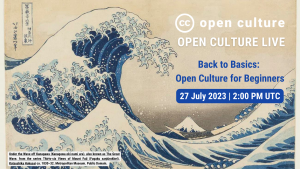
The CC Open Culture Team is excited to announce a new webinar series, Open Culture Live. This series will feature conversations with experts on a number of topics, from the basics of open culture to discussions about traditional knowledge, artificial intelligence, respectful terminologies in collections, and more.
As a first session, we wanted to introduce folks to the basics of open culture – how our licenses work, and how they can be harnessed by cultural heritage institutions or GLAMs (galleries, libraries, archives and museums) to responsibly share the world’s cultural heritage.
Under the Wave off Kanagawa (Kanagawa oki nami ura), also known as The Great Wave, from the series Thirty-six Views of Mount Fuji (Fugaku sanjūrokkei). Katsushika Hokusai ca. 1830–32. Metropolitan Museum. Public Domain.
Back to Basics: Open Culture for Beginners
27 July, 2023, 2:00 PM UTC
Jocelyn Miyara, Open Culture Manager & Connor Benedict, Open Culture Coordinator
Why is open access important for cultural heritage institutions? The mission of many of these kinds of organizations is to share culture and knowledge – and the internet enables sharing much more widely. Open culture’s most exciting potential is to empower creators anywhere in the world to discover, share, reuse and remix cultural heritage. We see open culture as a catalyst for the dissemination and revitalization of culture, a spark for the creation of new cultural expressions and experiences, and an engine for sustainable cultural, economic and social development, where culture as a public good takes center stage.
Creative Commons Announces New Board Members: Marta Belcher, James Grimmelmann & Luis Villa
I am delighted to introduce the latest additions to the Creative Commons Board of Directors: Marta Belcher, James Grimmelmann, and Luis Villa. They each bring unique skills and experiences, and they’re all passionate advocates for Creative Commons and the open movement.
We are at a pivotal moment in the development of Creative Commons. As we focus on CC’s strategic goal of accelerating better sharing and prepare for the first CC Global Summit since 2019 in Mexico City this October, the insights of Marta, James, and Luis will be invaluable.
Their appointment was made possible through an open nomination process steered by the Governance and Nominations Committee Chair, Carolina Botero, who harnessed the insights of the CC Global Network. I would like to thank the committee for their work, and a hearty welcome to Marta, James, and Luis. Let us all welcome them with open arms as they embark on their journey with us.
About the new board members:
Marta Belcher
Photo courtesy of Marta
Marta Belcher holds multiple esteemed positions in the tech and legal sectors, notably serving as President and Chair of the Filecoin Foundation and the Filecoin Foundation for the Decentralized Web. Additionally, she is the General Counsel and Head of Policy at Protocol Labs. She also lends her expertise to the Electronic Frontier Foundation as a Special Counsel. Marta is also a Board member of the Blockchain Association and the Zcash Foundation, and a member of Paradigm’s Crypto Policy Council. Marta is a pioneer in blockchain law and policy, and has testified in Congress and state legislatures, as well as speaking in European Parliament. Marta was previously an intellectual property litigator at Ropes & Gray, and has submitted briefs in the U.S. Supreme Court and U.S. appellate courts for high-profile public interest organizations, including EFF, the Center for Democracy & Technology, Public Knowledge, the Cato Institute, the National Consumers’ League, the Blockchain Association, and Project Gutenberg. Marta has been recognized by the Financial Times Innovative Lawyer awards, by Law360’s list of Top Attorneys Under 40, by CryptoWeekly’s list of Most Influential Women in Crypto, and as Business Intelligence Group’s Woman of the Year.
James Grimmelmann
Photo courtesy of James
James Grimmelmann is the Tessler Family Professor of Digital and Information Law at Cornell Tech and Cornell Law School. His work is primarily focused on how laws regulating software affect freedom, wealth, and power. His role often involves helping lawyers and technologists understand each other, and he’s applied concepts from computer science to tackle legal problems. He’s also written a casebook titled “Internet Law: Cases and Problems” and over fifty articles on a range of topics within computer and internet law. He holds a J.D. from Yale Law School and an A.B. in computer science from Harvard College. Before law school, he worked as a programmer for Microsoft; after graduation, he clerked for a federal appellate judge. He is an affiliated fellow of the Yale Information Society Project. He previously taught at New York Law School, Georgetown, and the University of Maryland. He has written for Slate, Salon, Wired, Ars Technica, and Publishers Weekly; he is a regular source of expert commentary for major news media including the New York Times, the Wall Street Journal, the Washington Post, and All Things Considered. He and his students created the Public Index website to inform the public about the Google Books settlement.
Luis Villa has made significant contributions to the open community since the late 90s, taking on a multitude of roles. He started as a developer, later transitioning into legal and board positions. His experience spans renowned organizations like Mozilla and the Wikimedia Foundation, where he held critical positions. In addition, he has provided legal counsel to a spectrum of companies, from small startups to giant Silicon Valley firms. His involvement in the open-source community extends beyond his professional roles. As a community member and informal advisor, he has worked with organizations such as Open Street Map, the Open Knowledge Foundation, the World Wide Web Consortium, and OpenETdata.org. Luis is also a co-founder and General Counsel at Tidelift, where the mission is making open source work better for everyone, including the maintainers behind the projects we all rely on, and the enterprises benefiting from their creations.
CC’s #BetterSharing Collection | July: Better Sharing For Brighter Future
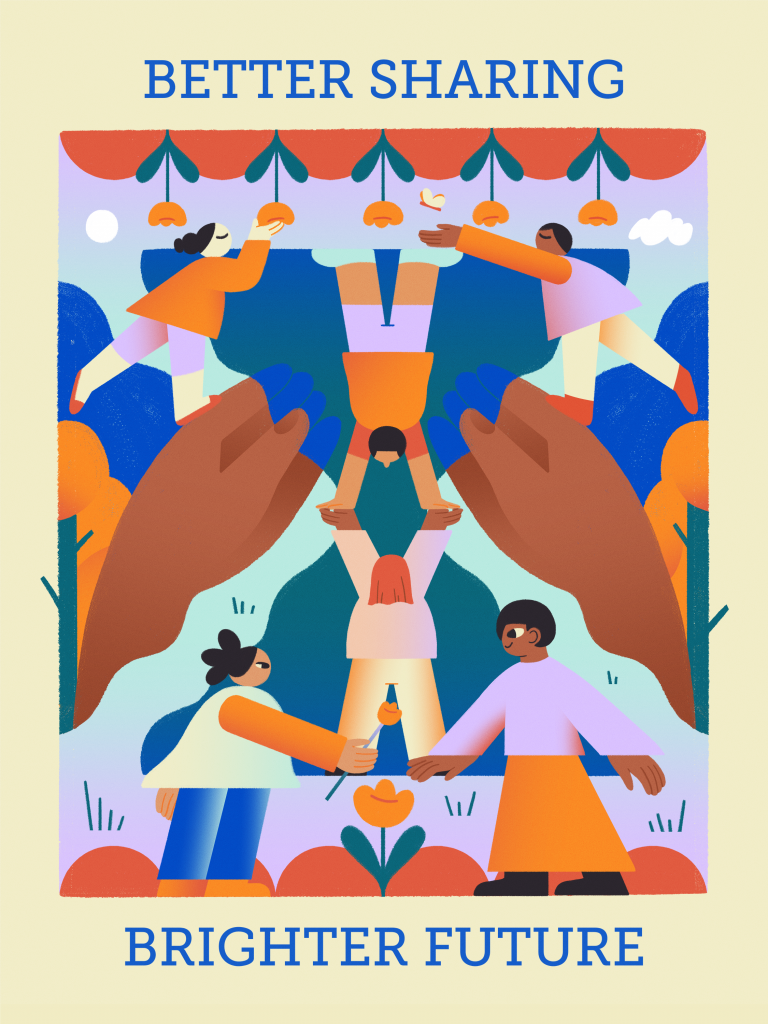
As part of our #20CC anniversary, last year we joined forces with Fine Acts to spark a global dialogue on what better sharing looks like in action. Our #BetterSharing collection of illustrations was the result — we gathered insights from 12 prominent open advocates around the world and tasked 12 renowned artists who embrace openness with transforming these perspectives into captivating visual pieces available under a CC license.
Each month throughout 2023, we will be spotlighting a different CC-licensed illustration from the collection on our social media headers and the CC blog. For July, we’re excited to showcase “Better Sharing For Brighter Future” by Janice Chang. The piece, licensed under CC BY-SA 4.0, was inspired by a quote from Tyler Green, Author, Historian, Art Critic and Producer/Host, The Modern Art Notes Podcast:
“It means understanding that sharing and open content is a means, not an end. For me, it means understanding that sharing and open content is a means, not an end, that open content and open access policies aren’t an end in and of themselves. Although within the context of an individual project, it’s an excellent end. But what we get, we the community of scholars, we the broader community of people, what we get is an opportunity to understand how this material fits within the worlds around us, allowing new and different ideas to more fully inform us. My favorite example is always going to be the more art and visual material, whether it’s photographs or engravings in 19th century magazines. The more we understand how images have worked across histories, the more we will understand how impactful artists and visual makers, engravers, whomever have been. And so I think that open access is probably the primary and most important means through which we will understand how artists have impacted the world.”
Meet the artist:
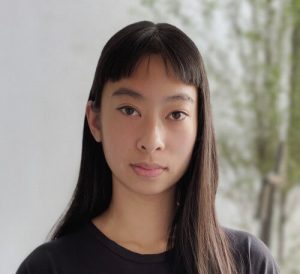
Janice Chang is a Los Angeles born and raised illustrator based in Brooklyn, NY. Much of her work takes on an honest representation of the sometimes humorous and bendy limbs of her characters as a way to engage in conversations around social and interpersonal issues. She works primarily for editorial, commercial, advertising, and motion clients, but also loves to explore painting murals, animation, and making sculptures.
The full #BetterSharing collection is available on TheGreats.co to be enjoyed, used and adapted, and then shared again, by anyone, forever. View the full collection >>
CC Joins Key AI Panel in Brussels
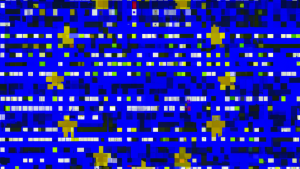
“EU Pixelated” by Creative Commons was cropped from an image generated by the DALL-E 2 AI platform with the text prompt “pixel art of computer code streaming across an EU flag.” CC dedicates any rights it holds to the image to the public domain via CC0.
As a part of CC’s continuing engagement in policy to shape generative artificial intelligence (AI), Brigitte Vézina, our Director of Policy and Open Culture, participated in a June session hosted by the European Internet Forum: Generative AI, Art & copyright: from creative machines to human-powered tools. The panel was held in the framework of EU negotiations on the development of the Artificial Intelligence Act, one of the world’s first regulations dedicated to AI.
The panel was chaired by MEP Dragos Tudorache, Rapporteur on the AI Act, and brought together speakers representing rightholders in the creative industries, an AI developer, and CC as the only representative of civil society present to defend the public interest. The debate touched on several copyright-related issues related to AI training, transparency and safeguards, AI-generated outputs, and more.
In our panel remarks, we emphasized how, for many years, we have been examining the interplay between copyright and AI — exploring ways in which these technologies and practices could help people build on and contribute to the commons, stimulate new creativity, and foster better sharing, i.e. sharing that is inclusive, equitable, reciprocal and sustainable.
Going forward, it is clear that a diverse, global community must be involved in guiding the regulation of generative AI, with expertise spanning the fields of copyright, certainly, but also ethics, privacy and data protection, and fundamental human rights, so that AI’s promises are fulfilled and its perils, averted.
CC will continue our work to represent the public interest in negotiations around AI policy, as well as continue to engage and grow our broad, global community to refine and share understanding of AI’s impact on the commons. Join us at our Global Summit in Mexico City during 3–6 October 2023 where our theme is AI & the Commons.
Wikipedia Moves to CC 4.0 Licenses
We are thrilled to announce that Wikipedia and other Wikimedia projects have now adopted version 4.0 of the Creative Commons BY-SA license! The project first began using version 3.0 of the CC licenses in 2009 following a community process, having previously used the GNU Free Documentation License.
This decision, made as part of a Terms of Use revision that was widely discussed by the Wikimedia community, will enable more compatibility and reuse with CC-licensed resources as well as take advantage of the improvements in the 4.0 licenses.
Wikipedia is run by the nonprofit Wikimedia Foundation, and is one of the most widely-used websites in the world. Its resources are all freely licensed for reuse by the public. This change will now enable Wikipedia to incorporate content from a variety of useful sources that also use CC 4.0 licenses, including publications from the United Nations and many national governments.
This change was made through a revision to the project’s Terms of Use, where all new edits to Wikipedia will be under version 4.0 of the CC BY-SA license. Older edits will remain under BY-SA 3.0, which allows adaptations to be made with 4.0-licensed material. This presents a small amount of complexity for reusers, but over time, as more and more of the project is revised, this will become less of a practical concern.
Version 4.0 of the CC licenses, first published in 2013, introduced several important updates and improvements. Some of the key benefits of this upgrade include greater internationalization, more practical attribution requirements, a grace period for correcting reuse errors, improved clarity and simplicity, and better handling of rights outside copyright, such as database rights. These changes make it an ideal fit for Wikimedia’s mission of simple, globally accessible reuse in a wide variety of contexts.
A big part of CC’s ongoing stewardship of the commons is helping organizations like Wikimedia keep their platforms and communities aligned with current open licensing tools and practices. With Wikipedia, Wiktionary, Wikidata, and all the other Wikimedia projects together being some of the biggest contributors to the open commons, we know how important it is for these essential works made by people from all over the world to be as interoperable as possible with other open content. CC salutes Wikimedia and its community for doing the necessary work to align thinking and technology to make the move to 4.0 a reality!
ccMixter: A Collaborative Music Community
The new ccMixter logo designed by community memberAirtone.
Back in 2004, ccMixter.org was born when Creative Commons and Wired magazine collaborated to support communities engaged in remixing openly-licensed and public domain music. As it has evolved over the years, ccMixter has become an independent project that supports musicians and creators working in remix culture, connecting them with each other and their fans. To reflect ccMixter’s contemporary identity, they have developed a new logo and a new tagline, “collaborative community”, represented by the “cc” in their name and logo.
Starting in 2009, ccMixter’s marks, terms of use, and format were managed by both Creative Commons and ArtisTech Media, an organization that supports global open music communities. Going forward, ccMixter will be operated independently by ArtisTech Media alone, with Creative Commons’ enthusiastic support.
“Today we’re celebrating an exciting new chapter for ccMixter,” said Emily Richards, CEO of ArtisTech Media. “Our history with Creative Commons and its licenses built a solid foundation for our community’s culture of sharing. We’re ready to take our creative collaboration to yet another level.”
Along with their new identity and independence, ccMixter has updated their platform to use the latest CC licenses, version 4.0, which enable shared music to be remixed more flexibly and with greater legal certainty across international jurisdictions.
“We are delighted that ccMixter can now be independently stewarded by the expert hands of Emily and her colleagues at ArtisTech Media,” said Catherine Stihler, CEO of Creative Commons. “Better sharing and the ability for us to work together with like-minded organizations further increases the value of the commons for generations to come. We wish Emily and her colleagues well and know that the commons is stronger for our working together to enable this project to live and grow in their hands.”
CC salutes ccMixter and its collaborative community and the ongoing beat of remix culture!
Stephen Wyber — Open Culture VOICES, Season 2 Episode 20
Did you know that access to cultural heritage is part of the UN Declaration of Human Rights? Stephen discusses this little known article among other important aspects of access, participation, and engagement of cultural heritage and the responsibilities of institutions in this regard. He also explains how Open Culture is a way to establish the social responsibility of institutions to a community and society.
Open Culture VOICES is a series of short videos that highlight the benefits and barriers of open culture as well as inspiration and advice on the subject of opening up cultural heritage. Stephen Wyber is the Director of Policy and Advocacy at IFLA which coordinates meetings and collaborations between GLAM institutions, namely libraries, around the world. He works to co-create meaningful understanding of the needs of libraries and what role libraries play in society and community.
Stephen responds to the following questions:
What are the main benefits of open GLAM?
What are the barriers?
Could you share something someone else told you that opened up your eyes and mind about open GLAM?
Do you have a personal message to those hesitating to open up collections?
Closed captions are available for this video, you can turn them on by clicking the CC icon at the bottom of the video. A red line will appear under the icon when closed captions have been enabled. Closed captions may be affected by Internet connectivity — if you experience a lag, we recommend watching the videos directly on YouTube.
European Parliament Gives Green Light to AI Act, Moving EU Toward Finalizing the World’s Leading Regulation of AI
Today, the European Parliament (EP) adopted its position in plenary on the Artificial Intelligence (AI) Act. This is the culmination of a months-long process whereby thousands of pages of amended text have been pored over by policymakers, civil society and industry alike. The strong, cross-party endorsement (499 votes in favor, 28 against and 93 abstentions) paves the way for tough negotiations with the European Council, which concluded its position at the end of last year. Since then, the bulk of the EP’s political focus has been on so-called “foundation models,” which are trained on vast ranges of data for a wide set of downstream tasks. In particular, they have focused on “generative AI,” with Members of the European Parliament (MEPs) seeking to provide a legal framework for recent innovations such as ChatGPT or Bard.
In a rare move, the EP, European Commission, and European Council agreed to start three-way negotiations — the so-called trilogues — immediately after the vote at 9pm CET today. This need for speed underscores the political imperative of reaching a deal before next year’s EP elections on the high-stakes, hot-button draft AI Act, which is the regulation that will set the rules around AI in the EU space. In fact, the Act is bound to shape how policymakers approach regulating AI in many other jurisdictions and at the international level.
Creative Commons (CC) has actively engaged in the AI Act process (see here and here) and welcomes the EU’s leadership on defining a regulatory framework around this impactful technology. In this blog post, we highlight the issues most likely to impact the topics we focus on: growing the commons and better sharing of knowledge and culture.
Background and key issues for CC
The AI Act process started in 2021 with a proposal by the Commission and has since been debated in Parliament and Council, whose approaches will need to converge in order for an agreement to be reached and the Act adopted.
In its initial conception, the Act focused on regulating certain uses of AI. In particular, it seeks to ban certain uses of AI, such as broad-based real-time biometric identification for law enforcement in public places. It also seeks to ensure that certain precautions are taken before deployment of uses deemed “high-risk,” such as the use of AI for access to education, employment, financial credit, or other essential services.
However, in the last year, the focus expanded. The Council incorporated provisions with respect to “general purpose AI” (GPAI), and the Parliament subsequently created requirements specifically for “foundation models.” Rather than addressing specific high-risk uses, these provisions impact technologies that have a wide range of uses, both potentially beneficial and harmful, and of varying degrees of risk. Moreover, the Parliament added specific requirements for generative AI, including requirements related to transparency of copyright works used to train these models.
At CC, we support the overall aims of the draft legislation, but we want to ensure that these new points of focus are handled in a careful, narrowly-tailored way. Specifically, here is what we will be focusing on as we engage policymakers going forward.
CC comments on specific issues
For many years, CC has focused on the interplay between copyright and AI, because of the way this technology can foster better sharing, helping people build on and contribute to the commons, spurring on new creativity and knowledge sharing. The Act poses several challenges to these aims, and we address them in turn below.
Free and open source software (FOSS)
FOSS provides important benefits, including by improving transparency and auditability of AI systems and by making it easier for a wide variety of players, including nonprofits, start-ups, researchers/academics and SMEs, to innovate, test and compete in the market. As such, CC’s views are that collaborative development of FOSS and merely making FOSS available in public repositories should not subject developers to the AI Act’s requirements.
GPAI, foundation models, and FOSS
We appreciate the concerns policymakers have about how general purpose tools can be used “downstream” by other actors in harmful ways. It is particularly important that downstream users have sufficient information about the underlying model in order to address possible risks.
At the same time, it is important to treat general purpose tools distinctly from tools aimed for a particular, high-risk use. For multi-purpose tools, it can be impractical for developers to implement risk management in ways suited for narrowly defined, “high risk” AI uses. In turn, imposing the same rules on GPAI creators may create significant barriers to innovation and drive market concentration, leading the development of AI to only occur within a small number of large, well-resourced commercial operators. With that in mind, we also want to ensure there are proportional requirements for FOSS “foundation models” that are “put on the market” or “put into service,” tailored to different services and providers.
In particular, we have concerns when it comes to FOSS developers. As above, merely developing and making available in a repository a FOSS “foundation model” or other general purpose tool should not subject developers to the Act’s requirements.
Transparency of training data and copyright
At CC, we are convinced that greater openness and transparency in the development of AI models can serve the public interest and facilitate better sharing by building trust among creators and users. As such, we generally support more transparency around the training data for regulated AI systems.
The Parliament version of the text includes specific provisions with respect to generative AI models, requiring providers to “document and make publicly available a sufficiently detailed summary of the use of training data protected under copyright law.” On the one hand, this can be a sensible way to ensure transparency, particularly for rightsholders who wish to exercise their right to “opt-out” of exceptions to copyright pertaining to AI training pursuant to Article 4 of the EU Copyright Directive in the Digital Single Market. On the other hand, it is important that this requirement is applied proportionately; developers should not be expected to literally list out every item in the training data, but rather provide useful summaries, such as use of a particular dataset like Common Crawl or LAOIN-5B, which rightsholders can then use to determine whether their works were used or not.
Generative AI and copyright generally
The Parliament’s text also requires that generative AI model providers take “adequate safeguards against the generation of content in breach of Union law, in line with the generally acknowledged state of the art, and without prejudice to fundamental rights, including the freedom of expression.” While perhaps to reaffirm that developers should comply with copyright law, this is likely to create much more uncertainty; at worst, it could be read to suggest a more sweeping requirement for developers to implement copyright filtering tools that could address perfectly lawful uses. We encourage policymakers to take steps to ensure this does not become a backdoor expansion of copyright law; to the extent policymakers want to consider this broader topic, they should do it separately, rather than tacked on to the AI Act at the eleventh hour.
Looking ahead
Regarding the start of the trilogues, Creative Commons CEO Catherine Stihler said: “Creative Commons remains committed to finding fair and lasting solutions to ensure AI can support creators and grow the commons, in line with our strategy of better sharing and our values of openness, transparency, fairness, and creativity. At CC, we will continue to proactively engage with EU institutions as the trilogues commence, in order to achieve our mission to empower individuals and communities around the world by equipping them with technical, legal and policy solutions to enable sharing of knowledge and culture in the public interest.”


 We are thrilled to announce that Wikipedia and other Wikimedia projects have now adopted version 4.0 of the Creative Commons BY-SA license! The project first began using