Help us protect the commons. Make a tax deductible gift to fund our work. Donate today!
Welcoming Angela Oduor Lungati as CC Board Chair
Effective October 30, 2024, Angela Oduor Lungati has been voted by the CC board of directors as CC board chair for a term of 2 years. Delia Browne, who has been the CC board chair since late 2022, and a board member since 2018, has completed her term on the CC board of directors.
Creative Commons (CC) has—and continues to be—fortunate to have an expert and passionate board of directors, many of whom have been instrumental to the success of CC at both the organizational level, as well as nationally and regionally. A healthy board of directors regularly welcomes new members following its bylaws, which means that we must also say goodbye to board members who have completed their term of service on our volunteer board.
Effective October 30, 2024, Angela Oduor Lungati has been voted by the CC board of directors as CC board chair for a term of two years, replacing Delia Browne who served as chair of the board from late 2022. Glenn O. Brown will continue his service as vice chair of the board. “It has been a tremendous pleasure and privilege to work with Delia and Angela. Their expertise, integrity, global perspectives, and down-to-earth demeanors make them ideal teammates and leaders for the org. I am thrilled to continue to work with Angela in her tenure as chair, with Anna as CEO, and with the great teams they lead,” says Glenn.
Meet Angela Oduor Lungati, CC’s New Board Chair
Angela is a technologist, community builder, and open source software advocate passionate about building and using appropriate technology tools to impact the lives of marginalized groups. She has over ten years of experience in software development, global community engagement, and non-profit organizational management.
Angela is the Executive Director at Ushahidi, a global non-profit technology company that helps communities quickly collect and share information that enables them to raise voices, inform decisions, and influence change. In addition to her service on the CC board of directors, Angela is a member of the Humanitarian OpenStreetMap team board of directors. She is also a member of the World Economic Forum’s Global Futures Council on Data Equity, and was recently named a World Economic Forum Young Global Leader in 2024 and a Mozilla 2024 Rise25 Honoree.
Angela joined the Creative Commons board in 2021. Her tenure as board chair begins at the same time as CC launches its refreshed strategic plan, which charts the path for sustaining and advancing CC’s open infrastructure of sharing, and advocating for and defending a thriving creative commons. As the first CC board chair from Kenya, Angela’s commitment to centering the global community at a time of immense change and innovation will steer CC into a future of sharing in the age of generative AI.
“I’m thrilled to be appointed the chair of the CC board of directors by my fellow board colleagues. I look forward to collaborating with the CC team and, of course, open advocates and all those who contribute to a thriving commons globally. In particular, I’m keen to support CC as it shifts towards a model of movement building alongside a global community as we accomplish more together than we can apart,” says Angela.
Celebrating and Giving Gratitude to Delia Browne
This is also a bittersweet moment for CC as we celebrate the accomplishments of Delia Browne, who has been the CC board chair since 2022, and a board member since 2018, as she steps down from the board following the end of her term. Delia’s energy, directness, and unwavering commitment to CC will be sorely missed and we are so thankful for her many contributions over the years. For those of you who haven’t had the chance to meet her, Delia is a copyright lawyer and policy advocate who leads the National Copyright Unit (NCU) in Australia, providing specialist copyright advice to Australian Schools and Technical and Further Education (TAFE) institutes with a focus on the rapidly changing digital teaching environment. Delia is a co-founder of Peer 2 Peer University (P2PU) and a board director of the Australian Digital Alliance. She is also a member of the editorial board of Media and Arts Law Review and has taught Intellectual Property at the University of New Wales, Griffith University, and the University of Auckland (her alma mater). Delia has also represented Creative Commons at the World Intellectual Property Organization (WIPO) at the Standing Committee on Copyright and Related Rights. Perhaps most significantly for us, though, Delia is a long time member of the CC Global Network.
Delia’s contributions to CC are far too many to list, but we’d like to highlight a few in an effort to capture the powerhouse that is Delia Browne:
Delia has attended every CC Global Summit since 2007.
Delia represented CC at the WIPO Standing Committee on Copyright and Related Rights and is dedicated to furthering the WIPO Limitations and Exception agenda, particularly with regard to education.
Delia was a key member of the community team that authored CC’s Global Network Strategy in 2017.
Delia oversaw and supported a CEO transition in early 2024.
Delia was CC’s first chair appointed from outside the United States, providing a global lens to CC’s strategy and priorities at the board level.
“Throughout my time on the CC board of directors, we’ve navigated immense change and capitalized on opportunities that drive us towards CC vision. It has been an honor to work with my fellow board colleagues and collaborators over the last seven years and I’m so pleased to hand the baton to Angie who will continue to guide the organization into the future,” says Delia.
Thankfully, Delia won’t be going too far as she will now join the CC Advisory Council and will be actively involved in supporting CC’s strategic efforts with regards to sharing in an age of generative AI. On behalf of the CC global community, board of directors, and team, we wish to thank Delia for her unwavering support, and we look forward to working with you in this new capacity.
Other CC Board Updates
The CC Board’s Governance & Nominations committee is currently wrapping up new board member recruitment and anticipates that we will welcome several new board members in the coming months.
Open Movement’s Common(s) Causes
This report maps current threats and opportunities facing the open movement, based on the ongoing work of the organizations behind the Common(s) Cause event, which took place in Katowice, Poland, as a pre-conference event for Wikimania 2024 on August 6, 2024.
The meeting was organized by Creative Commons, Open Knowledge Foundation, Open Future, and Wikimedia Europe in collaboration with the Wikimedia Foundation. The goal of the meeting was to create links between different advocacy efforts so that a shared advocacy strategy for the Knowledge Commons can be created.
One of the calls that jumped out for us was a call for defining new open principles – principles that could clarify what openness means in the context of today’s digital space and ensure its pro-public, democratic potential. Formulating such principles could help against several challenges, e.g. open washing.
Another clear call is the one confirming the assumptions behind the Common(s) Cause project: it is the call for a shared advocacy agenda, which could help ensure that Knowledge Commons are treated and sustained as critical digital infrastructures.
The event welcomed over 55 participants from 20 countries, most of whom traveled to Katowice to attend the Wikimania conference. The majority of attendees were from open advocacy communities. The event not only enabled the organizers to build stronger working ties with one another, but with the many other organizations who were represented at the event.
The participants acknowledged that the power of the open movement is only as strong as the bonds of the people working to advance an open, equitable agenda, and collective impact can only be achieved through individuals from different organizations working closely together.
The report identifies a few common causes that can be found at the intersection of open movement organizations’ strategies, the socio-technological zeitgeist, and current policy opportunities, such as:
(Re)defining openness in a new technological era.
Creation of a shared advocacy strategy and enhanced regional and thematic cooperation across the organizations.
Developing and testing governance approaches for our digital commons.
Advancing openness and sustainability for the technology, data, content, and governance of Digital Public Infrastructure.
This report is a starting point and serves as an invitation to the wider open community to join these causes as well as to formulate their own, which could then be backed by other organizations. The next step in this process will be disseminating its findings, hopefully resulting in further backing and refinement of the causes and additional feedback from the wider community, which this small convening could not fully represent.
We are excited to share a new video series titled Open Culture Capsules. In this multi-series video collection, we address some of the most frequently asked questions about our work in Creative Commons’ (CC) Open Culture Program. You can preview the series below and find each episode in full on the the CC YouTube channel.
The series features insights from CC staff and facilitators from the CC Certificate Course on Open Culture. Thank you for your participation in making this series a success!
Keep reading to find previews and overview of all five episodes:
Episode 1 (parts 1 and 2) — What does Creative Commons do for Open Culture? Brigitte Vézina, CC’s Director of Policy and Open Culture, talks about how the Open Culture Program is driving policy change for fair and equitable open access to cultural heritage. In this episode, Brigitte shares how capacity building and the Open Culture Platform are empowering a global network of people passionate about open culture.
Episode 2 (parts 1 and 2) — What is open culture? Shanna Hollich, CC’s Learning and Training Manager, explains that Open Culture at CCencompasses open access to both contemporary creativity and cultural heritage, promoting sharing under permissive terms with CC licenses and tools as well as other labels and statements.
Episode 3 (parts 1 and 2) — What are the main benefits of open culture? Revekka Kefalea, CC Certificate facilitator, shows how, by embracing open access, cultural heritage institutions (like museums, libraries and archives) can boost their digital relevance, how researchers and educators can gain new opportunities for collaboration, and how creators have increased access to resources that drive creativity.
Episode 4 (parts 1 and 2) — How do you open up a collection? Sionan Guenther, CC Certificate facilitator, walks through the first steps of opening up cultural heritage and highlights what is important to consider from the get-go.
Episode 5 (parts 1, 2 and 3) — How to mark open heritage? Evelin (scann) Heidel, CC Certificate facilitator, explains the basics of marking heritage materials with CC licenses and public domain tools, where to place the license or tool, and how these help ensure cultural heritage is accessible, with clear conditions for use, allowing everyone to freely engage, remix, and keep cultural heritage alive.
If you would like to watch more video content from CC’s Open Culture Program, check out Open Culture Voices and the Open Culture Live webinar series.
Meet the Recipients of the Fall 2024 CC Certificate Scholarship
We are pleased to announce our scholarship recipients for our Fall 2024 Creative Commons Certificate courses.
The Creative Commons (CC) Certificate courses are widely considered an essential resource for open access education and for increasing capacity for individuals and institutions using the CC licenses to increase open access.
The CC Certificate program offers in-depth courses about CC licenses, open practices, and the ethos of the Commons. Courses are composed of various readings, quizzes, discussions, and practical exercises to develop learners’ open skills. Currently we offer a CC Certificate for Open Culture, a CC Certificate for Academic Librarians, and a CC Certificate for Educators. Courses are open to everyone, from university students and entry-level professionals to experts in the fields of library science, education, and cultural heritage.
With the goal of reducing the barrier of participating in one of these essential trainings, CC is proud to have recently awarded eight scholarships. These scholarships would not be possible without your donations. We invite you to donate today so that we can continue offering these scholarships. You may also want to consider joining our Open Infrastructure Circle so that we can increase participation in these trainings globally.
Join us in congratulating the following scholarship recipients and keep reading to learn more about their journey in the open community:
ABIR Mohammed Galib Hasan, Bangladesh
Galib is a PhD Researcher in Hokkaido University, Japan. His primary research areas are: Educational Technology, Open Education and Generative AI. He was a founding member of the CC Bangladesh Chapter, serving as the Education Lead since 2018. Galib also served on the program committee of CC Global Summit in 2019 and 2020.
Bukola James, Nigeria
Bukola James is a certified librarian, Wikimedian, and community coordinator for the African Wikipedian Alliance. She also serves as the co-lead for the Open Culture Platform’s Outreach Working Group and as a Sub-Saharan Liaison Officer for the Wikimedia Foundation Peer Learning Program. Additionally, Bukola is a communications expert for the EduWiki Newsletter and a special adviser for the EduWiki User Group. She holds the position of co-team and project lead within African Wiki Women and other impactful initiatives.
Chaidir Amir, Indonesia
Chaidir is a professional librarian who has been working in libraries since 2023. He has certifications and competence in library management based on information and communication technology. He is an active member of multiple library forums and associations. Chaidir also serves as an accreditation assessor and library training facilitator.
Jes Graham, South Africa
Jes is a 28-year-old, disabled, non-binary South African who works at the University of Cape Town in open education, specifically in the development and production of open textbooks. Their driving motto for their work is to “be conscientiously creative in the pursuit of developing and sharing accessible knowledge through design.” To this end, Jes combines their skills in graphic design, Disability Studies, and editorial work and publishing to develop open educational resources (with a strong focus on multiple forms of accessibility) from a South African perspective. In their current work at the University of Cape Town, Jes has developed foundational skills in CC licensing, but aims to advance this knowledge to more deeply integrate CC licensing in their own work and support others in the local design and academic community.
John Okewole, Nigeria
John is an open education advocate working locally by encouraging colleagues to engage openness as a culture and attitude, and globally as a CC Global Network member and member of CC’s Open Education Platform). Some of his recent contributions include acting as a member of the Working Group 4 — Beyond Copyright: the Ethics of Open Sharing and serving as a co-lead of the CC Open Education Platform’s working group on the UNESCO Recommendation on OER. John is a Commonwealth Scholar who has completed an MA in Online and Distance Education at the Open University, UK and he also has a certificate in Designing and Facilitating E-Learning (Level 5) at the Open Polytechnic of New Zealand.
Jonas Bäckelin, Sweden
Jonas is currently the Content Manager on the Creative Commons Sverige team and the Sweden Chapter Lead. Outside of his CC work, Jonas is the solution manager and learning designer at Adda Kompetens, a part of the Swedish Association of Local Authorities and Regions (SALAR). He also serves as the moderator of the Upskilling och Reskilling committee at Swedish JobTech.
Tina Kalan, Slovenija
After working in the public school system and the national library, Tina has found her place in the academic library world. Her work is very dynamic, including everything from cataloging to information literacy courses. An important part of her workload is bibliographies, and her goal is to provide support to patrons, from students to researchers, in questions related to open access, open science and research assessments.
Tri Astari, Indonesia
Tri Astari is a lecturer who creates educational content under CC licenses, driven by a strong desire to make knowledge easily accessible. In addition, she is a member of Wikimedia Indonesia.
Congratulations again to the recipients. If you are interested in the CC Certificate courses, we invite you to register for 2025
Creative Commons Launches TAROCH Coalition for Open Access to Cultural Heritage
Creative Commons (CC) is proud to launch the TAROCH Coalition (Towards a Recommendation on Open Cultural Heritage), a collaborative effort to achieve the adoption of a UNESCO standard-setting instrument to improve open access to cultural heritage. We are grateful to the Arcadia Fund for supporting this initiative. Below we share an overview of TAROCH and invite mission-aligned organizations and institutions to apply to join.
TAROCH stands for Towards a Recommendation on Open Cultural Heritage.
TAROCH is a community initiative led by Creative Commons.
The mission is to encourage UNESCO Member States to draft and adopt a Recommendation (or other standard-setting instrument) promoting open solutions to enhance access to cultural heritage in the public domain.
The ultimate goal of the TAROCH Coalition is that cultural heritage is equitably accessible to all, in line with UNESCO’s broader mission and cultural and information policy, in particular intercultural dialog and cultural exchanges, thereby contributing to building more connected, resilient, and sustainable societies.
Who Drives TAROCH?
CC is the organization steering and funding TAROCH. The Coalition is led by representatives of a global, diverse community of organizations and institutions involved in cultural heritage and with an interest in open cultural heritage. While our individual missions differ, we all believe in the transformative power of open solutions and share a vision of fair and equitable access to cultural heritage. Meet the initial members of the TAROCH Coalition!
For a complete and up-to-date list of coalition members, please refer to the Statement of Commitment.
Why Is Promoting Open Access to Cultural Heritage Important?
We believe that culture, including cultural heritage, is the foundation of humanity and that open access can contribute to helping people around the world to:
Activate the 2022 Mondiacult Declaration and enjoy culture, including cultural heritage, as well as the digital commons (in keeping with the Global Digital Compact) as global public goods.
What are TAROCH’s Key Deliverables?
We aim to achieve the following by May 2026:
Develop and adopt a Statement on Open Access to Cultural Heritage for signature by civil society organizations and institutions.
Widely implement an advocacy strategy and disseminate advocacy tools and materials to promote the wider recognition of open access to cultural heritage.
The delivery of these two milestones will set the stage for on-the-ground advocacy efforts by a network of local ambassadors encouraging UNESCO member states to develop and adopt a UNESCO standard-setting instrument by 2029.
For More Information about TAROCH and to Read About Our Work To Date:
We’re proud to announce Creative Commons’ Legal Tools have been reviewed and accepted into the Digital Public Goods Alliance (DPGA) DPG Registry. The DPGA is a multi-stakeholder initiative, endorsed by the United Nations Secretary-General, that is working to accelerate the attainment of the UN Sustainable Development Goals in low- and middle-income countries. DPGA does this by facilitating the discovery, development, use of, and investment in digital public goods (DPGs) in order to create a more equitable world.
Being recognized as a DPG increases the visibility, support for, and prominence of open projects that have the potential to tackle global challenges. To become a digital public good, all projects are required to meet the DPG Standard to ensure that projects truly encapsulate open source principles.
Creative Commons provides and stewards the CC licenses and public domain tools that give every person and organization in the world a free, simple, and standardized way to grant copyright permissions for creative and academic works. In addition, the licenses support proper attribution and enable others to copy, distribute, and make use of those works. CC legal tools are digital public infrastructure that make the legal sharing of DPGs possible.
At Creative Commons, we are thrilled to have our Legal Tools recognised as DPGs as they can empower people to dramatically improve access to open content. By advocating for the use and implementation of DPGs, global communities can work together in prioritizing and mobilizing resources to help solve global challenges. CC’s legal tools and our programs play a critical role in helping to advance the DPG ecosystem.
For any inquiries about CC’s involvement in the Digital Public Goods Alliance, please reach out to Cable Green. For more information on the Digital Public Goods Alliance please reach out to hello@digitalpublicgoods.net.
Join us by supporting this ongoing work. You have the power to make a difference in a way that suits you best. By donating to CC, you are not only helping us continue our vital work, but you also benefit from tax-deductible contributions. Making your gift is simple – just click here. Thank you for your support.
CC Welcomes Sarah Pearson Back as General Counsel
As part of CC’s renewed commitment to investing in the core open infrastructure it stewards, we are excited to announce several updates to our legal team.
Sarah Hinchliff Pearson is returning to Creative Commons as General Counsel. She will manage in-house legal work and play a leading role in shaping CC’s stewardship program and its work in emerging technologies. Sarah spent the last couple of years at DuckDuckGo, where she spearheaded legal risk management for the launch of the company’s first paid service. She brings a fresh perspective on distributed leadership and working in the open after her experience with DuckDuckGo’s unique company culture. CC has missed Sarah, and we are pleased she is back to once again serve as the organization’s General Counsel.
Kat Walsh will be transitioning from General Counsel to Copyright and Licensing Counsel, where she will focus squarely on stewardship of the CC licenses and public domain tools. We are delighted that Kat can bring her full expertise to matters of copyright and licensing, especially as questions arise daily about how the licenses interact with emerging technologies like artificial intelligence. We are grateful to Kat for all of her work while serving as General Counsel these past couple of years. She is a mainstay in the open community, and on our team.
All of us are excited to be working together again. Kat and Sarah first worked closely together in the 4.0 licensing version process more than a decade ago! We could not be happier that we’ve been able to bring these two long-time experts of open licensing back together as CC faces hard questions around artificial intelligence. Between the legal experts on our team, our board, and in our global community, we are ready to move the dialogue forward.
If you are trying to reach the legal team and do not know where to direct your message, use the legal@creativecommons.org email address.
Six Insights on Preference Signals for AI Training
In these uncertain times, one thing is clear: there is an urgent need to develop new, nuanced approaches to digital sharing. This is Creative Commons’ speciality and we’re ready to take on this challenge by exploring a possible intervention in the AI space: preference signals.
At the intersection of rapid advancements in generative AI and our ongoing strategy refresh, we’ve been deeply engaged in researching, analyzing, and fostering conversations about AI and value alignment. Our goal is to ensure that our legal and technical infrastructure remains robust and suitable in this rapidly evolving landscape.
In these uncertain times, one thing is clear: there is an urgent need to develop new, nuanced approaches to digital sharing. This is Creative Commons’ speciality and we’re ready to take on this challenge by exploring a possible intervention in the AI space: preference signals.
Understanding Preference Signals
We’ve previously discussed preference signals, but let’s revisit this concept. Preference signals would empower creators to indicate the terms by which their work can or cannot be used for AI training. Preference signals would represent a range of creator preferences, all rooted in the shared values that inspired the Creative Commons (CC) licenses. At the moment, preference signals are not meant to be legally enforceable. Instead, they aim to define a new vocabulary and establish new norms for sharing and reuse in the world of generative AI.
For instance, a preference signal might be “Don’t train,” “Train, but disclose that you trained on my content,” or even “Train, only if using renewable energy sources.”
Why Do We Need New Tools for Expressing Creator Preferences?
Empowering creators to be able to signal how they wish their content to be used to train generative AI models is crucial for several reasons:
The use of openly available content within generative AI models may not necessarily be consistent with creators’ intention in openly sharing, especially when that sharing took place before the public launch and proliferation of generative AI.
With generative AI, unanticipated uses of creator content are happening at scale, by a handful of powerful commercial players concentrated in a very small part of the world.
Copyright is likely not the right framework for defining the rules of this newly formed ecosystem. As the CC licenses exist within the framework of copyright, they are also not the correct tools to prevent or limit uses of content to train generative AI. We also believe that a binary opt-in or opt-out system of contributing content to AI models is not nuanced enough to represent the spectrum of choice a creator may wish to exercise.
We’re in the research phase of exploring what a system of preference signals could look like and over the next several months, we’ll be hosting more roundtables and workshops to discuss and get feedback from a range of stakeholders. In June, we took a big step forward by organizing our most focused and dedicated conversation about preference signals in New York City, hosted by the Engelberg Center at NYU.
Six Highlights from Our NYC Workshop on Preference Signals
Creative Commons as a Movement
Creative Commons is a global movement, making us uniquely positioned to tackle what sharing means in the context of generative AI. We understand the importance of stewarding the commons and the balance between human creation and public sharing.
Defining a New Social Contract
Designing tools for sharing in an AI-driven era involves collectively defining a new social contract for the digital commons. This process is essential for maintaining a healthy and collaborative community. Just as the CC licenses gave options for creators beyond no rights reserved and all rights reserved, preference signals have the potential to define a spectrum of sharing preferences in the context of AI that goes beyond the binary options of opt-in or opt-out.
Communicating Values and Consent
Should preference signals communicate individual values and principles such as equity and fairness? Adding content to the commons with a CC license is an act of communicating values; should preference signals do the same? Workshop participants emphasized the need for mechanisms that support informed consent by both the creator and user.
Supporting Creators and Strengthening the Commons
The most obvious and prevalent use case for preference signals is to limit use of content within generative AI models to protect artists and creators. There is also the paradox that users may want to benefit from more relaxed creator preferences than they are willing to grant to other users when it comes to their content. We believe that preference signals that meet the sector-specific needs of creators and users, as well as social and community-driven norms that continue to strengthen the commons, are not mutually exclusive.
Tagging AI-Generated vs. Human-Created Content
While tags for AI-generated content are becoming common, what about tags for human-created content? The general goal of preference signals should be to foster the commons and encourage more human creativity and sharing. For many, discussions about AI are inherently discussions about labor issues and a risk of exploitation. At this time, the law has no concept of “lovingly human”, since humanness has been taken for granted until now. Is “lovingly human” the new “non-commercial”? Generative AI models also force us to consider what it means to be a creator, especially as most digital creative tools will soon be driven by AI. Is there a specific set of activities that need to be protected in the process of creating and sharing? How do we address human and generative AI collaboration inputs and outputs?
Prioritizing AI for the Public Good
We must ensure that AI benefits everyone. Increased public investment and participatory governance of AI are vital. Large commercial entities should provide a public benefit in exchange for using creator content for training purposes. We cannot rely on commercial players to set forth industry norms that influence the future of the open commons.
Next Steps
Moving forward, our success will depend on expanded and representative community consultations. Over the coming months, we will:
Continue to convene our community members globally to gather input in this rapidly developing area;
Continue to consult with legal and technical experts to consider feasible approaches;
Actively engage with the interconnected initiatives of other civil society organizations whose priorities are aligned with ours;
Define the use cases for which a preference signals framework would be most effective;
Prototype openly and transparently, seeking feedback and input along the way to shape what the framework could look like;
Build and strengthen the partnerships best suited to help us carry this work forward.
These high-level steps are just the beginning. Our hope is to be piloting a framework within the next year. Watch this space as we explore and share more details and plans. We’re grateful to Morrison Foerster for providing support for the workshop in New York.
Join us by supporting this ongoing work
You have the power to make a difference in a way that suits you best. By donating to CC, you are not only helping us continue our vital work, but you also benefit from tax-deductible contributions. Making your gift is simple – just click here. Thank you for your support.
CC strategic workshop reveals big opportunities for open access to cultural heritage
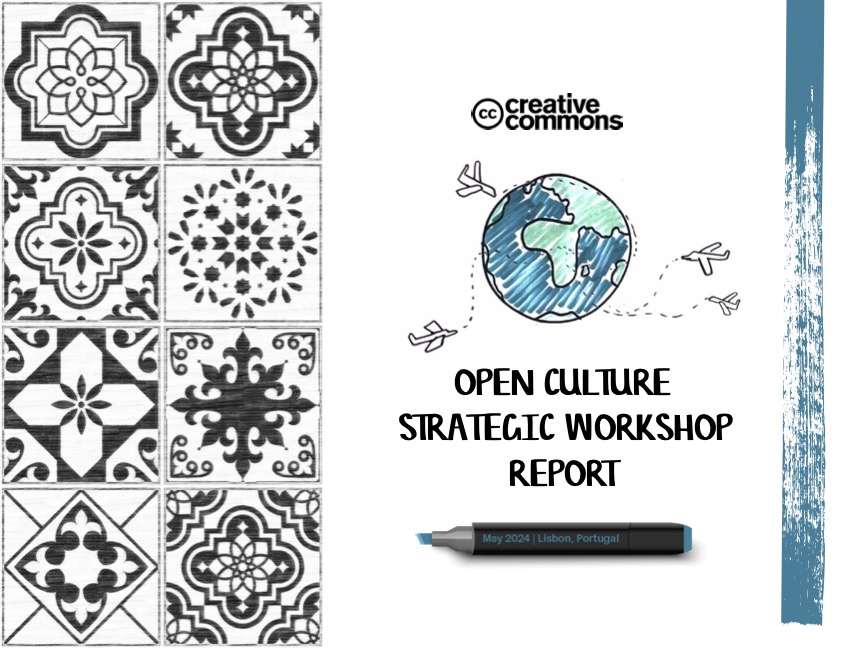
Open Culture Strategic Workshop Report Cover, by Dee Harris, CC BY 4.0
Last May, a diverse group of nearly 50 experts from every continent took part in Creative Commons’ Open Culture Strategic Workshop in Lisbon, Portugal, to advance our TAROCH initiative — Towards a Recommendation on Open Cultural Heritage. Over the course of two days, participants collaborated to co-create a strategic roadmap for future action, charting a course towards the elaboration by UNESCO Member States of an international legal instrument that would promote open solutions to enable equitable access to cultural heritage worldwide, in line with UNESCO’s broader mission on openness and heritage-related policy goals.
Today, we’re excited to share the workshop’s report, capturing the event’s highlights. Here are two of the main outcomes:
A narrower focus from “open culture” to “open cultural heritage in the public domain” — moving from TAROC to TAROCH.
Flexibility regarding the nature of the legal instrument: recommendation, declaration, or other type of UNESCO instrument.
The report also outlines anticipated developments, highlighting key milestones on the horizon. It concludes with a set of recommended actions to build on the momentum gained in Lisbon.
We are now in the process of building an architecture to organize future work and establish ladders of engagement. Watch this space!
In this interview, we were delighted to speak with Hanae Lrhoul, a graduate of the CC Certificate for Educators.
Launched in 2018, the Creative Commons Certificate program has trained and graduated nearly 1800 people from 66 countries. The Certificate program offers in-depth courses about CC licenses, open practices, and the ethos of the Commons. Our staff is constantly inspired by our community of Certificate alumni, accomplishing incredible things.
In this interview, we were delighted to speak with Hanae Lrhoul, a graduate of the CC Certificate for Educators.
Q: What inspired you to take the CC Certificate for Educators?
Q: You’re a professor in the school of information science. How has what you learned in the CC Certificate course informed your work?
Q: I understand that you’re an integral part of the CC Morocco team and helped establish that chapter back in 2020/2021. Can you tell us more about the state of open access and CC licenses in Morocco?
Q: I also know you’ve done some interesting work with the government – for example, you recently told me that the Ministry of Higher Education launched the first open science project as part of the Minister’s ESRI pact.
Q: What advice do you have for folks who are new to open science or open education initiatives and are looking to get more involved?
Q: Final words?
CC Certificate Alumni Interview with Hanae Lrhoul by Shanna Hollich is licensed via CC BY 4.0.
If you are a CC Certificate alum and would like to share your amazing work with our CC community, please reach out to us at certificates AT creativecommons DOT org.