Recommended Best Practices for Better Sharing of Climate Data
Creative Commons is happy to share our “Recommendations for Better Sharing of Climate Data,” informed by major government and intergovernmental climate agencies including ECMWF, NASA, NOAA, and the World Resources Institute. These recommendations help public climate data-producing institutions to choose the most suitable legal terms and licenses, and use metadata that center the user experience around attribution, licensing, and provenance.
At Creative Commons, we believe that addressing global challenges like the climate crisis requires opening the knowledge about those challenges. We are thrilled to announce the release of our “Recommendations for Better Sharing of Climate Data”— the culmination of a nine-month research initiative from our Open Climate Data project. These guidelines are a result of collaboration between Creative Commons, government agencies and intergovernmental organizations. They mark a significant milestone in our ongoing effort to enhance the accessibility, sharing, and reuse of open climate data to address the climate crisis. Our goal is to share strategies that align with existing data sharing principles and pave the way for a more interconnected and accessible future for climate data.
Our recommendations offer practical steps and best practices, crafted in collaboration with key stakeholders and organizations dedicated to advancing open practices in climate data. We provide recommendations for 1) legal and licensing terms, 2) using metadata values for attribution and provenance, and 3) management and governance for better sharing.
Opening climate data requires an examination of the public’s legal rights to access and use the climate data, often dictated by copyright and licensing. This legal detail is sometimes missing from climate data sharing and legal interoperability conversations. Our recommendations suggest two options: Option A: CC0 + Attribution Request, in order to maximize reuse by dedicating climate data to the public domain, plus a request for attribution; and Option B: CC BY 4.0, for retaining data ownership and legal enforcement of attribution. We address how to navigate license stacking and attribution stacking for climate data hosts and for users working with multiple climate data sources.
We also propose standardized human- and machine-readable metadata values that enhance transparency, reduce guesswork, and ensure broader accessibility to climate data. We built upon existing model metadata schemas and standards, including those that address license and attribution information. These recommendations address a gap and provide metadata schema that standardize the inclusion of upfront, clear values related to attribution, licensing and provenance.
Lastly, we highlight four key aspects of effective climate data management: designating a dedicated technical managing steward, designating a legal and/or policy steward, encouraging collaborative data sharing, and regularly revisiting and updating data sharing policies in accordance with parallel open data policies and standards.
As we release these recommendations, we extend an invitation to join us in an ongoing journey of collaboration. Together, we can continue to develop policies and practices that open up data, fostering advancements in climate research and innovation. Send us your comments at openclimatedata@creativecommons.org.
What did Creative Commons do for Open Culture in 2023?
2023 was quite a year for the Creative Commons (CC) Open Culture Program, thanks to generous funding from Arcadia, a charitable fund of Lisbet Rausing & Peter Baldwin. As the team grew from one full time employee to a team of three, we have had increased capacity to carry out our programmatic work. At the same time, pandemic-related travel restrictions eased, allowing the Open Culture Team to lead and participate in events and convenings in diverse locations, including Morocco, Uruguay, USA, Switzerland, UK, Mexico, and Portugal, to name a few. This allowed us to connect with community members in person, further cementing pre-existing strategic partnerships and engaging with new audiences. In this blog post we look back on some of the year’s key achievements.
Here are the top 5 things we are particularly proud of (in no particular order):
We completed Open Culture Voices — a series of insightful video interviews with open culture experts from around the world. It came to a close in November, gathering ca. 70K views across all platforms.
In November 2023, the Court of Appeal in THJ v Sheridan¹ offered an important clarification of the originality requirement under UK copyright law, which clears a path for open culture to flourish in the UK.
A game-changing ruling
In setting the copyright originality threshold, the court stated: “What is required is that the author was able to express their creative abilities in the production of the work by making free and creative choices so as to stamp the work created with their personal touch.” Crucially, the court affirmed that “this criterion is not satisfied where the content of the work is dictated by technical considerations, rules or other constraints which leave no room for creative freedom.” For a thorough analysis of the case, see Professor Eleonora Rosatti’s take for the IPKat.
The case is potentially a game-changer in the UK open culture landscape, as noted by open culture advocates Bendor Grosvenor (paywall) and Douglas McCarthy. How so? Because by setting the standard for copyright to arise based on “free and creative choices” it effectively bars copyright claims from being made over faithful reproductions of public domain materials (i.e., materials that are no longer or never were protected by copyright).
No copyright for faithful reproductions of public domain materials
This is a position that Creative Commons (CC) has been championing for years as part of our Open Culture Program: digital reproductions of public domain material must remain in the public domain. In other words, no new copyright (or related right) should arise over the creation of a digitized “twin.” Europeana and the Communia Association, among many other open culture organizations, share this position. It is also aligns with Article 14 of the 2019 EU Directive on Copyright in the Digital Single Market, which states that: “when the term of protection of a work of visual art has expired, any material resulting from an act of reproduction of that work is not subject to copyright […]”.
In practice, this means that CC licenses should not be used by cultural heritage institutions (museums, libraries, archives, etc.) to release digital reproductions of public domain works, since licenses can only be used in connection with in-copyright content. To share digital twins of public domain content, we recommend the public domain dedication tool (CC0) or the public domain mark (PDM).
A widespread but problematic practice
Alas, a great many institutions still claim full copyright or use CC licenses to share faithful reproductions of public domain material, often against payment of a (steep) fee — this is particularly prevalent in the UK, as reported by Dr. Andrea Wallace in her study for the Towards a National Collection program.
In an effort to curb this undesirable practice, in 2022, a CC Open Culture Platform working group led by Deborah De Angelis (CC Italy) and Tomoaki Watanabe (CC Japan) investigated this issue and developed proposals for technical, legal, and social interventions to address the problem of “PD BY” (i.e. the use of CC BY licenses to share reproductions of public domain works). On that basis, we are currently developing a set of guidelines to provide alternative design ideas and platform examples to cultural heritage institutions that wish to better share the digitized public domain cultural heritage material in their collections. Stay tuned for their release soon!
A new dawn for open culture in the UK and around the world?
This court case unlocks vast untapped potential for open culture to blossom in the UK cultural heritage sector. We are heartened that by offering enhanced legal certainty, this decision will give a boost to cultural heritage institutions to engage more deeply in the open culture movement and make these vast collections openly accessible to everyone.
Get Involved
For additional guidance and tailored support in developing or implementing open access policies or to get involved in promoting open culture around the world:
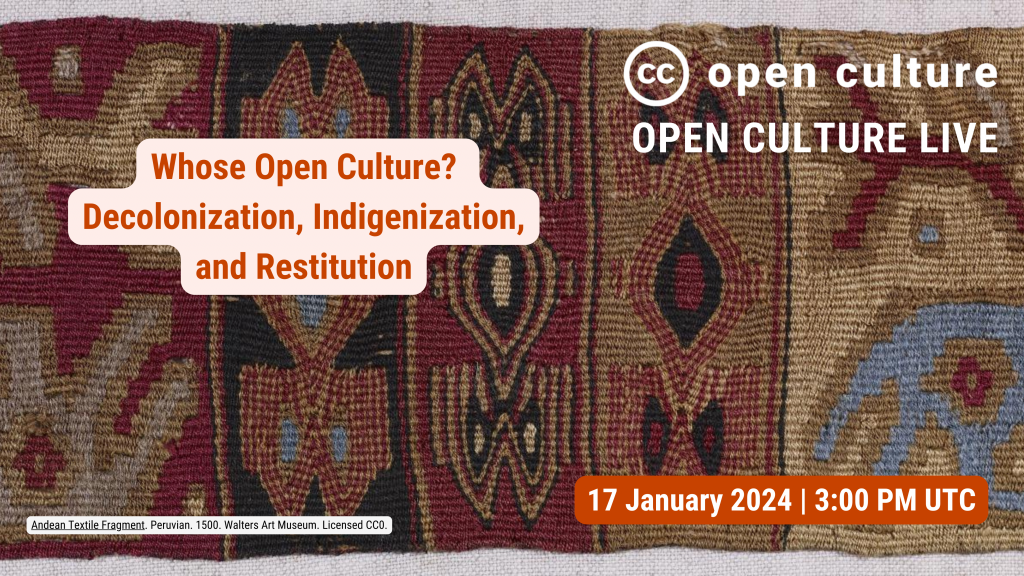
Upcoming Open Culture Live Webinar: “Whose Open Culture? Decolonization, Indigenization, and Restitution”
On Wednesday, 17 January, 2024, at 3:00 pm UTC, CC’s Open Culture Program will be hosting a new webinar in our Open Culture Live series titled “Whose Open Culture? Decolonization, Indigenization, and Restitution.” As we observed a few years ago, there is growing awareness in the open culture movement about issues related to the acquisition, preservation, access, sharing, and reuse of cultural heritage of Indigenous peoples and local communities (including traditional knowledge and traditional cultural expressions), heritage in the context of colonization, and culturally-sensitive heritage.
“Andean Textile Fragment” by Peruvian. 1500. Walters Art Museum., here slightly cropped, released into the public domain under CC0.
On Wednesday, 17 January, 2024, at 3:00 pm UTC, CC’s Open Culture Program will be hosting a new webinar in our Open Culture Live series titled “Whose Open Culture? Decolonization, Indigenization, and Restitution.”
As we observed a few years ago, there is growing awareness in the open culture movement about issues related to the acquisition, preservation, access, sharing, and reuse of cultural heritage of Indigenous peoples and local communities (including traditional knowledge and traditional cultural expressions), heritage in the context of colonization, and culturally-sensitive heritage. Many questions arise in the context of open access, for example:
Who decides what can be digitized and/or made openly available online, and under which conditions?
Who has control and who can make governance decisions over their contents?
How are the consultation and decision-making processes designed and implemented and by whom?
How can institutions communicate permitted uses to users (including but mostly going beyond CC licenses or tools)?
When is restitution the answer?
How do we share ethically, responsibility, and with respect and sensitivity?
Who should be entitled to answer those questions and take action?
In this webinar, we will discuss the many complex considerations around such heritage and explore some of the different approaches to respectful, sensitive, responsible, and ethical — in sum, better sharing. We will be joined by experts including:
Jane Anderson, Vice Chair & Founding Member, Strategic Advisor, Co-Founder, Local Contexts
Stephany RunningHawk Johnson, Executive Director, Local Contexts
Camille Callison, University Librarian, University of the Fraser Valley
Erna Lilje, Curator, Indigenous knowledge & material culture, Nationaal Museum van Wereldculturen
In this series, we tackle some of the more complex challenges that face the open culture movement, bringing in speakers with personal and professional expertise on the topic.
Today Creative Commons CEO Catherine Stihler is announcing the conclusion of her time leading the organization. On behalf of the Board of Directors, staff, and global community, we want to offer Catherine our sincere thanks. We are grateful to her for over three years of leadership at CC.
During her tenure as CEO, Catherine demonstrated tremendous energy. Joining as a leader in August 2020, in the middle of a global pandemic, meant navigating challenging times. Like many nonprofits during that time, the organization struggled financially. Under Catherine’s leadership the organization recovered from that. A successful 20th Anniversary Campaign that concluded in December 2022 led to more predictability for some of CC’s core program areas, due to multi-year funding commitments.
Organizational highlights from Catherine’s tenure at CC include a year-long campaign of thought leadership and community consultation on AI & the commons, which culminated in the 2023 CC Global Summit. This was CC’s first in-person community gathering since 2019. We also launched the Open Climate Campaign in partnership with SPARC and EIFL, and the organization has invested deeply in the Open Culture sector. Both initiatives are the result of generous funding from Arcadia. These are achievements that we can all be proud of.
The Creative Commons Board of Directors remains as committed as ever to CC’s mission of empowering individuals and communities around the world by equipping them with technical, legal, and policy solutions to enable sharing of knowledge and culture in the public interest.
As we look to the future, we are excited to come together with CC’s staff, global network, and broader community, to interrogate what our role is in protecting the commons in a very different world than the one we lived in 20+ years ago, when the CC licenses first came into existence. Anna Tumadóttir will serve as CC’s Interim CEO during this transition period.
New challenges lie ahead, and we are grateful to have the privilege of working on public interest solutions together with our dedicated staff and community. Once again, I want to express our thanks for Catherine’s service to the organization.
Yours,
Delia Browne, Chair of the Creative Commons Board of Directors
More California Community Colleges Get CC Certified!
The CC Certificate program provides training and tools for ZTC program faculty and staff to legally and effectively implement the open licensing requirements of California’s historic investment in education.
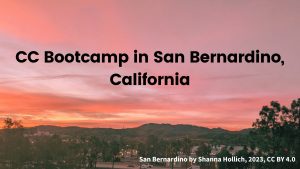
This December, Creative Commons led a CC Certificate Bootcamp, or condensed Certificate training, for faculty and staff from 16 different California Community Colleges implementing Zero Textbook Cost (ZTC) degree programs. This marked the second CC Bootcamp for California Community Colleges after the California legislature invested $115 million to expand ZTC degrees and the use of open educational resources (OER) within the statewide California community college system. ZTC degrees and increased use of OER reduce the overall cost of education and shorten the time to degree completion for students. With the average cost of course textbooks estimated at $100/student/course, ZTC degrees are crucial for students’ higher education. Further, students’ grades achieved in ZTC programs are higher than in traditional courses.
The CC Certificate program provides training and tools for ZTC program faculty and staff to legally and effectively implement the open licensing requirements of California’s historic investment in education. After learning about copyright basics, fair use, the public domain, and CC licensing, participants brainstormed and initiated some great ways to support ZTC program faculty and student needs. Examples of participant work include using generative AI to create “Creative Commons Bots,” tools to help others learn about licensing, and test their own knowledge with quiz questions; creating a grants guide for OER funding; drafting a potential strategic plan for OER/ ZTC work (work in progress), and remixing previous courses or resources to address ZTC communications and learning needs for localized audiences (works in progress). See what participants are saying below.
“This is one of the best professional development experiences I’ve had in years”
“Thank you so much for sharing wonderful resources and CC practices. I will share this knowledge with my colleagues”
“You’ve nailed the condensed week workshop. So much fun, and creating work groups was really beneficial”
We are proud to support California Community Colleges’ collaboration as they strengthen their foundations for open education. CC is grateful to the Michelson 20MM Foundation for generously funding this bootcamp at San Bernardino Valley College. Special thanks also go to the Academic Senate for California Community Colleges for their liaison work, expertise and support, to San Bernardino Valley College for hosting the event, and to Fresno Pacific University for providing professional development credits to faculty.
If you’re interested in advancing open education efforts in your own institution, Creative Commons offers an array of learning, training, and consulting opportunities to support our global community in developing open licensing expertise and a deeper understanding of recommended practices for better sharing. Visit the CC Training & Consulting page to learn more about our training services, workshops, lectures, and CC Certificate courses. Register for our next CC Certificate online courses, starting 29 January.
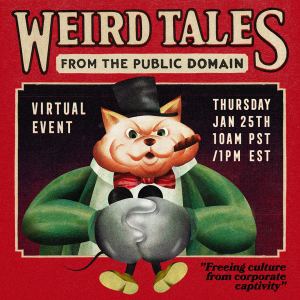
Celebrate Public Domain Day 2024 with us: Weird Tales from the Public Domain
Join Creative Commons, Internet Archive, and many other leaders from the open world to celebrate Public Domain Day 2024. The mouse that became Mickey will finally be free of his corporate captivity as the copyright term of the 1928 animated Disney film, Steamboat Willie, expires along with that of thousands of other cultural works on the first day of 2024.
The year 1928 brought us a host of still relevant, oft-revived and remixed culture, from H.P. Lovecraft’s classic horror story, “Call of Cthulhu” (originally published in Weird Tales; now currently a popular video game), to the Threepenny Opera, a critique of income inequality and the excesses of capitalism that is surprisingly on point for our current era.
And further, classic works of literature such as Orlando by Virginia Woolfe, Well of Loneliness by Radclyffe Hall, and Black Magic by Paul Mourad; children’s literature like House on Pooh Corner by A. A. Milne, which introduced the character Tigger, and Millions of Cats by Wanda Gág; movies like Charlie Chaplin’s The Circus, and Buster Keaton’s The Cameraman; and music like Dorothy Field’s “I Can’t Give You Anything But Love, Baby” and Cole Porter’s “Let’s Do It, Let’s Fall in Love” will grow the rich set of materials that are freely available to all of us as part of the public domain.
Join us for a virtual celebration at 10am PT / 1pm ET on 25 January, 2024, with an amazing lineup of academics, librarians, musicians, artists and advocates coming together to help illuminate the significance of this new class of works entering the public domain!
Of course our program wouldn’t be complete without a discussion of Generative AI, which to some has become a new kind of Eldritch God unleashed upon humanity—a Chtulhu of sorts—out to alter or control human reality. New AI technologies have raised all kinds of questions about human creativity, and the various monsters we must vanquish in order to preserve it. We’ll get into all that and more in our panel discussion of AI, Creativity and the Public Domain.
Open Culture Live Recap & Recording: Respectful Terminologies & Changing the Subject
On 22 November, we organized a webinar with a group of experts to discuss their unique approaches to reparative metadata practices: considering the ways that harmful histories and terminologies have made their way into collections labeling and categorization practices and finding ways to identify those terms, contextualize them, and/or replace them altogether.
Jill Baron, a librarian at Dartmouth College (USA) shared some of her learnings from a project to change subject headings in the United States Library of Congress after working with a student who encountered the subject heading “illegal aliens” in Dartmouth’s library catalog. The journey is captured in the documentary Change the Subject that she co-produced. Marco Redina spoke about his work on the DE-BIAS project, identifying harmful terms and adding context and more appropriate terminologies to more than 4.5 million records currently published on the Europeana website. Amanda Figueroa spoke about her efforts on the Curationist team where reviewers work to recontextualize collection descriptions with more contemporary and respectful descriptions through review and research. Carma Citrawati, a lecturer at Udayana University (Indonesia) spoke about her efforts to preserve traditional Balinese manuscripts in consultation with communities in Bali.
In the conversation, you will hear more about some of the nuances around the choice to keep legacy terminology in the record in order to preserve the history of harm, or replace it in order to make for a less harmful experience during discovery today. You will also hear from the experts about how they have engaged their communities around the work they do and get some advice on how you might think about confronting some of the harmful histories that have made their way into descriptions and metadata at your institution.
Sign up for our newsletter, Open Culture Matters, to learn about our upcoming webinars and keep up to date on news and events related to Cultural Heritage and Open Access and join the Open Culture Platform to get involved in our work.
Open Climate Campaign at UNFCCC Conference of the Parties 28
The complexity of climate change is on display at the United Nations Framework Convention on Climate Change (UNFCCC) Conference of the Parties (COP). The conference is arranged into two major zones, blue and green, with the former accessible only by parties with UNFCCC accreditation. The green zone is a landscape dotted by venues with booths inside representing different climate change stakeholders. Each booth delves into a different dimension of climate change – energy transition, the role of mangrove forests in carbon capture and climate education just to name a few.
At COP 28, the Open Climate Campaign highlighted another critical dimension of climate change – open access to climate change research. A common theme in presentations and statements at COP is that we know a lot about both the mechanistic causes of climate changes and its effects. Yet, most of that knowledge is in research publications, half of which is not accessible to read without a subscription. At the Open Climate Campaign we are on a mission to make the open sharing of research the norm in climate science. We know that to develop solutions, mitigations or adaptations to climate change, the knowledge about it must be open. The Open Climate Campaign teamed up with EQTYLab and the Endowment for Climate Intelligence (ECI) for the launch of their Climate GPT and a discussion of the pivotal role open plays in not only understanding climate change, but leveraging that knowledge into new technologies. The Open Climate Campaign is also embarking on a pilot project with ECI to elevate the accessibility of climate change research beyond just physical access to the publication and the data associated with it. Our collaboration will show the potential of combining openly licensed publications with generative Al. Across the conference venue the Frontiers Research Foundation was also discussing the critical role open plays in addressing climate change. They hosted a series of panel discussions including open science for inclusive and transformative climate and sustainability innovation and embracing open science for the climate crisis.
The Open Climate Campaign is looking forward to participating in COP 29 in Azerbaijan where we will continue to raise the need for open access to knowledge about climate change. We are looking to partner with other organizations at the intersection of climate and open to organize panels, presentations and/or workshops to amplify our shared message. If you would like to collaborate please reach out to: contact@openclimatecampaign.org
Celebrating Two Years of CC’s Open Culture Voices
Today we conclude the Open Culture Voices series, which over two years has showcased more than 65 open culture experts and practitioners from around the world. Over these two years we have had the privilege of engaging with remarkable individuals, each bringing their unique insights and stories to our community.
As we bid farewell to this enriching series, we want to take a moment to express our heartfelt gratitude to the interviewees who made this series possible. Your willingness to share your time, expertise, and experiences has left an indelible mark on our collective narrative. This journey has been more than a collection of interviews; it has been a tapestry of diverse stories that have inspired, educated, and connected us all. Your openness and authenticity have fostered a sense of community that goes beyond the digital realm: your perspectives are gathered in the CC report “What are the Barriers to Open Culture?” and several other resources which will continue to provide guidance and advice to the community.
Here are some of the experts’ insights:
“Standardized licenses support interoperability and compatibility with other collections. All of this means that users are able to find, access and use our content with fewer barriers and less friction, and this makes it easier for them to learn, share their learning, to create and innovate.” — Christy Henshaw
“When done right, the greatest advantage for open cultural heritage is digital equity. Removing paywalls means that more people can afford to access these materials. We live in a wildly inequitable world, and access to our culture should not contribute to this.” — Nicole Kang Ferraiolo
“Open culture is kind of a key building block for positive interaction and social inclusion” — Nkem Osigwue
“Weʼll often find that the benefits of being open with the collections outweigh the level of investment and cost, and the profit eventually made from generating income, selling, and controlling the use of collections.” — Dafydd Tudur
15, which ran from January 2022 to November 2023, the videos had more than 20,000 views on YouTube and more than 30,000 engagements here on the CC Blog.
Thank you everyone who has watched and learned from these videos already. We hope they continue to be a valuable resource for the blossoming open culture community.
All episodes can be watched from the Creative Commons Blog. The videos are licensed CC BY 4.0 to be easily adapted, reused and shared across the web.