Help us protect the commons. Make a tax deductible gift to fund our work. Donate today!
CC’s copyright platform 2022 working groups share their highlights
In 2022, two working groups (WGs) of the Creative Commons Copyright Platform collaborated on policy papers tackling issues related to copyright and access to knowledge. In this blog post, we highlight their insightful contributions to the CC copyright reform community.
Working Group on Digital Sharing Spaces
Led by Emine Yildirim, the WG on Digital Sharing Spaces was based on the idea that recent and upcoming legislative and policy instruments are likely to affect freedom to share. In 2022, the WG focused on how data sharing policies concerning publicly available data impact academic research and journalism in the public interest. While the group found that there are some safeguards in place, there are also several barriers for utilizing publicly available data by researchers and journalists. The main output of the WG was a position paper, encompassing two jurisdictions, the European Union and the United States. With this position paper, the group sought to provide some preliminary recommendations and to call for action and engagement to those who may be facing challenges and barriers in their respective jurisdictions. Watch the group’s January 2023 webinar recording. The WG hopes to use this position paper as a conversation starter for a bigger and more geographically inclusive debate.
Working Group on User Rights
Led by André Houang, the WG on User Rights was based on the idea that these rights are an integral part of the copyright system. As such, the WG focused on exchanging thoughts on how copyright can be reshaped to better balance the interests of authors and rights holders with the public interest, so as to allow for the full exercise of fundamental rights, such as freedom of expression and access to knowledge, culture and information. The main output of the WG are its position papers, in which it puts forward some ideas for a better copyright system. The WG´s 2021 position paper focused on different types of user rights, which could help balance the interests of rights holders and of users. The 2022 position paper approached the topic of an international instrument for the global harmonization of user rights, and you can watch the group’s webinar recording to hear more about it.
Participate in CC Copyright Platform calls — they are announced in the Slack channel and on the mailing list
Hala Essalmawi — Open Culture VOICES, Season 2 Episode 2
Hala says “if it’s open then you give a big opportunity for partnership” because the transparency created by openness makes it clear what you do and what you have and invites others to work with you. In this episode Hala shares some insight on copyright in Egypt and what open culture looks like in the work she does.
Open Culture VOICES is a series of short videos that highlight the benefits and barriers of open culture as well as inspiration and advice on the subject of opening up cultural heritage. Hala is the Head of the Legal Department at the Library of Alexandria. With more than 25 years of experience she has worked on IP and Copyright issues around the world with her work the library and with WIPO.
Hala responds to the following questions:
What are the main benefits of open GLAM?
What are the barriers?
Could you share something someone else told you that opened up your eyes and mind about open GLAM?
Do you have a personal message to those hesitating to open up collections?
Closed captions are available for this video, you can turn them on by clicking the CC icon at the bottom of the video. A red line will appear under the icon when closed captions have been enabled. Closed captions may be affected by Internet connectivity — if you experience a lag, we recommend watching the videos directly on YouTube.
Looking for that perfect picture to illustrate your post? That catchy tune to jazz up your video? Look no further than Openverse, the huge library of free and open stock photos, images, and audio contributed to the public commons by people around the world, now available at its new domain: openverse.org.
Here at CC we use Openverse daily to explore the public commons and find works to reuse in our communications and projects. Powerful tools like Openverse demonstrate how open technologies and communities like WordPress can build on the rich public commons we all help create to support what we call better sharing: sharing that is inclusive, just and equitable — where everyone has wide opportunity to access content, to contribute their own creativity, and to receive recognition and rewards for their contributions.
Finding and using free and open works has never been easier: Just visit Openverse, enter some keywords, and pick your favorite from the results. You can also filter by content type, sources, aspect ratio, size, open license and public domain statuses, and more, like the search for the keywords “art” and “universe” we used to find the image in this post.
Once you’ve picked a work, Openverse provides everything you need to use it: Visit the work in its home collection and copy a well-formed attribution statement to give proper credit for your use.
Openverse was incubated here at CC as “CC Search”, moving to the WordPress community in 2021, and has continued to thrive in its new home, now cataloging over 600 million images and audio tracks, with new collections of open works being added all the time, like the recent addition of more than 15 million images from iNaturalist, the project that enables citizen scientists and researchers to document and understand global biodiversity.
Contributors in the WordPress community continue to add new features and capabilities to Openverse. Coming up next will be new tools to easily use images from Openverse directly in WordPress itself; content safety features that will enable users to blur or opt in/out from specific types of sensitive content; and improvements to search relevancy and the quality of results.
Nicole Ferraiolo — Open Culture VOICES, Season 2 Episode 1
Nicole believes that “the greatest advantage of open cultural heritage is digital equity,” which is a guiding principle for many cultural institutions around the world. In this episode Nicole talks about how making collections open greatly increases accessibility across global demographics and interest groups which makes an institution more relevant to a wider audience.
Open Culture VOICES is a series of short videos that highlight the benefits and barriers of open culture as well as inspiration and advice on the subject of opening up cultural heritage. Nicole is at the time of the recording the Director of Global Strategic Initiatives at CLIR which is the Council on Library and Information Resources where she works to enhance research, teaching, and learning environments in collaboration with libraries, cultural institutions, and communities of higher learning.
Nicole responds to the following questions:
What are the main benefits of open GLAM?
What are the barriers?
Could you share something someone else told you that opened up your eyes and mind about open GLAM?
Do you have a personal message to those hesitating to open up collections?
Closed captions are available for this video, you can turn them on by clicking the CC icon at the bottom of the video. A red line will appear under the icon when closed captions have been enabled. Closed captions may be affected by Internet connectivity — if you experience a lag, we recommend watching the videos directly on YouTube.
Like the rest of the world, CC has been watching generative AI and trying to understand the many complex issues raised by these amazing new tools. We are especially focused on the intersection of copyright law and generative AI. How can CC’s strategy for better sharing support the development of this technology while also respecting the work of human creators? How can we ensure AI operates in a better internet for everyone? We are exploring these issues in a series of blog posts by the CC team and invited guests that look at concerns related to AI inputs (training data), AI outputs (works created by AI tools), and the ways that people use AI. Read our overview on generative AI or see all our posts on AI.
Note: We use “artificial intelligence” and “AI” as shorthand terms for what we know is a complex field of technologies and practices, currently involving machine learning and large language models (LLMs). Using the abbreviation “AI” is handy, but not ideal, because we recognize that AI is not really “artificial” (in that AI is created and used by humans), nor “intelligent” (at least in the way we think of human intelligence).
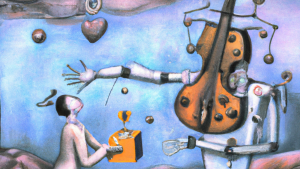
“Better Sharing With AI” by Creative Commons was generated by the DALL-E 2 AI platform with the text prompt “A surrealist painting in the style of Salvador Dali of a robot giving a gift to a person playing a cello.” CC dedicates any rights it holds to the image to the public domain via CC0.
Over the last year, innovation and use of generative artificial intelligence (AI) has exploded, providing new ways for people to create content of all sorts. For example, it’s been used to help create award winning art, develop educational materials, expedite software development, and craft business materials. Recently, three artists filed a class action lawsuit in the USA against StabilityAI and Midjourney, two companies that use the Stable Diffusion tool to enable people to generate images using simple text prompts. It follows on the heels of litigation brought by the same attorneys and other plaintiffs against GitHub and OpenAI for their Copilot and Codex tools for generating software code.
AI is an area that Creative Commons has longfocused on, including most recently in a webinar series we held last fall. We are going to expand on our views in future posts, including exploring why we think the legal arguments in the US court case against StabilityAI, Midjourney, and DeviantArt are ill-founded. (Getty Images also subsequently filed a similar suit against StabilityAI in the US, as well as apparently commencing litigation in the UK, but we have yet to see that complaint.)
But before digging into all of the legal issues, we wanted to take a step back and restate our general approach to generative AI.
CC on Generative AI
Creative Commons has always sought out ways to harness new technology to serve the public interest and to support better sharing of creative content — sharing that is inclusive, just, equitable, reciprocal and sustainable. We support creators to share their works as broadly and openly as they want, so that people can enjoy them globally without unnecessary barriers. We also advocate for policies that ensure new and existing creators are able to build on a shared commons, while respecting creators’ legitimate interests in control and compensation for their creative expressions.
A founding insight of Creative Commons is that all creativity builds on the past. When people learn to play the cello or paint a picture, for instance, they necessarily learn from and train their own skills by engaging pre-existing works and artists — for instance, noticing the style in which cellists like Yo-Yo Ma arrange notes, or building on surrealist styles initiated by artists like Dali. Similarly, while Star Wars invented the character of Luke Skywalker, it built on the idea of the hero’s journey, among many other elements from past works. People observe the ideas, styles, genres, and other tropes of past creativity, and use what they learn to create anew. No creativity happens in a vacuum, purely original and separate from what’s come before.
Generative AI can function in a similar way. Just as people learn from past works, generative AI is trained on previous works, analyzing past materials in order to extract underlying ideas and other information in order to build new works. Image generation tools like Stable Diffusion develop representations of what images are supposed to look like by examining pre-existing works, associating terms like “dog” or “table” with shapes and colors such that a text prompt of those terms can then output images.
Given how digital technologies function, training AI in this way necessarily involves making an initial copy of images in order to analyze them. As we’ve explored in the past and will discuss in future posts about these recent lawsuits, we think this sort of copying can and should be permissible under copyright law. There are certainly nuances when it comes to copyright’s interaction with these tools — for instance, what if the tools are later used by someone to generate an output that does copy from a specific creative expression? But treating copying to train AI as per se infringing copyright would in effect shrink the commons and impede others’ creativity in an over-broad way. It would expand copyright to give certain creators a monopoly over ideas, genres, and other concepts not limited to a specific creative expression, as well as over new tools for creativity.
Copyright, and intellectual property law in general, are only one lens to think about AI: It’s still important to grapple with legitimate concerns about this technology and consider what responsible development and use should be. For instance, what impact will these tools have on artists and creators’ jobs and compensation? How can we ensure that AI that is trained on the commons contributes back to the commons as well, supporting all types of creators? What about the use of these tools to develop harmful misinformation, to exploit people’s privacy (eg, their biometric data), or in ways that perpetuate biases? More generally, how can we ensure human oversight and responsibilities to ensure that these tools work well for society?
These are just some of the tricky issues that will need to be worked out to ensure people can harness AI tools in ways that support creativity and the public interest. Along with other policy and legal approaches to governing AI, it’s important to look to community-driven solutions that support responsible development and use. Already, StabilityAI will let artists opt-out of its training data set, as well as opt in to provide greater information about their works. While this precise approach raises a variety of views, indexing of the web has functioned well using a similar sort of opt-out approach — set through global technical standards and norms, rather than law. Creators of some generative AI tools are using licenses that constrain how they are deployed, which also carries various trade-offs.
What’s Next? Community Input
Supporting community-driven solutions has also always been at the heart of Creative Commons’ approach to creativity. If you’re interested in this subject, we are going to be holding meetings with the Creative Commons community, and we also plan to continue meeting with diverse stakeholders to explore what sorts of solutions may be helpful in this area. As we go along we’ll continue to report on what we’ve learned and seek out more community feedback.
Join the CC team at a community discussion about generative AI: How can we make it work better for everyone and support better sharing in the commons?
To enable participation around the world, we’ve scheduled three times for this conversation. Come to the one that works best for your schedule, or join as many as you like. We’ll be focused on the same questions and issues at each meeting, but different participants will bring different perspectives, reshaping each conversation. To enable participants to speak freely, these meetings will not be recorded, but the CC team will be taking notes to share outcomes from the conversations.
Curious about Creative Commons licenses? Join Creative Commons staff for an overview of the six CC licenses and two public domain tools. We will describe the CC license and tool elements, their legal, machine-readable, and human-readable layers, as well as show practical use cases for each of the licenses and tools. Participants will engage in discussion around contemporary challenges for creators, and have the chance to discuss questions with legal experts in copyright.
Join us for this introduction to CC licenses and tools to get your basic questions answered and practice sharing content to the commons: 10 February 2023, 2–7pm UTC (see the schedule in your local timezone).
CC’s #BetterSharing Collection | February: Sharing Brightens The Future
As part of our #20CC anniversary, last year we joined forces with Fine Acts to spark a global dialogue on what better sharing looks like in action. Our #BetterSharing collection of illustrations was the result — we gathered insights from 12 prominent open advocates around the world and tasked 12 renowned artists who embrace openness with transforming these perspectives into captivating visual pieces available under a CC license.
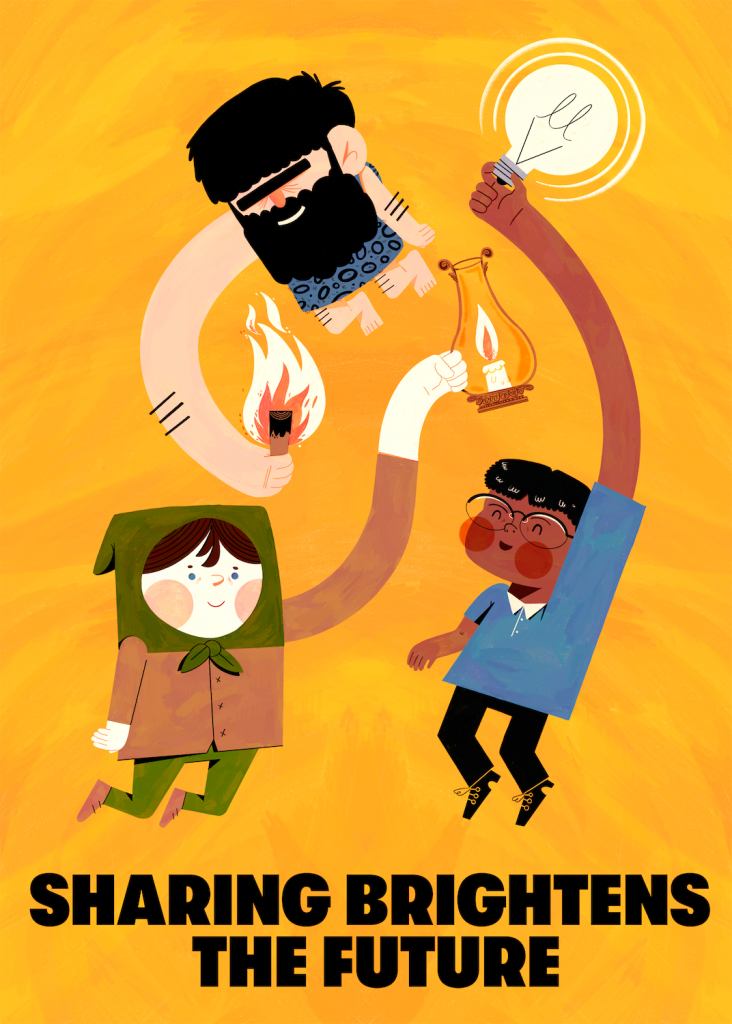
Each month throughout 2023, we will be spotlighting a different CC-licensed illustration from the collection on our social media headers and the CC blog. For February, we’re excited to showcase “Sharing Brightens The Future” by Bulgarian illustrator and graphic designer, Teo Georgiev. The piece, licensed under CC BY-SA 4.0, was inspired by a quote from Biyanto Rebin, an open knowledge advocate and Indonesian Wikipedian:
“Sedikit demi sedikit, lama-lama menjadi bukit (meaning: many a mickle makes a muckle).
An Indonesian proverb with the meaning of collaboration spirit, when we do a continuous effort little by little, it will eventually become bigger in the future. This is what happens when we share our resources, our works to the public, they will have a greater impact, since sharing can empower other people, sometimes the ones who are left behind, the underprivileged.”
Meet the artist:
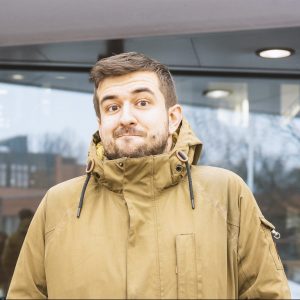
Photo courtesy of Teo Georgiev
Teo Georgiev is a Bulgarian illustrator, designer and artist based in Helsinki, Finland. He has received a BA in Graphic Design from Coventry University (UK) and is currently pursuing an MA in Visual Narrative at Aalto University (Finland), where he explores the intersection of comics and migration studies. From children’s books through to editorial illustrations and advertising, Teo draws playful characters, surreal stories and whimsical environments, which he then intertwines with inspiration collected from nature, culture and history. His style is a combination of naïve shapes, organic forms and bold colors. His list of past clients includes WWF, Habitat for Humanity, Converse, InVision and Ladybird Publishing, as well as boutique businesses and NGOs.
The full #BetterSharing collection is available on TheGreats.co to be enjoyed, used and adapted, and then shared again, by anyone, forever. View the full collection >>
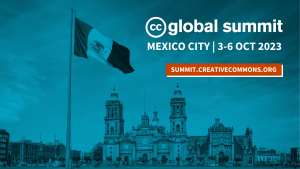
¿Interasado en ser voluntario en la formación de la Cumbre Global CC en la Ciudad de México?
¿Ya escuchaste la emocionante noticia de que el CC Global Summit 2023 será en la Ciudad de México? Ahora tienes la oportunidad de ser voluntario y formar parte de los comités que ayudarán a dar forma al programa y podrás evaluar las solicitudes de becas para futuros participantes.
Los voluntarios son esenciales para garantizar que la Cumbre CC refleje la vasta diversidad de personas involucradas en el movimiento de bienes comunes abiertos. Ser voluntario en un comité es gratificante, energiza tu compromiso con los bienes comunes y expande tus conexiones en la comunidad de CC. ¡Te animamos a que te involucres y contribuyas para que esta cumbre brille!
Voluntariado para el Comité de Formación del Programa
El Comité de Programa es responsable de ayudar a dar forma al aspecto impulsado por la comunidad del programa de la Cumbre. El comité revisará las propuestas de presentación a la convocatoria de la Cumbre (CFP, por sus siglas en inglés) y trabajará en colaboración para invitar a aquellos que mejor se adapten al tema, las vías y el cronograma del programa de la Cumbre.
Compromiso de Tiempo: Reuniones del comité (aproximadamente 5 horas) MÁS período de revisión (aproximadamente 5 a 8 horas según la cantidad de solicitudes)
Miembro de la comunidad CC: Sera seleccionado por los miembros del comité comunitario.
Compromiso de Tiempo: Igual que otros miembros del comité MÁS dos reuniones de preparación adicionales de 1 hora con el equipo CC (probablemente en mediados de febrero y principios de mayo)
Reuniones y Fechas Clave (Tentativo)
Fecha
Hora
Actividad
Semana empieza: el lunes 13 de marzo
Por determinar
REUNIÓN: Bienvenida y resumen del programa
Semana empieza: el lunes 20 de marzo
Por determinar
REUNIÓN: Revisión del formulario de solicitud de CFP
TBD: marzo–abril
Aplicaciones abiertas
Semana empieza: el lunes 3 de abril
Por determinar
REUNIÓN: Resumen del proceso de revisión y estructura del programa
TBD: abril–mayo
El comité revisa las solicitudes
Semana empieza: el lunes 8 de mayo
Por determinar
REUNIÓN: Finalizar envíos aceptados
Semana empieza: el lunes 15 de mayo
Notificaciones de aceptación enviadas
Semana empieza: el lunes 22 de mayo
Por determinar
REUNIÓN: Reunión final
Semana empieza: el lunes 22 de mayo
Confirmaciones de aceptación vencidas
Voluntarios para el Comité de Evaluación de Becas
CC financia a decenas de personas para que asistan a la Cumbre Global CC con la meta de apoyar la participación diversa. Este comité de voluntarios es responsable de revisar las solicitudes para el Fondo de Becas de la Cumbre Global CC.
Compromiso de tiempo: reuniones del comité a continuación (aproximadamente 4 horas) MÁS período de revisión (aproximadamente 6 a 8 horas según la cantidad de solicitudes)
You’ve heard the exciting news that the 2023 CC Global Summit will be in Mexico City? Now you have the opportunity to volunteer to join the committees that will help shape the program and evaluate applications for participant scholarships.
Volunteers are essential to ensure that the CC Summit reflects the rich diversity of people engaged in the open commons movement. Past CC Summit committee members report that volunteering is richly rewarding, energizing their engagement with the commons and expanding their connections in the CC community. We encourage you to get involved to make this Summit shine!
Volunteer for the Program Committee
The Program Committee is responsible for helping to shape the community-driven aspect of the CC Global Summit program. The committee will review responses to the Summit Call for Proposals (CFPs) and work collaboratively to invite those that best fit the Summit program theme, tracks, and schedule.
CC Community Member: To be selected from community committee members
Time Commitment: Same as other committee members PLUS two additional 1-hour preparation meetings with CC staff (likely in mid-February and early May)
Meetings & Key Dates (tentative)
Date
Time
Activity
Week starting Mon 13 March
To be arranged
MEETING: Welcome and program overview
Week starting Mon 20 March
To be arranged
MEETING: CFP application form review
TBD: March–April
Applications open
Week starting Mon 3 April
To be arranged
MEETING: Overview of review process and program structure
TBD: April–May
Committee reviews applications
Week starting Mon 8 May
To be arranged
MEETING: Finalize accepted submissions
Week starting Mon 15 May
Acceptance notifications sent
Week starting Mon 22 May
To be arranged
MEETING: Final meeting
Week starting Mon 22 May
Acceptance confirmations due
Volunteer for the Scholarship Evaluation Committee
CC funds dozens of people to attend the CC Global Summit to support diverse participation. This committee of volunteers is responsible for reviewing the applications for CC’s Global Summit Scholarship Fund.
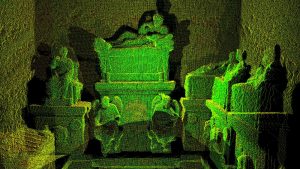
On 7 February 2023, Creative Commons will host a panel discussion on 3D scanning, preservation, access and revitalization of cultural heritage. As 3D technologies advance and cultural heritage institutions around the world seek better ways to enable people to engage with their collections, we also see cultural artifacts threatened by global climate change, armed conflict, and economic instability. At CC, we see building the “3D” commons in this complex moment as an essential activity in enabling a brighter future for all and solving the world’s most pressing challenges. How can 3D technologies and practices support what we call better sharing: sharing that is contextual, inclusive, just, equitable, reciprocal, and sustainable?
With experts, we’ll explore the many considerations around 3D scanning as it relates to cultural heritage preservation, revitalization, access and better sharing, as well as the impact on the public domain. Panelists will address:
the importance of open access to scans of cultural artifacts
the legal issues that can challenge access to 3D scans
policy implications of open licensing 3D scans
cultural and equity considerations around the origins of objects scanned
how museums, artists and organizations put 3D scanning and sharing into practice
CC’s Director of Learning and Training, Jennryn Wetzler, will moderate an expert panel with:
Michael Weinberg, Executive Director, Engelberg Center on Innovation Law and Policy, NYU School of Law
Jonas Heide Smith, Head of Digital at SMK, The National Gallery of Denmark
Cosmo Wenman, Open Access Advocate and 3D Design and Fabrication Consultant
As UNESCO’s Memory of the World program enters its fourth decade, questions at the intersection of preservation, access, copyright and new technologies are now more topical than ever. Join us to hear from experts and participate in the conversation!