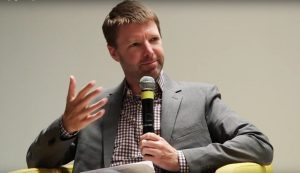
First photo: Yana Buhrer Tavanier, Second photo: Pavel Kounchev
On this episode, we’re joined by two guests, Yana Buhrer Tavanier and Pavel Kounchev, two of three co-founders of Fine Acts, a global creative studio that encourages experimentation and collaboration across disciplines to inspire social change. Fine Acts brings together multidisciplinary teams of artists, activists and technologists to prototype compelling works of art aligned with specific human rights campaigns. They publish all completed works on TheGreats.co, their free platform filled with socially engaged visual content, open to anyone to use or adapt non-commercially under CC licenses.
Yana is the Executive Director of Fine Acts, a TED Senior Fellow, Young Global Leader of the World Economic Forum, a Fellow of the Royal Society of Arts, and her most recent TED talk, focused on the concept of playtivism: incorporating multidisciplinary creative play and experimentation in activism has been viewed close to 2 million times. Pavel is chair of the board of Fine Acts, an Obama Foundation scholar at Columbia University, and a Royal Society of the Arts fellow. He was born in Bulgaria, where he also co-founded TimeHeroes with Yana – the biggest online volunteering service in the country, with 80,000 registered volunteers – for which he was named among Forbes Bulgaria’s list of 30 Under 30.
Please subscribe to the show in whatever podcast app you use, so you don’t miss any of our conversations with people working to make the internet and our global culture more open and collaborative.
The Future of Open Webinar Recap & Recording
Earlier this year, Creative Commons announced that four working groups of the Creative Commons Copyright Platform would examine policy issues affecting the open ecosystem from a global perspective: (1) artificial intelligence and open content; (2) platform liability; (3) copyright exceptions and limitations; and (4) the ethics of open sharing.
The CC Copyright Platform was established as a discussion space to strategize on copyright reform as a complementary action to developing and stewarding CC licenses. Over the last few months, each working group has discussed, researched and dissected these issues, and produced four Position Papers encapsulating their outcomes, available now on the CC Medium Publication.
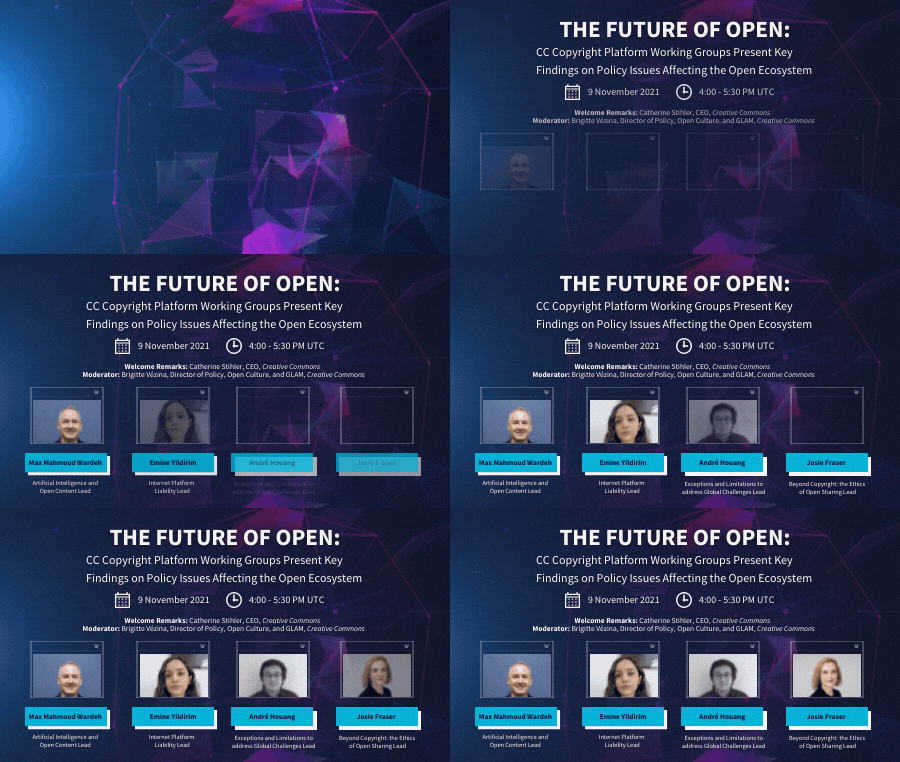
At ‘The Future of Open’ webinar, hosted on 9 November 2021, the four working group leads presented their work to CC Global Network members, practitioners, policymakers and the general public. Speakers at the webinar included: Catherine Stihler, CEO, Creative Commons (Welcome Remarks), Brigitte Vézina, Director of Policy, Open Culture, and GLAM, Creative Commons (Moderator), Max Mahmoud Wardeh, WG 1 Lead (Artificial Intelligence and Open Content), Emine Yildirim, WG 2 Lead (Internet Platform Liability), André Houang, WG 3 Lead (copyright exceptions and limitations), Josie Fraser, WG 4 Lead (the ethics of open sharing). Below you will find the webinar recording, summaries of the four papers, and links to read them.
Working Group 1 — Artificial Intelligence and Open Content
Max kicked things off presenting WG 1’s paper Key Findings of the Creative Commons Working Group on Copyright and AI. Max highlights that “this is an area that’s constantly changing in terms of the legislation, as well as, of course, the technology, and it’s also a very wide ranging remit in terms of how much progress has happened with regard to the use and generation of content by computers.” This informed the group’s decision to divide their work and outputs into five key areas: the definition of AI; text and data mining; training of AI and machine learning algorithms; AI generations and creations; and authors collaborating with AI. Max reminds us that the positions and recommendations mentioned in the paper are just a summary of the details that have gone into exploring and considering the topics of the Working Group. They will continue to build on the work done so far, in line with the developments in the social, technical, and legal aspects of AI and copyright. They invite you to explore and contribute to their continued work on the CC AI Working Group site, and by joining the conversation on their channel in the Creative Commons Slack.
Working Group 2 — Internet Platform Liability
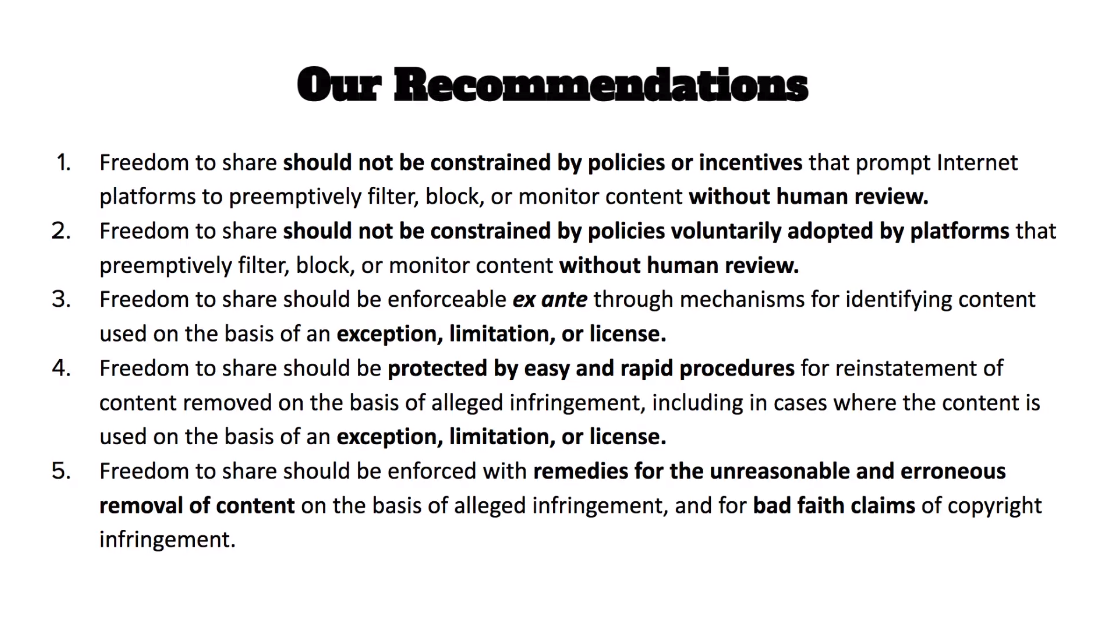
Emine presented key findings from WG 2’s paper Freedom to Share: How the Law of Platform Liability Impacts Licensors and Users. Emine shares that WG 2 limited the geographic scope of their paper to the European Union, U.S. & Canada, New Zealand, and several countries in Latin America (Chile, Costa Rica, El Salvador, Guatemala, Honduras, Nicaragua, Dominican Republic, Mexico, Brazil, and Peru). They focused their work and outputs on Freedom of Opinion and Expression, Access to Information, Right to Participate in Cultural Life and Freedom to Share. Through this lens, they assessed current trends and produced five recommendations:
Working Group 3 — Exceptions and Limitations to address Global Challenges
André shared key findings from WG 3’s paper Creative Commons Copyright Platform Working Group on User Rights’ Position Paper. In their paper, WG3 stressed that “important changes in copyright are necessary to ensure user rights are protected, and that copyright in turn achieves its goals of promoting access to culture and knowledge.” André starts by explaining that although they are traditionally referred to as “exceptions and limitations” of copyright, this paper refers to them as “user rights” to reflect the complex layers of this issue. André explains they “decided to avoid focusing on issues specific to U.S. copyright law or European copyright law, and instead adopt a broader view, which we understood could make our paper have a broader reach and be useful to different organizations.”
Working Group 4 — Beyond Copyright: the Ethics of Open Sharing
Josie presented key findings from WG 4’s paper Beyond Copyright: the Ethics of Open Sharing. To begin with, Josie starts off by explaining WQ 4’s definition of Ethics and Open Sharing in the context of this paper, explaining that “for the purposes of this paper, we’re looking at ethics primarily in relation to principles of equity, diversity and inclusion.” She adds “by ‘open sharing’ we mean the act of sharing digital materials either under an open license, or by applying a public domain tool”. This paper particularly focuses on the decisions that communities, groups and organizations take to share the materials they produce — including code, data and databases, images, software, sound and video recordings, written content, and 3D models — openly or not.
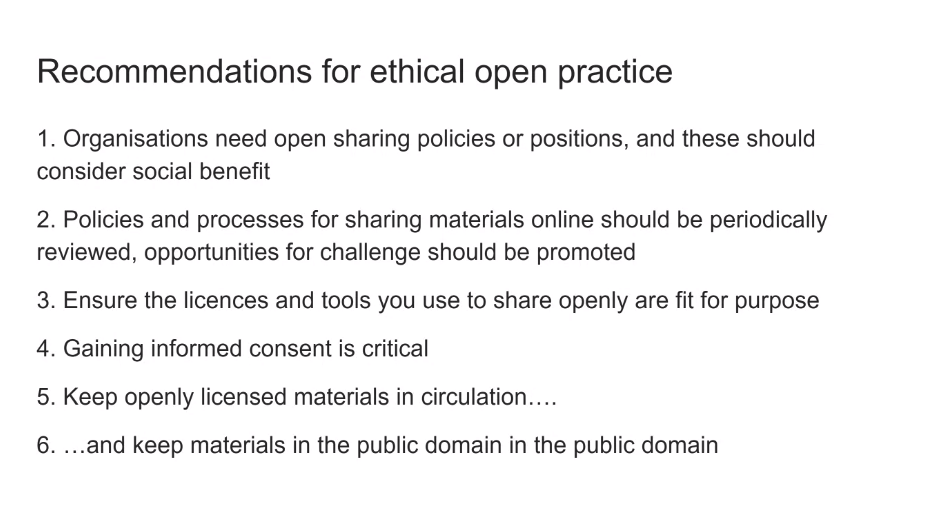
Based on these definitions, they explored this issue and developed 6 recommendations for an ethical open practice:
We are hugely appreciative of the efforts of all the working group members who contributed to these papers, those who participated in the public consultation of earlier drafts, and to the WG leads for their role in guiding these efforts and presenting them so clearly at the webinar.
———
The conversations continue in the Creative Commons Copyright Platform! Interested in joining? You can:
by Amber Vittoria for Fine Arts, licensed under CC BY-NC-SA 4.0
“Elliot was always willing to grapple with the hard problems, and you could tell he wasn’t satisfied with the easy answers. I remember rides on the Caltrain from Mountain View back to San Francisco where we’d use the whole time debating; in the best sense possible. He used those debates with me to find the underlying truth so we could improve what we did every day at CC.”
“Elliot was passionate, uncannily insightful, and a joy to work with personally and professionally. I really enjoyed EFF’s post. I don’t have anything particularly unique to add to CC’s that others wouldn’t have already expressed. I will miss his contributions to the public dialogue, whether at conferences or in his writings, where he could always be counted on to be pressing an urgent point or seeking out all points of view.”
“The thing that I remember most about him is that he was always strongly committed to doing the right thing. He cared a lot about doing right by people and about telling them the truth. He never wanted to communicate something that sounded good but wasn’t truly honest and forthright. That he could have a strong idea of what was right and still be able to hold in his head all the complexity of the issue, and empathy for those who believed differently. And that once he was committed to something that was right, he didn’t commit halfway. He was incredibly smart and perceptive, but never made a show of it. You’d just notice when he heard about an issue for the first time, and immediately figured out what the hardest bits were, and started asking questions about it to get to the truth. And then he could explain it to others as if it was the simplest thing in the world.”
“He made your work better somehow, by being supportive when you needed it, and being challenging when you needed that, by asking the questions that made you think more deeply about what you were doing and why, and who it would help. He always wanted to know how things ‘really’ worked and sometimes you’d find you didn’t know either. I’ve seen some of the EFF staff talk about how good he was as a manager of their activism team, and of course he was, he really cared about setting others up for success.”
“He cared a lot about what he was doing, whether it was going to help, whether people involved were behaving with integrity, and it’s a mindset that could be harsh and humorless but instead he was one of the most hilarious people you’d ever meet, cracking quietly devastating jokes, sharing bits of weird and delightful knowledge about everything that he carried in his head. He was really open to meeting people and hearing what they had to say and truly engaging with people and ideas that weren’t his. I’ve seen a bunch of remembrances on Twitter now and of course everyone who met him was struck by his kindness and intelligence, feeling his loss not just to the digital rights community but as a personal connection they were going to miss.”
“He was always someone I could trust to be honest, and to be kind. I wish I’d seen him more often without a work-related question to bring. I remember him spending a lot of time trying to understand the licensing changes so he could explain and advocate for them to others.”
“When I think about Elliot, the primary word that comes to mind is exuberance. Elliot was tall, had stunning red hair, and a loud wonderful voice and laugh. He had a quick smile and wit, and he was extremely knowledgeable and well-read, making him an incredibly interesting person to talk to about just about anything.”
“If I remember correctly, Elliot grew up in South Dakota and his father was a lawyer, and I think perhaps that made him especially interested in talking through legal issues despite not being a lawyer himself. He believed very deeply in the open internet and digital rights, and you could tell his work at both CC and EFF was far more than a j-o-b to him. He was passionate about it.”
“Elliot was also a poet, and I believe he did some spoken word poetry as well as lots of writing. I think that detail helps reveal why he almost had an aura about him, like he was in touch with some things in life that many people overlook.”
“I did not know Elliot that well, though we did socialize some during our brief time overlapping at CC. But yet he made a big impression on me. He was a ray of light or of sunshine. There was something larger than life about him, and I am really sad to know he is no longer in this world.”
CC Community Spotlight Series: Meet Tyler Green
This #GivingTuesday— Tuesday, November 30th, Creative Commons invites you to join our 20th Anniversary celebration. In the weeks leading up to #GivingTuesday, we’ll be spotlighting leaders in the Open Movement and encouraging you to support our Better Sharing, Brighter Future campaign.
Creative Commons is not only an online ecosystem of CC licenses and tech. We’re a movement of people— a vast network of dedicated activists, scholars, inspiring librarians and teachers, lawyers, artists, fashionistas, digital masterminds and policy makers, fighting for more equitable global access to education, resources and creativity.
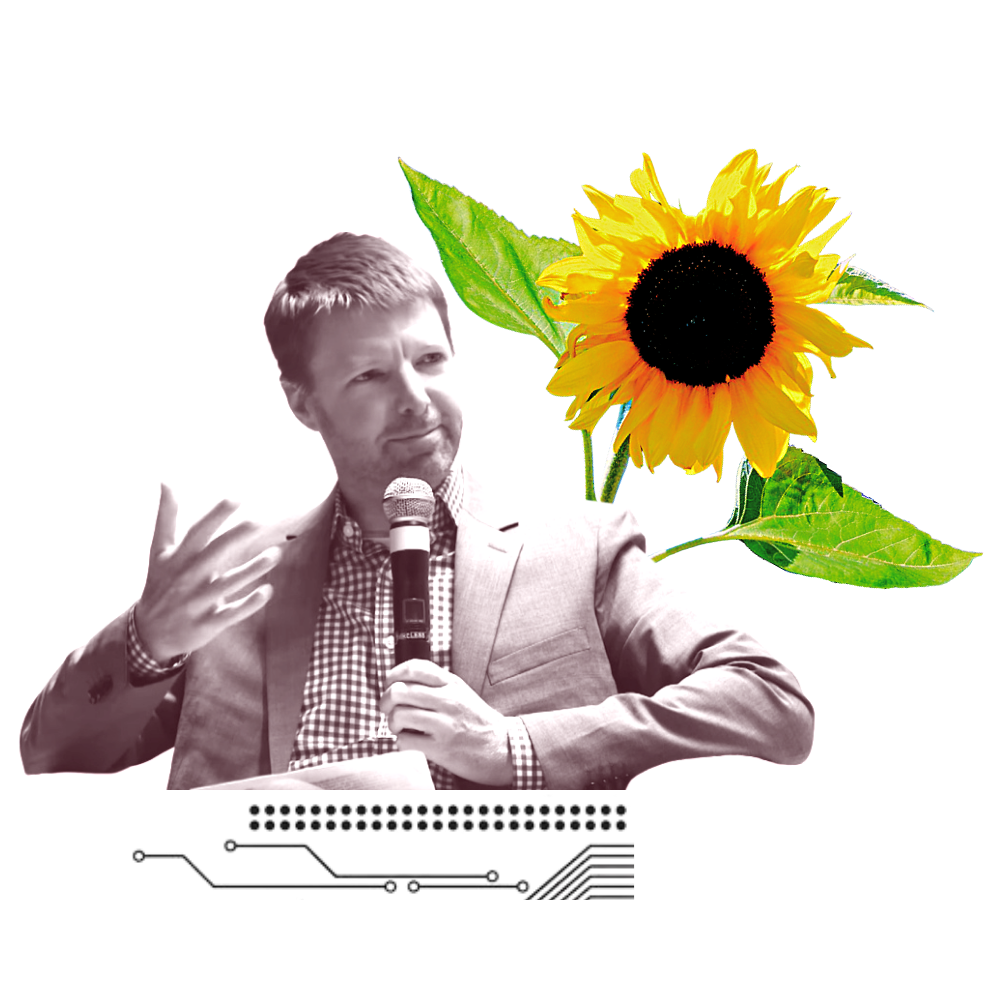
This includes individuals like Tyler Green, this week’s community spotlight, an award-winning historian, critic, author and host of The Modern Art Notes Podcast, a weekly (CC licensed!) program featuring discussions with artists, historians, authors and curators.
Green recently released a new book, Emerson’s Nature and the Artists: Idea as Landscape, Landscape as Idea, which explores the ways the written work of Ralph Waldo Emerson, a 19th century U.S. author, poet and philosopher, was deeply influenced by “American Art” and the natural landscape in the United States. He argues Emerson’s famous text Nature was a game changer in our modern day understanding of the commons and Open Access, and that, as a scholar, Green needed access to both visual and textual resources to make his case.
“…the greatest obstacle to understanding art’s role in the American project, in the idea of the American nation …is that it costs scholars serious money to publish our works. That makes it harder for scholars to know what’s out there, but it also makes it harder to make arguments. If you can’t publish the visual part of your argument with the textual part of your argument, why work hard to have an argument that is both visual and textual. And so open access is, at the risk of sounding grandiose, open access is the answer, right? Open access makes that possible.”
Green encourages his audience to consider how greater access to a range of historical resources, visual and written, might strengthen our ability to understand our collective past and imagine a better and brighter future.
In the coming weeks, we’ll feature more Open Access advocates like Green, who are working to make our global culture more open and collaborative. In the meantime, we invite you to join our Better Sharing, Brighter Futurecampaign. See below for ways to get involved.
As the United Nations Climate Change Conference, officially known as the 26th Conference of Parties, or COP26, continues in Glasgow, Scotland, I’m pleased to share some good news. The Open Society Foundations approved funding for Creative Commons, SPARC and EIFL to lead a global campaign promoting open access to climate and biodiversity research. This is a promising new strategy to encourage governments, foundations, institutes, universities and environmental organizations to use “open” to accelerate progress towards solving the climate crisis and to preserve global biodiversity. Catherine Stihler, CC’s CEO and a native of Scotland, publicly announced the campaign during her keynote at the University of St Andrews’ Power to the people event and will have the opportunity to announce the campaign at a COP26 fringe event – Open UK: Open Technology for Sustainability – on 11 November. CC is particularly happy to have the opportunity to work closely with our longtime allies in the open access movement to ensure that this effort is truly a global campaign, and hope that this initiative will help to provide a blueprint for future funding of similar collaborative campaigns.
Additional Detail
Climate change, and the resulting harm to our global biodiversity, is one of the world’s most pressing challenges. The complexity of the climate crisis requires collaborative global interventions that center on equity and evidence-based mitigation practices informed by multidisciplinary research. Many researchers, governments, and global environmental organizations recognize the importance of the open sharing of research to accelerate progress, but lack cohesive strategies and mechanisms to facilitate effective knowledge sharing and collaboration across disciplinary and geographic borders.
During the COVID-19 crisis, the power of open access to democratize knowledge sharing, accelerate discovery, promote research collaboration, and bring together the efforts of global stakeholders to tackle the pandemic took center stage. Scientists embraced the immediate, open sharing of preprints, research articles, data and code. This embrace of openness contributed to the rapid sequencing and sharing of the virus’ genome, the quick development of therapeutics, and the fastest development of effective vaccines in human history. The lessons learned during the pandemic can – and should – be applied to accelerate progress on other urgent problems facing society.
The goal of this project is to create a truly global campaign to promote open access, open science and open data as effective enabling strategies to accelerate progress towards solving the climate crisis and preserving global biodiversity. It will develop effective messaging, strategies, and tactics to empower stakeholders currently leading critical climate and biodiversity work to embed open practices and policies in their operations, and make open sharing of research the default.
We expect to identify the most important climate and biodiversity research publications not already OA and coordinate a campaign to open those publications, remove legal and policy barriers to applying open licenses to research articles, influence key funders (governments, foundations, and institutes) of climate science and biodiversity research to adopt and implement strong OA policies, and identify opportunities to open climate and biodiversity educational resources so students, teachers and citizens can learn about these global challenges and help contribute to solutions.
We will encourage global environment organizations to adopt open licensing policies to ensure all their content is free to be reused, built upon and shared for the global public good, delivering on their SDG commitments. We will engage with researchers, universities and policy makers in the Global South to ensure inclusive outcomes throughout.
We will share additional news on this campaign as it progresses.
Open Minds Podcast: Tyler Green of The Modern Art Notes Podcast
In this episode, CC’s Ony Anukem sits down for a conversation with award-winning author, historian and art critic, Tyler Green. Tyler is also the producer/host of The Modern Art Notes podcast, described by The Washington Post as “one of the great resources for all art lovers.” Tyler is an avid Creative Commoner, and since launching the podcast in 2011, it has been released, licensed CC BY-NC-ND 3.0.
Tyler recently published his latest book ‘Emerson’s Nature and the Artists,’ which brings together a selection of 75 artistic works in dialog with Ralph Waldo Emerson’s 1836 Nature essay for the first time. All of the artworks in the book were sourced from art museums and libraries with open access policies. Tyler offers his own compelling insights into Nature through new research into how Emerson’s art experiences influenced the essay, and in turn how it informed American art well into the twentieth century. In the episode, we discuss Emerson’s understanding of landscape and the public commons, and how it is still relevant to Creative Commons and the broader open movement today. Tyler shares top tips from a decades worth of podcasting experience and much more.
Please subscribe to the show in whatever podcast app you use, so you don’t miss any of our conversations with people working to make the internet and our global culture more open and collaborative.
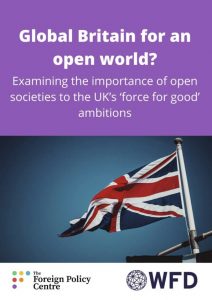
Digital Democracy from the ‘Global Britain for an open world?’ publication
Last month, the Foreign Policy Centre (FPC) and Westminster Foundation for Democracy (WFD) released a publication entitled Global Britain for an open world? Open societies around the world and the international system that supports them are under growing threat. This publication examines the importance of open societies to the UK’s ‘force for good’ ambitions. Edited by Adam Hug (FPC) and Devin O’Shaughnessy (WFD), it features several contributions from leading voices in Open, including Creative Commons CEO Catherine Stihler. Access the full publication here and read Catherine’s ‘Digital Democracy’ article below.
For digital democracy to succeed across the world, we need an open reformation in our democratic systems, practices and mindset. Far from radical, this is essential if we are to promote liberal democracy and open societies across the globe.
If the pandemic has taught us anything, it is that new ways of doing things are possible – if not preferable – and open access, data and content have played a critical role from developing a vaccine in record speed to citizen science initiatives tackling the virus in local communities. At Creative Commons we are proud of the part we play in enabling sharing in the public interest through our open licenses, creating open access to knowledge, culture, research and data worldwide. The Open COVID Pledge, freeing thousands of patents to be used in the fight against the virus, is just one example of our leadership in opening up knowledge for public good.
Across the world, our digital lives have enabled us to continue working and living when our physical world has been closed or limited. And now as we slowly return to a new normal, what can we learn from what we have just experienced to promote the benefits of digital democracy in the support of open societies across our world?
Digital democracy and human rights
Contained in the G7 Open Societies statement from July is the commitment to “protect digital civic space” through “capacity building and ensur[ing] that the design and application of new technologies reflect our shared values, respect human rights and international law, promote diversity and embed principles of public safety”. Taking human rights and international law, if digital democracy is to succeed human rights on-line and off-line must be protected and promoted. For what is legal off-line should be legal on-line and by default what is illegal off-line should be illegal on-line, where this supports democratic values. To protect individual human rights, digital democracy and an open society, we need to ensure that human rights today reflect our digital reality particularly as we seek to balance privacy with progress, our data rights with innovation.
Article 27(1) of the Universal Declaration of Human Rights is clear – ‘everyone has the right to freely participate in the cultural life of the community, to enjoy the arts and share in scientific advancement and its benefits’. On culture, during lockdown only those with internet access could enjoy a cultural life and even then it was limited to what collections galleries and museums could legally take place on-line. With internet access no longer available in public libraries, the poorest and most vulnerable were left even more isolated than before. Only those that could afford to subscribe to certain content channels could view the latest films or consume up to date content – a life line when we were locked down. Yet the benefits of open scientific research could be clearly evidenced during the pandemic when sharing research and open data literally helped save countless lives. Not only did official scientific research, the majority of which was publicly funded with an open access requirement, illustrate the impact of open practices but citizen driven open initiatives to understand and tackle the virus contributed to local understanding and decision making. It is a tragedy that open research sharing did not go further to open patent sharing and so once again the Global South suffers.
Two thoughts stem from here – where institutions and individuals were familiar with open practices and principles on-line, where trained individuals could volunteer or public funding supported, their application evidenced impact and results with scientific breakthroughs such as vaccines in record time. Those organisations that did not have the skills, resources or where the practices were not part of the culture and mindset, clearly lost out. Museums who digitised stayed accessible, those who did not remained closed. If we can learn anything from the pandemic and apply it to digital democracy, it is that for digital democracy to succeed and for an open society to flourish, we need digital skills, data skills, an open culture, clear communication and most importantly resources to support these actions. In a data driven society, digital democracy for open societies will only succeed if there is trust in the technology and its benefits.
China
In China we see the opposite of digital democracy – digital autocracy. I remember visiting China in 2008 being made aware that we were clearly being observed as foreigners. Fast forward to 2021 and there is no need for humans to be involved in day-to-day surveillance when cameras and biometric facial recognition can observe both foreigners and the population as a whole. The Chinese state-run biometric facial recognition technology holds data that controls an entire population in real time. No other country has this level of surveillance conducted by the state. Jaywalk in the street and a camera can pick up your indiscretion and ping you on your phone as a warning. If a multiple offender, it could potentially lead to a low social scoring, affecting job opportunities, an entire family’s standing in the eyes of the state or worse still, arrest.
For many Chinese, this is not a violation of human rights but about the state’s responsibility for their individual personal safety. For many the state’s intervention is welcomed by those where safety comes before freedom. For outsiders looking in this appears the epitome of Big Brother, the Orwellian control of a population with chilling effects. Yet as we condemn China, the UK and many G7 democracies use similar technology which has led to wrongful convictions and poor decision making, affecting prisoners, asylum seekers and people of colour. If we are to succeed in creating technology, as the G7 has described, which respects human rights and the rule of law we will need to lead on creating trusted open and accountable systems, with a human hand of care looking after the public’s interest. Currently there is a rash of regulation hurtling towards policy makers – some in the name of on-line safety which could have the chilling effect of stifling free speech, banning on-line content which would otherwise be legal off-line and detrimentally affecting individual human rights and freedom of expression. Proposals in Australia, according to Digital Rights Watch, could see new laws which would allow for hacking into your computer, your online accounts and any networks you had been in contact with. This would happen without you knowing or even without requiring a warrant. Clearly the on-line/offline human rights issue will become increasingly important as regulation is considered by Parliaments across the world.
Open Reformation in practice
To be a leader in digital democracy, we need to be aware of the complexity and trade-offs required both to defend and promote open societies. It is no coincidence that just as summer holidays ended and schools returned, there was an announcement by the Chinese Government that they would be restricting the amount of time minors played video games to an hour a day on Fridays, weekends and holidays. Many parents with teenage kids, me included, on the surface could not agree more about limiting screen time. But surely that is a parent’s job, not the state’s? Gaming today, what you eat tomorrow? Digital democracy could help society collectively find an alternative inclusive approach to this issue opposite to autocracy, using open, inclusive methods to reach consensus and make decisions. During the pandemic Taiwan has stood out on using digital democracy to empower citizens and promote an open society.
If ever there was an open reformation approach, Taiwan is its embodiment. Yet, their success is hugely down to leadership and that of one inspiring, wise and radical individual, Audrey Tang, Taiwan’s first ever digital minister. Tang understands technology. She is a free software programmer and in line with her open values makes herself available for interviews, conferences, summits and podcasts. She took the time recently to talk to Creative Commons in our Open Minds podcast where her passion and enthusiasm for open content licensing shines through. Her approach is often described as ‘radical transparency’ but her direct openness has benefited the world, helping to understand what open can empower and change.
Taiwan is both walking the walk and talking the talk driven both by geopolitical necessity but also reckoning that society has changed and democracy needs to reflect a new reality. In a recent interview for Noema, Tang quotes the Taiwanese President, Tsai Ing-wen who said “Before, democracy was a showdown between two opposing values. Now, democracy is a conversation among many diverse values.” This is why vTaiwan (virtual Taiwan) has at its core the belief that “the government and the citizens must have the same information so that there is a trustworthy basis for public conversation”. Open information helped Taiwan during the pandemic whilst the UK Government struggled with the very concept of open sharing information and data. If the UK is to promote open methods, information available to the government must be available to citizens, warts and all. What Taiwan teaches us is that to be effective in digital democracy technical understanding is critical. Taiwan’s success is down to their leadership and what open software enables. There are very few governments across the globe with a free software developer at the helm of digital policy making and yet with Web 2.0 (mobile, social and the cloud) moving to Web 3.0(Sir Tim Berners Lee coined the Semantic Web) (edge computing, AI and decentralised networks) we need to bridge the knowledge and culture gap before it becomes a chasm.
Open digital tools
Interoperability
To be a leader in digital democracy we need to place open digital tools at the heart of government decision making. These tools, freely accessible to use, are also more cost effective compared to their proprietary alternatives. Huge amounts of data and knowledge remain locked away even after a decade of open government initiatives. Often this is not by design; data does not talk to data, lack of interoperability between systems creates barriers and for the vast majority of civil servants and government ministers who are not data specialists this world is alien, complex and ironically feels so far from open that for the majority it feels in accessible, closed and elitist. This leads to those who understand this world to be evangelical concerning its benefits and whilst those who do not are at best ambivalent at worst hostile. For digital democracy to succeed and open societies to flourish we need a ladder of engagement making the world of Web 3 mainstream and accessible. This will help dispel myths, create understanding and foster trust.
Digital Open Champions (DoCs)
What if, barring reasons of national security, that all UK Government data were openly licensed in the same format and then promoted by those departments for citizen use or even cross departmental collaboration and experimentation? What if there’s a new leadership/coordination of data scientist/ethics driven civil servants, (the US announced a similar idea), who can communicate with a lay audience – let’s call them Digital Open Champions (DoCs)? A fast track of young, student recruits who can navigate this virtual world supported by their political masters. This could be painted as a recruitment exercise to attract a new, enthusiastic and change-driven cohort who want government to be run for the people by the people, with data at its centre. Mirroring Code for America’s volunteering leadership work, DoCs would not just be recruited in central government but in local government helping communities and volunteers create solutions to local problems. DoCs would form the first remote and distributed cross departmental team breaking silos in central, local and devolved governments. However, part of their role, similar to the not for profit world, would be not just technical proficiency but also communication for impact and change.
Storytelling and Ethics
Freeing the data is one step, communicating clearly and effectively the potential usage is another. Just like in the not for profit world, impact stories would determine success and create more budget relieving resources for even greater open reformation. This open reformation would also consider aspects of content, data and knowledge from an equity and ethical lens – creating the first ethical data collective separate from government, but which individuals could opt into if they desired as a trusted source of learning and inspiration. As social media platforms are forced to become interoperable – whether that is due to anti-trust or through platform regulation – users potentially could take their data and apply it where they want for the causes they care about and Web 3 will allow this to happen whilst preserving privacy. Could Web 3 be the key to unlock digital democracy benefiting citizens, parliaments and governments and by default promote open societies?
Conclusion
We are only at the beginning of this journey, but by considering the power of open data, content and sharing as it empowers digital democracy in support of open society principles, we are at a moment where open tools stand in defence of our central belief in democracy where:
Global Britain has the potential to showcase the use of open software, openly licensed content, research and data, as a leading player in the open reformation by both leading at home through Digital Open Champions but promoting abroad through FCDO support.
Open tools championed by the FCDO can promote an open global research space for the global public good.
Design and application of new technologies can reflect our shared democratic and ethical values.
Open technologies can help deliver a shared future, supporting healthy democracies and open societies across our world.
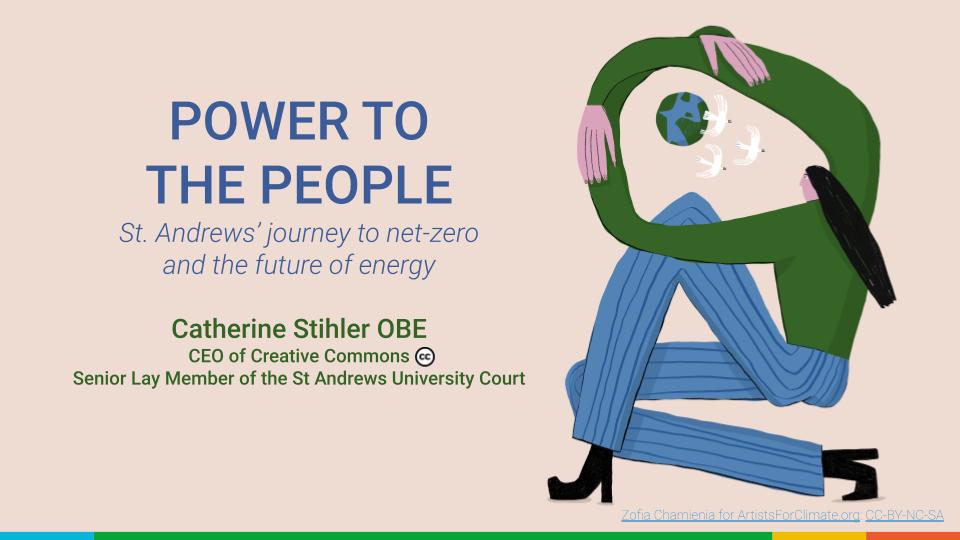
Power to the people
On Thursday 28 October 2021, Creative Commons CEO Catherine Stihler delivered a keynote at the University of St Andrews’ Power to the people: St Andrews’ journey to net-zero and the future of energy event ahead of the annual United Nations Climate Change Conference, officially known as the 26th Conference of Parties, or COP26. In her keynote, Catherine discusses how open access to research and data, and the ability to widely share context-specific approaches, are key to unlocking sustainable solutions for every facet of climate change and preservation of biodiversity. Read the full speech below and access the presentation slides here and the video here.
Introduction
Good evening and welcome to this wonderful COP26 event. I’m Catherine Stihler, CEO of Creative Commons, and the elected Chair of University Court, the governing body of the university. So I stand before you this evening with my two distinct but related hats on.
Let me start with Creative Commons. Also referred to as CC, is an international nonprofit organization dedicated to building and sustaining a thriving commons of shared knowledge and culture that serves the public interest.
CC removes the legal and technical obstacles to sharing knowledge to help society overcome its most pressing challenges, from climate change to health emergencies to education for all.
CC has been at the forefront of the digital commons for 20 years, partnering with activists and advocates, institutions, and governments to build a more equitable, accessible, and innovative world. And on our 20th anniversary year, we have made a commitment to “Better Sharing” and advocating for open access to knowledge and culture.
Part of our work supports efforts in the creation, adoption and implementation of open access policies. CC assisted the UKRI in developing a new open access policy, which launched in August 2021. This move will increase opportunities for the findings of publicly funded research to be accessed, shared and reused in the UK research community and globally. CC also helped write the UNESCO Recommendations for Open Educational Resources and Open Science. We are now working through three coalitions to help national governments implement the recommendation on Open Education and we plan to do the same with Open Science.
I’m excited to speak with you today with both my professional and St Andrews hats on, in order that we can achieve together our net zero ambitions by 2035.
1979
In 1979, data collected over 130 years – since reliable records were kept – indicated that global temperatures were rising.
That same year, government leaders launched the First World Climate Conference in Geneva.
The science of climate change was just emerging, and nations in attendance were urged “to foresee and prevent potential man-made changes in climate that might be adverse to the well-being of humanity.”
Declarations at the conference identified that increased atmospheric concentrations of carbon dioxide from the burning of fossil fuels, deforestation, and changes in land use was the leading cause that the planet was warming.
In 1990, when the Second World Climate Conference was held, scientists and technology experts at the conference issued a stronger statement about the risks.
Margaret Thatcher delivered a speech at the conference, comparing the threat of global warming to the Gulf War – which was then just escalating following Iraq’s invasion of Kuwait. She also talked about the importance of research.
Breakthroughs in science – and many other disciplines – come from access to knowledge and for 20 years, Creative Commons has been working with governments, institutions, foundations and activists across the globe in a coordinated effort to openly license scientific research articles, data and educational resources.
Thatcher Quote from 1990
Briefly returning to Margaret Thatcher, in 1990, she mentioned the power of a coordinated effort, “We must also make sure that research is carefully targeted. Too many people can do the same thing, and at the same time vital problems can be neglected. The task of global observation is immense. It will require a coordinated effort more ambitious than any attempt before, as the meeting of scientists and experts last week recognized.”
Developments at the Second World Climate Conference led to the establishment of the
United Nations Framework Convention on Climate Change as a framework for international cooperation to combat climate change.
The Conference of Parties, known as COP, is the decision-making body responsible for monitoring and reviewing the implementation of the United Nations Framework Convention on Climate Change. It brings together the 197 nations and territories – called Parties.
Getting real and UK action
So here we are, decades later, swimming in the effects of our actions, or lack-there-of.
Is it reassuring that scientists saw this coming, or is it reprehensible that we waited so long to coordinate efforts? Both.
Last week during a BBC interview, America’s climate envoy John Kerry said that the COP26 summit in Glasgow is the “last best hope for the world to get its act together. He said that if greenhouse gas emissions were not reduced by 2030, there was no chance of holding the rise in the earth’s temperature to 1.5 degrees Celsius.
The UK has already experienced 1.2C of warming compared to preindustrial levels and a mean sea level rise of 16cm. The 1.5 degree goal was set in The Paris Agreement in 2015.
Put into perspective, if we don’t limit global warming below two-degrees, sea-levels will rise several meters, and tropical reefs will be extinct. If the planet warms three-degrees, there will be forests in the Arctic, and most coastal cities will be gone.
Four? Europe will be in permanent drought. Polynesia will be swallowed by the sea.
Five Degrees? According to the world’s leading climate scientists – the end of human civilization.
With doom and gloom on the horizon, many countries are finally prioritizing a low-carbon future.
70% of the world economy is covered by net zero targets, up from less than 30% when the UK took on the Presidency of the COP26.
The UK was the first country to pledge to reduce carbon emissions by 78% by 2035, and completely phase out coal power by 2024.
The Prime Minister has set out a Ten Point Plan for a green industrial revolution.
Time is ticking. Our “last best hope” IS now.
Urgent solutions
Floods. Droughts. Heat. Extreme weather disrupts and threatens lives and infrastructures. Fluctuating temperatures create conditions for disease to spread. It accelerates food insecurity and can cause stress, anxiety and other mental health disorders. Even slow-developing events – like droughts – have even been linked to increases in suicide.
We need urgent solutions. Just imagine if the research from climatologists, biologists, geoscientists, engineers, psychologists were open to all. This multidisciplinary approach to looking for solutions could lead to incredible discoveries, much like the accidental penicillin breakthrough.
Today, as more than 30,000 species face the threat of extinction, so much scientific research still remains locked behind paywalls. Many climate affected communities, particularly in rural and/or lower-resourced areas, are unable to access climate or biodiversity research or data due to prohibitive copyright laws.
While many researchers, governments, and global environmental organizations recognize the importance of the open sharing of knowledge to accelerate progress, they lack cohesive strategies and mechanisms to facilitate sharing and collaboration across disciplinary and geographic borders.
But challenges can stimulate opportunities.
Crises can motivate collective adrenaline and accelerate motivations and cooperative behaviors. During COVID-19, when under extreme duress, the scientific community turned to “open” to accelerate progress. This resulted in democratized sharing and accelerated discovery, as scientists from across the globe embraced the immediate, open sharing of preprints, research articles, data, and code. This adoption of openness contributed to the rapid sequencing and sharing of the virus’ genome, the quick development of therapeutics, and the fastest development of effective vaccines in human history. The lessons learned during the pandemic can and should be applied to accelerate progress on other urgent problems facing our society.
Open Research and Data
As you can see, there are many benefits of open access to research and data. Not only does this help ensure information is available to all regardless of their location or economic situation, but it helps accelerate processes and solutions.
Effective change will rely on collaborative interventions across policy, research, practitioners, and communities to create actionable, tailored, and evidence-based implementation strategies. This includes plain language summaries and open licensing enabling translation into local languages.
Under the current scientific journal publishing model, the cost of open access is falling on higher education institutions who pay exorbitant article processing charges (or APCs), whilst the publishers are reporting record profits. Individual researchers and their institutions are having to find thousands of pounds to do the right thing.
Governments and other research funders, researchers and public universities have an opportunity to rethink how we should fund, do and share research. If the purpose of research is to share peer reviewed knowledge with the public to make the world a better place, we need to think about research as a public good.
If we built a new system for producing and sharing scientific knowledge – what would we build and how would we fund it? How do we get to a world in which everyone has immediate open access to scientific research and data, authors can keep their copyright, and we spend significantly less public money producing and sharing quality, peer reviewed research? Could governments both require open access to publicly funded research and support public Universities to host and steward open access journals?
Open access to research and data, and the ability to widely share context-specific approaches, is the key to unlock sustainable solutions for every facet of climate change and preservation of biodiversity. This includes a greater investment in the inclusion and agency of affected communities in climate research, and robust policy frameworks which prioritize open access to publicly and foundation funded research.
To date, there has not been a coordinated global effort to address the challenge to open access to scientific research on climate change or biodiversity. But this will soon change. I am pleased to announce that the Open Society Foundations has funded CC and our partners SPARC and EIFL to lead a global campaign to promote open access to climate and biodiversity research. This is a promising strategy to accelerate progress towards solving the climate crisis and preserving global biodiversity.
Opening access to climate science shouldn’t be limited to scientific communities. In order to empower educators and students, science educational resources also need to be accessible for all. This leads me to open education.
Open Education
Scotland is one of the world’s leading countries in the Eco-Schools programme and COP26 provides us with a unique opportunity to recognize and celebrate our long-standing commitment to education and sustainability.
Scotland’s Learning for Sustainability is an excellent example of how access to educational resources can empower students, teachers and individuals. I’m proud that over 98% of Scotland’s local authority schools are registered in the programme, with 31% receiving the highest award – the Green Flag.
Battlefield Primary School in Glasgow has been involved in the programme since 2005 and are constantly striving to find new ways to make the school more sustainable and environmentally friendly. Their search led them to using solar energy as a school greenhouse.
When educators can share resources, they can improve curriculum and learning outcomes. Developing the next generation of environmental leaders is not just a good idea, it’s essential.
Does it seem reasonable that education in the age of the internet should be more expensive and less flexible than it was in previous generations? As people and knowledge are increasingly networked and available online, what will it mean for learning, work, and society?
As economies become increasingly global and networked, the skills and knowledge required to successfully acquire and keep good jobs require a higher education. All national governments invest in and have strategic goals for how their public education systems can support individuals, families, and the broader society.
Climate education is so important, and while big solutions like renewable and cleaner sources of energy will come from government and corporate action, individuals also have the power to make change at a grander scale by using your voice as a consumer, a customer, a voter and an active citizen.
Individual choices also provide a contribution for our future.
CC’s Sustainability Policy
At CC, we have made and are continuing to prioritize sustainable practices to minimize our impact on the environment. Our employees have been working remotely since 2015, avoiding commuter and office building impacts. Much of our program work is guided by the UN Sustainable Development Goals. We just completed our 2nd year having a virtual Global Summit, which eliminated the need for staff and community travel and food waste. When purchasing team equipment and locating our servers, we look for the most sustainable options. At CC, we don’t rest on our laurels, and we are currently developing more purposeful sustainability policies thinking about energy use of our employees with remote working, travel off setting, and like at St Andrews, training in personal approaches to sustainability.
St Andrews Sustainability (energy, mindset, travel off setting)
I know our Quaestor, Derek Watson, will talk more about the Eden Campus and the key part it will play to reach net zero by 2035. But as we look at Sustainability, the work of the sustainability board, and now sustainability being a key strategic pillar for the university, We know that to reach net zero by 2035 will require action for each and everyone of us.
Of all the actions, whether biodiversity, energy conservation, food choices, all of these require a mindset shift—traveling by car to an event like this tonight will need to be carefully assessed. Was there a public transport option? If not, could I have spoken remotely travel or who pays for the offsetting of my carbon footprint?
At the event itself, if there is food, are we looking at this sustainably? and the list goes on. We are entering a period of change where each and every one of us will play a part, and those who go above and beyond recognized for their endeavors.
Envisage 2035 – 14 years from now, where will we be?
So as I come to the end of my talk, fourteen years ago, in 2007, the UN Intergovernmental Panel on Climate Change issued the Fourth Assessment Report to assess scientific, technical and socio-economic information concerning climate change.
People from over 130 countries contributed to the report, which took 6 years to produce. This groundbreaking document is the largest and most detailed summary of the climate change situation ever undertaken.
Contributors included more than 2500 scientific expert reviewers, more than 800 contributing authors, and more than 450 lead authors. It cited over 6,000 peer-reviewed scientific studies.
Here are some of the findings.
Warming of the climate system is unequivocal, as is now evident from observations of increases in global average air and ocean temperatures, widespread melting of snow and ice and rising global average sea levels.
Most of the global average warming over the past 50 years is “very likely” due to human activities.
Unmitigated climate change would, in the long term, be likely to exceed the capacity of natural, managed and human systems to adapt.
And this one is essential! Many impacts of climate change can be reduced, delayed or avoided by mitigation.
Let’s flip this idea and look forward 14 years to 2035, when we will cross a point of no return to stop Earth’s temperatures from rising by 2 degrees Celsius and setting off a disastrous array of global disasters?
I hope we can all work together so that our findings look like this.
We’ve successfully halved emissions every decade.
The air is cleaner than it has been since the Industrial Revolution.
Trees are everywhere.
There are fewer cars on the road, and electric railways crisscross landscapes.
Smart tech prevents unnecessary energy consumption
Now that is a world that I would like to live in.
This is our last best hope.
Just imagine what we can achieve if we ALL work together.
Thank you for being here tonight and over to Derek.
As Open Access Week 2021 Draws to a Close, the UK Prepares to Host COP26
As International Open Access Week (25 – 31 October) draws to a close, the UK prepares to welcome the world to the COP26 summit (31 October – 12 November). Creative Commons CEO, Catherine Stihler, says the UK has the opportunity to unlock digital democracy if the government invests in and commits to open software, openly licensed content, research and data.
If the pandemic has taught us anything, it is that new ways of sharing information and knowledge are possible.
Open access, data and content have played a critical role, from developing a vaccine in record speed to citizen science initiatives tackling the virus in local communities.
But as we mark International Open Access Week across the globe, it’s clear that these lessons are not universally being learned.
Restrictive copyright systems and other barriers to access and sharing of knowledge and information are threatening the foundations of our free and democratic societies.
As the UK prepares to welcome the world to COP26, the importance of open data and open science in providing evidence-based solutions and required actions to achieve net zero and mitigate the impact of climate change is clear.
But the need for open access goes far wider than just the UK – it applies across the global research space, which must work together for the public good.
And there is an opportunity for a Global Britain that showcases the use of open software, openly licensed content and research and data, and becomes a leading player at home and abroad.
The launch of a new National Data Strategy and the UK Research and Innovation’s new open access policy are positive developments; but the UK’s ambitions must not be confined to its own borders. The challenges ahead of us require a global response.
If our international influence is as strong as the UK Government claims it is, then the current G7 presidency is an opportunity for the Foreign Office to champion open tools and promote the design and application of new technologies that reflect our democratic and ethical values.
Because there are major challenges to openness across the world.
In China, we see the opposite of digital democracy – digital autocracy.
The Chinese state-run biometric facial recognition technology holds data that controls an entire population in real-time.
No other country has this level of surveillance conducted by the state.
If we are to succeed in creating technology, as the G7 has described, which respects human rights and the rule of law, then we will need to lead on creating trusted, open and accountable systems – with a human hand of care looking after the public’s interest.
Currently, there is a rash of regulation hurtling towards policy makers – some in the name of online safety, which could have the effect of stifling free speech, banning online content which would otherwise be legal offline, and detrimentally affecting individual human rights and freedom of expression.
Proposals in Australia, according to Digital Rights Watch, could see new laws which would allow for hacking into your computer, your online accounts and any networks you had been in contact with.
So to be a leader in digital democracy, we need to be aware of the complexity and trade-offs required both to defend and promote open societies.
The UK can look to Taiwan for an open reformation approach.
Taiwan’s success is down to its leadership and recognition of what open software enables; but then there are very few governments across the globe with someone like Audrey Tang, a free software developer, at the helm of digital policy making.
For the UK to be a leader in digital democracy, we need to place open digital tools at the heart of government decision-making.
Huge amounts of data and knowledge remain locked away even after a decade of open government initiatives.
What if, barring reasons of national security, all UK Government data was openly licensed in the same format and then promoted by those departments for citizen use, or even cross departmental collaboration and experimentation?
What if there’s a new collaboration of ‘digital open champions’ (DOCs) – data scientists and ethics-driven civil servants who can communicate with a lay audience?
Because while freeing data is one step, communicating clearly and effectively the potential usage is another.
This International Open Access Week, coming just ahead of COP26 and near the end of the UK’s G7 presidency, is an opportunity to unlock digital democracy – benefiting our citizens, parliaments and governments.
Creative Commons (CC) Certificate: available in Yorùbá, Burmese and Turkish!
The CC Certificate is a global learning opportunity covering open licensing and the ethos of sharing. The Certificate is built with the intention of adaptation and remix. While the CC Certificate courses address (1) educators, (2) academic librarians, and (3) the galleries, libraries, archives and museums (GLAM) communities, everyone is welcome. We seek opportunities to share and adapt the Creative Commons Attribution licensed (CC BY) course content for different cultures, languages and countries. The more audiences for whom the content resonates, the greater the impact of our open licensing tutorials.
Today, Creative Commons proudly presents the latest translations of the CC Certificate course content. Thanks to CC Nigeria, CC Turkey, and the following individuals, our course content on open licensing and recommended practices for open sharing are available to over 140M Yorùbá, Burmese, Turkish language speakers around the world.
Orçun Madran, CC Turkey, Global Network Council Representative
Adéṣínà Ghani Ayẹni (also known as Ọmọ Yoòbá) and CC Nigeria completed the Yoruba translation, sharing it with a Nigerian case study at the end of 2020. Through the practice of neologism (coining of new words), Ọmọ Yoòbá introduced new words to describe copyright concepts covered in the Certificate content, which were not previously part of the Yorùbá vocabulary. CC Nigeria organized a team of reviewers, including Yorùbá language teachers and tech experts, to ensure the content’s accuracy. Access the Yoruba translation and country case study here.
As part of the Transformation by Innovation in Distance Education (TIDE) project, Dr. Beck Pitt led the collaborative remix of the Creative Commons Certificate programme for Librarians. The course is available in English and Myanmar languages, with accompanying facilitated course materials, here.
Thanks to Goethe-Institut Istanbul’s financial support, CC Turkey was able to translate CC Certificate course content into Turkish by September 2021. CC Turkey volunteers proofread and localized content, under the coordination of Ilkay Holt and Orcun Madran. The Turkish translations, published here, will help reduce the gap in the relevant Turkish open licensing literature. Turkish librarians, educators, GLAM specialists, funders and other interested parties can educate themselves and train their audiences, adopt good practices in using licences, and make their works and digital collections more open.
The three translations and Nigerian case study are added to the CC Certificate website, along side the Arabic and Italian translations. While Creative Commons does not vet translations or update them with our annual content updates, we are immensely proud to share them as accompaniments to the core CC Certificate content. We celebrate having the CC Certificate materials now available in six languages: Arabic, Burmese, English, Italian, Turkish and Yoruba!

 The CC Copyright Platform was established as a discussion space to strategize on copyright reform as a complementary action to developing and stewarding CC licenses. Over the last few months, each working group has discussed, researched and dissected these issues, and produced four Position Papers encapsulating their outcomes, available now on the CC Medium Publication.