Cloudflare leak: Please reset your CCID password
Web services company Cloudflare revealed late yesterday that it had experienced a large-scale memory leak. About two million websites use Cloudflare for services like content delivery and Internet security. Creative Commons uses Cloudflare, and we investigated this issue as soon as it was reported.
We have not found any cause for concern—as far as we know, CCID login data was not exposed. And because our donor data did not touch the Cloudflare service, we do not believe it was ever at risk. Additionally, Cloudflare has contacted us directly and informed us that we are not among the sites they know of that were affected by the leak.
Despite this, out of an abundance of caution, we are requiring all CCID users to reset their passwords. We are sending emails to CCID users asking them to do this immediately by going to login.creativecommons.org.
If there are any changes, we will be in touch to let you know. For more information about the Cloudflare memory leak, read the company’s incident report.
Update on Great Minds v FedEx Office Litigation Involving BY-NC-SA
Update: Shortly after publishing this post, we received word that Judge Hurley today has granted defendant FedEx Office’s motion to dismiss. You can read the order here [pdf]. This is the very result CC advocated for in its motion for leave to file an amicus brief,and we’re delighted with the outcome, the ruling, and the court’s analysis. The court found on the facts as presented by Great Minds, FedEx’s copying is permitted by the “unambiguous” terms of BY-NC-SA. Look for an in-depth post on the decision and its implications for users of the NC licenses and users of NC-licensed works next week.
Earlier this week, Judge Hurley issued an order denying our motion for leave to file an amicus brief at this stage in the litigation between Great Minds and FedEx Office. The central question in that case turns on the proper interpretation of the CC Attribution-NonCommercial-ShareAlike 4.0 International license (BY-NC-SA). In our motion, we sought permission to file a brief in support of FedEx Office and to assist the court in its interpretation of the license. As detailed in the motion, we believe it’s clear based on the facts alleged that the conduct engaged in by FedEx Office when it copied educational materials at the direction of school districts, whose use everyone agrees is non commercial, is not a violation of the license. You can read our rationale for this interpretation in our earlier blog post and in our motion [PDF] seeking permission to file an amicus brief, and learn why we’re fighting to protect non commercial uses here.
We’ll be monitoring the litigation for an update on the pending motion by FedEx Office to dismiss the case. We look forward to seeing how the court resolves the issue consistent with its order, and look forward to participating in the litigation if our assistance is needed at a later stage.
A special thanks to Andy Gass and Jonathan Ellis, our pro bono counsel at Latham & Watkins, for their assistance with the motion and amicus brief.
Official Arabic and Croatian Translations of 4.0 Licenses Now Available!
Via a milestone translation effort, we are happy to announce the official translation of the Creative Commons 4.0 licenses into Arabic. An estimated 420 million people around the world speak Arabic, the sixth most spoken language in the world, making this translation effort the most far-reaching to date.
The Arabic translation is the result of an unprecedented collaboration among more than a dozen translation and technical team members from nine Arab countries. The translation team consulted with members of the CC community in the Arab world to achieve consensus on technical and legal terms. An online public consultation was conducted from July 12-21, 2016, following a face-to-face working session in Istanbul among several of the team leaders. The public consultation resulted in contributions by lawyers, active license users, linguists, translators, librarians, and representatives of cultural heritage institutions. Blogs, social media and a mailing list were used to inform the translation process. The Arabic translation was funded in part with the generous support of the Ford Foundation and Wikimedia Foundation.
Special congratulations go to Riyadh Al Balushi, Hala Essalmawi, Sadeek Hasna, Pierre el Khoury, and Mohammad el-Said for leading this multi-year effort, together with the terrific support of former CC regional coordinator Naeema Zarif.
 The Croatian translation is also notable and expected to have significant impact. While using standard Croatian legal terminology, the translation will not only benefit Croatian speakers, but also speakers of affiliated languages across the Southeast Europe. The CC licenses are used by a range of Croatian-language users, from Wikipedia, various online news outlets, political parties, open access repositories, down to individual creators and users of free cultural works.
The public consultation process took place from January through June 2016. The translation team reached out especially to the IP lawyers, professional translators and the Wikipedia community during the consultation process. Special thanks are due to Tomislav Medak, Marcell Mars and Diana Kovačević Remenarić. We want to also thank to Nena Antić from CC Serbia and Ante Jerić for their invaluable help and comments, as well as former CC regional coordinators John Weitzmann and Gwen Franck for supporting the translation.
Please visit our wiki for more details about these new translations. Congratulations to the teams on their work!
GISWatch 2016: addressing economic, social and cultural rights on the internet
 The current dominant public policy discourse on the internet and human rights addresses the importance of the these new technologies to empower civil liberties. There is no better example of this than freedom of speech, traditionally mediated by power structures that do not allow it to flourish. Another important stream of this discourse hinges on the security and surveillance debate – massive surveillance through technology due to security needs is one of the most serious challenges we are facing today in the field.
In spite, or perhaps because of this, there is less attention paid to the way those technologies affect or enhance economic, social and cultural rights (ESCR). Being seen as second class rights (or even third class, in some cases), there is a need to start talking about the importance of them to dramatically improve the live conditions of the least advantaged groups within our societies, both in terms of access to infrastructure, educational resources, access to health care, to work conditions, between others.
Such is the frame of the GISWatch report (Global Information Society Watch) of 2016. The aim of the report is cover to state of the information society from a civil society perspective worldwide. It was been published since 2006 as a collective effort of activists, scholars and academics leaded by the Association for Progressive Communications, and the 2016 report is just about internet and economic, social and cultural rights.
The 2016 report includes the work of several people within the Creative Commons global community trying to address issues related with trade agreements and ESCR, the right to educational resources and the internet, and the digital protection of traditional knowledge. This report is a key document to better understand the connections between technological advances and social empowering of human rights, particularly where access to knowledge and cultural resources is a key element.
The report is CC BY licensed as well!
Copyright Filtering Mechanisms Don’t (and can’t) Respect Fair Use
During Fair Use Week organizations and individuals are publishing blog posts, hosting workshops, and sharing educational resources about the implementation and importance of this essential limitation to the rights endowed by copyright. Fair use (and in other countries, the related “fair dealing”) is a flexible legal tool that permits some uses of copyrighted material without permission from the original rights holder, such as for use in news reporting, criticism, teaching, and other reasons.
Fair use and fair dealing are both a part of the larger constellation of limitations and exceptions to copyright. These limitations are a necessary check on the exclusive rights granted to copyright holders, and it’s important to expand and strengthen limitations and exceptions through fundamental copyright reform in order to protect the rights of the public in accessing and using creativity and culture.
We continue to support ongoing efforts to reform copyright law to strengthen users’ rights and expand the public domain. Last year the European Commission, the executive branch of the European Union, introduced its proposal for a Directive on copyright in the Digital Single Market. We’ve been working with Communia and other organisations to support positive changes to the EU copyright regulation, especially in promoting limitations and exceptions to the copyright rules that benefit users’ rights and the public interest.
How well does the Commission’s proposal balance the rights of content creators with the rights of the public? The answer: poorly. There are well-intentioned but flawed proposals for exceptions on digital education and text and data mining. Now the relevant committees are providing feedback and amendments to the original proposal, and the Committee on Culture and Education might be listening to the suggestions from civil society organisations. Its draft opinion suggests the introduction of additional exceptions for User-Generated Content, and Freedom of Panorama. These could help correct some of the imbalance in the Commission’s plan.
But perhaps the most troubling aspect of the proposal is Article 13, the section of the Commission’s legislation that would set up a preemptive copyright filtering mechanism for user contributed content. The Commission proposes that information society service providers (ISSP) that store and give access to copyrighted materials that their users upload must take specific measures to ensure that these materials do not contain other rightsholders’ works. In other words, ISSPs will need to adopt technology that would effectively recognize and prevent uploads of any content that includes even fragments of videos, music, pictures, and any other type of work that belongs to someone other than the person sharing it.
The filter mechanism would apply to all user-uploaded content. It would operate blindly—which means it couldn’t tell the difference between a piece of content being shared improperly and a piece of content being shared under an existing exception to copyright. As Communia wrote last week, upload filters don’t—and can’t—respect user rights:
Upload filters cannot recognize existing freedoms such as the right of quotation or parody. The draft opinion ignores case law of the Court of Justice of the European Union that states that monitoring content is in breach with freedom of expression and privacy.
This type of “shoot first, ask questions later” filtering approach is detrimental to users and could lead to a chilling effect on those who would otherwise attempt to use copyrighted content under an exception to copyright. The Commission’s proposal and the draft opinion of the Committee on Culture and Education suggests that the responsibility should be on users to complain if their content is taken down. This is an unfair burden.
The collateral damage to user rights associated with filtering mechanisms is not a new problem. For years platforms such as YouTube have struggled with how to fulfill their legal obligations to remove protected content posted without the permission of the copyright holder, while at the same time attempting to take into consideration that some uses of works are made under fair use or another exception to copyright.
As we continue the fight for sensible copyright reform in Europe, we know that any EU legislative requirement aimed at addressing the unauthorized use of third-party content needs to fully respect the freedoms enshrined by exceptions and limitations to copyright.
European Space Agency announces new Open Access Policy for Images and Data
Yesterday, the European Space Agency announced an Open Access policy for images and data under a Creative Commons BY-SA license. ESA has made various moves toward making data and images more open in the past, but this announcement is a major milestone for the organization’s commitment to openness.
Previously, ESA released individual images under Creative Commons licenses, but this organizational shift marks a substantial change in the way that ESA shares with the world. The choice of CC BY-SA clears ESA’s content for use in larger repositories like Wikipedia (and Wikimedia Commons), as well as by any individual member of the public. It also reaffirms the organization’s commitment to widely sharing open data and imagery across the web.
“This evolution in opening access to ESA’s images, information, and knowledge is an important element of our goal to inform, innovate, interact, and inspire in the Space 4.0 landscape,” said ESA Director General Jan Woerner in the organization’s announcement about the new policy.
Because many ESA images are created in collaboration with partners, this first release under CC BY-SA is limited to content that is completely owned by ESA (or for which any third-party rights have been cleared). The organization plans to release other sets of images under CC BY-SA in future phases of this new Open Access project.
The full repository includes the Rosetta images, “Sounds from Space,” Earth Observations from the agency, Hubble images and video, and the Planetary Science Data Archive.
Ground Control to the ESA, you’ve really made the grade! Check out the entire archive.
Announcing CC’s new board chair, Molly Shaffer Van Houweling, and newest board member, Ruth Okediji
I am thrilled to announce the appointment of two new members of the Creative Commons Board of Directors: Molly Shaffer Van Houweling and Ruth Okediji. In addition, the board has selected Molly Shaffer Van Houweling to serve as Board Chair. Molly is a brilliant and accomplished legal academic with an extensive history with Creative Commons and the open movement. Ruth is a highly esteemed international copyright and intellectual property lawyer, professor, and author. She is also a keynote speaker at this year’s Creative Commons global summit.
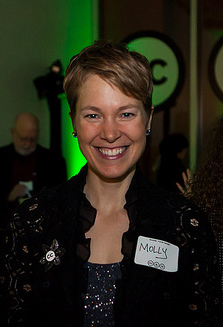
Molly was Creative Commons’ first Executive Director from 2001-2002. As one of the key members of the original CC team, she was critical in designing CC’s legal infrastructure and drafting the legal language for Creative Commons copyright licenses. Since then, she has served in various roles on the CC Board of Directors and Advisory Council. She is a Professor of Law and Associate Dean at University of California at Berkeley, School of Law, where she has taught since 2005. Her work in internet and technology policy and copyright is vast, and she has held fellowships at Harvard’s Berkman Center and Stanford’s Center for Internet and Society. She also serves on the board of directors at Author’s Alliance and was an early employee at ICANN. Molly is also one of the fastest women in the world on a bicycle, setting a 2015 World Record by cycling 46.273 km in an hour. She is also a five-time UCI Amateur Road World Champion.
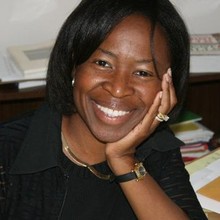
Ruth Okediji is William L. Prosser professor of law at the University of Minnesota. Ruth was also part of the process of negotiating the recently approved Marrakesh treaty; she joined the Nigerian delegation and helped lead the African Group. Her upcoming book, Copyright Law in an Age of Limitations and Exceptions, will be published in March by Cambridge University Press. Professor Okediji is the author of several books on copyright and intellectual property and is regularly cited for her work on IP in developing countries. She is an editor and reviewer of the Journal of World Intellectual Property, and has chaired the Association of American Law Schools Committee on Law and Computers, its Committee on Intellectual Property, and its Nominating Committee for Officers and Members of the Executive Committee.
CC’s outgoing board chair, Paul Brest, will remain on the board for the balance of the year to facilitate the transition for Molly. Our current vice chair Chris Thorne, was reinstated. Paul has been a tremendous board chair, guiding CC through many challenges and new opportunities, and we would like to thank him for his service to the organization. I’m personally grateful for his friendship, guidance and ongoing support.
CC is very excited to welcome Molly and Ruth to the Board of Directors. The accomplishments of these remarkable women as lawyers, academics, and trusted advisors to Creative Commons cannot be overstated. On behalf of the entire CC board, I am thrilled to welcome them in their new roles.
Transforming public spaces with the Institute for Infinitely Small Things
The Institute for Infinitely Small Things addresses the commons through an art for all approach to engage with the political through their work in public spaces. As a research and art praxis group, their work is interdisciplinary and site-specific, yet it draws on data, multimedia, and documentation to concretize their ephemeral performance pieces on the web and beyond.
Over the past thirteen years, the collective has “conducted creative, participatory research to temporarily transform public spaces dominated by non-public agendas,” engaging with “social and political tiny things.” In encouraging interaction with the spaces that surround their installations, the Institute’s work is personal and political and works as a vehicle for local change wherever they find themselves.
Many of the Institute’s projects can be perused on the website of Berlin-based artist Nicole Siggins, who answered questions for this interview, or at their website.
As an artist-run organization concerned with public engagement, what kinds of tactics do you use to encourage participation in your projects?
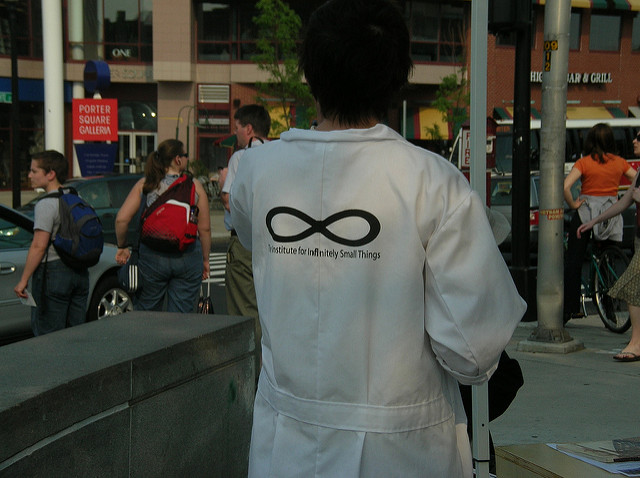
We perform many of our actions in public view, whether that be on the street in the middle of a busy square, while engaging a classroom, or in an exhibition space. When working in public space we use humor and spectacle to spark curiously in the people around us. This in turn brings people in closer to us, where we can then engage them in the project by asking questions about what they see and perceive, both in the actions we are taking and how it relates to the world and spaces around them. Tactics we have used in the past are wearing lab coats, moving our bodies in unexpected ways, using the landscape in a way that is different from its intended use, creating barriers, getting in the way, and obstructing pathways as a way of encouraging interaction.
A good deal of your work is temporal, yet it is the kind of art that thrives on the internet – videos, remixes, and datasets, like the Corporate Commands dataset. How do you balance site-specific installations with sharing your work online? Do you believe that making your work accessible to a larger audience will encourage its dissemination?
It is important to us that the work continue on its own path once we are finished with it. We are less interested in claiming ownership over the works than we are these works existing on their own to inspire others to engage more consciously and constructively with the world around them. Site specific installations are important because we get to engage with the local public in a space that belongs to them. This is, at heart, the core of the work. However, we truly hope that seeing our work online encourages others to continue to engage with the subject matter long after any site specific installation is over. We do hope that making our work accessible to a larger audience will encourage its dissemination and will encourage people to come up with their own similar ideas or begin their own Institute like groups.
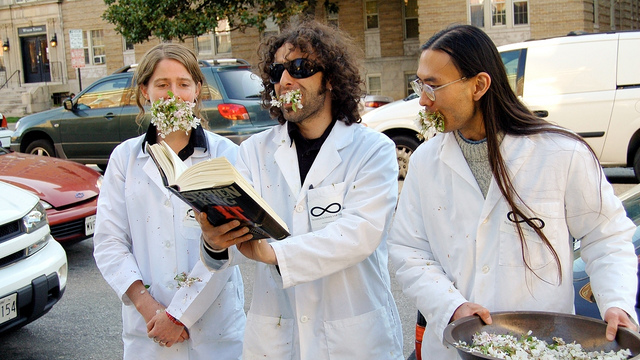
The Institute for Infinitely Small Things – Corporate Commands: Say It With Flowers via Eyebeam CC BY-NC 2.0
So many of your installations involve seeking meaning in objects, work, capital, feelings, and politics. How do you bring the personal into the political in your work? How do you conceive of these interventions and installations?
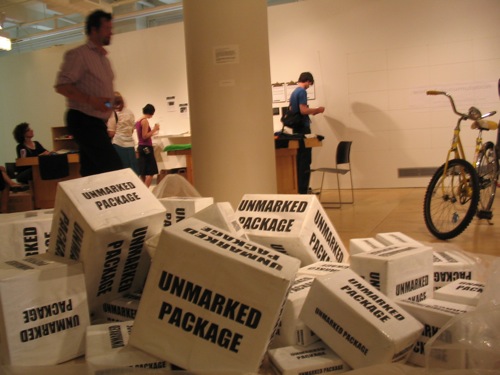
We believe that the personal is the political. Our ideas come from what is going on around us in our political and personal climate. For example, our project “Unmarked Package: A Case for Feeling Insecure” brought us through may different Chicago neighborhoods, setting up a temporary installation of empty boxes which were wrapped in white paper and marked “unmarked package” on all four sides. We then spoke with the residents of each neighborhood about how they would react if they saw an unmarked package and if being super vigilant made them feel safer. This idea emerged from living in a world where we are repeatedly told over intercoms and loudspeakers in train stations and airports to be cautions and to be on the look out for “suspicious behaviour” or “unmarked packages.” Our project was a vehicle to better understand the permeating culture of fear that exists all around us and to engage the public on whether these announcements and behaviors overall made us feel more safe or threatened. Thus, the objects that appear in our works are only a vessel to get the conversation going and to begin a dialogue about what is happening around us in our world.
Video: CC BY-N.C. 3.0
As a research institute, you came of age during the Bush administration and continued to create work through Occupy and other social movements. How do you see your work changing in scope with the new administration in the US? What’s next for the institute?
There is definitely a lot to talk about with the new administration in the USA. Last spring we ran the Campaign Limericks project, a series of events that analysed the speeches of all the political candidates using DataBasic. The goal of the project was to remix the presidential candidates’ speeches into limericks by finding the most used words in the speeches. It went over well and some of the limericks came out really great! We had events in Boston, Des Moines, and Hartford. Our projects tend to emerge out of community discussion. Right now there is so much going on with the new administration that it is difficult to focus on one topic. However, the ideas of borders, space, and fear have been past topics of our work that only seem more relevant in the current political climate. We hope that we are able to find ways to speak to a greater audience and bring more light to the issues at hand. We want to get people involved and to feel like they are an important piece in changing the world and raising awareness.
What do the commons mean to you? How does your work foster a robust global commons? What do you see as the future of the commons?
In Boston, when we refer to commons, we are often speaking about a physical space, such as the Boston Common. In this sense, our work relates to and promotes interest in the public spaces around us and how they are used. We hope to influence others to take stock of the spaces around them and have a critical view about why things happen as they do. Why are all the streets in Cambridge, Massachusetts named after white men when the current city is so diverse? Why are people harassed and accused of having crossed the border when a border itself is placed right though their previously existing community? Why is it impossible to find something free to to in Harvard Square? The commons and public space should belong to everyone. Our work aims to help people think about and realize that in their own lives.
As for the more abstract commons (information, ideas and concepts that are free for anyone to use) the Institute works to involve everyone in the art we perform. We strive to show that art and research is the commons – it’s accessible to everyone! Making art and using performative research to get people thinking and talking helps bring people together to have important conversations about what is going on in our communities. Sharing our art and ideas on the Internet further spreads the invitation to the wider world. In this way, we use the commons in both senses to invite people to begin to have these important conversations.
Job Opportunity: Director of Product Engineering
On February 7, 2017, Creative Commons released a public beta of CC Search. Our goal was to inspire discussion, debate, and ideas on how we can build a front door to the commons, and make content more discoverable and usable, and foster a culture of collaboration and gratitude. Now we’re looking for a Director of Product Engineering to lead that team at CC.
At Creative Commons it’s important to hire talented, diverse teams and advance women in leadership roles, and we’ve worked diligently this past year to ensure more of those voices are part of our team. You can help: if you know a bright, creative, technically-proficient woman or someone from a diverse community who wants to change the world with us, encourage them to apply. If that person is you, I can’t wait to hear from you.
There is no “front door” to the commons, and with over 1.1 billion works on platforms all over the world on over 9 million websites, the tools people need to curate, share, and remix works aren’t yet available. We launched the CC Search beta on February 7, 2017, indexing about 1 percent of the commons, and a focus on images as a first media type. We have had a great initial response and positive media coverage. But we have so much more to do to reach the scale of our ambition.
This project will unite billions of records for works and metadata, multiple platforms, diverse media types, and a variety of user communities and partners. It’s a difficult but rewarding problem for an inspired and creative leader. We want to build this product with a small dev team as part of an open community, and create something useful, delightful, and essential to the work of creators, educators, scientists, cultural institutions, and our partners.
Primary Responsibilities
The Director of Product Engineering reports to the CEO and will lead the development and implementation of CC’s products and services. You’ll be responsible for the CC Search roadmap and the review and enhancement of existing tools to ensure their successful adoption on the web. This is a rare opportunity to lead within an organization that is fundamental to sharing online, operating at a global scale. The successful candidate will lead a technical team to meet the needs of this vital organization, and to build a more vibrant, usable global commons, powered by collaboration and gratitude.
We believe that diverse teams build better organizations and better services. Applications from qualified candidates from all backgrounds, including those from under-represented communities, are very welcome.
The Director of Product Engineering leads the technology team to:
- Develop, lead and implement an ambitious product strategy, including a product and service roadmap for CC Search and other relevant services. Lead a small team aligned with our goal of a more vibrant, usable commons powered by collaboration and gratitude
- Attract and oversee a small team of software developers and UX designers to build innovative, robust software both for CC use and for public release
- Work in the open, in public repositories, open chat rooms, public wikis and a global community
- Work with the CEO and Director of Development to seek funding for CC’s various technical projects
- Represent the organization and provide technical leadership within various open communities and with CC partners. Coordinate with other outside communities, companies, and institutions to further Creative Commons’ mission, for example: W3C, non-profit communities like EFF, Open Knowledge, and Wikipedians, and the open data, open access, library, and open education communities
Qualifications and requirements
- Proven team and product leadership, and an entrepreneurial spirit: a collaborative, motivated self-starter
- Demonstrated experience building and deploying large scale web services; experience on mobile is a plus
- Ability to identify and scope user requirements and develop specifications
- Excellent management, written, and oral communication skills
- Familiarity with content licensing including Free/Open licenses a plus
- Familiarity with consumer privacy
- Fluent in one of Spanish, Arabic, or French (in addition to English) a plus
- Desire to work in a diverse, global, highly collaborative team environment
Work Environment and Location
Creative Commons is a distributed organization. This position is available to applicants in Canada and the US, in a remote working environment, provided they have reasonable mobility for necessary travel, and high-speed broadband access. Laptop/desktop computer and necessary resources are supplied. May require some travel.
How to Apply
Please email your cover letter and resume as a single PDF to “jobs@creativecommons.org” with the subject heading of “Director of Product Engineering / [Last Name].” No phone calls, please.
About CC
Creative Commons is a nonprofit organization that enables the sharing and use of creativity and knowledge through free legal tools. We are a leader in the global movement for free culture and open knowledge with an affiliate community in 85 countries. Our free, easy-to-use copyright licenses provide a simple, standardized way to give the public permission to share and use your creative work — from “all rights reserved” to “some rights reserved.” The first phase of CC’s work was about establishing the licenses as standard, and growing the archive. The next phase will establish a more vibrant, usable commons powered by collaboration and gratitude. Today, the global commons stands at over 1.1 billion licensed works, made up of photos, video, audio, datasets, open textbooks, research, 3D models, and more.
Celebrating Public Domain Day and Fair Use Week 2017 in Israel– Thanks to CC Awesome Fund!
Every 1st of January, the Law and Technology Clinic and Creative Commons Israel celebrate the Public Domain Day. In Israel about 70 years after the death of the author, her works are released to the Public Domain.
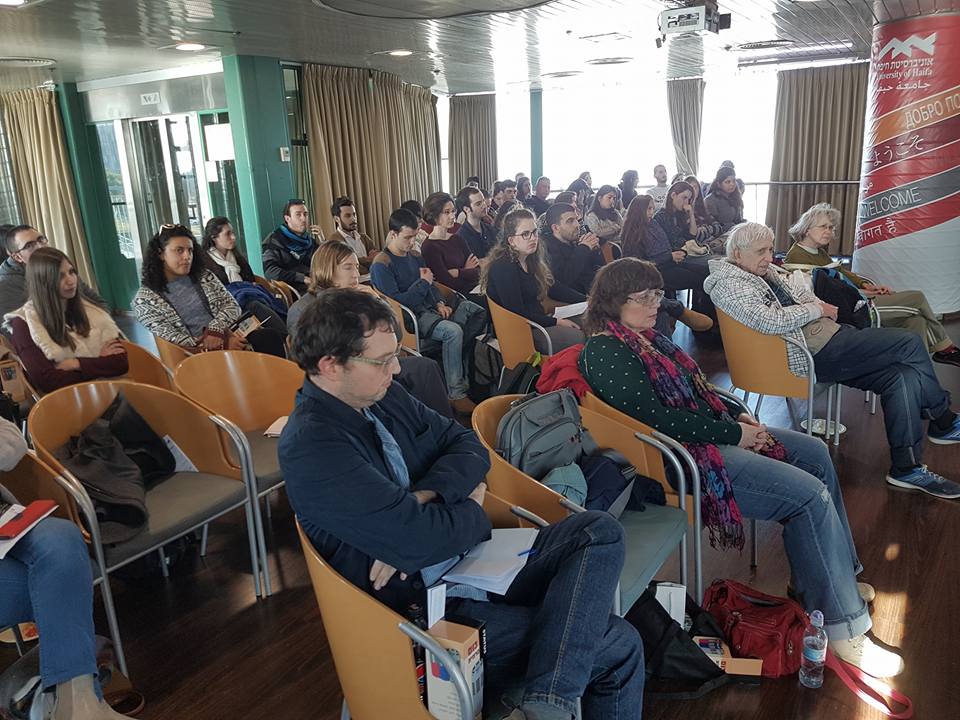
This year on the 16 Jan. 2017 CC awesome fund helped us celebrate the Public Domain Day 2017 and Fair Use Week.
The celebration took place at Haifa University Faculty of Law. During the event we presented Creative Commons Licenses and explained about the Public Domain Day. We also talked about Fair Use Week which will take place on the 20-24 Feb. 2017.
What is Fair Use?
Copyright law creates a system of checks and balances that balance between the public domain and the granting of incentive for authors to create. Therefore, the new Israeli Copyright Act of 2007 includes permitted uses. Fair Use is one of them.
The new Israeli Copyright Act of 2007 replaced the old Copyright Act of 1911. The fair dealing clause was replaced by a Fair Use clause which is very much similar to the U.S. Fair Use clause:
“19. Fair Use
(a) Fair use of a work is permitted for purposes such as: private study, research, criticism, review, journalistic reporting, quotation, instruction and examination by an educational institution.
(b) In determining whether a use made of a work is fair within the meaning of this section the factors to be considered shall include, inter alia, all of the following:
(1) The purpose and character of the use;
(2) The character of the work used;
(3) The scope of the use, quantitatively and qualitatively, in relation to the work as a whole;
(4) The impact of the use on the value of the work and its potential market.
(c) The Minister may make regulations prescribing conditions under which a use shall be deemed a fair use”
There is another judicial criterion that has to be met before the use can be considered “fair” – attribution to the author.
However, the fair use clause is unclear and often impossible to say in advance whether a particular use should be considered fair or not.
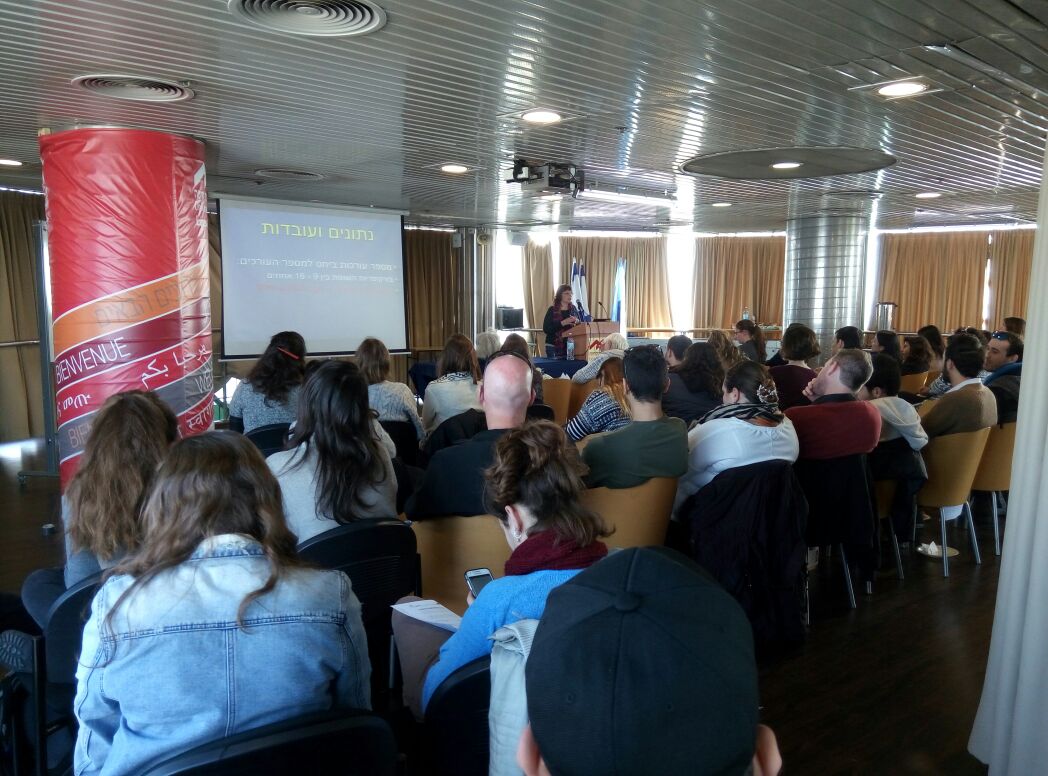
This year we devoted the celebration to women authors.
Mr. Yair Even-Zohar (Zemereshet Israel) talked about women, authors, and performers whose works and performances are in the public domain. Mrs. Hana Yariv (Wikimedia Israel) talked about women as editors in the Hebrew Wikipedia and about the forgotten women who lack an entry in Wikipedia. The Israeli Creative Commons Coordinator Dalit Ken-Dror Feldman explained about the public domain and about CC Licenses. The Law and Technology Clinic read works that are in the Public Domain and that were written by women – Hannah Szenes, Rachel Bluwstein Sela and Mary Shelley.
It was awesome!!!
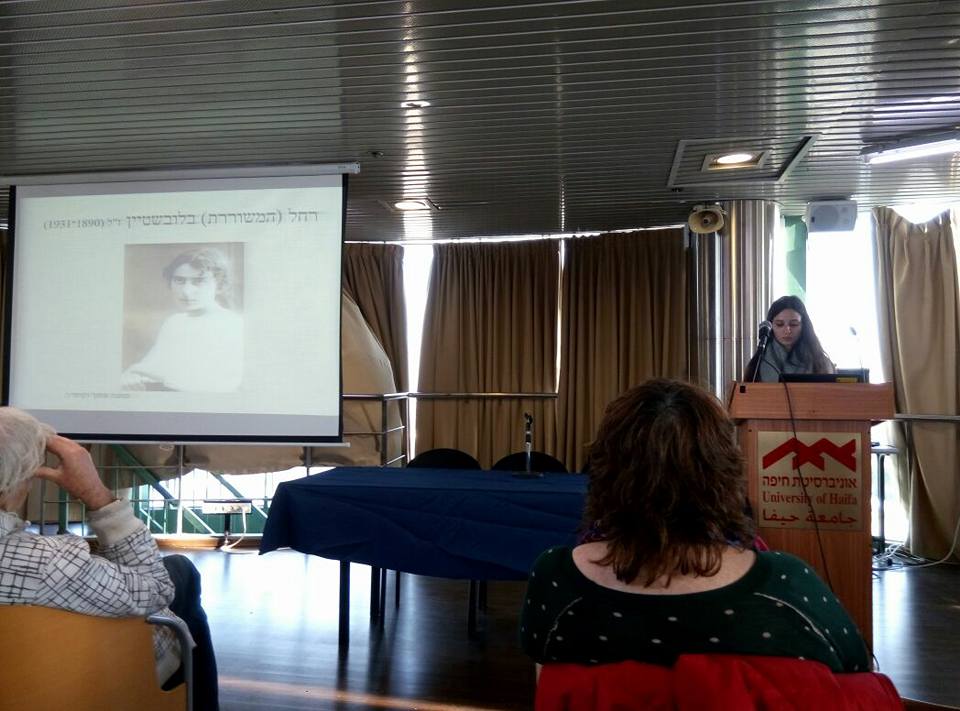
All photos via Dalit KD, Creative Commons Israel