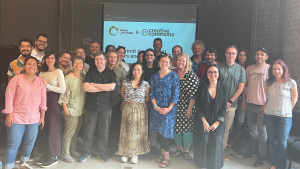
“CC Global Summit 2023 Day 0” by Creative Commons is licensed CC BY 4.0.
On the eve of the CC Global Summit, members of the CC global community and Creative Commons held a one-day workshop to discuss issues related to AI, creators, and the commons. The community attending the Summit has a long history of hosting these intimate discussions before the Summit begins on critical and timely issues.
Emerging from that deep discussion and in subsequent conversation during the three days of the Summit, this group identified a set of common issues and values, which are captured in the statement below. These ideas are shared here for further community discussion and to help CC and the global community navigate uncharted waters in the face of generative AI and its impact on the commons.
Background considerations
Recognizing that around the globe the legal status of using copyright protected works for training generative AI systems raises many questions and that there is currently only a limited number of jurisdictions with relatively clear and actionable legal frameworks for such uses. We see the need for establishing a number of principles that address the position of creators, the people building and using machine learning (ML) systems, and the commons, under this emerging technological paradigm.
Noting that there are calls from organized rightholders to address the issues posed by the use of copyrighted works for training generative AI models, including based on the principles of credit, consent, and compensation.
Noting that the development and deployment of generative AI models can be capital intensive, and thus risks resembling (or exacerbating) the concentration of markets, technology, and power in the hands of a small number of powerful for-profit entities largely concentrated in the United States and China, and that currently most of the (speculative) value accrues to these companies.
Further noting that, while the ability for everyone to build on the global information commons has many benefits, the extraction of value from the commons may also reinforce existing power imbalances and in fact can structurally resemble prior examples of colonialist accumulation.
Noting that this issue is especially urgent when it comes to the use of traditional knowledge materials as training data for AI models.
Noting that the development of generative AI reproduces patterns of the colonial era, with the countries of the Global South being consumers of Northern algorithms and data providers.
Recognizing that some societal impacts and risks resulting from the emergence of generative AI technologies need to be addressed through public regulation other than copyright, or through other means, such as the development of technical standards and norms. Private rightsholder concerns are just one of a number of societal concerns that have arisen in response to the emergence of AI.
Noting that the development of generative AI models offers new opportunities for creators, researchers, educators, and other practitioners working in the public interest, as well as providing benefits to a wide range of activities across other sectors of society. Further noting that generative AI models are a tool that enables new ways of creation, and that history has shown that new technological capacities will inevitably be incorporated into artistic creation and information production.
Principles
We have formulated the following seven principles for regulating generative AI models in order to protect the interests of creators, people building on the commons (including through AI), and society’s interests in the sustainability of the commons:
It is important that people continue to have the ability to study and analyse existing works in order to create new ones. The law should continue to leave room for people to do so, including through the use of machines, while addressing societal concerns arising from the emergence of generative AI.
All parties should work together to define ways for creators and rightsholders to express their preferences regarding AI training for their copyrighted works. In the context of an enforceable right, the ability to opt out from such uses must be considered the legislative ceiling, as opt-in and consent-based approaches would lock away large swaths of the commons due to the excessive length and scope of copyright protection, as well as the fact that most works are not actively managed in any way.
In addition, all parties must also work together to address implications for other rights and interests (e.g. data protection, use of a person’s likeness or identity). This would likely involve interventions through frameworks other than copyright.
Special attention must be paid to the use of traditional knowledge materials for training AI systems including ways for community stewards to provide or revoke authorisation.
Any legal regime must ensure that the use of copyright protected works for training generative AI systems for noncommercial public interest purposes, including scientific research and education, are allowed.
Ensure that generative AI results in broadly shared economic prosperity – the benefits derived by developers of AI models from access to the commons and copyrighted works should be broadly shared among all contributors to the commons.
To counterbalance the current concentration of resources in the the hands of a small number of companies these measures need to be flanked by public investment into public computational infrastructures that serve the needs of public interest users of this technology on a global scale. In addition there also needs to be public investment into training data sets that respect the principles outlined above and are stewarded as commons.
In keeping with CC’s practice to provide major communications related to the 2023 Global Summit held in Mexico City in English and Spanish, following is the text of this post originally created in English translated to Spanish
Hacer que la IA funcione para los creadores y los bienes comunes
En vísperas de la Cumbre Global CC, los miembros de la comunidad global CC y Creative Commons celebraron un taller de un día para discutir cuestiones relacionadas con la IA, los creadores y los bienes comunes. La comunidad que asiste a la Cumbre tiene una larga historia de albergar estas discusiones íntimas antes de que comience la Cumbre sobre temas críticos y oportunos.
Como resultado de esa profunda discusión y de la conversación posterior durante los tres días de la Cumbre, este grupo identificó un conjunto de cuestiones y valores comunes, que se recogen en la siguiente declaración. Estas ideas se comparten aquí para una mayor discusión comunitaria y para ayudar a CC y a la comunidad global a navegar por aguas inexploradas frente a la IA generativa y su impacto en los bienes comunes.
Consideraciones preliminares
Reconociendo que en todo el mundo el estatus legal del uso de obras protegidas por derechos de autor para entrenar sistemas generativos de IA plantea muchas preguntas y que actualmente solo hay un número limitado de jurisdicciones con marcos legales relativamente claros y viables para tales usos. Vemos la necesidad de establecer una serie de principios que aborden la posición de los creadores, las personas que construyen y utilizan sistemas de aprendizaje automático y los bienes comunes, bajo este paradigma tecnológico emergente.
Señalando que hay llamados de titulares de derechos organizados para abordar los problemas que plantea el uso de obras protegidas por derechos de autor para entrenar modelos de IA generativa, incluso basados en los principios de crédito, consentimiento y compensación.
Observando que el desarrollo y despliegue de modelos generativos de IA puede requerir mucho capital y, por lo tanto, corre el riesgo de asemejarse (o exacerbar) la concentración de mercados, tecnología y poder en manos de un pequeño número de poderosas entidades con fines de lucro concentradas en gran medida en los Estados Unidos y China, y que actualmente la mayor parte del valor (especulativo) corresponde a estas empresas.
Señalando además que, si bien la capacidad de todos para aprovechar los bienes comunes globales de información tiene muchos beneficios, la extracción de valor de los bienes comunes también puede reforzar los desequilibrios de poder existentes y, de hecho, puede parecerse estructuralmente a ejemplos anteriores de acumulación colonialista.
Señalando que esta cuestión es especialmente urgente cuando se trata del uso de materiales de conocimientos tradicionales como datos de entrenamiento para modelos de IA.
Señalando que el desarrollo de la IA generativa reproduce patrones de la era colonial, siendo los países del Sur Global consumidores de algoritmos y proveedores de datos del Norte.
Reconocer que algunos impactos y riesgos sociales resultantes del surgimiento de tecnologías de IA generativa deben abordarse mediante regulaciones públicas distintas de los derechos de autor, o por otros medios, como el desarrollo de estándares y normas técnicas. Las preocupaciones de los titulares de derechos privados son sólo una de una serie de preocupaciones sociales que han aparecido en respuesta al surgimiento de la IA.
Señalando que el desarrollo de modelos generativos de IA ofrece nuevas oportunidades para creadores, investigadores, educadores y otros profesionales que trabajan en el interés público, además de brindar beneficios a una amplia gama de actividades en otros sectores de la sociedad. Señalando además que los modelos generativos de IA son una herramienta que permite nuevas formas de creación, y que la historia ha demostrado que inevitablemente se incorporarán nuevas capacidades tecnológicas a la creación artística y la producción de información.
Principios
Hemos formulado los siguientes siete principios para regular los modelos de IA generativa con el fin de proteger los intereses de los creadores, las personas que construyen sobre los bienes comunes (incluso a través de la IA) y los intereses de la sociedad en la sostenibilidad de los bienes comunes:
Es importante que la gente siga teniendo la capacidad de estudiar y analizar obras existentes para crear otras nuevas. La ley debería seguir dejando espacio para que las personas lo hagan, incluso mediante el uso de máquinas, al tiempo que aborda las preocupaciones sociales que aparecen por el surgimiento de la IA generativa.
Todas las partes deberían trabajar juntas para definir formas para que las personas creadoras y quienes son titulares de derechos expresen sus preferencias con respecto a la capacitación en IA para sus obras protegidas por derechos de autor. En el contexto de un derecho exigible, la capacidad de hacer un “opt out” de tales usos debe considerarse el límite legislativo, ya que los enfoques basados en la aceptación voluntaria y el consentimiento bloquearían grandes sectores de los bienes comunes debido a la duración y el alcance excesivos de la protección de los derechos de autor, así como el hecho de que la mayoría de las obras no están siendo activamente gestionadas.
Además, todas las partes también deben trabajar juntas para abordar las implicaciones para otros derechos e intereses (por ejemplo, protección de datos, uso de la imagen o identidad de una persona). Esto probablemente implicaría intervenciones a través de marcos distintos del derecho de autor.
Se debe prestar especial atención al uso de materiales del conocimiento tradicional para entrenar sistemas de IA, incluidas formas para que los custodios de las comunidades proporcionen o revoquen la autorización.
Cualquier régimen legal debe garantizar que se permita el uso de obras protegidas por derechos de autor para entrenar sistemas generativos de IA con fines no comerciales de interés público, incluidas la investigación científica y la educación.
Garantizar que la IA generativa dé como resultado una prosperidad económica ampliamente compartida: los beneficios que obtienen los desarrolladores de modelos de IA del acceso a los bienes comunes y a las obras protegidas por derechos de autor deben compartirse ampliamente entre quienes contribuyen a los bienes comunes.
Para contrarrestar la actual concentración de recursos en manos de un pequeño número de empresas, estas medidas deben ir acompañadas de inversión pública en infraestructuras computacionales públicas que satisfagan las necesidades de los usuarios de interés público de esta tecnología a escala global. Además, también es necesario invertir públicamente en sets de datos de entrenamiento que respeten los principios descritos anteriormente y se administren como bienes comunes.
Chan Zuckerberg Initiative Funds New Project to Openly License Life Sciences Preprints
Today, Creative Commons (CC) is excited to announce new programmatic support from the Chan Zuckerberg Initiative (CZI) to help make openly licensed preprints the primary vehicle of scientific dissemination.
“We are delighted to have been awarded this new grant to help us leverage our expertise to make life sciences research more open and accessible,” said Catherine Stihler, CC CEO. “From open review to translation to AI and machine-learning applications, realizing the full potential of preprints is predicated on them being openly licensed.”
The eighteen-month grant will enable CC to collaborate with CZI on a project focused on significantly increasing use of the CC BY 4.0 license on preprints in the life sciences by working with funders, preprint servers, and other preprint stakeholders.
“Preprint servers have seen a marked increase in uploads across many scientific disciplines, particularly in the life sciences1, spurred by recognition of the importance of timely, open access to research results during the COVID-19 pandemic,” said Dario Taraborelli, Science Program Officer at CZI. “Preprints are not only a faster pathway to the dissemination of research results, they also enable the development of an entire scholarly communication ecosystem around them. We are excited to partner with CC to further develop and strengthen this ecosystem and bring together funders, institutions, preprint servers, and other stakeholders to promote openly licensed preprints.”
“We are so pleased to have our open access research work further supported by CZI,” said Cable Green, CC Director of Open Knowledge. “Opening preprints is essential to our strategy to support better sharing, which includes helping scientists open and share all the components of their research — without long publication timelines — to support access, text and data mining, reproducibility, and further inquiry.”
This work will complement activities already underway with CC and our partners in the Open Climate Campaign, a multi-year project to promote open access to research to accelerate progress towards solving the climate crisis and preserving global biodiversity, and our Open Climate Data Project, an initiative to help open large climate datasets.
Deborah De Angelis — Open Culture VOICES, Season 2 Episode 27
“Open access is essential for education, innovation, and cultural participation.” Deborah believes that cultural heritage institutions such as libraries, archives, and museums are not just responsible for the preservation of material but in the access and promotion of material for the public good. Institutions should can choose to make their material available online and these policies can help culture to flourish.
Open Culture VOICES is a series of short videos that highlight the benefits and barriers of open culture as well as inspiration and advice on the subject of opening up cultural heritage. Deborah is an independent lawyer who advocates for open access policies in Italy as the CC Italy Chapter Lead. Italy is known for cultural heritage laws that restrict accessibility which Deborah, CC Italy, and Creative Commons regularly discuss in blog posts and other material.
Deborah responds to the following questions:
What are the main benefits of open GLAM?
What are the barriers?
Could you share something someone else told you that opened up your eyes and mind about open GLAM?
Do you have a personal message to those hesitating to open up collections?
Closed captions are available for this video, you can turn them on by clicking the CC icon at the bottom of the video. A red line will appear under the icon when closed captions have been enabled. Closed captions may be affected by Internet connectivity — if you experience a lag, we recommend watching the videos directly on YouTube.
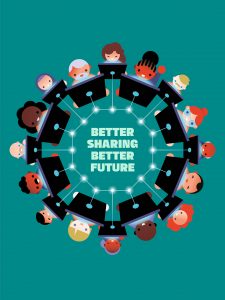
As part of our #20CC anniversary, last year we joined forces with Fine Acts to spark a global dialogue on what better sharing looks like in action. Our #BetterSharing collection of illustrations was the result — we gathered insights from 12 prominent open advocates around the world and tasked 12 renowned artists who embrace openness with transforming these perspectives into captivating visual pieces available under a CC license.
Each month throughout 2023, we will be spotlighting a different CC-licensed illustration from the collection on our social media headers and the CC blog. For September, we’re excited to showcase “Better Sharing, Better Future” by Spanish illustrator, Maria Picassó i Piquer. The piece, licensed under CC BY-SA 4.0, was inspired by a quote from Kyle Smith, CC Canada member & member of LexDAO and Fellow in Gitcoin’s KERNEL incubator:
“Better Sharing, Brighter Future means continuing Jobs’s ‘bicycle of the mind’ dream with modern ‘IoT’ general purpose machines like Raspberry Pi so we can unleash the latent power of humanity and innovate ourselves out of this fossil-fuel-driven climate crisis.”
Maria is a Catalan artist born in 1983. She graduated in Architecture and soon left her office job to be a full-time illustrator, her lifetime passion. Navigating between design and illustration, her works cover a wide variety of supports such as magazines, books, clothing and video games published worldwide. She’s got a passion for distilling faces down to their most recognisable essence. Her recognizable geometric caricatures have led her to be a guest speaker in various conventions in both Europe and USA.
We have an incredible group of people lined up to be keynote speakers at the 2023 CC Global Summit, to be held 3–6 October in Mexico City. In our first announcements, we welcomed writer Anya Kamenetz and Māori media leader Peter-Lucas Jones. We are deeply honored to announce that the Summit’s opening keynote will be from Francisco J. Rivas Mesa, also known by his stage name Tito Rivas. Francisco is a sound artist, musician, researcher, cultural leader, and General Director of Mexico’s National Sound Archive, who will speak on global culture from the deeply rooted perspective of Mexico and Latin America.
Francisco J. Rivas Mesa has a degree in Audiovisual Communication from the Universidad del Claustro de Sor Juana and in Philosophy from the Universidad Nacional Autónoma de México (UNAM). He is a candidate for a Doctorate in Musical Technologies from the Faculty of Music of UNAM. He has a Diploma in Executive Training for Cultural and Museum Leaders (ILM, Universidad Iberoamericana). His work has focused on experimentation with sound, visual and performative media as a creator, researcher and cultural manager. He has also been interested in strategies to produce social and ethical access to archives and their reuse for educational and cultural purposes. He has been a professor of subjects on sound and audiovisual creation in academic institutions and as a creator and curator his work has been presented and exhibited in various national and international venues and festivals. He has also published specialized articles on sound phenomenology and the archeology of listening. He is a member of the Sound and Listening Studies Network (RESEmx) and the Scientific Committee of the Mexico Acoustic Ecology Network (REAmx). He was part of the team that inaugurated Mexico’s National Sound Archive in 2008 as head of the Sound Research and Experimentation department and as Deputy Director of Sound Promotion and Dissemination. He was curator of the Espacio Sonoro de Casa del Lago (UNAM) and director of the Ex Teresa Arte Actual museum of INBAL. He is currently general director of the National Sound Archive of Mexico and president of the Ibermemoria Sonora, Photographic and Audiovisual Program.
Like Francisco, all our keynoters connect directly with CC’s areas of focus, from contemporary creativity and cultural heritage, to media, science, education, and journalism. With the Summit’s theme of AI and the commons, we also expect to be challenged with new and reborn perspectives that we should consider in thinking about artificial intelligence and its intersection with open knowledge and culture. All the Summit keynotes will honor both the Summit’s location in Mexico, and the CC community’s global scope.
We invite you to join us at the Summit in Mexico City to hear Francisco and many other diverse voices speak. Our hope is that the keynote addresses, the full Summit program, and our informal connections in Mexico City and online will combine to enable us all to cultivate CC’s strategy of better sharing, sharing that is contextual, inclusive, just, equitable, reciprocal, and sustainable.
Tenemos un grupo increíble de personas preparadas para ser oradores principales en la Cumbre Global 2023, que se llevará a cabo del 3 al 6 de octubre en la Ciudad de México. En nuestros primeros anuncios, dimos la bienvenida a la escritora Anya Kamenetz y al líder de medios Māori Peter-Lucas Jones. Ahora nos sentimos profundamente honrados de anunciar que el discurso de apertura de la Cumbre estará a cargo de Francisco J. Rivas Mesa, también conocido por su nombre artístico Tito Rivas. Francisco es artista sonoro, músico, investigador, gestor cultural, y director general de la Fonoteca Nacional de México, quien hablará sobre la cultura global desde la perspectiva profundamente arraigada de México y América Latina.
Francisco J. Rivas Mesa es licenciado en Comunicación Audiovisual por la Universidad del Claustro de Sor Juana y en Filosofía por la Universidad Nacional Autónoma de México (U.N.A.M). Candidato a Doctor en Tecnologías Musicales por la Facultad de Música de la U.N.A.M. Cuenta con un Diploma en Formación Ejecutiva para Líderes Culturales y de Museos (ILM, Universidad Iberoamericana). Su trabajo se ha enfocado en la experimentación con medios sonoros, visuales y performáticos como creador, investigador y gestor cultural, asimismo se ha interesado en las estrategias para producir acceso social y ético de los archivos y su reaprovechamiento con fines educativos y culturales. Ha sido profesor de asignaturas sobre creación sonora y audiovisual en instituciones académicas y como creador y curador se ha presentado y expuesto su trabajo en diversos recintos y festivales nacionales e internacionales. También ha publicado artículos especializados sobre fenomenología del sonido y arqueología de la escucha. Es miembro de la Red de Estudios sobre el Sonido y la Escucha (RESEmx) y del Comité Científico de la Red Ecología Acústica México (REAmx). Formó parte del equipo que inauguró en 2008 la Fonoteca Nacional como jefe del departamento de Investigación y Experimentación Sonora y como Subdirector de Promoción y Difusión del Sonido. Fue curador del Espacio Sonoro de Casa del Lago (UNAM) y director del museo Ex Teresa Arte Actual del INBAL. Actualmente es director general de la Fonoteca Nacional de México y presidente del Programa Ibermemoria Sonora, Fotográfica y Audiovisual.
Al igual que Francisco, todos nuestros oradores principales se conectan directamente con las áreas de enfoque de CC, desde la creatividad contemporánea y el patrimonio cultural hasta los medios, la ciencia, la educación y el periodismo. Con el tema de la Cumbre sobre la IA y los bienes comunes, también esperamos enfrentar el desafío de perspectivas nuevas y renacidas que deberíamos considerar al pensar en la inteligencia artificial y su intersección con el conocimiento y la cultura abiertos. Todas los oradores principales de la Cumbre honrarán tanto la ubicación de la Cumbre en México como el alcance global de la comunidad CC.
¡Estén atentos para conocer a nuestros otros oradores principales! Te invitamos a unirte a nosotros en la Cumbre en la Ciudad de México para escuchar hablar a Francisco y muchas otras voces diversas. Nuestra esperanza es que los oradores principales, el programa completo de la Cumbre y nuestras conexiones informales en la Ciudad de México y en línea se combinen para permitirnos a todos cultivar la estrategia de CC de compartir mejor, un compartir que sea contextual, inclusivo, justo, equitativo, recíproco y sostenible.
The CC Global Summit is now just one week away! As we make the final preparations for this first opportunity to gather in person at a Summit in several years, we are excited to unveil the program that will take place 3–6 October in Mexico City. Since 2006, the CC Global Summit has brought together thousands of CC community members, activists, creators, advocates, librarians, educators, lawyers, and technologists from around the world to discuss, collaborate, and take action to make our global culture more open and collaborative.
We must begin by honoring the very special Summit venue, the Centro Cultural Universitario Tlatelolco, next to the Plaza de las Tres Culturas. As we gather to collaborate on the future of the open commons, we will be surrounded by rich culture from Mexico’s history. Bringing these cultural themes together is “We Are the Commons,” the illustration commissioned specially for the Summit by Mexican artist Eréndira Derbez.
We are especially honored to welcome the Summit’s three keynote speakers, who have been invited to challenge us with new and reborn perspectives about open knowledge and culture, and to honor both the Summit’s location in Mexico and our community’s global scope.
Marina Núñez Bespalova, Mexico’s Undersecretary of Cultural Development, who will open the Summit speaking on global culture from the deeply rooted perspective of Mexico and Latin America.
Peter-Lucas Jones, whose keynote on day two draws from his work as a leading figure in Māori media and his collaborations to honor local and traditional knowledge and culture in a global context.
Anya Kamenetz, who will close the Summit with a keynote that grows out of her work as a journalist, writer, and now, activist focused on climate education for children.
If you can’t make it to Mexico City, there are several opportunities to engage with the Summit virtually. First, take a moment to register for free virtual access to make sure you get all the information about how you can participate in the Summit at a distance and at different times, including:
the sessions that will be livestreamed
the pre-recorded video sessions you can watch on demand
Bringing hundreds of people together for a rich program in a world capital like Mexico City is a challenge CC could not have undertaken without a lot of support from many sources.
We are deeply grateful to the team at CC Mexico — especially Irene Soria, Iván Martínez, and the team of volunteers they brought together — for their dedicated assistance large and small to make the Summit happen in their city.
We also thank the volunteers around the world who gave their time and energy on the Summit program and scholarship committees. The overwhelming interest in this year’s Summit generated big challenges for these people who stepped up to help shape a Summit that we hope is diverse, enriching, and practical. Another heartfelt thank you goes out to our friends at Wikimedia Mexico who are sponsoring a group of volunteers to help out during the event. We are grateful for this partnership and looking forward to meeting everyone next week!
Beyond all the essential community effort powering the Summit, we especially thank the sponsors who contributed financial support to make it possible to offer the scholarships that enable people from all over the world to attend the Summit and to ensure this ambitious gathering will be rewarding and successful.
¡Falta solo una semana para la Cumbre Mundial CC! Mientras hacemos los preparativos finales para esta primera oportunidad de reunirnos en persona en una Cumbre en varios años, estamos entusiasmados de presentar el programa que se llevará a cabo del 3 al 6 de octubre en la Ciudad de México. Desde 2006, la Cumbre Global CC ha reunido a miles de miembros de la comunidad CC, activistas, creadores, defensores, bibliotecarios, educadores, abogados y tecnólogos de todo el mundo para discutir, colaborar y tomar medidas para hacer que nuestra cultura global sea más abierta y colaborativa.
Debemos comenzar honrando la sede tan especial de la Cumbre, el Centro Cultural Universitario Tlatelolco, junto a la Plaza de las Tres Culturas. Mientras nos reunimos para colaborar en el futuro de los bienes comunes abiertos, estaremos rodeados de la rica cultura de la historia de México. Uniendo estos temas culturales es “Somos Los Comunes”, la ilustración encargada especialmente para la Cumbre por la artista mexicana Eréndira Derbez.
Nos sentimos especialmente honrados de dar la bienvenida a los tres oradores principales de la Cumbre, quienes han sido invitados a desafiarnos con perspectivas nuevas y renacidas sobre el conocimiento y la cultura abiertos, y a honrar tanto la ubicación de la Cumbre en México como el alcance global de nuestra comunidad.
Marina Núñez Bespalova, Subsecretaría de Desarrollo Cultural de México, quien abrirá la Cumbre hablando sobre la cultura global desde la perspectiva profundamente arraigada de México y América Latina.
Peter-Lucas Jones, cuyo discurso de apertura del segundo día se basa en su trabajo como figura destacada en los medios Māori y sus colaboraciones para honrar el conocimiento y la cultura local y tradicional en un contexto global.
Anya Kamenetz, quien cerrará la Cumbre con un discurso que surge de su trabajo como periodista, escritora y ahora activista centrada en la educación climática para los niños.
Si no puede asistir a la Ciudad de México, existen varias oportunidades para participar virtualmente en la Cumbre. Primero, tómate un momento para registrarse para obtener acceso virtual gratuito y asegurarte de obtener toda la información sobre cómo puedes participar en la Cumbre a distancia y en diferentes horarios, incluyendo:
las sesiones que serán transmitidas en vivo
las sesiones de vídeo pregrabadas que puedes ver cuando quiera
las sesiones informales de conexión que CC está organizando con Virtually Connecting
la oportunidad de conectarse con participantes en México y alrededor del mundo en el slack de la comunidad CC
y la oportunidad de conocer a los presentadores y participantes de la Cumbre en reuniones virtuales una vez finalizada la Cumbre en México
Gracias a todos los que hicieron posible la Cumbre
Reunir a cientos de personas para un rico programa en una capital mundial como la Ciudad de México es un desafío que CC no podría haber emprendido sin mucho apoyo de muchas fuentes.
Estamos profundamente agradecidos al equipo de CC México, especialmente a Irene Soria, Iván Martínez y el equipo de voluntarios que reunieron, por su dedicada ayuda, grandes y pequeñas, para que la Cumbre se llevará a cabo en su ciudad.
También agradecemos a los voluntarios de todo el mundo que brindaron su tiempo y energía en los comités de programa y de becas de la Cumbre. El interés abrumador en la Cumbre de este año generó grandes desafíos para estas personas que dieron un paso al frente para ayudar a dar forma a una Cumbre que esperamos sea diversa, enriquecedora y práctica. Otro aprecio de todo corazón para nuestros amigos de Wikimedia México que patrocinan a un grupo de voluntarios para ayudar durante el evento. ¡Estamos agradecidos por esta asociación y esperamos conocerlos a todos la próxima semana!
Más allá de todo el esfuerzo comunitario esencial que impulsó la Cumbre, agradecemos especialmente a los patrocinadores que contribuyeron con apoyo financiero para hacer posible ofrecer becas que permitan a personas de todo el mundo asistir a la Cumbre y garantizar que esta ambiciosa reunión sea gratificante y exitosa.
Logos used by permission from sponsoring organizations.
¿Está interesado en patrocinar la CC Global Summit 2023? Por favor contáctenos en development@creativecommons.org.
Christy Henshaw — Open Culture VOICES, Season 2 Episode 26
“Open access means that we’re able to reach more people in a more equitable fashion.” Christy explains how the Wellcome Collection has been using Open Access to increase the engagement and shared value of an art and culture collection in a private foundation. Christy also shares some insight about the benefits of leveraging existing tools, such as CC Licenses and platforms like Wikicommons, to have a greater positive impact on society.
Open Culture VOICES is a series of short videos that highlight the benefits and barriers of open culture as well as inspiration and advice on the subject of opening up cultural heritage. Christy is the Digital Production Manager at the Wellcome Collection which is a museum and library that is part of the Wellcome Trust, one of the largest trusts in the world dedicated to improving health outcomes globally. The Wellcome Collection has made 300,000 pieces from the collection available online, including procedures and software through Github repositories.
Christy responds to the following questions:
What are the main benefits of open GLAM?
What are the barriers?
Could you share something someone else told you that opened up your eyes and mind about open GLAM?
Do you have a personal message to those hesitating to open up collections?
Closed captions are available for this video, you can turn them on by clicking the CC icon at the bottom of the video. A red line will appear under the icon when closed captions have been enabled. Closed captions may be affected by Internet connectivity — if you experience a lag, we recommend watching the videos directly on YouTube.
Marina Núñez Bespalova Será una Oradora Principal en la Cumbre Mundial CC 2023
Lamentamos informar que debido a un conflicto de programación imprevisto, Marina Núñez Bespalova no puede dar un discurso en la Cumbre Global CC 2023, pero tenemos el honor de darle la bienvenida al artista sonoro, músico, investigador y gestor cultural mexicano Francisco J. Rivas. Mesa, también conocido por su nombre artístico Tito Rivas. Leer más sobre Francisco >
Tenemos un grupo increíble de personas preparadas para ser oradores principales en la Cumbre Global 2023, que se llevará a cabo del 3 al 6 de octubre en la Ciudad de México. En nuestros primeros anuncios, dimos la bienvenida a la escritora Anya Kamenetz y al líder de medios Māori Peter-Lucas Jones. Ahora nos sentimos profundamente honrados de anunciar que el discurso de apertura de la Cumbre estará a cargo de Marina Núñez Bespalova, Subsecretaría de Desarrollo Cultural de México, quien hablará sobre la cultura global desde la perspectiva profundamente arraigada de México y América Latina.
Marina Núñez Bespalova es subsecretaria de Desarrollo Cultural de la Secretaría de Cultura de México desde agosto de 2019. Doctorada en Filología Hispánica, Marina es editora y gestora cultural con casi dos décadas de servicio público en el sector cultural. Anteriormente ha sido Directora General de Publicaciones de Conaculta (el Consejo Nacional para la Cultura y las Artes), la Secretaría de Cultura y del Archivo General de la Nación, y estuvo a cargo de la concepción de la plataforma LibrosMéxico. También ha sido encargada del programa Salas de Lectura y del Plan Nacional de Lectura de 2016 a 2018, de la expansión de diversos programas infantiles y juveniles, así como de programas específicos sobre intervención cultural en situaciones de crisis y trabajo con población migrante, entre otros cargos públicos. Ha formado parte del grupo que promovió diversas iniciativas de ley en materia cultural. Ha sido docente en universidades globales en las que, además, ha tenido estancias de investigación, como la Queen Mary University of London, la Complutense de Madrid o la Sapienza de Roma. Recibió apoyos del Ministerio de Educación de España para realizar su tesis doctoral y participar en un grupo de investigación sobre la Edad Media y la cultura laica a través del mecenazgo. Ha participado ampliamente en foros nacionales e internacionales, ha enseñado numerosos cursos y seminarios y ha sido autora de obras en publicaciones académicas y literarias.
Al igual que Marina, todos nuestros oradores principales se conectan directamente con las áreas de enfoque de CC, desde la creatividad contemporánea y el patrimonio cultural hasta los medios, la ciencia, la educación y el periodismo. Con el tema de la Cumbre sobre la IA y los bienes comunes, también esperamos enfrentar el desafío de perspectivas nuevas y renacidas que deberíamos considerar al pensar en la inteligencia artificial y su intersección con el conocimiento y la cultura abiertos. Todas los oradores principales de la Cumbre honrarán tanto la ubicación de la Cumbre en México como el alcance global de la comunidad CC.
¡Estén atentos para conocer a nuestros otros oradores principales! Te invitamos a unirte a nosotros en la Cumbre en la Ciudad de México para escuchar hablar a Marina y muchas otras voces diversas. Nuestra esperanza es que los oradores principales, el programa completo de la Cumbre y nuestras conexiones informales en la Ciudad de México y en línea se combinen para permitirnos a todos cultivar la estrategia de CC de compartir mejor, un compartir que sea contextual, inclusivo, justo, equitativo, recíproco y sostenible.