Marina Núñez Bespalova to Keynote CC Global Summit 2023
We are sorry to say that due to unforeseen scheduling conflict, Marina Núñez Bespalova is unable to speak at the 2023 CC Global Summit, but we are honored to welcome instead Mexican sound artist, musician, researcher, and cultural leader Francisco J. Rivas Mesa, also known by his stage name Tito Rivas. Read more about Francisco >
We have an incredible group of people lined up to be keynote speakers at the 2023 CC Global Summit, to be held 3–6 October in Mexico City. In our first announcements, we welcomed writer Anya Kamenetz and Māori media leader Peter-Lucas Jones. We are now deeply honored to announce that the Summit’s opening keynote will be from Marina Núñez Bespalova, Mexico’s Undersecretary of Cultural Development, speaking on global culture from the deeply rooted perspective of Mexico and Latin America.
Marina Núñez Bespalova is the undersecretary of Cultural Development in Mexico’s Ministry of Culture, starting in August 2019. With her doctorate in Spanish philology, Marina is an editor and cultural manager with almost two decades of public service in the cultural sector. She has previously been General Director of Publications of Conaculta (National Council for Culture and the Arts), the Ministry of Culture, and the National Archive, and was in charge of the conception of the platform LibrosMéxico. She also led the Reading Rooms program, the National Reading Plan from 2016 to 2018, and the expansion of various children and youth programs, as well as specific programs on cultural intervention in crisis situations and work with migrant populations, among other public charges. She has been part of the group that promotes various cultural law initiatives. She has been a teacher at global universities where she has also had research stays, such as the Queen Mary University of London, the Complutense of Madrid, and the Sapienza of Rome. She received support from the Spanish Ministry of Education to carry out her doctoral thesis and participate in a research group on the Middle Ages and secular culture through patronage. She has participated widely in national and international forums, taught many courses and seminars, and authored works in both academic and literary publications.
Like Marina, all our keynoters connect directly with CC’s areas of focus, from contemporary creativity and cultural heritage, to media, science, education, and journalism. With the Summit’s theme of AI and the commons, we also expect to be challenged with new and reborn perspectives that we should consider in thinking about artificial intelligence and its intersection with open knowledge and culture. All the Summit keynotes will honor both the Summit’s location in Mexico, and the CC community’s global scope.
We invite you to join us at the Summit in Mexico City to hear Marina and many other diverse voices speak. Our hope is that the keynote addresses, the full Summit program, and our informal connections in Mexico City and online will combine to enable us all to cultivate CC’s strategy of better sharing, sharing that is contextual, inclusive, just, equitable, reciprocal, and sustainable.
Today Creative Commons (CC) delivered a statement to the World Intellectual Property Organization (WIPO) Conversation on Generative AI and Intellectual Property, as part of our engagement in global policy discussions around the important issues raised by these new technologies and their impact on creativity, the commons, and better sharing, i.e. sharing that is inclusive, equitable, reciprocal, and sustainable. In this blog post, we share the statement as delivered by Brigitte Vézina, CC’s Director of Policy and Open Culture.
Thank you Chair for giving me the floor on behalf of Creative Commons, the organization behind the eponymous copyright licenses that have released more than 2,5 billion works into the commons to date.
At CC we know generative AI, without proper guardrails, runs the risk of being exploitative and damaging the commons, yet it also has the potential to enhance it like never before. This conundrum leaves us with many hard questions:
How can creators be fairly rewarded for building our shared commons?
How can we support the new forms of creativity enabled by AI?
How do we support creators through these unprecedented technological developments?
In search of answers we held community consultations over the past months (including a symposium in New York City last week). As one would expect, we garnered a wide variety of views:
Some creators are very concerned about AI and perceive it as a serious threat to their livelihood — at the same time many artists are relishing the new possibilities offered by AI as it pushes the boundaries of human creative expression and can make creativity more equitably accessible, for example, for people with disabilities. We just published an open letter from over 70 artists* who use generative AI to help surface their experiences and views.
Some developers want unbridled freedom to build their model — but some are looking forward to working with opt-outs, i.e. respecting the wishes of creators who do not want to have their content trained upon, or to train on openly licensed content. We are already seeing efforts to help creators signal their preferences and norms and standards are emerging through community practice and portend fresh and innovative approaches.
In this context, WIPO should help develop norms and practices that are flexible and that will work to increase transparency and empower creators with choices that reflect their values and aspirations. WIPO should approach this with fairness and sustainability in mind — instead of promoting an expansion of copyright, it should ascertain its intrinsic balance and promote the commons on which all creativity depends. In particular, since all creativity builds on the past, copyright needs to continue to leave room for people to study, analyze and learn from previous works to create new ones, including by analyzing past works using automated means.
Mr. Chair, copyright is only one lens through which to consider generative AI. Copyright is a rather blunt tool that often leads to black-and-white solutions that fall short of harnessing all the diverse possibilities that generative AI offers for human creativity. Copyright is not a social safety net, an ethical framework, or a community governance mechanism — and yet we know that regulating generative AI needs to account for these important considerations if we want to support our large community of creators who want to contribute to enriching a commons that truly reflects the world’s diversity of creative expressions.
Thank you, Mr. Chair and to WIPO for hosting this important conversation.
Jennie Rose Halperin — Open Culture VOICES, Season 2 Episode 25
Jennie says “one thing that I love about the internet is that it has allowed us to do things we weren’t able to in the past.” In this episode we learn about the differences between digital and physical collections and what it means to be open to the public online as well as in real life when the mission of the institution is to serve the public interest and share cultural heritage.
Open Culture VOICES is a series of short videos that highlight the benefits and barriers of open culture as well as inspiration and advice on the subject of opening up cultural heritage. Jennie Rose Halperin is the Director at the Library Futures project at NYU Engelberg.
Jennie responds to the following questions:
What are the main benefits of open GLAM?
What are the barriers?
Could you share something someone else told you that opened up your eyes and mind about open GLAM?
Do you have a personal message to those hesitating to open up collections?
Closed captions are available for this video, you can turn them on by clicking the CC icon at the bottom of the video. A red line will appear under the icon when closed captions have been enabled. Closed captions may be affected by Internet connectivity — if you experience a lag, we recommend watching the videos directly on YouTube.
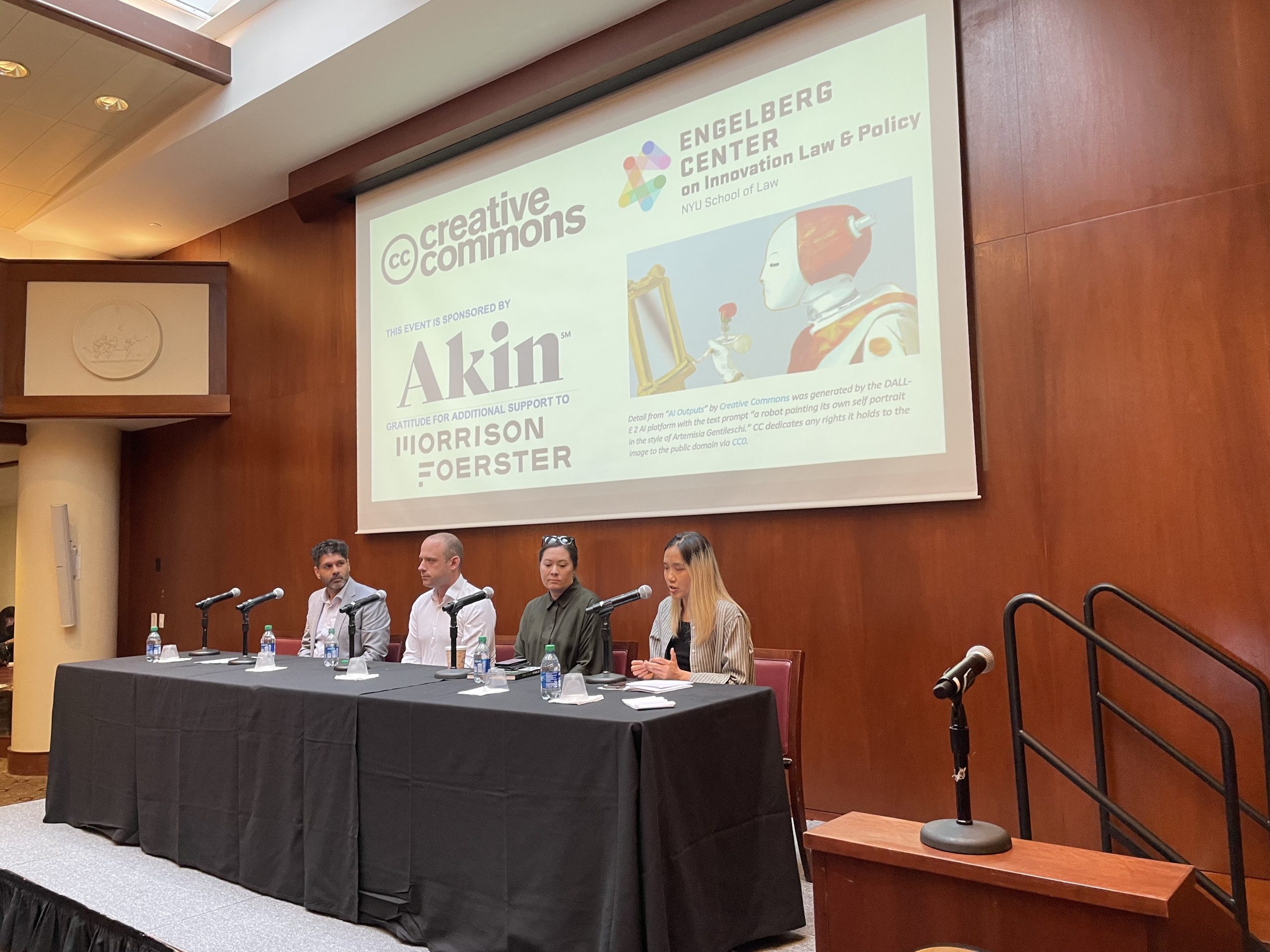
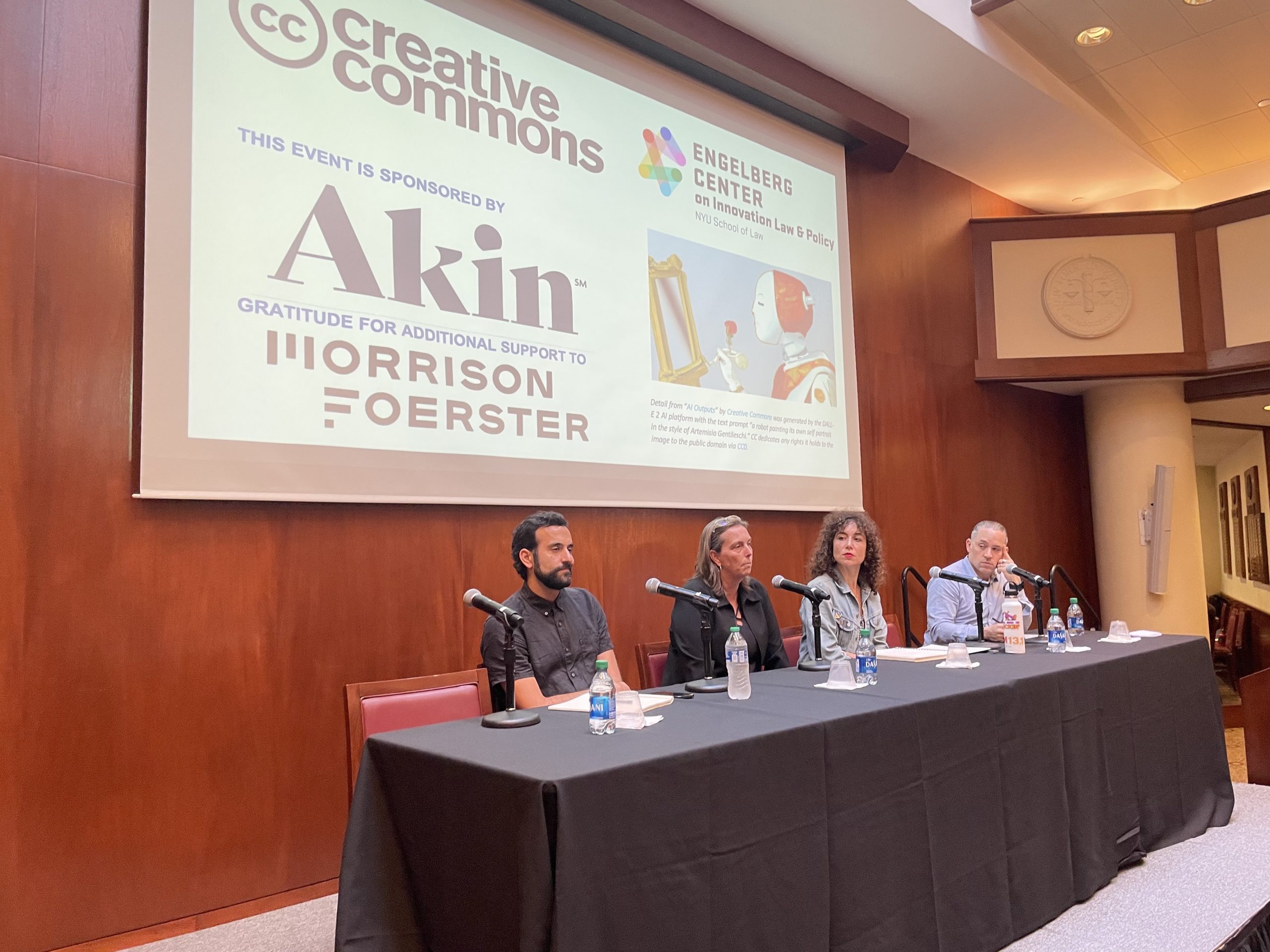
This week, Creative Commons (CC) convened 100+ participants during two events in New York City to discuss the important issues surrounding generative artificial intelligence (AI), copyright, and creativity.
For many years, we at CC have been examining the interplay between copyright and generative AI, exploring ways in which this technology can foster creativity and better sharing, i.e. sharing that is inclusive, equitable, reciprocal, and sustainable — and it is through this lens that we strive to tackle some of the most critical questions regarding the potential of generative AI tools for creators, cultural heritage institutions, and the general public.
In search of answers we have been holding community consultations over the past months to consider how best to maximize the public benefits of AI, to address concerns with how AI systems are trained and used, and to probe how AI will affect the commons. These two NYC events come within the scope of these wider consultations aimed at assisting us in taking action with informed intention.
On 12 September, we ran a workshop at the offices of Morrison Foerster to unpack the multiple issues that arise once generative AI enters the creativity cycle. If all creativity remixes the past — which needs to be responsibly preserved and cared for — is generative AI a game changer? This was the question an interdisciplinary mix of participants approached with insight and empathy throughout the afternoon’s dynamic sessions. History teems with examples of how humans dealt with technological disruptions in the past (from the printing press and oil painting to photography), yet many participants pointed to the need to think differently and imagine new structures for AI to deliver on its promise to enhance the commons. Issues around attribution, bias, transparency, agency, artistic identity and intent, democratization of AI, and many others, peppered the discussions in small and large groups. While no definite pathways emerged, participants embraced the uncertainty and relished the prospect of generative AI being used for the common good.
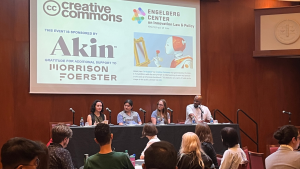
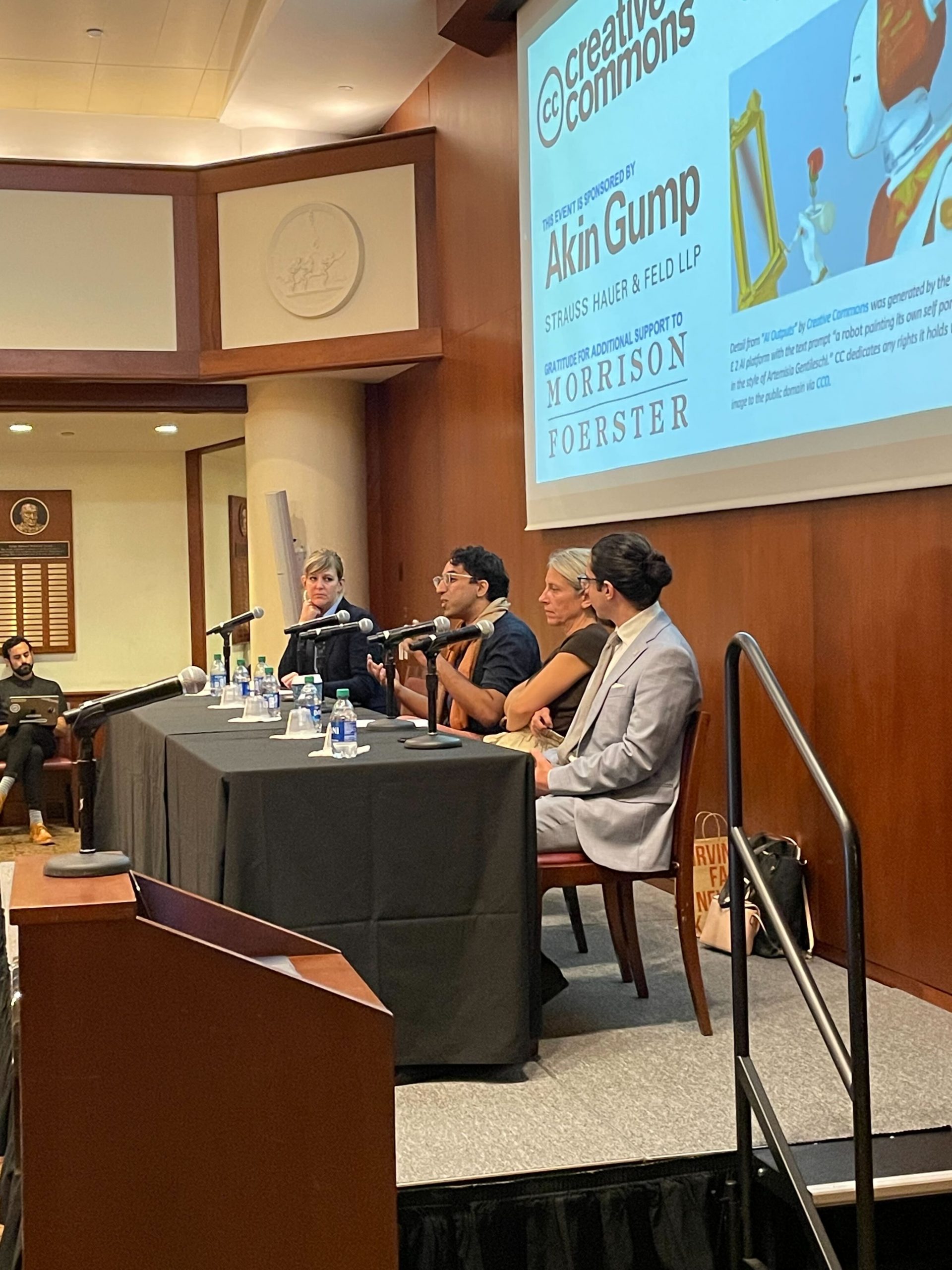
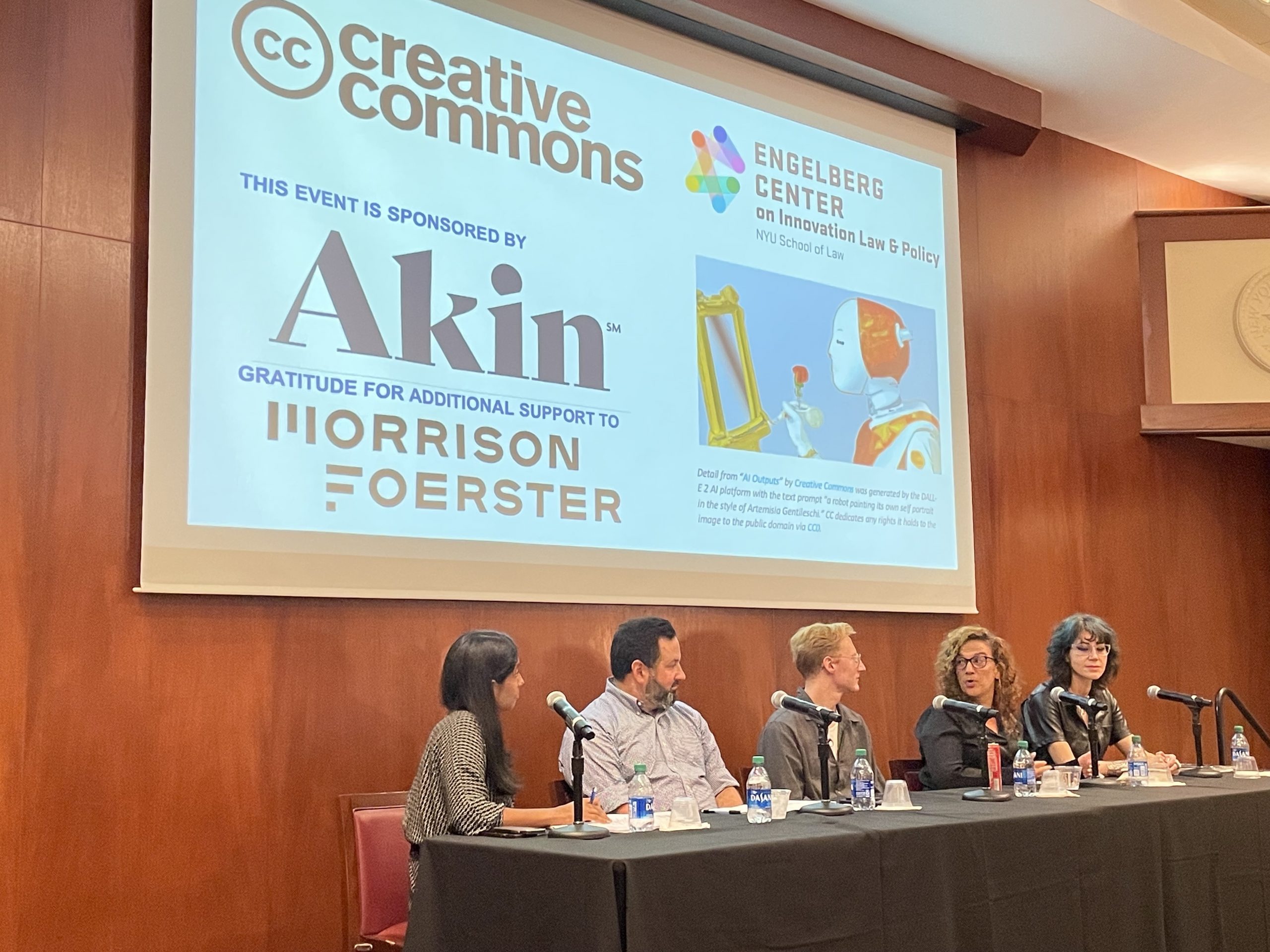
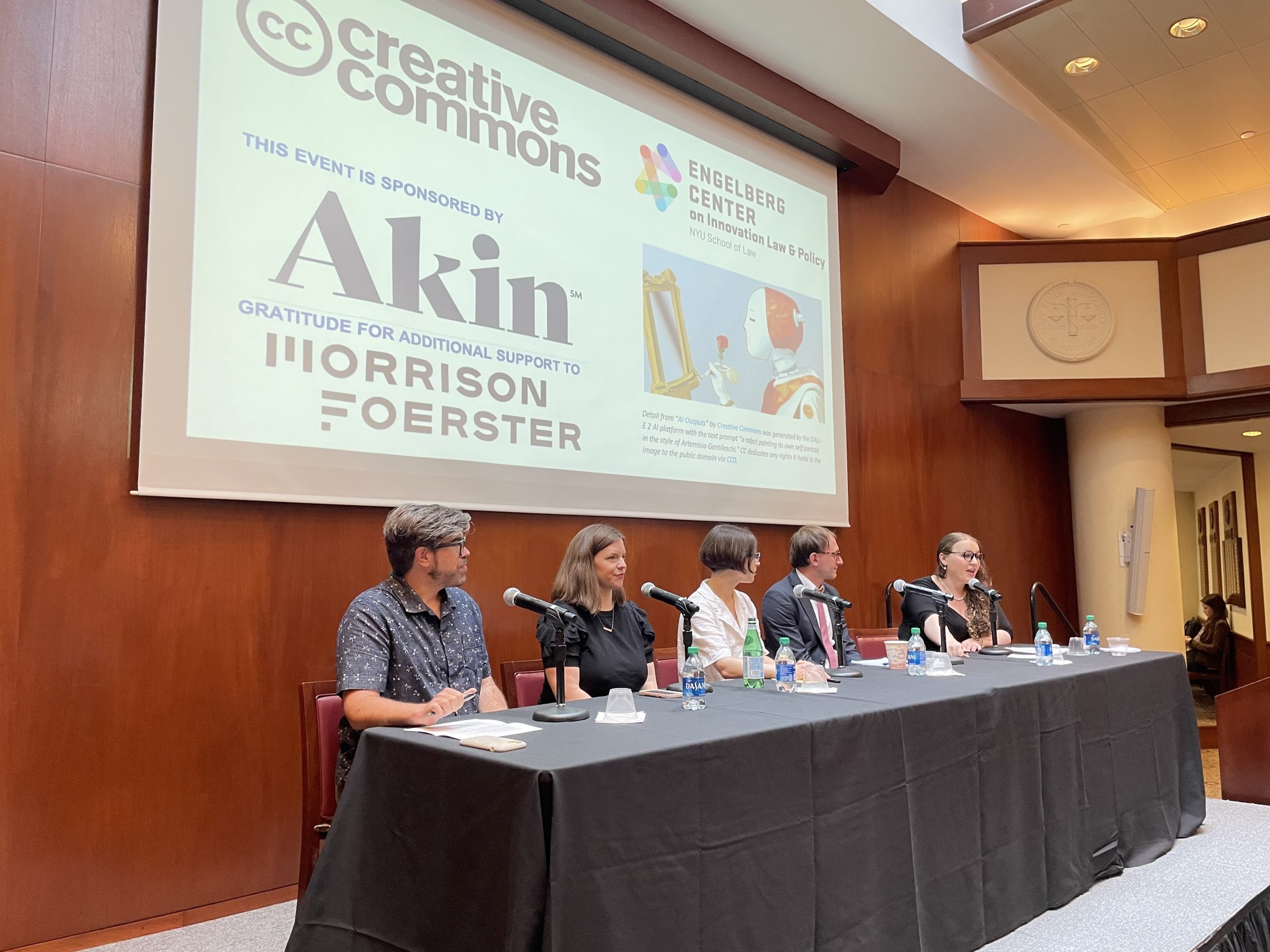
The conversations flowed through the following day’s symposium, Generative AI and the Creativity Cycle, at the Engelberg Center at New York University. 100 participants attended the event, which brought together experts from various fields — including law, the arts, cultural heritage, and AI technology — speaking on seven panels covering a wide range of issues at the nexus of creativity, copyright, and generative AI.
Running like red threads across the panels, here are some of the key themes that surfaced throughout the day’s lively conversations:
Transparency: This requirement was often cited as a precondition for society to build trust in generative AI. Transparency was deemed essential in the datasets, algorithms and models themselves, as well as in AI systems in general. Similarly, a focus on the ways users of AI content could be transparent about their processes was also needed. This tied closely to notions of attribution and recognizing machine input into creative processes.
Attribution (or similar notions of recognition, credit, or acknowledgement): This feature reflects CC’s emphasis on better sharing: nurturing a fair and equitable sharing ecosystem that celebrates and connects creators.
Bias: The problem of bias in AI models as well as the inequalities they perpetuate and compound came up in most if not all sessions. The imperative to address bias was raised alongside calls for greater diversity and inclusion, as is already undertaken in data decolonization efforts.
Economic fairness: Several discussions pointed to a need for fair remuneration, distributive justice, and a universal basic income, as well as employment protection for creators.
Copyright issues (both on the input/training and output levels): While some speakers suggested a sense of loss of control due to a lack of copyright-based permission or consent, others reiterated the fundamental right for anyone to read and absorb knowledge including through machine-automated means.
A multi-pronged approach: Given the multifaceted nature of the challenges raised by generative AI, many speakers highlighted the need to engage on multiple levels to ensure responsible developments in AI. This tied in with the need for adequate incentives and support for open sharing, a sustainable open infrastructure, culture as a public good, sharing in the public interest, all in order to prevent further enclosures of the commons.
Collaboration: Collaborative creation with machines as well as with other humans could give rise to a “remix culture 2.0,” where generative AI as a tool could assist in the emergence of new forms of creativity through “amalgamated imagination.”
Although the above summary does not do justice to the depth and thoughtfulness of the event’s discussions, it does give a flavor of the topics at stake and should help inform those thinking about AI development, regulation, and its role in supporting better sharing of knowledge and culture in our shared global commons.
A special thank you to our workshop participants and symposium speakers and moderators. We are grateful to have had the opportunity to connect with many of you and share diverse perspectives on this complex topic. We are grateful to Morrison Foerster for supporting the workshop, donating space and resources. We’d also like to thank our lead symposium sponsor Akin Gump as well as the Engelberg Center on Innovation Law & Policy for publicly hosting these important conversations.
Fred Saunderson — Open Culture VOICES, Season 2 Episode 24
“New content thrives on reuse and remixing of old content which is increased when you have an open approach to culture.” Fred believes that open culture simplifies many aspects of culture preservation, sharing, and creation by making things clearer and easier to manage for institutions and individuals and that open culture solves challenges for future generations by making information accessible.
Open Culture VOICES is a series of short videos that highlight the benefits and barriers of open culture as well as inspiration and advice on the subject of opening up cultural heritage. Fred is the Rights and Information Manager at the Library of Scotland where he works to make the vast collections of Scotland accessible to the world.
Fred responds to the following questions:
What are the main benefits of open GLAM?
What are the barriers?
Could you share something someone else told you that opened up your eyes and mind about open GLAM?
Do you have a personal message to those hesitating to open up collections?
Closed captions are available for this video, you can turn them on by clicking the CC icon at the bottom of the video. A red line will appear under the icon when closed captions have been enabled. Closed captions may be affected by Internet connectivity — if you experience a lag, we recommend watching the videos directly on YouTube.
Tenemos un grupo increíble de personas preparadas para ser oradores principales en la Cumbre Global 2023, que se llevará a cabo del 3 al 6 de octubre en la Ciudad de México. Recientemente anunciamos a Anya Kamenetz y ahora, en nuestro segundo anuncio, damos la bienvenida a Peter-Lucas Jones, quien va a pronunciar un discurso a la Cumbre que surge de su trabajo como figura destacada en los medios Māori y sus colaboraciones para honrar el conocimiento y la cultura local y tradicional en un contexto global.
Peter-Lucas Jones (Te Aupōuri, Ngāi Takoto, Ngāti Kahu) es el director ejecutivo de Te Hiku Media y un gobernador experimentado en el ecosistema de medios Māori. Actualmente es presidente de Te Whakaruruhau o ngā Reo Irirangi Māori, vicepresidente de Whakaata Māori y presidente de Te Rūnanga Nui o Te Aupōuri. Como kaitiaki (guardián) de confianza de los datos Māori, Peter-Lucas negocia la responsabilidad de proteger los datos iwi (tribales) y Māori, al mismo tiempo que satisface las necesidades de los financiadores y las expectativas de los iwi y hapū (subtribus). Peter-Lucas tiene experiencia en transmisión terrestre y digital trabajando con kaumātua (ancianos) y marae (lugar de reunión Māori sagrado) para grabar contenido y brindar acceso a te reo ā-iwi (variación del lenguaje tribal), tikanga ā-iwi (variación cultural tribal), kōrero tuku iho (tradiciones orales) e historia iwi. Es un locutor de radio en idioma Māori galardonado que se centra en asuntos políticos y temas de actualidad. Esta experiencia ha visto el desarrollo de una licencia Kaitiakitanga para Te Hiku Media que proporciona un marco para guiar el uso de datos Māori desde una perspectiva haukāinga (gente de origen de marae). Te Hiku Media utiliza ahora estos datos para desarrollar herramientas de NLP y NLU para te reo Māori.
Al igual que Peter-Lucas, todos nuestros oradores principales se conectan directamente con las áreas de enfoque de CC, desde la creatividad contemporánea y el patrimonio cultural hasta los medios, la ciencia, la educación y el periodismo. Con el tema de la Cumbre sobre la IA y los bienes comunes, también esperamos enfrentar el desafío de perspectivas nuevas y renacidas que deberíamos considerar al pensar en la inteligencia artificial y su intersección con el conocimiento y la cultura abiertos. Todas los oradores principales de la Cumbre honrarán tanto la ubicación de la Cumbre en México como el alcance global de la comunidad CC.
¡Estén atentos para conocer a nuestros otros oradores principales! Te invitamos a unirte a nosotros en la Cumbre en la Ciudad de México para escuchar hablar a Peter-Lucas y muchas otras voces diversas. Nuestra esperanza es que los oradores principales, el programa completo de la Cumbre y nuestras conexiones informales en la Ciudad de México y en línea se combinen para permitirnos a todos cultivar la estrategia de CC de compartir mejor, un compartir que sea contextual, inclusivo, justo, equitativo, recíproco y sostenible.
We have an incredible group of people lined up to be keynote speakers at the 2023 CC Global Summit, to be held 3–6 October in Mexico City. Recently we announced Anya Kamenetz, and now in our second announcement, we welcome Peter-Lucas Jones, who will address the Summit with a keynote that grows out of his work as a leading figure in Māori media and his collaborations to honor local and traditional knowledge and culture in a global context.
Peter-Lucas Jones (Te Aupōuri, Ngāi Takoto, Ngāti Kahu) is the CEO of Te Hiku Media and an experienced governor in the Māori media ecosystem. He is currently the Chair of Te Whakaruruhau o ngā Reo Irirangi Māori, Deputy Chair of Whakaata Māori and Chairman of Te Rūnanga Nui o Te Aupōuri. As a trusted kaitiaki (guardian) of Māori data, Peter-Lucas negotiates the responsibility of protecting iwi (tribal) and Māori data while meeting the needs of funders and the expectations of iwi and hapū (sub-tribes). Peter-Lucas has terrestrial and digital broadcasting experience working with kaumātua (elders) and marae (sacred Māori meeting place) to record content and provide access to te reo ā-iwi (tribal language variation), tikanga ā-iwi (tribal cultural variation), kōrero tuku iho (oral traditions) and iwi history. He is an award winning Māori language radio broadcaster with a focus on political affairs and topical issues. This experience has seen the development of a Kaitiakitanga License for Te Hiku Media that provides a framework to guide the use of Māori data from a haukāinga (home people of marae) perspective. This data is now used by Te Hiku Media to develop NLP and NLU tools for te reo Māori.
Like Peter-Lucas, all our keynoters connect directly with CC’s areas of focus, from contemporary creativity and cultural heritage, to media, science, education, and journalism. With the Summit’s theme of AI and the commons, we also expect to be challenged with new and reborn perspectives that we should consider in thinking about artificial intelligence and its intersection with open knowledge and culture. All the Summit keynotes will honor both the Summit’s location in Mexico, and the CC community’s global scope.
Stay tuned to learn about our other keynote speakers! We invite you to join us at the Summit in Mexico City to hear Peter-Lucas and many other diverse voices speak. Our hope is that the keynote addresses, the full Summit program, and our informal connections in Mexico City and online will combine to enable us all to cultivate CC’s strategy of better sharing, sharing that is contextual, inclusive, just, equitable, reciprocal, and sustainable
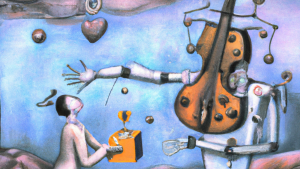
“Better Sharing With AI” by Creative Commons was generated by the DALL-E 2 AI platform with the text prompt “A surrealist painting in the style of Salvador Dali of a robot giving a gift to a person playing a cello.” CC dedicates any rights it holds to the image to the public domain via CC0.
As part of Creative Commons’ ongoing community consultation on generative AI, CC has engaged with a wide variety of stakeholders, including artists and content creators, about how to help make generative AI work better for everyone.
Certainly, many artists have significant concerns about AI, and we continue to explore the many ways they might be addressed. Just last week, we highlighted the useful roles that could be played by new tools to signal whether an artist approves of use of their works for AI training.
At the same time, artists are not homogenous, and many others are benefiting from this new technology. Unfortunately, the debate about generative AI has too often become polarized and destructive, with artists who use AI facing harassment and even death threats. As part of the consultation, we also explored how to surface these artists’ experiences and views.
Today, we’re publishing an open letter from over 70 artists who use generative AI. It grew from conversations with an initial cohort of the full signatory list, and we hope it can help foster inclusive, informed discussions.
“We write this letter today as professional artists using generative AI tools to help us put soul in our work. Our creative processes with AI tools stretch back for years, or in the case of simpler AI tools such as in music production software, for decades. Many of us are artists who have dedicated our lives to studying in traditional mediums while dreaming of generative AI’s capabilities. For others, generative AI is making art more accessible or allowing them to pioneer entirely new artistic mediums. Just like previous innovations, these tools lower barriers in creating art—a career that has been traditionally limited to those with considerable financial means, abled bodies, and the right social connections.”
Read the full letter and list of signatories. If you would like to have your name added to this list and are interested in follow-up actions with this group, please sign our form. You can share the letter with this shorter link: creativecommons.org/artistsailetter
While the policy issues here are globally relevant, the letter is addressed to Senator Chuck Schumer and the US Congress in light of ongoing hearings and “Insight Fora” on AI hosted in the USA. Next week, Schumer is hosting one of these Fora, but the attendees are primarily from tech companies; the Motion Picture Association of America and the Writers Guild of America are invited, but there are no artists using generative AI specifically.
We also invited artists to share additional perspectives with us, some of which we’re publishing here:
Nettrice Gaskins said: “Generative AI imaging is a continuation of creative practices I learned as a college student, in my computer graphics courses. It’s the way of the future, made accessible to us in the present, so don’t throw the baby out with the bathwater.”
Elizabeth Ann West said: “Generative AI has allowed me to make a living wage again with my writing, allowing me to get words on the page even when mental and chronic health conditions made doing so nearly impossible. I published 3 books the first year I had access to Davinci 3. Generative AI allows me to work faster and better for my readers.”
JosephC said: “There must be room for nuance in the ongoing discussion about machine-generated content, and I feel that the context vacuum of online discourse has made it impossible to talk and be heard when it comes to the important details of consent, the implications of regulation, and the prospects of making lives better. We need to ensure that consenting creatives can see their work become part of something greater, we need to ensure pioneering artists are free to express themselves in the medium that gives them voice, and we need to be mindful of the wishes of artists who desire to have their influence only touch the eyes and ears and minds of select other humans in the way they want. Opportunities abound; let us work together to realize them.”
Tim Simpson said: “Generative AI is the photography of this century. It’s an incredible new medium that has immense potential to be leveraged by artists, particularly indie artists, to pursue artistic visions that would have been completely infeasible for solo artists and small teams just a year ago. Open source AI tools are immensely important to the development of this medium and making sure that it remains available to the average person instead of being walled off into monopolized corporate silos. Many of the regulatory schemes that are being proposed today jeopardize that potential, and I strongly urge congress to support measures that keep these tools open and freely available to all.”
Rob Sheridan said: “As a 25 year professional artist and art director, I’ve adapted to many shifts in the creative industry, and see no reason to panic with regards to AI art technology itself….I fully understand and appreciate the concerns that artists have about AI art tools. With ANY new technology that automates human labor, we unfortunately live under a predatory capitalism where corporations are incentivized to ruthlessly cut human costs any way they can, and they’ve made no effort to hide their intentions with AI (how many of those intentions are realistic and how many are products of an AI hype bubble is a different conversation). But this is a systemic problem that goes well beyond artists; a problem that didn’t begin with AI, and won’t end with AI. Every type of workforce in America is facing this problem, and the solutions lie in labor organizing and in uniting across industries for major systemic changes like universal healthcare and universal guaranteed income. Banning or over-regulating AI art tools might plug one small hole in the leaky dam of corporate exploitation, but it closes a huge potential doorway for small creators and businesses.”
Anya Kamenetz Será una Oradora Principal en la Cumbre Mundial CC 2023
Tenemos un grupo increíble de personas preparadas para ser oradores principales en la Cumbre Global 2023, que se llevará a cabo del 3 al 6 de octubre en la Ciudad de México. En nuestro primer anuncio, damos la bienvenida a la escritora Anya Kamenetz, quien cerrará la Cumbre con un discurso de apertura que surge de su trabajo como periodista y ahora activista centrada en la educación climática para los niños.
Anya Kamenetz habla, escribe y piensa sobre la justicia generacional y cómo los niños aprenden, crecen y prosperan en un planeta cambiante. Cubrió la educación como periodista durante muchos años, incluso para NPR, donde también cocreó el podcast Life Kit:Parenting en asociación con Sesame Workshop. Kamenetz es actualmente asesor del Aspen Institute y de la Climate Mental Health Network sobre nuevas iniciativas en la intersección de los niños y el cambio climático. Es autora de varios libros de no ficción aclamados: Generation Debt (Riverhead, 2006); DIY U: Edupunks, Edupreneurs, and the Coming Transformation of Higher Education (Chelsea Green, 2010) ; The Test: Why Our Schools Are Obsessed With Standardized Testing, But You Don’t Have To Be (Public Affairs, 2016); y The Art of Screen Time: How Your Family Can Balance Digital Media and Real Life (Public Affairs, 2018). Su último libro es The Stolen Year: How Covid Changed Children’s Lives, And Where We Go Now (Public Affairs, 2022). Kamenetz creció en Luisiana en una familia de escritores y místicos y se graduó en Yale University. Vive en Brooklyn con su marido y sus dos hijas y escribe el boletín The Golden Hour.
Al igual que Anya, todos nuestros oradores principales se conectan directamente con las áreas de enfoque de CC, desde la creatividad contemporánea y el patrimonio cultural hasta los medios, la ciencia, la educación y el periodismo. Con el tema de la Cumbre sobre la IA y los bienes comunes, también esperamos enfrentar el desafío de perspectivas nuevas y renacidas que deberíamos considerar al pensar en la inteligencia artificial y su intersección con el conocimiento y la cultura abiertos. Todas los oradores principales de la Cumbre honrarán tanto la ubicación de la Cumbre en México como el alcance global de la comunidad CC.
¡Estén atentos para conocer a nuestros otros oradores principales! Te invitamos a unirte a nosotros en la Cumbre en la Ciudad de México para escuchar hablar a Anya y muchas otras voces diversas. Nuestra esperanza es que los oradores principales, el programa completo de la Cumbre y nuestras conexiones informales en la Ciudad de México y en línea se combinen para permitirnos a todos cultivar la estrategia de CC de compartir mejor, un compartir que sea contextual, inclusivo, justo, equitativo, recíproco y sostenible.
We have an incredible group of people lined up to be keynote speakers at the 2023 CC Global Summit, to be held 3–6 October in Mexico City. In our first announcement, we welcome writer Anya Kamenetz, who will close the Summit with a keynote that grows out of her work as a journalist, and now, activist focused on climate education for children.
Anya Kamenetz speaks, writes, and thinks about generational justice, and how children learn, grow and thrive on a changing planet. She covered education as a journalist for many years including for NPR, where she also co-created the podcast Life Kit:Parenting in partnership with Sesame Workshop. Kamenetz is currently an advisor to the Aspen Institute and the Climate Mental Health Network on new initiatives at the intersection of children and climate change. She’s the author of several acclaimed nonfiction books: Generation Debt (Riverhead, 2006); DIY U: Edupunks, Edupreneurs, and the Coming Transformation of Higher Education (Chelsea Green, 2010) ; The Test: Why Our Schools Are Obsessed With Standardized Testing, But You Don’t Have To Be (Public Affairs, 2016); and The Art of Screen Time: How Your Family Can Balance Digital Media and Real Life (Public Affairs, 2018). Her latest book is The Stolen Year: How Covid Changed Children’s Lives, And Where We Go Now (Public Affairs, 2022). Kamenetz grew up in Louisiana in a family of writers and mystics, and graduated from Yale University. She lives in Brooklyn with her husband and two daughters and writes the newsletter The Golden Hour.
Like Anya, all our keynoters connect directly with CC’s areas of focus, from contemporary creativity and cultural heritage, to media, science, education, and journalism. With the Summit’s theme of AI and the commons, we also expect to be challenged with new and reborn perspectives that we should consider in thinking about artificial intelligence and its intersection with open knowledge and culture. All the Summit keynotes will honor both the Summit’s location in Mexico, and the CC community’s global scope.
Stay tuned to learn about our other keynote speakers! We invite you to join us at the Summit in Mexico City to hear Anya and many other diverse voices speak. Our hope is that the keynote addresses, the full Summit program, and our informal connections in Mexico City and online will combine to enable us all to cultivate CC’s strategy of better sharing, sharing that is contextual, inclusive, just, equitable, reciprocal, and sustainable.