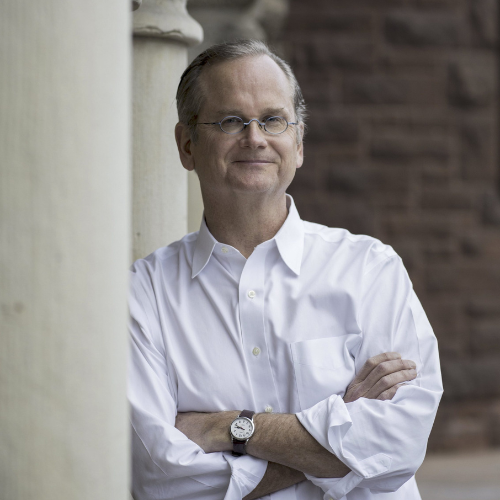
Lawrence Lessig
Founder / Board Member Emeritus
Lawrence Lessig is the Roy L. Furman Professor of Law and Leadership at Harvard Law School. Prior to returning to Harvard, he taught at Stanford Law School, where he founded the Center for Internet and Society, and at the University of Chicago. He clerked for Judge Richard Posner on the 7th Circuit Court of Appeals and Justice Antonin Scalia on the United States Supreme Court. He holds an honorary degree from the University of Victoria, Victoria, Canada, UCLouvain, Belgium, Lund Univeristy, Sweden, Athabasca University, Athabasca, Canada, Amsterdam University, Amsterdam.
Lessig is the founder of Equal Citizens and a founding board member of Creative Commons. He serves on the Scientific Board of AXA Research Fund, is a member of the American Academy of Arts and Sciences and the American Philosophical Society. He has received numerous awards including a Webby, the Free Software Foundation’s Freedom Award, Scientific American 50 Award, and Fastcase 50 Award. Lessig’s early work focused on law and technology, especially as it affects copyright. His current work addresses the failure of democracy, and innovations to reform democracy.
He is the author of hundreds of articles and essays, and a dozen books, including: They Don’t Represent Us: Reclaiming Our Democracy (2019), Fidelity & Constraint: How the Supreme Court Has Read the American Constitution (2019), America, Compromised (2018), Republic, Lost v2 (2015), The USA is Lesterland (2014), One Way Forward (2012), Republic, Lost: How Money
Corrupts Congress—and a Plan to Stop It (2011), Remix: Making Art and Commerce Thrive in the Hybrid Economy (2008), Code v2 (2006), Free Culture (2004), The Future of Ideas (2001), and Code and Other Laws of Cyberspace (1999).
Lessig holds a BA in economics and a BS in management from the University of Pennsylvania, an MA in philosophy from Cambridge University, and a JD from Yale.