Creative Commons has been exploring questions around artificial intelligence for a long time: how this profound technological shift might affect people’s motivations to share, whether the intentions behind sharing work before AI became mainstream still hold when we consider how those works are being used now, and how we sustain a thriving commons when the fundamental bargain of the open web has shifted.
Since 2002, Creative Commons (CC) licenses have served as legally enforceable tools for digital sharing. Beyond their functionality, they also signal a commitment to open sharing in the public interest. CC’s general guidance has been to acknowledge and support all valid uses for each of our current six licenses and two public domain tools.
At the recent Founders Fireside Chat, Creative Commons founder Lawrence Lessig referred to himself as “hopelessly naive.” It struck me that this sort of naivete—the kind that is about believing in the potential for good when sharing knowledge with other humans—is the glue that holds the entire Creative Commons movement together, across borders and belief systems.
In this post, we outline our plans to build upon and strengthen CC signals in order to support our goal of sustained access to human knowledge. We do not have all the answers yet. What we do have is a framework for how we will work toward them.
by
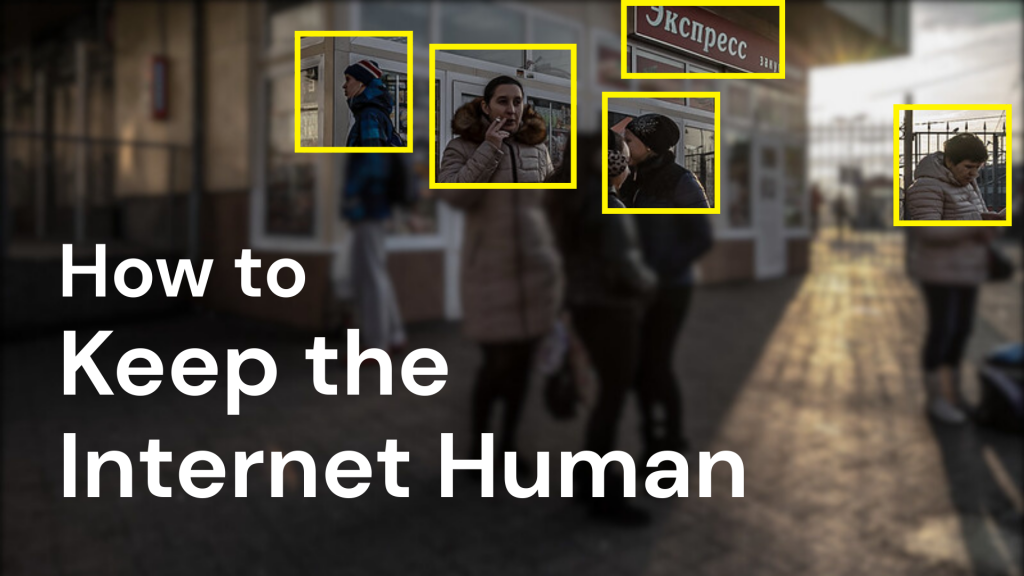
Sarah Hinchliff PearsonPolicyPhoto by Dmitry Ryzhkov, 2014, licensed with CC BY-NC-SA 2.0, Flickr, remixed by Creative Commons, 2026, CC BY 4.0.
I like to say I am a “writer who lawyers”. I begin here because I want to name my biases up front. I am a lawyer, but I come to this work first and foremost as a writer thinking about the conditions that will allow us to continue to share knowledge publicly. And in spite of—or perhaps because of—the fact that I am a lawyer, I have a healthy skepticism about the power of legal terms and conditions. The law will play a role, but the challenge of keeping the internet human will ultimately be navigated by the stories we imagine and tell. We need new stories.
What role do books play in training AI models, and how might digitized books be made widely accessible for the purposes of training AI? What dataset of books could be constructed and under what circumstances? A new paper investigates the concept of a responsibly designed, broadly accessible dataset of digitized books to be used in training AI models.
Creative Commons welcomes the adoption by the European Parliament of the EU’s Artificial Intelligence Act. We engaged intensively with EU policymakers to safeguard the appropriate interplay with EU copyright legislation. The EU must now ensure implementation allows broad, open access to harness the full potential of generative AI whilst enforcing the safeguards provided.
Dear Open Movement Creators, Activists, and Stewards, A key question facing Creative Commons as an organization, and the open movement in general, is how we will respond to the challenge of shaping artificial intelligence (AI) towards the public interest, growing and sustaining a thriving commons of shared knowledge and culture. So much of generative AI…
In the past year, Creative Commons, alongside other members of the Movement for a Better Internet, hosted workshops and sessions at community conferences like MozFest, RightsCon, and Wikimania, to hear from attendees regarding their views on artificial intelligence (AI). In these sessions, community members raised concerns about how AI is utilizing CC-licensed content, and discussions…