This year at CC Global Summit, we hosted workshops focused on the notion of a better version of the internet. For the workshops, we prepared in smaller groups, identified common areas of interest and concern, and gathered a global group of voices to dig into the issues. In this blog post, we introduce the Better Internet series, which we will use to share the findings of the workshops we hosted at the CC Global Summit, explore the perspectives communicated by those who participated, and share what we are working on with partners to drive these conversations forward and take action.
Throughout 2021, community partners interested in building what was loosely being called a “better internet” have been coming together for conversations. Some partners joined as an opportunity to mark the 10th anniversary of the US-based fight to defeat the legislation known as SOPA/PIPA.
Anniversaries are often an opportune time to not only look back, but to also look forward to the future. In fact, many anniversaries are being celebrated in the open movement this year. Twenty years ago, Creative Commons (CC), Wikimedia, Public Knowledge, and MIT OpenCourseWare were founded. Ever ahead of the curve, the Internet Archive celebrated 25 years. Collectively, we’ve all been looking back – and looking forward – and talking about how, as forces with shared values, we can help keep the internet open, accessible, and safe for the future.
The conversations range from light and reflective to deep and contemplative. Some have been asynchronous. Some become a snowball that starts rolling down the hill into reflections about better days, and past collaborations about an open internet. Before major platforms. Before social media. Before clickbait, misinformation, and fake news. There is a desire among this group to build an improved version of the internet for those who live there now, and protect its best features for the future generations to come.
Today, we are imagining a multi-stakeholder public interest technology alliance, working together to shape a vision for a Better Internet. Let’s protect the good and define a positive, affirmative view of how we can solve and transform the challenges we face.
At this year’s CC Global Summit, we hosted two workshops focused on this notion of a better version of the internet. This fully supports our vision to advance Better Sharing, outlined in our current organizational strategy. For the Summit workshops, we prepared in smaller groups, identified common areas of interest and concern, and gathered together a global group of voices to dig into the issues.
Our focus was on:
Misinformation and Disinformation
Access to Information and Knowledge
Platformization and Choice
Internet Architecture and Open Standards
Last Mile Access
Today, we are imagining a multi-stakeholder public interest technology alliance, working together to shape a vision for a Better Internet. Let’s protect the good and define a positive, affirmative view of how we can solve and transform the challenges we face.
We also called for folks to explore what the concept of Positive Internet Citizenship might mean for this movement, and the critical role of Diversity, Equity, and Inclusion in all of the work that we want to carry forward.
In some ways, these are distinct topics, each with their own set of existing actors, policy environments, and agendas. In other ways, they’re slices from the same apple. Considerations for fighting misinformation can tie back to provenance of content, which can be strengthened by greater access to information. Open standards and interoperability would decrease the power of platformization to keep folks locked into separate walled gardens. Every issue must be grounded in the importance of protecting fundamental human rights online and empowering those who are marginalized. The absolute prerequisite to any of this is folks actually being online. We cannot ignore last mile access as a key matter of equity and access.
It turns out a lot of folks have been thinking along these same lines, as the desire to steer our way towards a better digital experience takes hold at all levels. Our work will be to effectively work together and find common ground.
In the United States, President Biden’s Summit for Democracy is publicly about protecting democracy and advancing human rights, but on the fringe there is a plan emerging to form a new alliance – The Alliance for the Future of the Internet. As Politico reported earlier in November, civil society groups appear jarringly absent from the alleged multi-stakeholder effort. In addition, critics may also point to the fact that instead of building something new, perhaps building on something existing, like the Freedom Online Coalition, would be a more useful investment. It remains to be seen how this will all play out.
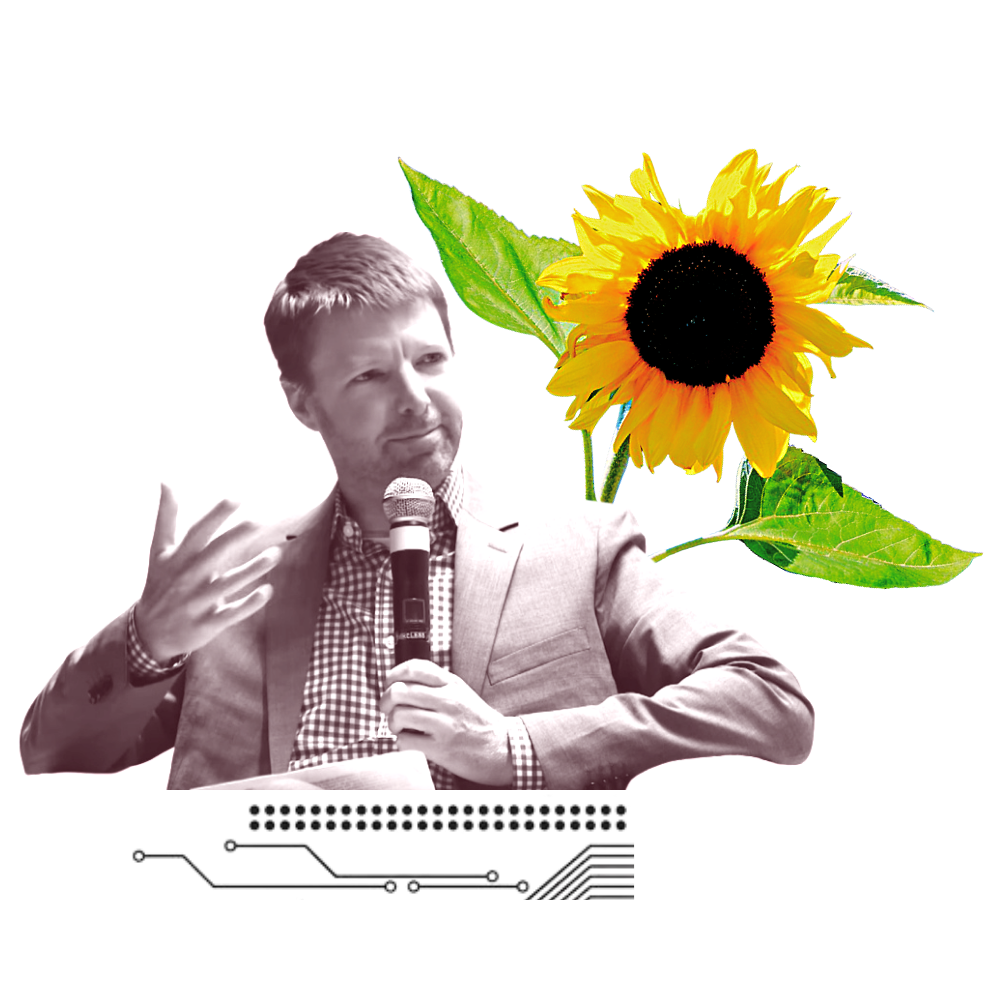
Earlier this month, the Knight Foundation hosted a digital event, Lessons from the First Internet Ages, which brought together activists, academics, civil servants, and everything in between, to reflect on the last 30 days, and posit how things might have been done, and perhaps should be done differently. Members of the open movement contributed their voices, from Creative Commons board member Alexander Macgillivray, to Internet Archive founder Brewster Kahle, to creator and tech activist Cory Doctorow, and many more luminaries.
The signals from government and civil society that we need to build a better internet may in part be getting stronger due to the digital policy environment globally. In the EU, a number of challenges have been identified with the transposition of Article 17 of the CDSM Directive. There is potential for openly licensed and public domain content, along with other content being used legitimately, to be over-filtered or taken down, which would be a massive blow to those who work towards free and open access to knowledge and information. Concurrently, the Digital Services Act that is being debated has the potential to overregulate and impact freedom of expression. We want to see a balance between online safety and individual empowerment being preserved, as the #OffOn campaign is fighting for.
As Creative Commons coordinates with other organizations to continue these conversations around a Better Internet, and give shape to a movement, the very underpinnings include using our existing collective power of convening to impact change. Call it an alliance. Call it a coalition. Call it a movement. Call it a multi-stakeholder effort. At the end of the day, this is about folks working on different but complementary issues, coming together across local, regional, and national divides to give shape to our own civil society agenda, to fulfill the promise of the Internet, and to build something that works for the people and serves the public interest. In the coming weeks, we will be sharing some of the findings from the workshops we hosted at the CC Global Summit, exploring the perspectives communicated by those who took part, and sharing what we’re working on with fellow believers to continue moving the conversation forward. Watch this space and help us expand the values on which we can build a Better Internet.
Creative Commons welcomes EC recommendation on common European data space for cultural heritage
Notre Dame, Paris, 1886. by Okänd – Swedish National Museum of Science and Technology, Sweden – Public Domain.
A few days ago, the European Commission (EC) released a recommendation for a common data space for cultural heritage, which aims to “accelerate the digitization of all cultural heritage monuments and sites, objects and artefacts for future generations, to protect and preserve those at risk, and boost their reuse in domains such as education, sustainable tourism and cultural creative sectors.” Europeana, the European digital cultural platform, will serve as the basis for building this common data space. It will allow museums, galleries, libraries, and archives across Europe to share and reuse the digitized cultural heritage images, such as 3D models of historical sites and high quality scans of paintings, on the Europeana platform.
The recommendation encourages Member States to digitize by 2030 all monuments and sites that are at risk of degradation, and half of those highly frequented by tourists. Thierry Breton, Commissioner for Internal Market, said: “We owe the preservation of our European cultural heritage to future generations. This requires building and deploying our own technological capabilities, empowering people and businesses to enjoy and make the most of this heritage. We must take advantage of the opportunities brought by artificial intelligence, data, and extended reality.” This last point was reinforced by the EC on Twitter: “3D, artificial intelligence or virtual reality can accelerate the digital transformation of the cultural sector.”
Creative Commons (CC) is eager to explore the recommendation and its potential to catalyze “open GLAM,” the set of ideals, principles and values promoting preservation, open access, sharing and reuse of cultural heritage around the world, in line with our organization’s value of global inclusivity and commitment to better sharing. As part of our Open GLAM Program, we strive to help create a regulatory environment that supports creativity, collaboration, and the sharing of creative works and cultural heritage, upholds user rights and enables a rich, robust and thriving public domain. The recommendation appears to be a step in the right direction.
The recommendation succeeds the 2011 Recommendation on the digitization and online accessibility of cultural material and digital preservation, which underwent review last year. Creative Commons had submitted comments to the consultation on the opportunities offered by digital technologies to the cultural heritage sector. We are thrilled to see many of our comments have found an echo in the new recommendation. Here’s a summary of what we pushed for:
Access and use of cultural heritage is also governed by ethical considerations that must be taken into account
The implementation of the CDSM Directive must support cultural institutions
There is a crucial need for training and capacity building on copyright and licensing issues in the cultural heritage sector
Artificial intelligence can potentially offer many benefits for the cultural heritage sector
Our Open GLAM Program comes within the scope of our strategy for 2021-2025, whose central theme is better sharing, i.e. sharing that is contextual, ethical, inclusive, sustainable, purposeful and prosocial. We look forward to following the development and implementation of the recommendation, and will endeavor to put our tools for accessing, using, and resharing cultural heritage in the hands of all to build a brighter future for everyone, everywhere.
Cultural heritage must be preserved, accessed, shared, reused and celebrated throughout the world. At Creative Commons, we’re proud to support the cultural heritage sector through our Open GLAM Program. Interested in learning more? Join the Creative Commons Open GLAM Platform, subscribe to our mailing list or get in touch info@creativecommons.org!
CC Certificate Alumnus, Mostafa Azad Kamal on his work with open education policies and practice
The Creative Commons Certificate program provides unique training courses for educators, academic librarians and the GLAM community (galleries, libraries, archives and museums). Certificate courses are an investment in open movements, training people on copyright, open licensing, and the ethos of working with our global, shared commons using CC licenses.
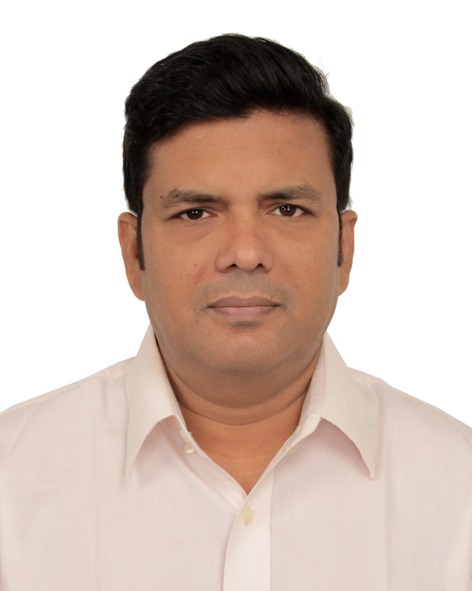
Portrait, Mostafa Azad Kamal, CC BY 4.0
After launching in 2018, and certifying approximately 1000 graduates from 56 countries, Creative Commons (CC) is taking stock of the incredible community of Certificate participants and alumni. We are particularly interested in learning about local “case studies” of open licensing in local country contexts, and asking alumni about their experiences. CC Certificate alumni have used the Certificate courses in a number of ways—read about alumni testimonials here, and an in-depth adaptation one alumnus made of course content here. In this interview, we highlight one Certificate graduate’s work in Bangladesh, and celebrate the momentum he’s built in open education.
This interview is with Mostafa Azad Kamal. Mostafa is the Dean of Business Faculty at Open University in Bangladesh. He mentors people for the Open Education for a Better World project (OE4BW); was a reviewer for UNESCO OER* Recommendation; and helped draft a National OER Policy for Bangladesh. Mostafa serves as a CC Global Network Chapter Lead for Bangladesh.*
Mostafa is also designing and updating the curriculum for the OU bachelor of business program in Bangladesh, moving to OER materials where possible. He and colleagues have developed almost 40 business modules using OER for students.
An Interview With Mostafa Azad Kamal at Open University Bangladesh, Dean of Business Faculty
CC: Thank you for joining us today. We understand you have a pretty unique role, working at the intersection of open education policy and practice. As Dean of Business Faculty at Open University in Bangladesh, you understand how OER serves the needs of students in your classes, and you’ve given numerous talks about the importance of OER; but, you also were a reviewer for the UNESCO OER Recommendation (passed in November 2019), you developed an open OER repository for Bangladesh in 2013, and now, you helped draft the National OER Policy that the Ministry of Education is considering. Tell us about this policy and what it took to draft it.
Mostafa:My journey with the open movement started in 2012. With the help of the Commonwealth of Learning’s (COL) open schooling initiatives (led by Ms. Frances Ferriera), I planned to develop an OER Policy for Bangladesh Open University (BOU). As I believed that Open Policy would create a commitment of the authority of BOU, my colleague Dr. Sadia Afroze Sultana and I designed a workshop for OER Policy development for BOU. It was exciting that BOU was the first university in Bangladesh to have an OER Policy. Following the policy, BOU developed a repository that contains the books developed for the learners of different BOU programs. Now BOU has 43 formal programs with 600,000 students. BOU OER repository is extensively visited by BOU learners as well as other learners.
I’ve always had a strong intention to create awareness of open education in Bangladesh, so I began looking for an opportunity to draft a policy for the Ministry of Education. I managed to convince Dr. Sanjaya Mishra, Educational Specialist (eLearning) at the Commonwealth of Learning, to provide support for the National OER Policy.
Developing the National OER Registry happened in 3 phases. First, we conducted a nationwide survey among public university students and produced a COL report identifying the strong need for OER among the university students. The study found that the limited access to the books decreased students’ learning achievements and affected their grades.
Based on these findings, we drafted a national policy on OER. This required hosting two national consultation workshops and incorporating feedback on a draft policy before submitting the policy to the Ministry of Education for further approval.
In phase 3, the Ministry of Education started a feedback and vetting process, working with various related agencies, institutions and ministries before finalizing the draft. Now it is waiting for the final approval from the cabinet division of the government.
“The study found that the limited access to the books decreased students’ learning achievements and affected their grades.”
CC: How do you see policy and practice working together? What are some of the challenges open policies face, either in creation or implementation?
Mostafa: Policy is a commitment from the top management as well as the stakeholders. I believe policy is critical for mainstreaming the open culture and practices. Since the open movement is relatively new at educational institutions, an informed policy usually makes the stakeholders aware of the concept and motivates them to use and create OER. Though practicing open education is not necessarily dependent on the open policy, a policy is always helpful for mainstreaming open educational practices at institutions.
Open policies face challenges in various ways.
The mindset of the institution’s leadership is a big obstacle for promoting open policies. Most of the institutions charge money from the students on study packages. So, they do not feel comfortable with open sharing.
Sometimes, authors do not permit institutions to share their resources openly. They are mostly afraid of economic loss, or losing their moral rights.
Teachers are often used to using foreign textbooks for their courses, even if those books are copyrighted and highly expensive. They like to maintain this status quo, as they are so much confused about the quality of open resources. So, they do not encourage open education.
Another challenge is the lack of skills in using OER for teaching and learning.
CC: Now let’s talk about OER in practice. I understand you and colleagues have developed almost 40 business course modules using OER. How is OER helping your MBA students
Mostafa:As the Dean of the Business School, I am now working toward adoption and adaptation of OER for all our courses of MBA, BBA, Commonwealth MBA and PGD programs. The reasons are:1) textbooks are highly expensive, students buy bootlegs which are violations to copyright; and 2) textbook case studies and examples never reflect the local context for Bangladeshi students.
I got a plan to engage students (MBA and commonwealth MBA) in developing case studies from local contexts. I prefer to give them assignments for developing content based on their local contexts. I strongly believe that the content developed by students helps their engagement, helps them learn more, and makes the material better for future students.
Pedagogically, I never believe that a student can learn from a fixed textbook if he/she is not engaged in their own context. Also, to be future ready, learners must understand how to search for and synthesize relevant resources. A singular, closed textbook limits learners to one source of knowledge, subject to old theories, cases and concepts. So, they end up just memorizing the concepts. Considering the issue of contextualization and the importance of the capacity of surfing the world of knowledge, I strongly believe that there is no better alternative to OER.
CC: You took the CC Certificate in 2018, but you’d already contributed a tremendous amount in the field of open education. Did the CC Certificate help you with any of your open projects?
Mostafa: Certainly. It helps me in five ways. First, I am confident that I got a certificate that speaks to the authenticity of my understanding of open licenses. Secondly, the CC Certificate course enhanced my understanding of open education, copyright issues, open licenses and open policies very much. With clarity on the concepts, I’m better able to teach my colleagues and participants in local workshops. Thirdly, the Certificate offers a very gracious network with the kind and noble open leaders and practitioners worldwide, which allows me to keep myself in the learning process not only in OER, but also in eLearning, learning design and open pedagogies. Fourthly, I am confidently pushing the institutions and government agencies to develop open policies for their benefits and the benefits of the rest of the world as well. Fifthly, I am now helping my colleagues at my university, as well as other universities in Bangladesh and India, find OER and develop OER-based study resources. Recently, I facilitated 3 workshops on OER, where more than 1000 teachers from 20 universities of Bangladesh attended. They came up with 20 institutional OER Policies which are in revision form.
“Though practicing open education is not necessarily dependent on the open policy, a policy is always helpful for mainstreaming open educational practices at institutions.”
CC: That’s terrific! Once the national policy is done, what do you hope to accomplish next?
Mostafa: Once the national policy is approved, I will convince the Ministry to create a fund for promoting open educational practices among all universities. As a first step, I aim to help develop OER policies for the country’s 150 universities, and also conduct the workshops, seminars and summits to make the academics and learners aware of OER.
CC: If there’s one piece of advice you could give people, like educators or administrators, considering conducting open work at their institution, what would it be?
Mostafa:The fundamental truth of education is ‘learning’. To ensure meaningful learning, we must not keep ourselves confined to a few expensive and copyrighted textbooks, which limits learners’ access to resources and their ability to think deeply and critically. Another point is that the copyrighted textbooks from foreign origin are not customizable, which reduces the quality of learning. Therefore, OER can help them reduce the cost of education, enhance the quality of learning, and expand the free and legal access to plainly relevant education resources.
CC: Thanks again for your time with us here.
We celebrate Mostafa’s excellent work, and we want to celebrate more of our CC Certificate alumni’s work, as well as the fantastic work of people in the broader open education community! If you have a story about something you’ve tried or an open project you’ve accomplished at your institution, please let us know (email certificates@creativecommons.org).
—
*Readers note: Open Educational Resources (OER) are teaching, learning, and research materials that are either (a) in the public domain or (b) licensed in a manner that provides everyone with free and perpetual permission to engage in the 5R activities.
Retain – make, own, and control a copy of the resource Reuse – use your original, revised, or remixed copy of the resource publicly Revise – edit, adapt, and modify your copy of the resource Remix – combine your original or revised copy of the resource with other existing material to create something new Redistribute – share copies of your original, revised, or remixed copy of the resource with others
CC Community Spotlight Series: Meet the co-founders of Fine Acts, Pavel and Yana
In the weeks leading up to #GivingTuesday on November 30th, we’re spotlighting leaders in the Open Movement and encouraging you to support our Better Sharing, Brighter Future campaign.
We’re inching toward our $100,000 goal and hoping you can help us out. The good news is every donation up to $30,000 will be matched. You can transform your $25 donation into a $50 one. ?
Last week, we took a look at the work of historian, critic, author and podcast host Tyler Green, who highlighted how Open Access to art history is critical in strengthening our understanding of the past.
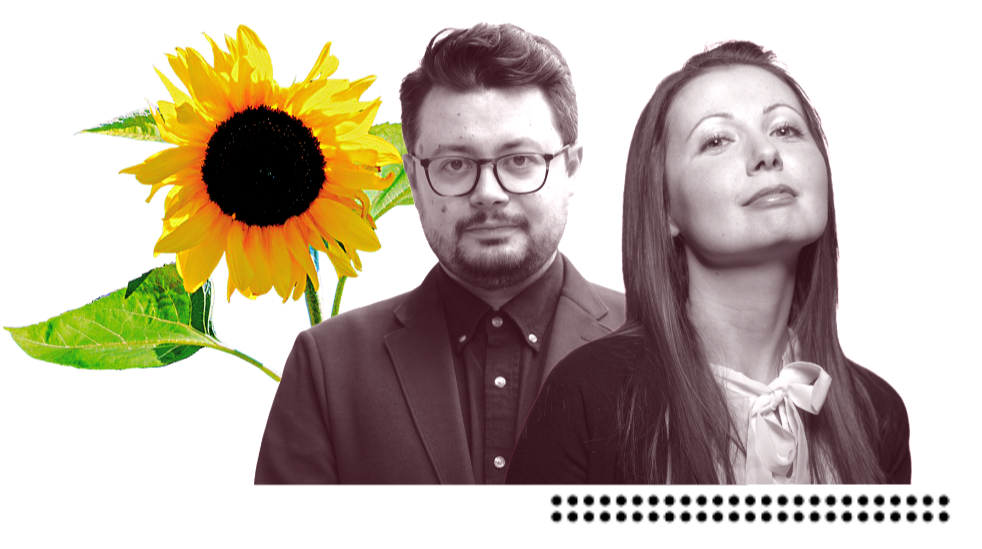
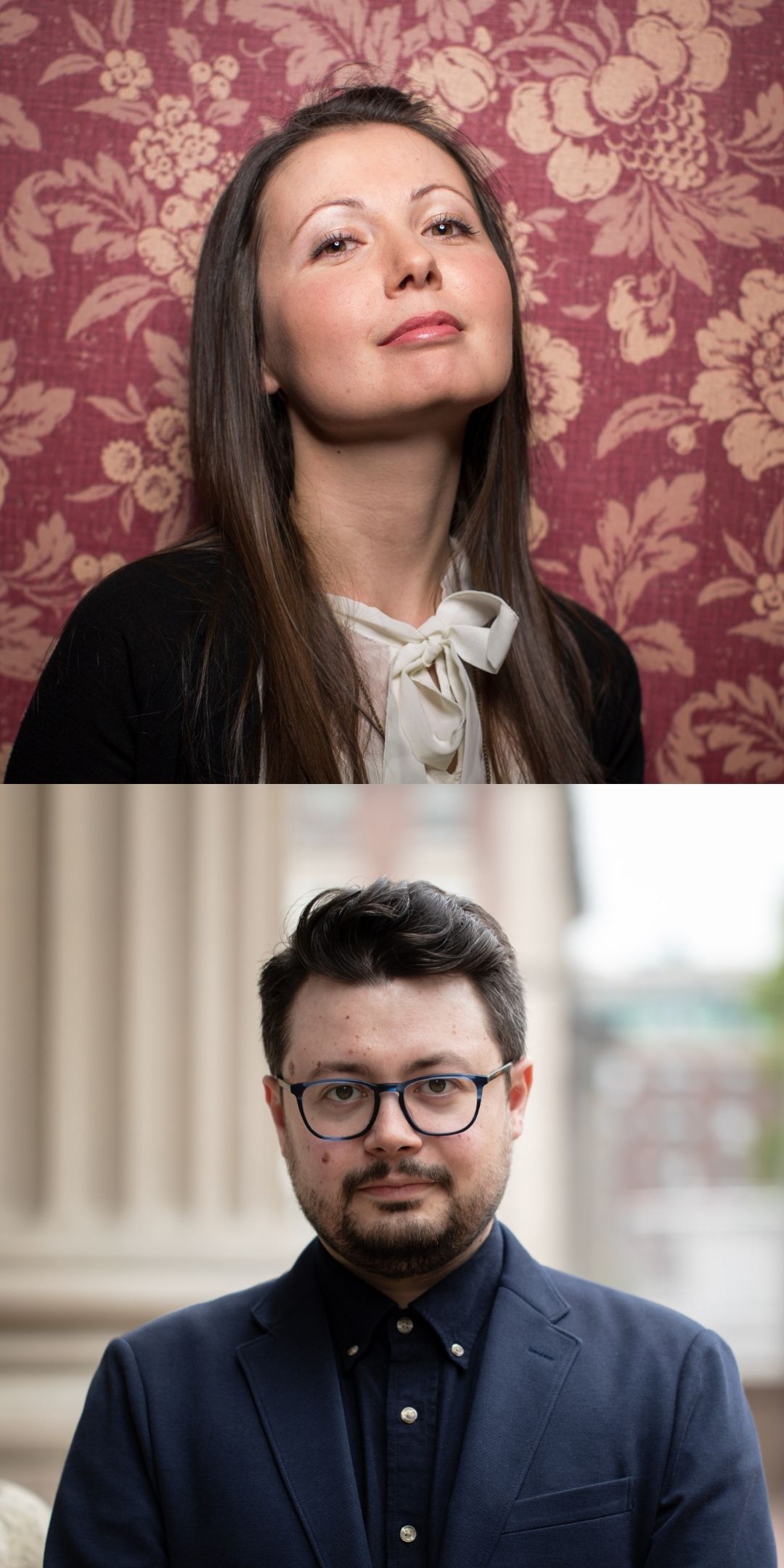
This week, we’re featuring dynamic duo Yana Buhrer Tavanierand Pavel Kounchev, two of three co-founders of Fine Acts, a global creative studio that encourages experimentation and collaboration across disciplines to inspire social change. Yana and Pavel met on Twitter over a decade ago, united in their drive for activism that centers art, experimentation and play.
Fine Acts brings together multidisciplinary teams of artists, activists and technologists to prototype compelling works of art aligned with specific human rights campaigns. They publish all completed works under Creative Commons on TheGreats.cofor anyone to use and adapt, especially nonprofits and activists who, they say, often lack easy access to the visual materials needed for an impactful campaign.
“…creating this kind of powerful visual content on social issues does result in raising visibility and engagement. However, it is very difficult for nonprofits to produce it because they very rarely have the resources or the person on their team that could produce these kinds of content. Publishing it under an open license, we do solve such a key problem for many nonprofits or grassroots groups, even individual activists.”
Yana and Pavel hope more nonprofits and individuals will embrace play and experimentation in their work, and recognize art as a central strategy in driving social change.
You can learn more about Yana Buhrer Tavanierand Pavel Kounchev and their organization Fine Acts by tuning into Creative Commons’ Open Minds Podcast.
Join us next week for one final Community Spotlight before #GivingTuesday kicks off on November 30th.
In the meantime, we invite you to join our Better Sharing, Brighter Futurecampaign. See below for ways to get involved.
Share why you support the open movement or how CC has impacted your work on social media, with the hashtags #CCTurns20 and/or #BetterSharing and tagging @creativecommons.
First photo: Yana Buhrer Tavanier, Second photo: Pavel Kounchev
On this episode, we’re joined by two guests, Yana Buhrer Tavanier and Pavel Kounchev, two of three co-founders of Fine Acts, a global creative studio that encourages experimentation and collaboration across disciplines to inspire social change. Fine Acts brings together multidisciplinary teams of artists, activists and technologists to prototype compelling works of art aligned with specific human rights campaigns. They publish all completed works on TheGreats.co, their free platform filled with socially engaged visual content, open to anyone to use or adapt non-commercially under CC licenses.
Yana is the Executive Director of Fine Acts, a TED Senior Fellow, Young Global Leader of the World Economic Forum, a Fellow of the Royal Society of Arts, and her most recent TED talk, focused on the concept of playtivism: incorporating multidisciplinary creative play and experimentation in activism has been viewed close to 2 million times. Pavel is chair of the board of Fine Acts, an Obama Foundation scholar at Columbia University, and a Royal Society of the Arts fellow. He was born in Bulgaria, where he also co-founded TimeHeroes with Yana – the biggest online volunteering service in the country, with 80,000 registered volunteers – for which he was named among Forbes Bulgaria’s list of 30 Under 30.
Please subscribe to the show in whatever podcast app you use, so you don’t miss any of our conversations with people working to make the internet and our global culture more open and collaborative.
The Future of Open Webinar Recap & Recording
Earlier this year, Creative Commons announced that four working groups of the Creative Commons Copyright Platform would examine policy issues affecting the open ecosystem from a global perspective: (1) artificial intelligence and open content; (2) platform liability; (3) copyright exceptions and limitations; and (4) the ethics of open sharing.
The CC Copyright Platform was established as a discussion space to strategize on copyright reform as a complementary action to developing and stewarding CC licenses. Over the last few months, each working group has discussed, researched and dissected these issues, and produced four Position Papers encapsulating their outcomes, available now on the CC Medium Publication.
At ‘The Future of Open’ webinar, hosted on 9 November 2021, the four working group leads presented their work to CC Global Network members, practitioners, policymakers and the general public. Speakers at the webinar included: Catherine Stihler, CEO, Creative Commons (Welcome Remarks), Brigitte Vézina, Director of Policy, Open Culture, and GLAM, Creative Commons (Moderator), Max Mahmoud Wardeh, WG 1 Lead (Artificial Intelligence and Open Content), Emine Yildirim, WG 2 Lead (Internet Platform Liability), André Houang, WG 3 Lead (copyright exceptions and limitations), Josie Fraser, WG 4 Lead (the ethics of open sharing). Below you will find the webinar recording, summaries of the four papers, and links to read them.
Working Group 1 — Artificial Intelligence and Open Content
Max kicked things off presenting WG 1’s paper Key Findings of the Creative Commons Working Group on Copyright and AI. Max highlights that “this is an area that’s constantly changing in terms of the legislation, as well as, of course, the technology, and it’s also a very wide ranging remit in terms of how much progress has happened with regard to the use and generation of content by computers.” This informed the group’s decision to divide their work and outputs into five key areas: the definition of AI; text and data mining; training of AI and machine learning algorithms; AI generations and creations; and authors collaborating with AI. Max reminds us that the positions and recommendations mentioned in the paper are just a summary of the details that have gone into exploring and considering the topics of the Working Group. They will continue to build on the work done so far, in line with the developments in the social, technical, and legal aspects of AI and copyright. They invite you to explore and contribute to their continued work on the CC AI Working Group site, and by joining the conversation on their channel in the Creative Commons Slack.
Working Group 2 — Internet Platform Liability
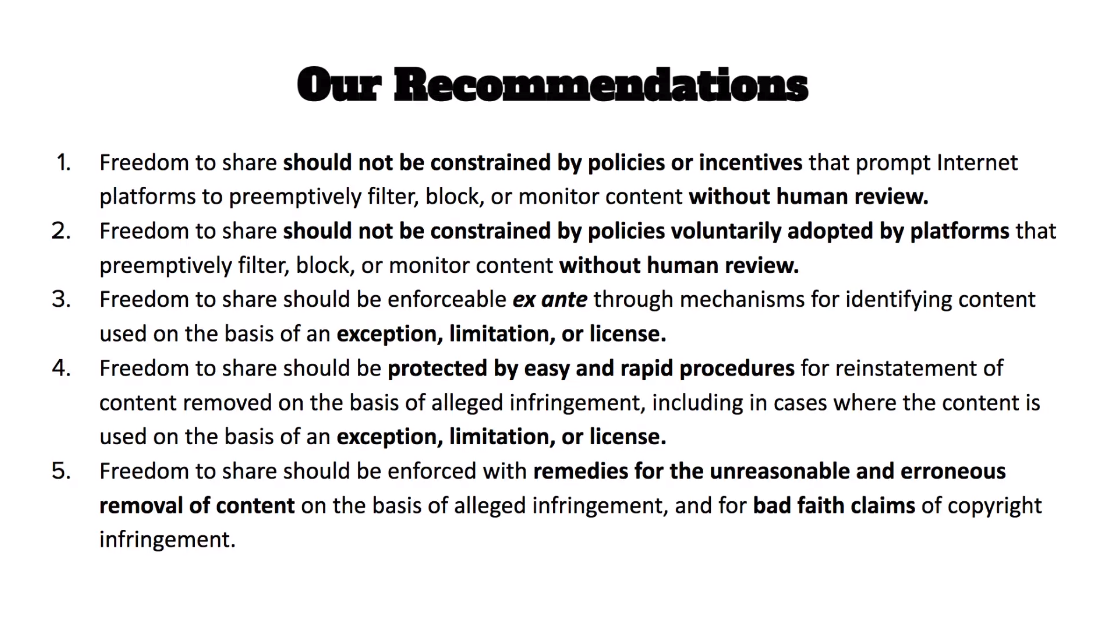
Emine presented key findings from WG 2’s paper Freedom to Share: How the Law of Platform Liability Impacts Licensors and Users. Emine shares that WG 2 limited the geographic scope of their paper to the European Union, U.S. & Canada, New Zealand, and several countries in Latin America (Chile, Costa Rica, El Salvador, Guatemala, Honduras, Nicaragua, Dominican Republic, Mexico, Brazil, and Peru). They focused their work and outputs on Freedom of Opinion and Expression, Access to Information, Right to Participate in Cultural Life and Freedom to Share. Through this lens, they assessed current trends and produced five recommendations:
Working Group 3 — Exceptions and Limitations to address Global Challenges
André shared key findings from WG 3’s paper Creative Commons Copyright Platform Working Group on User Rights’ Position Paper. In their paper, WG3 stressed that “important changes in copyright are necessary to ensure user rights are protected, and that copyright in turn achieves its goals of promoting access to culture and knowledge.” André starts by explaining that although they are traditionally referred to as “exceptions and limitations” of copyright, this paper refers to them as “user rights” to reflect the complex layers of this issue. André explains they “decided to avoid focusing on issues specific to U.S. copyright law or European copyright law, and instead adopt a broader view, which we understood could make our paper have a broader reach and be useful to different organizations.”
Working Group 4 — Beyond Copyright: the Ethics of Open Sharing
Josie presented key findings from WG 4’s paper Beyond Copyright: the Ethics of Open Sharing. To begin with, Josie starts off by explaining WQ 4’s definition of Ethics and Open Sharing in the context of this paper, explaining that “for the purposes of this paper, we’re looking at ethics primarily in relation to principles of equity, diversity and inclusion.” She adds “by ‘open sharing’ we mean the act of sharing digital materials either under an open license, or by applying a public domain tool”. This paper particularly focuses on the decisions that communities, groups and organizations take to share the materials they produce — including code, data and databases, images, software, sound and video recordings, written content, and 3D models — openly or not.
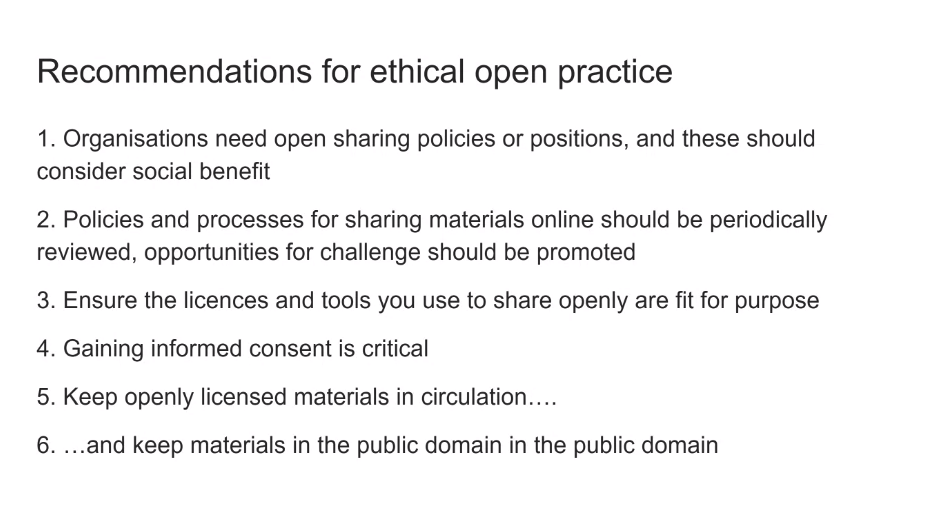
Based on these definitions, they explored this issue and developed 6 recommendations for an ethical open practice:
We are hugely appreciative of the efforts of all the working group members who contributed to these papers, those who participated in the public consultation of earlier drafts, and to the WG leads for their role in guiding these efforts and presenting them so clearly at the webinar.
———
The conversations continue in the Creative Commons Copyright Platform! Interested in joining? You can:
by Amber Vittoria for Fine Arts, licensed under CC BY-NC-SA 4.0
“Elliot was always willing to grapple with the hard problems, and you could tell he wasn’t satisfied with the easy answers. I remember rides on the Caltrain from Mountain View back to San Francisco where we’d use the whole time debating; in the best sense possible. He used those debates with me to find the underlying truth so we could improve what we did every day at CC.”
“Elliot was passionate, uncannily insightful, and a joy to work with personally and professionally. I really enjoyed EFF’s post. I don’t have anything particularly unique to add to CC’s that others wouldn’t have already expressed. I will miss his contributions to the public dialogue, whether at conferences or in his writings, where he could always be counted on to be pressing an urgent point or seeking out all points of view.”
“The thing that I remember most about him is that he was always strongly committed to doing the right thing. He cared a lot about doing right by people and about telling them the truth. He never wanted to communicate something that sounded good but wasn’t truly honest and forthright. That he could have a strong idea of what was right and still be able to hold in his head all the complexity of the issue, and empathy for those who believed differently. And that once he was committed to something that was right, he didn’t commit halfway. He was incredibly smart and perceptive, but never made a show of it. You’d just notice when he heard about an issue for the first time, and immediately figured out what the hardest bits were, and started asking questions about it to get to the truth. And then he could explain it to others as if it was the simplest thing in the world.”
“He made your work better somehow, by being supportive when you needed it, and being challenging when you needed that, by asking the questions that made you think more deeply about what you were doing and why, and who it would help. He always wanted to know how things ‘really’ worked and sometimes you’d find you didn’t know either. I’ve seen some of the EFF staff talk about how good he was as a manager of their activism team, and of course he was, he really cared about setting others up for success.”
“He cared a lot about what he was doing, whether it was going to help, whether people involved were behaving with integrity, and it’s a mindset that could be harsh and humorless but instead he was one of the most hilarious people you’d ever meet, cracking quietly devastating jokes, sharing bits of weird and delightful knowledge about everything that he carried in his head. He was really open to meeting people and hearing what they had to say and truly engaging with people and ideas that weren’t his. I’ve seen a bunch of remembrances on Twitter now and of course everyone who met him was struck by his kindness and intelligence, feeling his loss not just to the digital rights community but as a personal connection they were going to miss.”
“He was always someone I could trust to be honest, and to be kind. I wish I’d seen him more often without a work-related question to bring. I remember him spending a lot of time trying to understand the licensing changes so he could explain and advocate for them to others.”
“When I think about Elliot, the primary word that comes to mind is exuberance. Elliot was tall, had stunning red hair, and a loud wonderful voice and laugh. He had a quick smile and wit, and he was extremely knowledgeable and well-read, making him an incredibly interesting person to talk to about just about anything.”
“If I remember correctly, Elliot grew up in South Dakota and his father was a lawyer, and I think perhaps that made him especially interested in talking through legal issues despite not being a lawyer himself. He believed very deeply in the open internet and digital rights, and you could tell his work at both CC and EFF was far more than a j-o-b to him. He was passionate about it.”
“Elliot was also a poet, and I believe he did some spoken word poetry as well as lots of writing. I think that detail helps reveal why he almost had an aura about him, like he was in touch with some things in life that many people overlook.”
“I did not know Elliot that well, though we did socialize some during our brief time overlapping at CC. But yet he made a big impression on me. He was a ray of light or of sunshine. There was something larger than life about him, and I am really sad to know he is no longer in this world.”
CC Community Spotlight Series: Meet Tyler Green
This #GivingTuesday— Tuesday, November 30th, Creative Commons invites you to join our 20th Anniversary celebration. In the weeks leading up to #GivingTuesday, we’ll be spotlighting leaders in the Open Movement and encouraging you to support our Better Sharing, Brighter Future campaign.
Creative Commons is not only an online ecosystem of CC licenses and tech. We’re a movement of people— a vast network of dedicated activists, scholars, inspiring librarians and teachers, lawyers, artists, fashionistas, digital masterminds and policy makers, fighting for more equitable global access to education, resources and creativity.
This includes individuals like Tyler Green, this week’s community spotlight, an award-winning historian, critic, author and host of The Modern Art Notes Podcast, a weekly (CC licensed!) program featuring discussions with artists, historians, authors and curators.
Green recently released a new book, Emerson’s Nature and the Artists: Idea as Landscape, Landscape as Idea, which explores the ways the written work of Ralph Waldo Emerson, a 19th century U.S. author, poet and philosopher, was deeply influenced by “American Art” and the natural landscape in the United States. He argues Emerson’s famous text Nature was a game changer in our modern day understanding of the commons and Open Access, and that, as a scholar, Green needed access to both visual and textual resources to make his case.
“…the greatest obstacle to understanding art’s role in the American project, in the idea of the American nation …is that it costs scholars serious money to publish our works. That makes it harder for scholars to know what’s out there, but it also makes it harder to make arguments. If you can’t publish the visual part of your argument with the textual part of your argument, why work hard to have an argument that is both visual and textual. And so open access is, at the risk of sounding grandiose, open access is the answer, right? Open access makes that possible.”
Green encourages his audience to consider how greater access to a range of historical resources, visual and written, might strengthen our ability to understand our collective past and imagine a better and brighter future.
In the coming weeks, we’ll feature more Open Access advocates like Green, who are working to make our global culture more open and collaborative. In the meantime, we invite you to join our Better Sharing, Brighter Futurecampaign. See below for ways to get involved.
As the United Nations Climate Change Conference, officially known as the 26th Conference of Parties, or COP26, continues in Glasgow, Scotland, I’m pleased to share some good news. The Open Society Foundations approved funding for Creative Commons, SPARC and EIFL to lead a global campaign promoting open access to climate and biodiversity research. This is a promising new strategy to encourage governments, foundations, institutes, universities and environmental organizations to use “open” to accelerate progress towards solving the climate crisis and to preserve global biodiversity. Catherine Stihler, CC’s CEO and a native of Scotland, publicly announced the campaign during her keynote at the University of St Andrews’ Power to the people event and will have the opportunity to announce the campaign at a COP26 fringe event – Open UK: Open Technology for Sustainability – on 11 November. CC is particularly happy to have the opportunity to work closely with our longtime allies in the open access movement to ensure that this effort is truly a global campaign, and hope that this initiative will help to provide a blueprint for future funding of similar collaborative campaigns.
Additional Detail
Climate change, and the resulting harm to our global biodiversity, is one of the world’s most pressing challenges. The complexity of the climate crisis requires collaborative global interventions that center on equity and evidence-based mitigation practices informed by multidisciplinary research. Many researchers, governments, and global environmental organizations recognize the importance of the open sharing of research to accelerate progress, but lack cohesive strategies and mechanisms to facilitate effective knowledge sharing and collaboration across disciplinary and geographic borders.
During the COVID-19 crisis, the power of open access to democratize knowledge sharing, accelerate discovery, promote research collaboration, and bring together the efforts of global stakeholders to tackle the pandemic took center stage. Scientists embraced the immediate, open sharing of preprints, research articles, data and code. This embrace of openness contributed to the rapid sequencing and sharing of the virus’ genome, the quick development of therapeutics, and the fastest development of effective vaccines in human history. The lessons learned during the pandemic can – and should – be applied to accelerate progress on other urgent problems facing society.
The goal of this project is to create a truly global campaign to promote open access, open science and open data as effective enabling strategies to accelerate progress towards solving the climate crisis and preserving global biodiversity. It will develop effective messaging, strategies, and tactics to empower stakeholders currently leading critical climate and biodiversity work to embed open practices and policies in their operations, and make open sharing of research the default.
We expect to identify the most important climate and biodiversity research publications not already OA and coordinate a campaign to open those publications, remove legal and policy barriers to applying open licenses to research articles, influence key funders (governments, foundations, and institutes) of climate science and biodiversity research to adopt and implement strong OA policies, and identify opportunities to open climate and biodiversity educational resources so students, teachers and citizens can learn about these global challenges and help contribute to solutions.
We will encourage global environment organizations to adopt open licensing policies to ensure all their content is free to be reused, built upon and shared for the global public good, delivering on their SDG commitments. We will engage with researchers, universities and policy makers in the Global South to ensure inclusive outcomes throughout.
We will share additional news on this campaign as it progresses.
Open Minds Podcast: Tyler Green of The Modern Art Notes Podcast
In this episode, CC’s Ony Anukem sits down for a conversation with award-winning author, historian and art critic, Tyler Green. Tyler is also the producer/host of The Modern Art Notes podcast, described by The Washington Post as “one of the great resources for all art lovers.” Tyler is an avid Creative Commoner, and since launching the podcast in 2011, it has been released, licensed CC BY-NC-ND 3.0.
Tyler recently published his latest book ‘Emerson’s Nature and the Artists,’ which brings together a selection of 75 artistic works in dialog with Ralph Waldo Emerson’s 1836 Nature essay for the first time. All of the artworks in the book were sourced from art museums and libraries with open access policies. Tyler offers his own compelling insights into Nature through new research into how Emerson’s art experiences influenced the essay, and in turn how it informed American art well into the twentieth century. In the episode, we discuss Emerson’s understanding of landscape and the public commons, and how it is still relevant to Creative Commons and the broader open movement today. Tyler shares top tips from a decades worth of podcasting experience and much more.
Please subscribe to the show in whatever podcast app you use, so you don’t miss any of our conversations with people working to make the internet and our global culture more open and collaborative.
 The CC Copyright Platform was established as a discussion space to strategize on copyright reform as a complementary action to developing and stewarding CC licenses. Over the last few months, each working group has discussed, researched and dissected these issues, and produced four Position Papers encapsulating their outcomes, available now on the CC Medium Publication.