New Revisions to CC Certificate Course Content = New Opportunities for Translations
We are delighted to share the latest version of our Creative Commons Certificate Course content, available on our Certificates website as an OER (open educational resource) in multiple formats.
The Creative Commons Certificate program launched in 2018 to strengthen our global communities’ efforts to share open knowledge and culture. To date, we have over 1700 graduates of the Certificate program from 65 different countries.
The program was built for iteration and adaptation. We regularly revise and update the CC Certificate materials based on direct feedback from our community of participants, facilitators, and alumni. We make all iterations of our course openly available under a CC BY license. As a result, our community has created countless derivative trainings, faculty presentations, workshops, courses and open education, open access and open culture communication materials. Community members have also translated course reading content and made it available as open educational resources in 10 languages: Arabic, Bengali, Burmese, English, French, Italian, Slovak, Spanish, Turkish, and Yoruba.
Now, we are pleased to announce the latest revision of our course content available on our Certificate Resources page, accessible and downloadable in multiple file formats.
With the 2024 course content, we hope to reach new audiences, and we invite new translation projects to help us. Translation work could mean both updating existing translations or creating entirely new ones. If you’re interested in making the CC Certificate course content available in your own local language(s) by participating in a future translation project, please reach out to us at certificates [at] creativecommons.org for more information.
If you’re interested in a CC Certificate course, you can learn more and register for our upcoming June 2024 and September 2024 options on our website. If you are already CC Certified, we encourage you to share your experiences with your colleagues and to become an active participant in our alumni community, where you can read our alumni newsletter, learn about additional training opportunities, and participate in upcoming community projects. Contact certificates [at] creativecommons.org if you are not already on the alumni listserv and we will add you.
We send a special thanks to the many wonderful CC staff, Certificate course facilitators, community members and volunteers who help make this work possible. We’re looking forward to continued improvements to the CC Certificate program as we explore new audiences and new opportunities to help you reach your open education goals.
Where in the world is… this public domain material? Helping users refer to host institutions.
Whether the institution is a neighborhood archive, a national library, or an art museum, the guidelines offer a fresh and innovative approach to prompting users to reference the institution when using public domain materials. Based on the Working Group’s proposal for a social intervention, they present various design ideas, rooted in the EAST Model for behavioral change.
What problem are these guidelines addressing?
Often, institutions wish to be acknowledged for the role they play preserving, restoring, digitizing, sharing, and overall providing context and meaning for the cultural heritage that they steward. To ensure users “credit” them, many institutions choose CC licenses (which require “attribution”) to release faithful reproductions of public domain material. This is bad practice. Digital reproductions of public domain materials should remain in the public domain and thus be shared under CC0 or PDM.
As a best practice, CC recommends a simple framework to create behavioral change and encourage positive outcomes through “nudges.” The guidelines offer a few design ideas for institutions to provide a comprehensive “reference statement,” if and where appropriate.
The guidelines address key questions, including:
How can institutions nudge users to reference them?
What information should be included in a reference statement?
What would a nudge look like in practice?
How to organize the data needed to implement these ideas?
Are you ready to implement one of these designs? Do you have comments on how to expand or improve these guidelines, especially on the technical aspects? Would you like to help make this resource available in other languages?
Updates on Open Culture Platform Activity Fund Winners 2023
In 2023, the Creative Commons (CC) Open Culture Platform ran an open call for funded activities as part of our efforts to develop local, non-Western models of open culture, and to support the growth of the open culture movement around the world. Platform members voted on proposed projects, winners were announced in May, and the projects all ended at the end of the year. In this blog post, project leaders share their experiences, including some of the challenges they faced as well as their most important accomplishments.
Archiving History of Ghana: Case Study of Forts and Castles
Francis Quasie
This project aimed at documenting some of the existing forts and castles in Ghana on Wikimedia Commons with the aim of making these resources available to use by anyone around the world through Creative Commons tools and licenses.
This project has seen remarkable outcomes. We covered our target areas and produced a total of three hundred and fifty two (352) images out of our target number of three hundred (300) images for Wikimedia Commons. We also uploaded eight (8) videos in addition to the images on Wikimedia Commons making the total number of three hundred and sixty (360) images and videos in total all under Creative Commons BY-SA 4.0 International license. All the 360 images and videos were uploaded in a category of “Forts and Castles in Ghana” on Wikimedia Commons. Also another outcome of this project we are excited about is the relationship established with the Ghana Museum and Monument Board with regard to preserving African heritage. We have shared the images documented on Wikimedia Commons with the Ghana Museum and Monument Board and some of the entities under the Museum. We have also shared our photographs with some of the Senior High School and university institutions which will be used for educational purposes.
These forts and castles on Wikipedia have been updated with the current images documented to provide more understanding of these historical sites in Ghana. We are happy for this project because we provide vital information on Wikimedia Commons and Wikipedia as well, and we also had an opportunity to learn a lot about our historical monuments in Ghana as we document for the next generation.
Building a sustainable social, technical & legal infrastructure for Open GLAM in Pakistan; the quantitative analyses for the development of open heritage science for Pakistani heritage
.
Muhammad Imtiaz Subhani, PhD. Amber Osman Lead, Creative Commons, Pakistan Co-lead, Creative Commons, Pakistan (Project Principal Investigator) (Project Co-Investigator)
This project aimed to establish a comprehensive and sustainable social, technical, and legal infrastructure for Open GLAM (Galleries, Libraries, Archives, and Museums) in Pakistan, focusing on fostering open heritage science for Pakistani heritage. The initiative has undertaken in-depth analyses to quantify and assess the cultural heritage sites and institutions, their current state and their accessibility, while identifying their legal frameworks, technological and social infrastructures and also addressing the technological aspects for digitization and preservation. The cultural heritage sites and institutions were investigated in terms of their counts in each province and city, their types, location addresses, level of access including license types. Further, in order to better quantify Pakistani heritage, a self-administered focused group survey was conducted through deploying eight focused group volunteers. 2000 respondents/cultural stakeholders (250 respondents through each of eight focused groups) were reached out from all over Pakistan to quantify the several positions of legal, technological and social frameworks pertaining to Pakistan heritage.
In our endeavor to establish a robust and sustainable social, technical, and legal infrastructure for Open GLAM in Pakistan, we’ve achieved significant milestones and gained valuable insights. Through meticulous analysis, we quantified and assessed the state and accessibility of GLAMs, heritage sites, and institutions across provinces, identifying legal frameworks, technological infrastructures, and avenues for digitization and preservation. Notably, our study confirmed the presence of 424 heritage entities spread across all provinces, with Punjab exhibiting a dense concentration. We’ve successfully facilitated open access to heritage resources, particularly in Sindh, through collaborations with Creative Commons and governmental bodies.
Technological advancements include the launch of a beta version Dashboard for easy access to heritage details and the establishment of XploreOpen, a dedicated web platform catering to Pakistan’s heritage. Furthermore, we innovatively mapped all heritage sites onto the map of Pakistan using padlet.com. Our work underscores the importance of open heritage science and sets the stage for continued preservation and celebration of Pakistan’s cultural heritage. The test version of the platform can be accessed at www.xploreopen.org. This project also mapped out all of the cultural heritage sites and institutions on the map of Pakistan while using innovative solution padlet.com. To enhance XploreOpen and foster technological advancement and growth, additional funding will be crucial for its future success.
GLAM institutions in Colombia open to their citizens
Viviana Rangel
This project aimed to unite key stakeholders within the GLAM community at local, district, and national levels to comprehend their primary needs arising from: (a) the integration of new technologies into the daily operations of GLAMs as cultural affairs managers at district and national levels, and the resulting implications for the national copyright system; and (b) the challenges confronted by local communities in safeguarding their traditional cultural heritage. To respond to this objective, five workshops were held in different cities and districts of the country with managers of different community, district and national GLAMs. These workshops used a collaborative dialogue methodology among stakeholders, which was designed as part of the project and is expected to serve as a reference point for other initiatives.
The main result of these workshops was the possibility of dialoguing with community members in Bogota, Medellin, Cali, Pasto and Tumaco, representing approximately 15 GLAMs located in different departments of the country and at different territorial scales. These conversations served as input for the construction of two documents: (a) a roadmap for the GLAM community; and (b) a document of recommendations designed to improve the capacities of decision-makers. These documents, in turn, opened the possibility for us to dialogue with policymakers about the need to advance in a reform of the national copyright law, but also allowed us to strengthen the organization of the GLAM community for political advocacy.
Findings
As part of the findings in the stakeholder dialogues, it was obtained that:
There is a delay in national regulations regarding exceptions and limitations for GLAMs, but there are significant advances in the implementation of new technologies for GLAMs serving large or medium-sized audiences.
There is a constant concern in the country about the risk of copyright infringement by GLAMs, coupled with a lack of knowledge about copyright exceptions and limitations.
The territorial approach of the project shed light on the asymmetries between territories and the various challenges they face in terms of copyright. The approaches to the different territories revealed the difficulties in protecting the intellectual property of the traditional knowledge and expressions of the ancestral, artisanal and indigenous communities of our country.
The GLAMs in the different territorial levels have recognized the need to hold workshops on the exceptions and limitations that cover their current activities. Additionally, discussions have highlighted the importance of organizing advocacy efforts in this area.
Failure to put this discussion on the table has put at risk the defense of the public interest and the guarantee of cultural rights for Colombian citizens throughout the national territory.
Outcomes
As results of the project, the following were achieved:
Design material and promote the organization for political advocacy aimed at holding a hearing with the National Directorate of Copyright for the updating of the national regulations.
Opening a necessary discussion for the country that had been postponed due to lack of organization. Resumption of the discussion with decision makers.
An exhaustive review of the progress of the exceptions and limitations in the country’s copyright legislation.
Mapping and diagnosis of the needs and problems of the GLAM in the country. Using a territorial approach that allowed the identification of needs, considering the specific context of each department and community with which we were able to relate.
Mapping of actors and characterization of the relationships between GLAMs, public policy makers and international organizations working on issues related to copyright reform in the country.
Identification of challenges in the coordination between GLAM institutions in charge of preserving and defending cultural heritage and national entities responsible for building and supervising the copyright system in the country.
Digitization and Protection of Specialized Heritage Institutions
Seyi Osunade
Heritage institutions, also known as cultural heritage institutions or memory institutions, are organizations that preserve, protect, and provide access to cultural and historical materials of significant importance. These institutions play a vital role in safeguarding and promoting our shared cultural heritage. Heritage institutions encompass various types of organizations, including: Galleries, Laboratories, Libraries, Archives and Museums.
University of Ibadan plays host to a number of specialized cultural heritage institutions that are not visible online but used for teaching and research. This project seeks to identify such centers across the three campuses, 16 faculties and numerous centers so as to encourage digitization and use of CC protection mechanisms. The production of a draft institutional policy and an e-book with available artifacts and location of the specialized cultural heritage institutions are the deliverables from this project.
Outcomes:
These are some documented outcomes from the work done:
Pictures taken at the UI Cultural Heritage Museum are shared on Flickr
E-book with available artefacts and location of the specialized cultural heritage institutions
A Public Domain Database of Digitized Creative Works in Nigeria
Isaac Oloruntimilehin
The initial plan by Free Knowledge Africa to onboard enumerators across different libraries in Nigeria didn’t work out as expected. We released a call for librarians across libraries in Nigeria to join the campaign to help identify works in the public domain in their libraries. However, the librarians we selected faced difficulties in accessing the collections of the libraries. Some of them were junior librarians at these institutions and didn’t have enough influence to help advocate for the project, because of some institutional factors and gatekeeping, and they were just librarians who were interested in participating in the campaign. A better approach would have been to work with one library at a time which we later adopted with the National Library of Nigeria where we identified a friendly stakeholder. We also reached out to private libraries and archives, as well as State and government libraries and archives to help identify works in the Nigerian public domain, but most of these Information centers didn’t have books that dated back to the pre-colonial era and books that fall under the Nigerian public domain according to the Nigerian Copyright Act.
After much deliberation and back and forth with these institutions without much progress, we decided to write to the National Library of Nigeria which is the apex library of the country. As expected, they had most of these public domain works which were acquired through legal deposits and donations.
Free Knowledge Africa moved ahead to establish a partnership with the National Library of Nigeria through the Virtual Library Services Department, through which we were able to identify works in the Public Domain. We also held an outreach and training at the National Library Headquarters where we trained the staff of the Virtual Library Services Department about the open movement, open licenses, public domain and digitization.
We were able to complete the digitization of 449 works (books, newspapers, and images) in the public domain in partnership with the National Library of Nigeria. The project is progressing slowly so far because of limited manpower and outdated technology in finding works that are in the public domain in the library’s collection. We uploaded the works on Wikimedia Commons in the Nigerian public domain category, and we intend to create Wikidata items and transcribe the books on Wikisource to make them citable and discoverable.
We identified some works that are also in the public domain according to the Nigerian Copyright laws, but some of these works were copyrighted and had all rights reserved. We decided to not digitize these works to avoid potential lawsuits from the publishers.
We were faced with a few challenges during this project. Some of them include:
Bureaucracy lies within most of these institutions as some processes which normally should have taken a few days were prolonged to as long as a month.
We were able to identify a few government publications which according to the Nigerian Copyright Act are expected to be in the public domain. However, some of them were copyrighted with the ‘All Rights Reserved’ mark. To avoid copyright infringement, we didn’t digitize those works after the effort had been put into sorting and identifying them.
Due to insufficient funding, we were limited in the number of books we were able to digitize. We were unable to digitize special works such as delicate materials and voluminous books because such works would need special care and could only be handled by experts. We were able to digitize only a few books that fell under this category due to limited funding.
Last but not least, there was a lack of understanding on the part of the librarians. We had to go through several meetings and even organize a training session for the librarians to give them insight into what we hoped to achieve. This training session was organized to enlighten them on the importance of the public domain and why we must digitize these precious works.
Some of our key learnings include:
Identifying the key stakeholders saves time and money, as they can cut through the bureaucracy. The challenge lies in identifying them.
Partnership helps in cutting costs and sharing what the other parties stand to gain helps in bringing them on board and getting invested in the project.
Advocacy needs to be done to change the perception of open licensing by librarians in Nigeria, they need to be more involved in the open movement, to see the big picture.
Building Open GLAM Community for Sustainable Open Licensing Practices in Nigeria
Bukola James
Under the Creative Commons Open Culture Platform Activity Fund, we launched the Building Open Culture Community for Sustainable Open Licensing Practices in Nigeria project. Over two months, from July to September 2023, the project aimed to cultivate an open culture ecosystem in Nigeria, focusing on Galleries, Libraries, Archives, and Museums (GLAM). Goals included raising awareness and understanding of Creative Commons licenses among GLAM professionals, increasing digitization and online visibility of collections using appropriate CC platforms and licenses.
Building Awareness and Capacity
Through collaborative efforts, the project increased open culture practices among GLAM professionals in Nigeria. Extensive planning from July to September 2023 led to a series of offline and online activities aimed at enriching GLAM professionals’ skills and understanding of Creative Commons licenses.
The initiatives included a two-day online session and in-person events discussing open culture practices and offering practical guidance on platform utilization. This enabled professionals to effectively use platforms like Wikimedia Commons, to enhance the global visibility of their collections through active participation.
Audience Reached
Through an extensive recruitment campaign and pre-community assessment, we’ve built a dynamic network of 175 Open Culture advocates across Meta,Facebook, and WhatsApp, connecting them to the Creative Commons global and open culture platform. This network is poised to lead Creative Commons programs and open culture initiatives in Nigeria. Concurrently, the project facilitated six GLAM institutions in Nigeria to share over 100 aesthetics and collections on Wikimedia Commons, enriching a growing repository for future generations. Our project’s impact is evident in promoting the use of Creative Commons licenses, enhancing accessibility and visibility of GLAM collections online.
Lessons Learned
The project period was not just about achieving milestones but also about learning and evolving. The journey taught us the tremendous potential that lies in the collaborative efforts of GLAM professionals in achieving openness and how open knowledge platforms like Wikimedia Commons can help increase the use and re-use of CC licenses and GLAM collections in Nigeria. We learned that structured training, comprising theoretical understanding paired with practical exposure, can play a pivotal role in empowering professionals. Moreover, the enthusiastic participation and feedback from the attendees emphasized the appetite for such initiatives, showcasing a promising road ahead filled with collaborations and knowledge-sharing.
Conclusion
The strides made toward open culture advocacy are celebrated as we embrace the future. Through collaborative efforts, a vibrant community of advocates has been established, alongside project initiatives and virtual platforms for ongoing engagement. The Building Open Culture Community project exemplifies the power of clear vision and determined execution. Gratitude is extended to all contributors. The project’s insights will shape Nigeria’s open culture narrative and shared knowledge in the GLAM sector. Excitement abounds for the continued growth and impact of these efforts.
Creative Commons thanks each of these contributors for their inspiring efforts towards making culture around the world more open. Their pioneering work and advocacy helps to spread the message that access to knowledge and culture is a human right around the world. We can also learn from these awardees about some of the challenges that are faced in different contexts around the world, and bring visibility to the varied strategies for the open movement in each of these contexts.
Congratulations to each of you for your successful projects, and we look forward to sharing the projects selected by the Open Culture Platform for 2024 in the coming months.
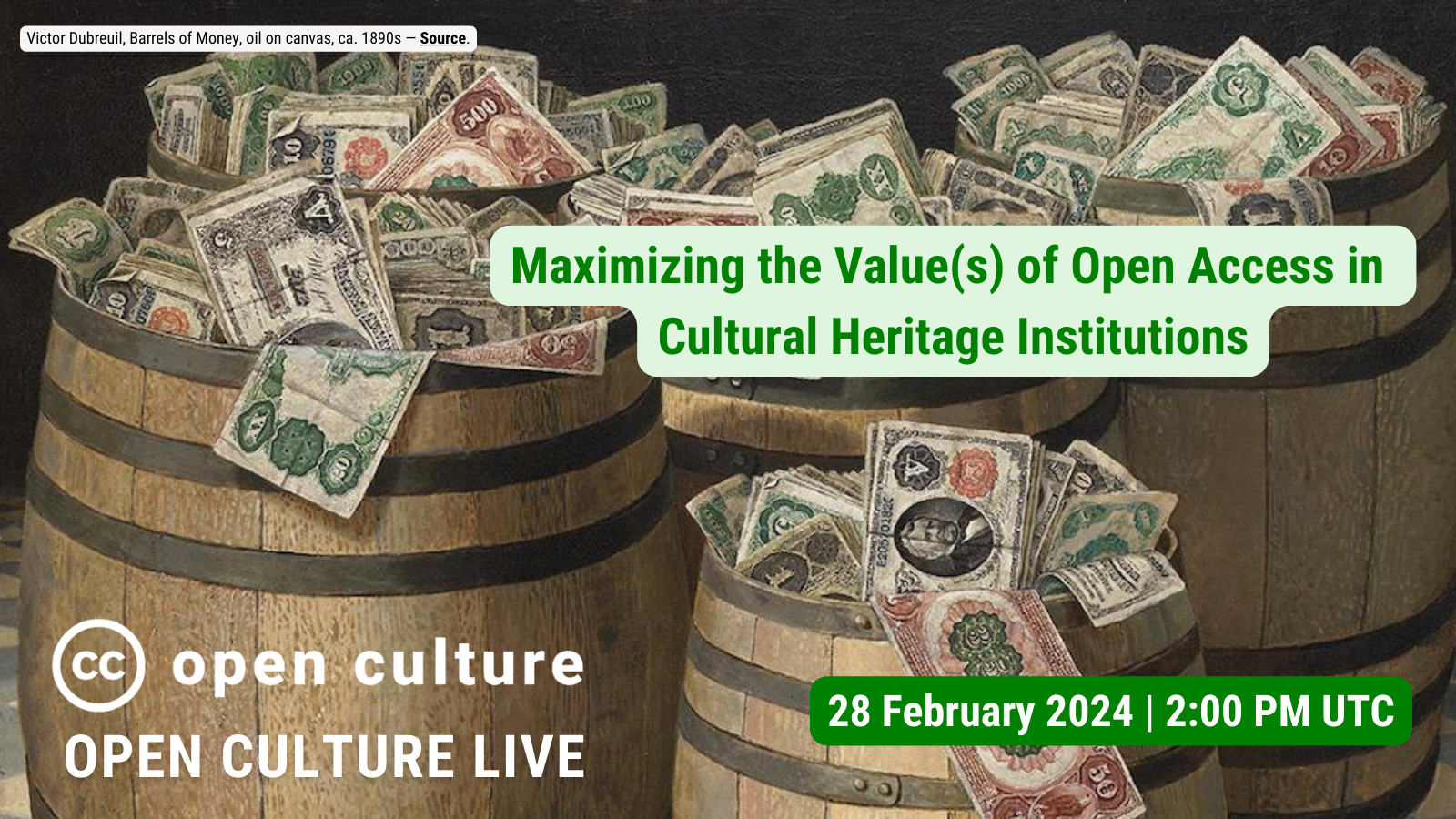
Upcoming Open Culture Live Webinar: “Maximizing the Value(s) of Open Access in Cultural Heritage Institutions”
“Barrels of Money” by Victor Dubreuil. 1890s. Brandywine Museum of Art, Public Domain.
On Wednesday, 28 February 2024, at 2:00 pm UTC, CC’s Open Culture Program will be hosting a new webinar in our Open Culture Live series titled “Maximizing the Value(s) of Open Access in Cultural Heritage Institutions.”
One common concern for GLAMs thinking about going open is the potential loss of revenue from image licensing — however, open collections are said to often draw in more viewers, onsite visitors, and (financial) supporters. There are also costs associated with the work of granting permissions on an image by image basis in employee time and legal fees. Ultimately, how do the costs and benefits stack up? How can we ensure the value of cultural heritage collections continues to support their financial sustainability?
We will be joined by a panel of experts including:
Kristofer Erickson, Professor of Social Data Science at University of Glasgow
Douglas McCarthy, Open GLAM Researcher and Author
Elliott Bledsoe, Co-Lead of Creative Commons Australia & Wikimedia Australia Committee Member
Giovanna Fontenelle, Program Officer, Culture and Heritage at Wikimedia Foundation
We will dive into some important questions like:
What are the financial, commercial, and economic impacts of open access in cultural heritage?
Is the cost of a licensing mechanism worth the revenue it might generate?
If not, what are some of the more creative ways to share open collections in ways that do not compromise the institution’s financial sustainability?
What are some of the new opportunities for revenue generation that go hand in hand with the open ethos?
How can GLAMs develop an economic model that enables them to offer services aimed at sparking creativity, cultivating a deep connection with heritage, and expanding meaningful learning opportunities in the spirit of their public-interest mission?
CC is a non-profit that relies on contributions to sustain our work. Support CC in our efforts to promote better sharing at creativecommons.org/donate.
What is Open Culture Live?
In this series, we tackle some of the more complex challenges that face the open culture movement, bringing in speakers with personal and professional expertise on the topic.
CC Supports a new Digital Knowledge Act for Europe
Creative Commons supports the development of a Digital Knowledge Act. In this blog post, we offer some background on the need for a law that supports researchers and knowledge institutions as a means of spurring knowledge-based innovation for a sustainable future.
In December last year, the Communia Association for the Public Domain — of which Creative Commons (CC) is a member — asked the European Commission and European Parliament to consider the development of a Digital Knowledge Act. In this blog post, we offer some background on the proposal and explain why CC fully supports it.
Rationale for a Digital Knowledge Act
European knowledge institutions (libraries, universities, schools, etc.) as well as researchers face numerous copyright challenges in the digital environment. Access to academic publications, their reproduction for research purposes, text-and-data mining, etc. are all activities that are necessary to conduct serious research but are hampered by misaligned copyright rules, especially where cross-border collaboration is key.
As top EU institutions are gearing up for a new mandate for the next five years, a Digital Knowledge Act would enable knowledge institutions to fulfill their mission and offer the same services online as offline. Such a regulation could improve copyright law by introducing the following for the benefit of knowledge institutions:
a unified research exception
an EU-wide e-lending right
a limited liability regime for those acting in good faith
reasonable licensing conditions
a right to circumvent technological protection measures.
CC’s work on policy and open knowledge
CC recognizes that equitable policy which enables and promotes open access (OA) is pivotal to making knowledge open. For example, in 2022 CC, in partnership with SPARC and EIFL, launched the Open Climate Campaign, a four-year project working to make the open sharing of research the norm in climate science. At the center of this work is partnering with national governments, private funders, and environmental organizations to develop open access policies for their grantees. Another project aims to identify recommended best practices for better sharing of climate data and yet another strives to promote open licensing for life sciences preprints. Through these OA policies and best practices we believe we can change the culture of sharing and promote the adoption of open practices for knowledge to grow and help solve the greatest challenges of our times.
Why we support this initiative
But discrete open access policies and best practices are not enough. Knowledge institutions need to be able to rely on a clear, harmonized, and supportive legal system that operates across borders. That is why CC’s policy work centers on promoting better sharing of knowledge and culture through global copyright reform. Knowledge institutions are pivotal actors in the fight against climate change and hold many of the keys to unlock knowledge. If we are going to solve the world’s biggest problems, the knowledge about them must be open, and institutions , which hold that knowledge in trust for the public, must be able to operate within a legal framework that is conducive to their core mission and purpose. A Digital Knowledge Act would provide such a structure at an EU-wide scale and would contribute to accelerating research, boosting scientific progress, and spurring knowledge-based innovation for a sustainable future.
An Invitation for Creators, Activists, and Stewards of the Open Movement
Dear Open Movement Creators, Activists, and Stewards,
A key question facing Creative Commons as an organization, and the open movement in general, is how we will respond to the challenge of shaping artificial intelligence (AI) towards the public interest, growing and sustaining a thriving commons of shared knowledge and culture.
So much of generative AI is built on the digital infrastructure of the commons and uses the vast quantity of images, text, video, and rich data resources of the internet. Organizations train their models with trillions of tokens from publicly available datasets like CommonCrawl, GitHub open source projects, Wikipedia, and ArXiV.
Access to the commons has enabled incredible innovations while creating the conditions for the concentration of power in entities that are able to amass the immense energy and data needed to train AI models. Community consultations at conferences like MozFest, RightsCon, Wikimania, and the CC Global Summit have also revealed concerns about transparency, bias, fairness, and attribution in AI.
Alignment Assembly
To start addressing some of these challenges, between 13 February and 15 March, Open Future will host an asynchronous, virtual alignment assembly for the open movement to explore principles and considerations for regulating generative AI. We hope to reach participants spread across different fields of open and coming from different regions of the world. We are organizing the assembly in partnership with Open Future and Fundación Karisma.
We want to bring to the conversation the perspectives of:
Activists and experts, including digital rights advocates and legal experts
Stewards: people from organizations that steward collections that are part of the digital commons such as Wikimedia, open access repositories, and cultural heritage collections
Creators: people who create works that form part of the digital commons, broadly: not only visual artists and musicians but also researchers who do open science or open source programmers
We will use the process of an alignment assembly, an experiment in collective deliberation and decision-making. This model is pioneered by the Collective Intelligence Project (CIP), led by Divya Siddarth and Saffron Huang. The model has been used by OpenAI, Anthropic, and the government of Taiwan.
You can sign up to take part in the process by registering your interest here (we will only use the contact information to invite you to the assembly and to provide updates and delete it once the assembly process is complete).
Ahead of the Creative Commons Global Summit last year, Creative Commons and Open Future hosted a workshop on generative AI and its impact on the commons. The group agreed and released a set of principles on “Making AI work for Creators and the Commons.” Now, we would like to test and expand this work.
Outcome
The Alignment Assembly on AI and the Commons builds on and continues all of this work.
We treat the principles as a starting point. We are using the alignment assembly methodology and the pol.is tool to understand where there is consensus and which principles generate controversy. In particular, how much alignment there is between the perspectives of activists, creators, and stewards of the commons.
At the end of the process, we will produce a report with the outcomes of the assembly and a proposal for a refined set of principles. As the policy debate about the commons and AI develops, we hope the assembly will provide insights into better regulation of generative AI.
What does the CC Community Think about Regulating Generative AI?
In the past year, Creative Commons, alongside other members of the Movement for a Better Internet, hosted workshops and sessions at community conferences like MozFest, RightsCon, and Wikimania, to hear from attendees regarding their views on artificial intelligence (AI). In these sessions, community members raised concerns about how AI is utilizing CC-licensed content, and discussions touched on issues like transparency, bias, fairness, and proper attribution. Some creators worry that their work is being used to train AI systems without proper credit or consent, and some have asked for clearer guidelines around public benefit and reciprocity.
In 2023, the theme of the CC Global Summit was AI and the Commons, focused on supporting better sharing in a world with artificial intelligence — sharing that is contextual, inclusive, just, equitable, reciprocal, and sustainable. A team including CC General Counsel Kat Walsh, Director of Communications & Community Nate Angell, Director of Technology Timid Robot, and Tech Ethics Consultant Shannon Hong collaborated to use alignment assembly practices to engage the Summit community in thinking through a complex question: how should Creative Commons respond to the use of CC-licensed work in AI training? The team identified concerns CC should consider in relation to works used in AI training and mapped out possible practical interventions CC might pursue to ensure a thriving commons in a world with AI.
At the Summit, we engaged participants in an Alignment Assembly using Pol.is, an open-source, real-time survey platform, for input and voting. 25 people voted using the Pol.is, and in total 604 votes were cast on over 33 statements, with an average of 24 votes per voter. This included both pre-written seed statements and ideas suggested by participants.
The one thing everyone agreed on wholeheartedly: CC should NOT stay out of the AI debate. All attendees disagreed with the statement: “CC should not engage with AI or AI policy.”
Pol.is aggregates the votes and divides participants into opinion groups. Opinion groups are made of participants who voted similarly to each other, and differently from other groups. There were three opinion groups that resulted from this conversation.
Group A: Moat Protectors
Group A comprises 16% of participants and is characterized by a desire to focus on Creative Commons’ current expertise, specifically some relevant advocacy and the development of preference signaling. They uniquely support noncommercial public interest AI training, unlike B and C. This group is uniquely against additional changes like model licenses and strongly against political lobbying in the US.
Group B: AI Oversight Maximalists
Group B, the largest group with 36% of participants, strongly supports Creative Commons taking all actions possible to create oversight in AI, including new political lobbying actions or collaborations, AI teaching resources, model licenses, attribution laws, and preference signaling. This group uniquely supports political lobbying and new regulatory bodies.
Group C: Equitable Benefit Seekers
Group C, containing 32% of participants, is focused on protecting traditional knowledge, preserving the ability to choose where works can be used, and prioritizing equitable benefit from AI. This group strongly supports requiring authorization for using traditional knowledge in AI training and sharing the benefits of profits derived from the commons. Like group A, this group is against political lobbying in the US.
There are two key limitations of this assembly: participant sample size and participant representativeness. There are over 22,000 members in the Creative Commons slack community, which is only a subset of the many more members of the CC community more broadly. 30 people were present and active voting members of the assembly. While many participants were open movement leaders in their countries and represented the perspectives of more individuals, this sample is too small to have a complete picture of the CC community’s desires. We did not perform a demographic survey of the room, but data from the overall conference suggests that American and European perspectives may be overrepresented in our assembly.
AI is deeply connected to networked digital technologies — from the bazillions of works harvested from the internet to train AI to all the ways AI is shaping our online experience, from generative content to recommendation algorithms and simultaneous translation. Creative Commons engaged participants at Wikimania on August 15, 2023 to shape how AI fits into the people-powered policy agenda of the Movement for a Better Internet.
The goal of this session was to brainstorm and prioritize challenges that AI brings to the public interest commons and imagine ways we can meet those challenges. In order to better understand participant perspectives, we used Pol.is, a “real-time survey system, that helps identify the different ways a large group of people think about a divisive or complicated issue.” This system is a powerful way to aggregate and understand people’s opinions through written expression and voting.
Nate Angell and I both joined the conference virtually, two talking heads on a screen, while the majority of approximately 30 participants joined in-person in Singapore. After introducing the Movement for a Better Internet and asking folks to briefly introduce themselves, we immediately started our first Pol.is with the question: “What are your concerns about AI?” If you’re curious, you can pause here, and try out Pol.is for yourself.
In Pol.is, participants voted on a set of ten seed statements — statements that we wrote, based on previous community conversations,— they added their own concern statements, and then they voted on concern statements written by their peers in the room. Participants can choose “Agree,” “Disagree,” or “Unsure.” Overall, 31 total people voted and 532 votes were cast (with an average of 17.16 votes per person).
96% of participants agreed that “Verification of accuracy, truthfulness and provenance of AI-produced content is difficult.” This statement drove the most consensus among all participants in the group. Consensus indicates that people from different opinion groups have a common position, or in other words, people who do not usually agree with each other agree on this topic. The other two most consensus-driving concerns were: “Large-scale use of AI may have a negative impact on the environment” and “I suspect a push for greater copyright control would eventually be appropriated and exploited by big companies. E.g. Apple and privacy.”
The most divisive statement was: “AI is developing too fast and its impact is unclear.” Divisive implies the areas with the most differing opinions (rather than with the most disagreement, as widespread disagreement is a consensus too). The other three most divisive statements were also the most unclear statements, with more than 30% voting “Unsure”: “AI can negatively impact the education of students,” “AI can use an artist’s work without explicit permission or knowledge,” and “AI and the companies behind them steal human labor without credit and without pay.”
Back in our workshop room, we viewed the data report live, which was somewhat difficult due to limitations in text size. Participants in the room elaborated on their concerns, highlighting why they agreed or disagreed on particular points.
In the second half of the workshop, we asked participants to imagine ways we can meet one particular challenge. We focused our discussion on the only statement with 100% agreement: “AI makes it easier to create disinformation at scale.”
Participants were asked to write down their ideas in a shared document, and stand up to share their thoughts in front of the audience. The three major buckets for innovation in this space were education, technical advancement, and cultural advocacy. In education, participants brought up the need for critical thinking education to reinforce the ability to identify reliable sources and AI tools education to allow more people to understand how misinformation is created. Technical projects included developing AI to tackle disinformation, building a framework for evaluating AI tools during development, and creating better monitoring systems for misinformation. Participants also highlighted the need for cultural advocacy, from building the culture of citations and human-generated reference work to policy advocacy to maintain the openness of the commons.
Creative Commons will continue community consultations with Open Future Foundation in the next month. Sign up and learn more here.
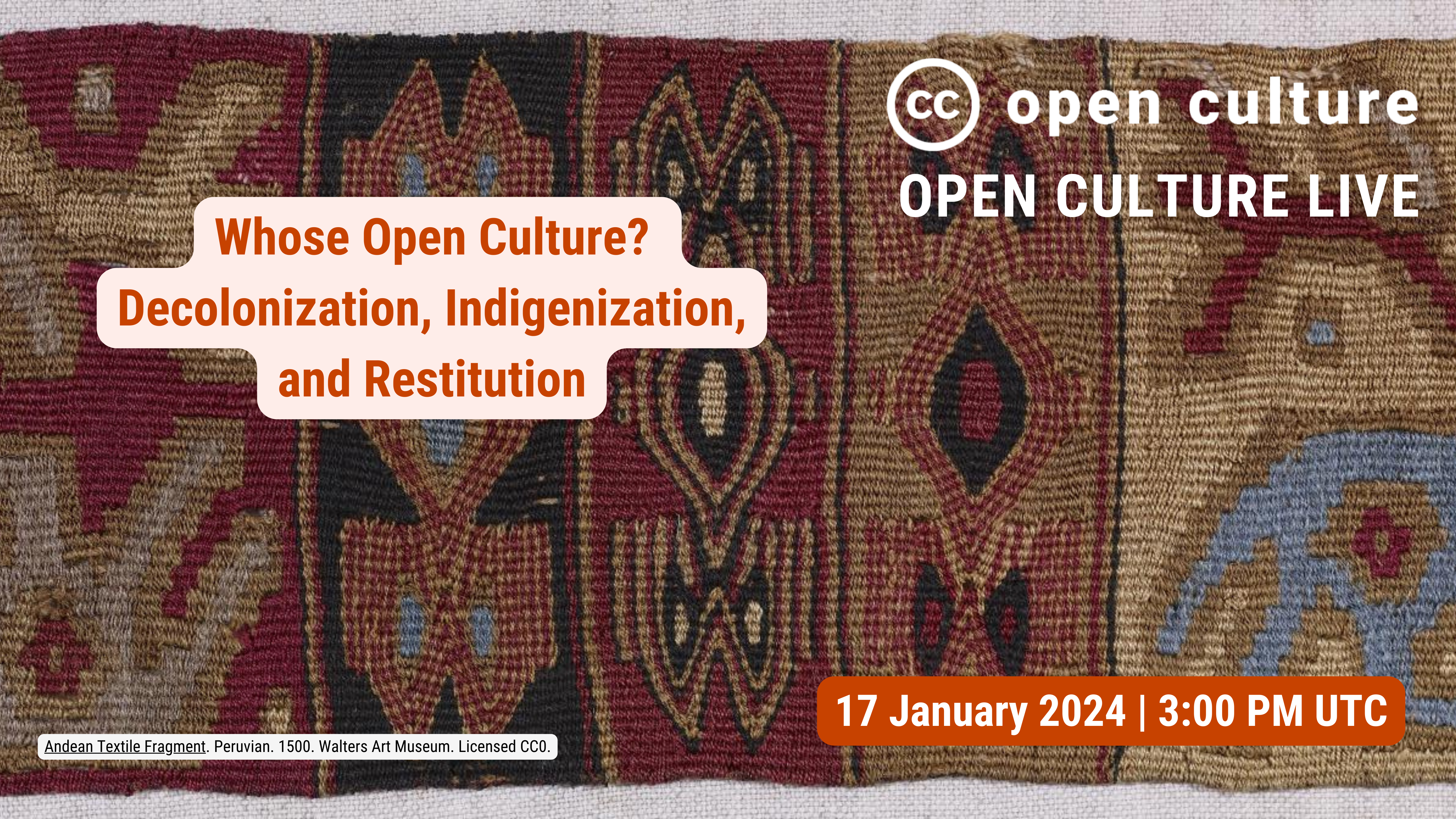
Recap & Recording: “Whose Open Culture? Decolonization, Indigenization, and Restitution”
“Andean Textile Fragment” by Peruvian. 1500. Walters Art Museum., here slightly cropped, is released into the public domain under CC0.
In January we hosted a webinar titled “Whose Open Culture? Decolonization, Indigenization, and Restitution” discussing the intersection of indigenous knowledge and open sharing. Our conversation spanned a variety of topics regarding indigenous sovereignty over culture, respectful terminology, and the legacy of colonialism and how it still exists today. While we strive for more open sharing, it is important to recognize the cases where culture should not be open to all.
The United Nations Declaration on the Rights of Indigenous Peoples had a significant impact on the ability for indigenous people to advocate for their rights, and for institutions to have clearer guidance on the treatment of indigenous cultural expressions. But there is much more to be done. Institutions stewarding indigenous cultural expressions must be patient and take the time needed to build relationships with the communities whose culture is in their collections in order to establish ways of sharing with consideration and consent.
In this webinar, we were joined by:
Jane Anderson, Vice Chair & Founding Member, Strategic Advisor, Co-Founder, Local Contexts
Stephany RunningHawk Johnson, Executive Director, Local Contexts
Camille Callison, University Librarian, University of the Fraser Valley
Erna Lilje, Curator, Indigenous knowledge & material culture, Nationaal Museum van Wereldculturen
We shared a reading list in our announcement post, here are some more links as shared by the panelists and by some audience members during the conversation:
In this series, we tackle some of the more complex challenges that face the open culture movement, bringing in speakers with personal and professional expertise on various topics. Watch past webinars:
Save the date for our next webinar “Maximizing the Value(s) of Open Access in Cultural Heritage Institutions” on 28 Feb at 2 PM UTC.
CC is a non-profit that relies on contributions to sustain our work. Support CC in our efforts to promote better sharing at creativecommons.org/donate
CC Open Education Platform Activities: 2023 in Review
The CC Open Education community had a busy 2023! Community members reflect on their accomplishments, lessons learned and what is next.
The CC Open Education community had a busy 2023! Five project teams, spanning nine countries, worked on open education projects ranging from developing STEAM, interactive, and climate change-related OER, to international curriculum alignment and translation work. Community members also worked on multimedia resources supporting the UNESCO Recommendation on OER, and presented in CC’s biannual Open Education Lightning Talks. Community members reflect on their accomplishments, lessons learned and what is next below. CC staff lightly edited text for clarity.
Building a K-12 Interactive Open Textbook
Update from Werner Westermann: This project developed a K-12 Open Textbook in the subject of Civics and Citizenship subject for 11th and 12th Grade, aligned to the official K-12 curriculum of Chile. With the CC funding, we made 60% progress on one Open Textbook for 11th grade, surpassing ourinitial goal. We worked with teachers, creators of the interactive resources and a graphic designer on all four learning units of the 11th grade Open Textbook, as defined by Chile’s official curriculum for Civics and Citizenship. To help others’ open education projects, we share some lessons we encountered:
This type of community engagement requires specific and explicit guidelines and benchmarks for quality. Like any book development, this Open Textbook required a general editor to orchestrate community contributions, manage expectations, and enforce quality guidelines and benchmarks.
Standardized workflowsare necessary. It was most efficient to load content, then follow up with graphic and interactive resources, rather than focus on those specifics first. We tested an AI Smart Import tool that creates H5P interactive resources in seconds, in order to save up to 50% development time.
Community adoption of a tech tool (the H5P editor in our case) requires flexibility to adapt to the tool for mastery. We had a lot of discussions about what H5P could and could not achieve. For better results, postpone specific expectations and work on what is editor enabled.
What’s next? The next step is to complete the 11th grade Open Textbook development and publish it, pending funding. We also await an AI tool for Spanish support to speed up production.
Popularization of OER in Ukraine: Small steps to a big goal
Update fromTetiana Kolesnykova: Polytechnic University of Milan and the Ukrainian State University of Science and Technologies (USUST) partnered to translate and localize a MOOC on OER: “Using Open Educational Resources in Teaching.” This OER provides equitable and inclusive access to education amidst full-scale war in Ukraine. Despite the war, the project achieved its aim: there is now a version of the MOOC for Ukrainian learners. Our lessons from this work included: listening to each other, negotiating where needed, and compromise. We were not looking for perfection but for a good result to be achieved within all limitations. With teamwork and strong motivation, we solved the challenges of the project together; and the end result exceeded our expectations. As a result: All MOOC subtitles for each video, the course description and all tests were made available in Ukrainian, ensuring participants gain a better understanding and support with the final assessment. We also created eight additional instructions and illustrations in Ukrainian. We developed a mock-up of the Certificate of Completion of the course “Using Open Educational Resources in Teaching” adapted into Ukrainian. Several faculty and librarians tested the MOOC in Ukrainian.
We started promoting the Ukrainian localisation of the MOOC “Using Open Educational Resources in Teaching” in October. Politecnico di Milano (METID) and the Scientific Library of the Ukrainian State University of Science and Technologies (USUST) presented our collaborative project at international conferences, national webinars, publications, and on the website of the USUST Scientific Library.
While it is too early to measure the success of the Ukrainian MOOC “Using Open Educational Resources in Teaching,” we know it is already raising awareness of OER opportunities among the wider Ukrainian academic community.
What’s next? We will continue our teamwork, and ignite new OER adaptations in a sustainable way.
STEAM Ahead with OER in South Africa project
Update from Dan McGuire: This collaborative project between Ghana, South Africa and the US created, curated, and sourced OER content aligned to Ghanaian and South African education standards.
Our colleague, Peter Amoabil observed that using the MoodleBox and OER materials provided learning opportunities for students without the need to rely on the internet, which is very useful in Ghana where over 95% of schools don’t have internet access. Students were able to use the digital content for all subjects and especially for reading in their mother tongue, Dagbani. Reading materials in Dagbani have previously been very hard to acquire.
In South Africa, we were able to translate both reading materials and math assessments from English into isiXhosa for students in grades Pre-K through 1st grade. Students were excited to learn using WIFI devices.
What’s next? Translating educational materials into the students’ mother tongue is especially valuable and innovative. We plan to expand the professional development for use of digital OER materials aligned to national standards to more teachers in both Ghana and South Africa. This project helped us establish a process to create and deliver learning materials to Pre-K — 6th grade students. We will also be making the OER professional development courses and instructional content available via open repositories.
Climate Change: OER integrating SDG components in Education in two Southeast Asian Countries
Update from Dr. Suma Parahakaran: This project worked with the Malaysian Ministry of Education as well as Malaysian and Laotian schools, creating OER and experiential learning activities. Primary and Secondary school students engaged in cross disciplinary, technical, and integrated learning activities, such as setting up solar panels on rooftops. They got to attend workshops and brainstorms with international experts and teachers. Students also created videos, brochures and other resources focused on ethics, climate change and sustainable development education. Finally, students then entered a competition related to Climate Change and Sustainable Development OER. For more information and results of the competition, view the project website.
What’s next?While there are private Youtube links to the videos, they will be made public soon. Project lead: Dr. Suma Parahakaran
Alquimetricos
Update from Fernando Daguanno: Alquimétricos is an OER project that uses connectors and sticks to build geometric structures for STEAM education. Through experiential learning, the project develops students’ spatial, mathematical and kinetic understanding. The Alquimétricos Kit Zero is already published online and available to purchase: see our repositories for ready-to-print and fully editable CC BY files, including content, packaging and labeling.
During 2023 we developed a new product line of elementary-school-oriented kits, drawing from eight years of experiences and research. The kits include a deck of cards with guidelines, a bunch of hubs and sticks that help educators make Alquimétricos’ activities dynamic in the classroom. The new kit was developed and introduced as part of the (FADU-UBA) DiJu post degree “Toys and Games Design” course 2023. It was launched in Argentina at the Open Education Meeting in Bariloche – Argentinian Patagonia, presented at the OpenEd Conference 2023 and displayed at the CC Global Summit in Mexico City.
What’s next? Next steps include translation to Portuguese and English and sharing the project in global OER repositories. We will seek support proofreading and sharking Kit Zero in a community call in early 2024.
Global Commons: Unlocking Open Education with Creative Commons
Update from Lisa Di Valentino and John Okewole: This project developed a short animated video describing Creative Commons and how CC licenses support the implementation of the United Nations Recommendation on OER. We currently have a first version of the video created by Brainboxx Studios for which we will re-record the English narration. We have also solicited translations of the transcript from other subgroup members in the nine other UNESCO languages, and have offers for translation in Arabic, Chinese, Hindi, Italian (of which we now have a draft), and Spanish.
What’s next? We will finalize the English video and determine how to translate the video text. We will also design handouts in the various languages explaining the benefits of using Creative Commons licensing for open educational resources.
CC Open Education Lightning Talks
Lightning Talks are seven-minute presentations on a given area of expertise or work. Based on community demand, CC hosted Open Education Lighting Talks online in February and in-person, at the CC Summit in October. Community members’ presentations ranged from explorations of OER for social justice to practical applications, such as using machine translation algorithms for OER translation and recommendations for digital publishing. CC also presented a forthcoming microcredential course on which we are partnering with the University of Nebraska Omaha, in effort to bring more open licensing expertise to new audiences.
What’s next? We look forward to learning more from the open education community in future CC Open Education Lightning Talks!
Creative Commons extends our gratitude to the inspiring CC community members making a difference in their educational contexts. We look forward to continued open education collaborations in 2024! If you would like to join our Open Education community, visit the CC Open Education Platform site for more information.
 .
.