by
Brigitte VézinaOpen CultureA cropped version of "'Espejo exterior o espía'." by Biblioteca Rector Machado y Nuñez is marked with Public Domain Mark 1.0. with a white CC open culture logo
2022 was quite a year for the Creative Commons (CC) Open Culture Program, thanks to generous funding from Arcadia, a charitable fund of Lisbet Rausing & Peter Baldwin, and the Samuel H. Kress Foundation. In this blog post, we take a look back at some of the year’s highlights in our program’s four components: Policy,…
Last Friday (16 December 2022), Creative Commons proudly celebrated twenty years of CC licensing and all the groundbreaking collaboration it has enabled. As we look back on this remarkable journey, time seems to pass more quickly than ever — yet our gratitude for each milestone remains unwavering, as do words of thanks towards everyone who…
Today, Creative Commons (CC) is excited to announce one million US dollars in new programmatic support from the Patrick J. McGovern Foundation (PJMF) to help open large climate datasets. The twelve-month grant will enable CC to conduct key climate data landscape analyses and expand our work, bringing people together to create policy and practices to…
Since its creation in 2001, Creative Commons (CC) has helped release nearly 5 million digital open images of cultural heritage held in cultural heritage institutions using CC tools. We have also been promoting open culture to build a more equitable, accessible, and innovative world, and it is based on this rich experience that our Open…
As the year comes to a close, we’re spotlighting Creative Commons’ public policy work, recapping what we’ve done and looking ahead to the new year. In this edition, we turn to our work on better sharing of data. The sharing of open data can be incredibly beneficial to society: facilitating enhanced scientific collaboration and reproducibility,…
As the year comes to a close, we’re spotlighting Creative Commons’ public policy work, recapping what we’ve done and looking ahead to the new year. In this edition, we turn to our work on artificial intelligence (AI). Recently, you might have seen the news headline “Art Made With Artificial Intelligence Wins at State Fair,” or…
by
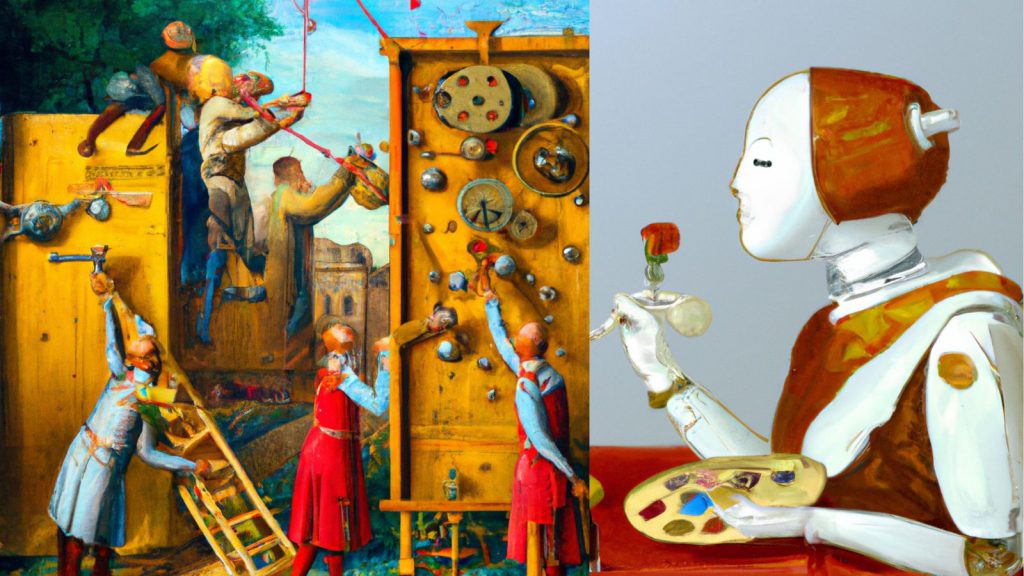
Creative CommonsBetter Internet“AI Inputs and Outputs” by Creative Commons was made from details from two images generated by the DALL-E 2 AI platform with the text prompts “A Hieronymus Bosch triptych showing inputs to artificial intelligence as a Rube Goldberg machine; oil painting” and “a robot painting its own self portrait in the style of Artemisia Gentileschi.” CC dedicates any rights it holds to the image to the public domain via CC0.
On 9 and 10 November 2022, Creative Commons hosted a pair of webinars on artificial intelligence (AI). We assembled two panels of experts at the intersection of AI, art, data, and intellectual property law to look at issues related to AI inputs — works used in training and supplying AI — and another focused on…
As part of Creative Commons’ key strategic goal of Better Sharing, today we have joined six other organizations spanning the globe to launch the Movement for a Better Internet, a diverse community of advocates, activists, academics, and civil society groups working together to promote policies that create a better internet for people everywhere. The movement…
During 2021–2022, CC has been celebrating the 20th anniversary of our founding in 2001 and the first release of the CC licenses in 2002, successfully concluding an ambitious fundraising campaign to support programs like Open Culture, Open Climate, and Open Education, and to help ensure CC’s ongoing sustainability. In November 2022, CC will bring the…
This week, policymakers from around the world gather in Mexico for MONDIACULT2022, the UNESCO World Conference on Cultural Policies and Sustainable Development, a critical event that is bound to shape the future of international cultural policies worldwide. In the lead-up to MONDIACULT2022, Creative Commons’ (CC) Brigitte Vézina delivered a keynote to the international forum “Digitalizar…