Stay informed. Sign up for CC’s newsletter.
Twenty-five years ago, a small group of people made a bet. They believed that if you gave creators a simple set of tools and licenses in language that a lawyer, a machine, and a human could all read, millions of people might choose to share their work with the world instead of locking it down.
“We said, oh gosh, if a million people use these licenses, that would be amazing,” Hal Abelson recalled, laughing at how small that ambition sounds now. Today the number “starts with a B.”
Hal’s quote was one of many memorable moments during Creative Commons’ Founders Fireside Chat, a special benefit event for CC’s 25th anniversary.
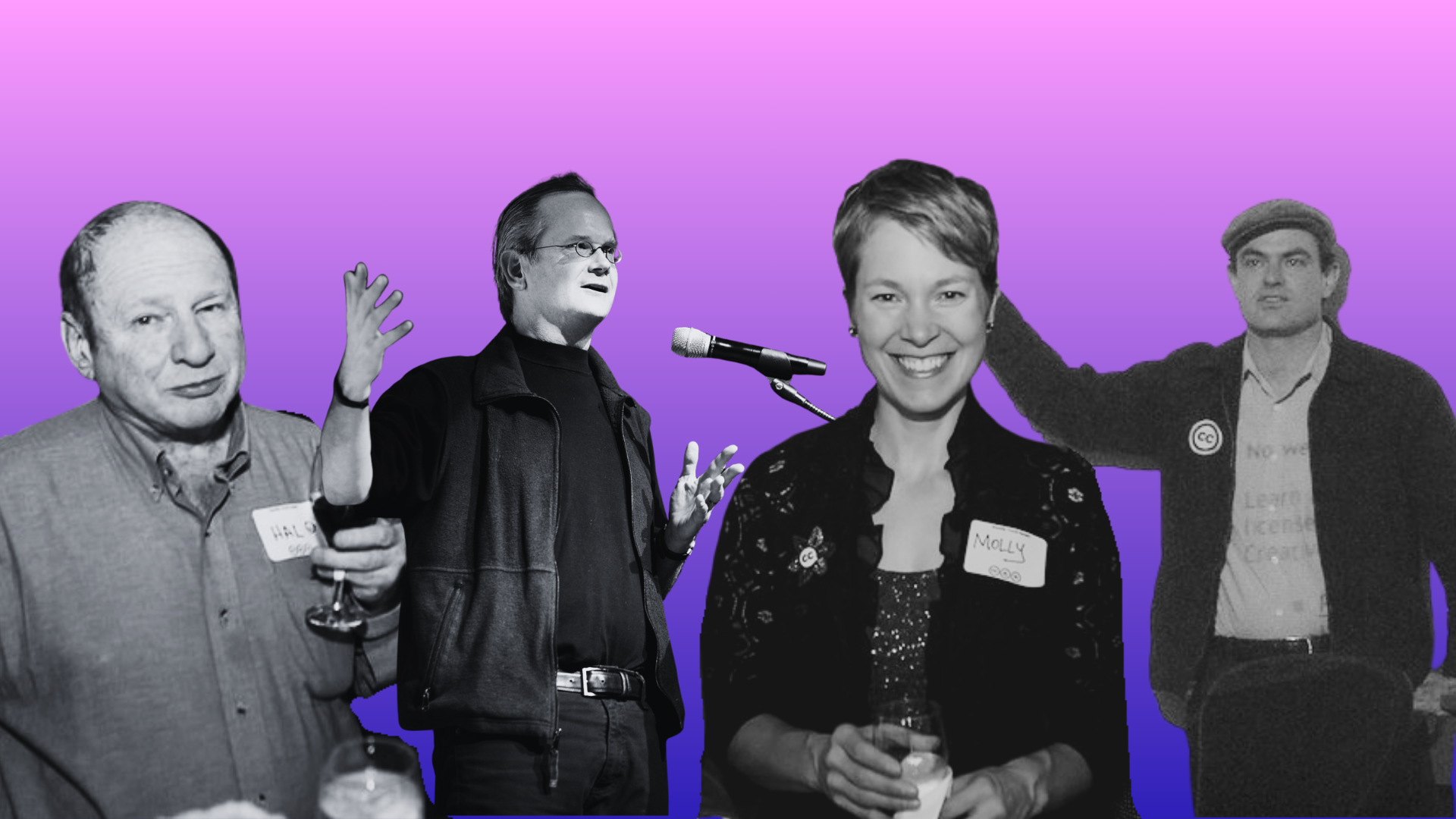
Moderator Glenn Otis Brown, CC’s CEO from 2002 to 2005 and the mind behind “Some Rights Reserved,” opened the conversation to three of the people who were there in the beginning: Lawrence (Larry) Lessig, the co-founder and emeritus board member since 2014; Hal Abelson, the founding director who served on the board until 2015 and helped shape CC’s role in open science and OER; and Molly Van Houweling, CC’s founding executive director, who later chaired the board from 2016 to 2022.
What followed wasn’t just a recap of history. It was closer to eavesdropping on old friends remembering how a hopeful guess became the way the world shares.
First, There Was Uncertainty
Molly set the scene first. The early days weren’t defined by confidence, they were defined by not knowing whether the right tool was a license, a search engine, or something else entirely. Not knowing if anyone would actually be part of what was being built. Some early management consultants even produced a report asking why anyone would give away rights they automatically held. Molly’s response still lands: “What’s more motivating than proving the management consultants wrong when they say humans don’t behave this way?”
Then Larry shared an early memory. Creative Commons was incubated out of Stanford Law School, where Larry was a professor running the Center for Internet and Society, and where Glenn, as CC’s first CEO, was building the organization day to day. Larry described coming in one morning and finding Glenn asleep under his desk, having worked through the night out of sheer conviction. That, Larry said, was the moment he realized they’d accidentally lit a spark of entrepreneurial energy that was going to take off everywhere.
Finally, Hal traced the technical DNA of it all back to MIT OpenCourseWare, which launched alongside CC and became what the group nicknamed “the anchor tenant.” This was proof, early on, that serious institutions would use these licenses. “It’s not only putting out to the world,” Hal said. “It’s teaching the world how to make these things.”
A Voice from the Past
Partway through the conversation, a familiar name lit up in the Zoom window. Eric Saltzman, an original CC board member who’d been part of the project before it was even incorporated, unmuted with a cheerful “Hi, everyone.” He brought a layer of stories that was equal parts mischief and delight, like the time IP attorney Diane Cabell quietly cleared CC’s now-iconic logo of any conflict with Chanel’s, simply by pointing out that one mark’s two C’s curved one way and the others curved the opposite. Then he shared a story fresh off a CC summit in Korea where he found himself deep in the countryside, swapping stories with a complete stranger from Austria who had no connection to CC at all. On hearing that he had just come from “a Creative Commons thing,” the stranger lit up, describing it as one of the best things that had ever happened in his work. Half a world from where any of it began, a stranger had been impacted by CC tools and licenses.
A Candlelit Apartment and a Supreme Court Loss
Some of the richest moments were the ones that simply hadn’t been told in a while. Larry resurrected the story of meeting Gilberto Gil, Brazil’s eventual Minister of Culture, when his friend John Perry Barlow brought him along, at one in the morning, to Gil’s apartment. They found Gil sitting on the floor by candlelight, guitar in hand, seemingly paying them no attention at all. That didn’t stop Larry from pitching the idea behind Creative Commons anyway, right there as Gil kept playing. Then, suddenly, Gil stopped. He looked up, and said, “I love this, this is great.” That encounter helped launch CC Brazil and led, years later, to Gil performing at CC’s fifth anniversary celebration.
And near the end, Larry shared something he said most people don’t know. The real origin of his drive to start CC traces back to a promise made to Eric Eldred, the plaintiff in a Supreme Court case Larry argued, and lost seven to two, that challenged Congress’s power to keep extending copyright terms. Before that case began, Larry told Eldred that no matter what happened in court, they’d build a commons for creative work regardless. Creative Commons, in Larry’s words, was “the delivery on that promise.”
AI Is In the Room
No CC founders’ conversation in 2026 could avoid the question in every room these days. Glenn put it to the panel directly: “Today, knowledge and culture is being reused on an almost unimaginable scale by machines, by models, by LLMs, some in a handful of private hands, some more distributed in open ways. How do you begin to process the notion of reusing creative work, building on what came before, in a 2002 notion versus today? Do you think of Creative Commons culture, or remix culture, the same way in a world of AI, or do you think about it differently?”
Larry argued for drawing a clear line between content built for humans to use and content built for machines, and pushed back hard on the idea of extending legal protections to AI systems like we do to people.
Molly offered the conversation’s emotional center of gravity, stating that remix culture and CC’s success stories have always mattered because they connect humans to other humans, and that fully machine-made work risks crowding out, or making us doubt, that sense of connection altogether.
Hal turned to the lawyers with a question. “Now we’re talking about the sound of somebody’s voice, we’re talking about the style by which somebody does something and we’re actually seeing lawsuits that are claiming copyright infringement over that. I was wondering how you think about that expanding as the machines can cover more and more stuff.”
The answer, as Glenn pointed out, is unsettling. Style alone has never been something copyright protects. Working “in the style of” someone else has always fallen on the unprotected, idea side of the law. The trouble is that mimicking style is exactly what AI does best, which is why the conversation keeps drifting toward whether other legal tools might end up doing more of that protective work than copyright ever could.
Closing: One Word Each
Asked to sum up 25 years in a single word, the answers landed like a thesis statement for the event. Hal went with empowering. “The reason anyone’s doing this is that we’re empowering other people to build on existing work.” Eric, laughing that Hal had already used most of the good words, added inspiring. Larry kept it simple: community. Molly chose serendipity, “because when you release your works into the world, there’s no telling who, with whom, they will connect.” And Glenn closed it out with belonging, “a thing that you belong to, whether you actually realize it or not.”
Twenty-five years later, no one described a master plan. What came through instead was a string of unplanned connections, a commitment to the values of openness, and a determination to find a better way to share. A man asleep under a desk. A guitar that stopped mid-song in a candlelit apartment. A stranger in the countryside. A promise kept after losing a case at the Supreme Court. Somehow, that’s how you get from “a million people, that would be amazing” to a number that starts with a B.
If you missed the conversation, you can watch the recording. We have more to come as part of our 25th anniversary. Stay up to date about upcoming events and subscribe to our newsletter so you don’t miss a thing.
Posted 30 June 2026