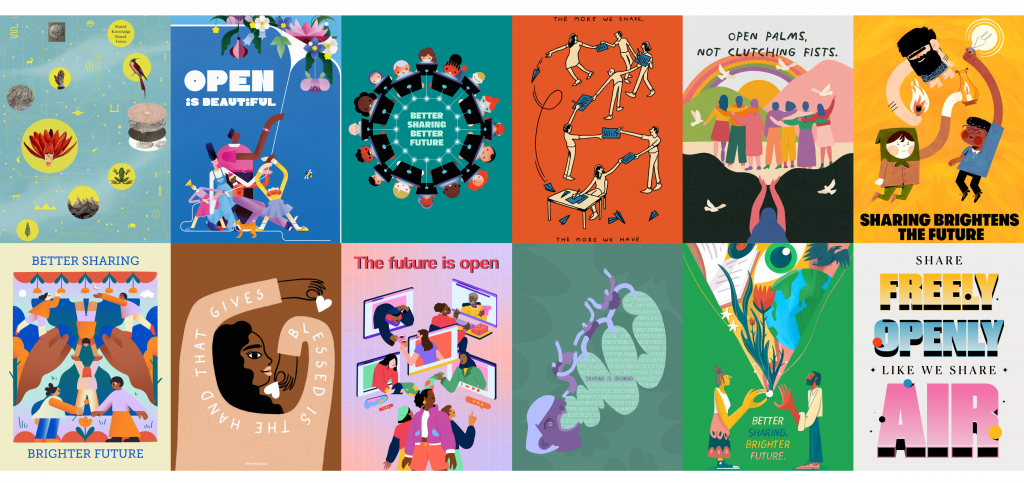
As part of our #20CC anniversary, last year we joined forces with Fine Acts to spark a global dialogue on what better sharing looks like in action. Our #BetterSharing collection of illustrations was the result — we gathered insights from 12 prominent open advocates around the world and tasked 12 renowned artists who embrace openness with transforming these perspectives into captivating visual pieces available under a CC license.
Each month throughout 2023, we will be spotlighting a different CC-licensed illustration from the collection on our social media headers and the CC blog. For May, we’re excited to showcase “The Future Is Open” by Mumbai-based fashion and graphic designer, Preeti Singh. The piece, licensed under CC BY-SA 4.0, was inspired by a quote from Ebenezar Wikina, Founder, Policy Shapers, and Advocacy Coordinator, Foundation for Partnerships Initiatives in the Niger Delta (PIND Foundation):
“Better Sharing, Brighter Future means that as we continue to find better ways to share ideas, products and solutions on the internet, we’d directly be working towards a brighter future for ourselves and generations to come.”
Meet the artist:
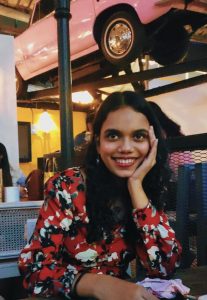
Preeti Singh is a talented visual communication designer and passionate artist, known for her captivating artworks that convey compelling stories. Based in Mumbai, India, she has made a name for herself as a skilled fashion and graphic designer. Since she was a child, Preeti has been fascinated by art, culture, and history, and has always had a keen interest in illustration and literature. Her creative journey began with these interests, which have greatly influenced her work. Preeti’s pieces reflect her extensive searches in art, culture, history, and mythology.
The full #BetterSharing collection is available on TheGreats.co to be enjoyed, used and adapted, and then shared again, by anyone, forever. View the full collection >>
Jessemusse Cacinda — Open Culture VOICES, Season 2 Episode 12
“Open culture creates conditions for us to know ourselves, but above all to eachother.” Jessemusse shares this insight with us and talks about what open culture and open access in GLAM institutions has done for his writing work and how it has shaped his views about language representation. Open Culture has provided a way to reframe histories of his culture and community.
Open Culture VOICES is a series of short videos that highlight the benefits and barriers of open culture as well as inspiration and advice on the subject of opening up cultural heritage. Jessemusse is a Mozambican author who previously co-founded a publishing house in Mozambique focused on underrepresented languages and cultures in publishing. His work has evolved into more creative writing where his true passion lies.
Jessemusse responds to the following questions:
What are the main benefits of open GLAM?
What are the barriers?
Could you share something someone else told you that opened up your eyes and mind about open GLAM?
Do you have a personal message to those hesitating to open up collections?
Closed captions are available for this video, you can turn them on by clicking the CC icon at the bottom of the video. A red line will appear under the icon when closed captions have been enabled. Closed captions may be affected by Internet connectivity — if you experience a lag, we recommend watching the videos directly on YouTube.
Killian Downing — Open Culture VOICES, Season 2 Episode 11
In this episode Killian Downing tells us how “[Open Culture] is about inclusivity and inspiring people and involving them more deeply…” in stories through digital cultural heritage. He is passionate about creating community and engagement through digital cultural heritage initiatives.
Open Culture VOICES is a series of short videos that highlight the benefits and barriers of open culture as well as inspiration and advice on the subject of opening up cultural heritage. Killian is an Archivist at Dublin City University in Ireland where he works to innovate the universities’ digital cultural heritage practices.
Killian responds to the following questions:
What are the main benefits of open GLAM?
What are the barriers?
Could you share something someone else told you that opened up your eyes and mind about open GLAM?
Do you have a personal message to those hesitating to open up collections?
Closed captions are available for this video, you can turn them on by clicking the CC icon at the bottom of the video. A red line will appear under the icon when closed captions have been enabled. Closed captions may be affected by Internet connectivity — if you experience a lag, we recommend watching the videos directly on YouTube.
Elevating Emerging Audiences: Share Your Experience
Calling all AI developers, NFT creators, and entrepreneurs
As our world faces increasingly complex and interconnected challenges, it becomes clear that innovation and collaboration are essential to finding viable solutions. Creative Commons is proud of the thousands who make our global community. And this year, we’re expanding. We’re endeavoring to connect with groups who we’ve identified as emerging audiences: AI developers, NFT creators, and entrepreneurs.
If you are involved in any of these fields, we invite you to participate in our survey and share your experiences with us. Your contributions will help us to gain a deeper understanding of the unique perspectives, needs, and aspirations of these communities that we’re eager to engage with and serve.
AI Developers
Generative AI has become increasingly prevalent in our daily lives. With these developments, it’s important these advancements are developed responsibly and ethically. By engaging with AI developers, Creative Commons hopes to provide valuable resources and tools to help AI developers navigate the complex landscape of copyright and licensing in the digital age. Moreover, AI developers bring a wealth of expertise and perspective to the Creative Commons community. As experts in machine learning, data analytics, and other cutting-edge technologies, they are uniquely positioned to help develop innovative solutions to some of the world’s most pressing challenges.
NFT Creators
Connecting with NFT creators is essential to creating empowering licensing standards in the landscape of digital creativity. NFTs, or non-fungible tokens, are digital assets that represent ownership of unique, one-of-a-kind pieces of content, such as art, music, or videos. Our open licenses, by providing a flexible and customizable way to license work, foster autonomy, collaboration, and innovation. We believe this can help NFT creators gain further visibility and sustainability for their work. By working together, Creative Commons and NFT creators can help shape the future of digital content creation and distribution.
Entrepreneurs
Entrepreneurs play a significant role in driving innovation, pushing the boundaries of what’s possible and driving new developments in the business sector. We believe that through Creative Commons licenses, entrepreneurs can safeguard their intellectual property rights while also facilitating the free exchange of ideas and creativity. Contrary to the popular belief that competition is the driver of success in business, we believe business is more fruitful when we can unlock the full range of our collective creativity.
Connecting with these emerging audiences is vital to our mission of developing a more creative and interconnected world.
Following the insights of this survey, we’ll dive deep into other forms of research and connect with individuals who have expressed interest in 1:1 interviews. Through deep engagement with AI developers, NFT creators, and entrepreneurs, Creative Commons hopes to tap into a reservoir of creativity and ingenuity that will propel collaboration and innovation forward. We look forward to learning more about how we can serve you.
For questions, or to get further involved in this research, please reach out to Naily Nevarez.
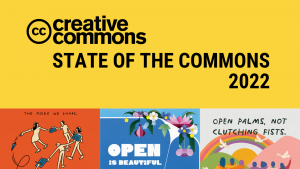
We are pleased to present the 2022 Creative Commons State of the Commons annual report. This report highlights key innovations, achievements, collaborations, conversations, and partnerships from CC and our global community over the past year.
In 2022 we were incredibly proud to mark twenty years of CC licensing and all the groundbreaking collaboration it has enabled as we closed our successful 20th anniversary campaign, which raised over $16 million dollars to support CC programs and our ongoing sustainability. As we look back on this remarkable journey, time seems to pass more quickly than ever — yet our gratitude for each milestone remains unwavering, as do words of thanks towards everyone who helped make it possible. I invite you to revisit important moments in CC’s history in our interactive timeline. If something is missing, you’ll see a way to suggest other events to include in the history.
In 2022, we met our 20th Anniversary fundraising goal, we launched two new programs — the Open Climate Campaign and the Movement for a Better Internet — and were involved in policy deliberations in ways we have never been before. Our signature Open Culture program continued to make great strides in the global cultural heritage space. In 2023, we want to build on this success with our first in-person CC Global Summit in four years, which will be held in Mexico City the first week of October. This landmark event will explore emerging technologies and CC’s role in creating a more open world where everyone can thrive — the call for proposals and registration will open soon.
The front and back covers of this year’s report showcase some very special artworks. In 2022 we collaborated with Fine Acts to commission the #BetterSharing collection of illustrations, inspired by quotes about our strategic theme of better sharing from 12 prominent global open advocates. These CC-licensed visual pieces were created by 12 internationally renowned artists and shared on TheGreats.co, an open repository of free illustrations focused on social justice issues.
As we step into the future, we are grateful for your continued commitment and support of CC. Our work would not be possible without YOU in our community. I hope you’ll read our full report to learn more about key accomplishments across the CC community in 2022. We look forward to engaging with you more in 2023!
Sandra Soster — Open Culture VOICES, Season 2 Episode 10
Sandra notes that “the collections being present online, helps to reduce theft of works of art.” When the information about collection is available to the public then the public will also help to recover works that are sold on marketplaces illegally. Sandra shares insights about working with Open GLAM in Brazil, in museums, and other institutions, and with support from Wikimedia.
Open Culture VOICES is a series of short videos that highlight the benefits and barriers of open culture as well as inspiration and advice on the subject of opening up cultural heritage. Sandra is the GLAM & Culture Manager at Wiki Movemento Brasil and recently worked with a CC Open Culture Working Group to create a GLAM/Open Culture glossary and bibliography.
Sandraresponds to the following questions:
What are the main benefits of open GLAM?
What are the barriers?
Could you share something someone else told you that opened up your eyes and mind about open GLAM?
Do you have a personal message to those hesitating to open up collections?
Closed captions are available for this video, you can turn them on by clicking the CC icon at the bottom of the video. A red line will appear under the icon when closed captions have been enabled. Closed captions may be affected by Internet connectivity — if you experience a lag, we recommend watching the videos directly on YouTube.
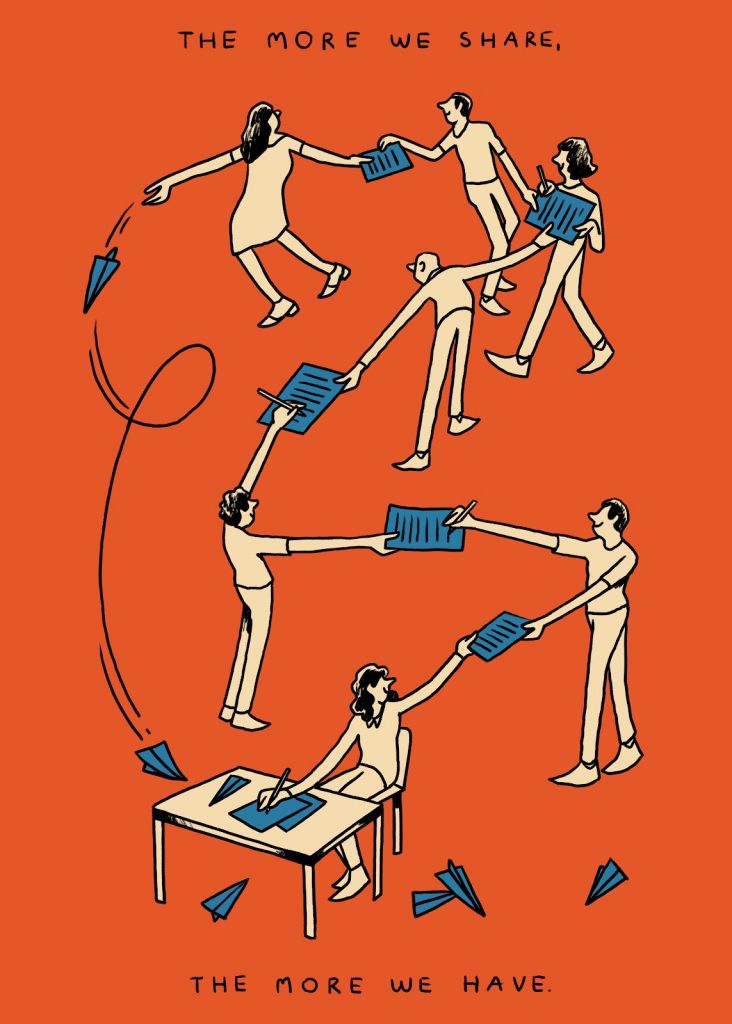
As part of our #20CC anniversary, last year we joined forces with Fine Acts to spark a global dialogue on what better sharing looks like in action. Our #BetterSharing collection of illustrations was the result — we gathered insights from 12 prominent open advocates around the world and tasked 12 renowned artists who embrace openness with transforming these perspectives into captivating visual pieces available under a CC license.
Each month throughout 2023, we will be spotlighting a different CC-licensed illustration from the collection on our social media headers and the CC blog. For April, we’re excited to showcase “The More We Share, The More We Have (series 1/2)” by Brazilian illustrator and cartoonist, Pietro Soldi. The piece, licensed under CC BY-SA 4.0, was inspired by a quote from Cory Doctorow, science fiction author, journalist and tech activist:
“In my utopia, we figure out how to create and keep separate rules that regulate the relationships between creators and their industry (e.g. writers and publishers, musicians and labels, etc); and rules that regulate the relationships between creators and their *audiences*. The things an audience does with a work — and the way that they relate to its creator — shouldn’t be a free-for-all; nor should the way that creators relate to those audiences. But whatever those rules should be, they will necessarily be very different from the way that the creative industries regulate interactions among their constituent actors.”
Meet the artist:
Pietro Soldi is a Brazilian illustrator and cartoonist hailing from São Paulo and currently based in London, UK. Born in 1990, Pietro has made a name for himself in the world of illustration and comics. Immensely inspired by the world of newspaper comic strips, Pietro’s work is distinguished by its fluid linework, vibrant colors, and delightful humor. While he has a passion for black ink on paper, Pietro revels in opportunities to experiment with diverse materials and techniques, such as animation. Pietro is 6′ 4″ which makes him easily spottable from a distance or in a crowded place.
The full #BetterSharing collection is available on TheGreats.co to be enjoyed, used and adapted, and then shared again, by anyone, forever. View the full collection >>
Nkem E. Osuigwe — Open Culture VOICES, Season 2 Episode 9
“When the culture of openness is part of society it helps knowledge to grow” is what Nkem says to introduce her perspective on Open Culture. In this episode we learn about how the walls around culture discourage growth and discovery and how opening up knowledge and culture encourages inclusivity and fosters growth.
Open Culture VOICES is a series of short videos that highlight the benefits and barriers of open culture as well as inspiration and advice on the subject of opening up cultural heritage. Nkem has been working with open access and open culture at Libraries and institutions across Africa for more than 20 years. She works to increase engagement with public knowledge and promote open access across the continent through her work at the African Library and Information Association.
Nkem responds to the following questions:
What are the main benefits of open GLAM?
What are the barriers?
Could you share something someone else told you that opened up your eyes and mind about open GLAM?
Do you have a personal message to those hesitating to open up collections?
Closed captions are available for this video, you can turn them on by clicking the CC icon at the bottom of the video. A red line will appear under the icon when closed captions have been enabled. Closed captions may be affected by Internet connectivity — if you experience a lag, we recommend watching the videos directly on YouTube.
Creative Commons Open Education Platform: 2022 in Review
The Creative Commons Open Education Team is pleased to provide a snapshot of progress made toward opening access and equity in education, through a look at our collective efforts in 2022.1 We laud the CC open education community for its important work throughout 2022. CC and community members’ open education efforts in 2022 included, but were not limited to:
We ran a successful French translation, as well as the first ever Spanish language sprint for the CC Certificate course reading content. Thanks to the efforts of CC Certificate graduates and additional translators,2569 million more people will have access to CC Certificate open educational resources (OER) in their native languages. These published works enable 493 million native Spanish speakers and 76 million native French speakers to access translations in their languages — not to mention others who have Spanish or French as a second language.
CC continued its partnership with InclusiveAccess.org, a community-driven initiative that launched in 2021, to raise awareness of the facts about textbook sales models that add the cost of digital course materials into students’ tuition and fees. Learn more about it in our Open Minds Podcast interview with Trudi Radke.
We interviewed Jennifer Miller about her Open Syllabus for Open Scienceproject (see lightning talk below), which provides a complete but flexible way for early career researchers to learn about open science.
We ran CC Open Education Lightning Talks in March and August. Lightning talks are concise presentations that provide a specific update or story. During the talks, open education practitioners highlighted OER into capstone courses, discussed funding opportunities within open education, and explored how the CC Network can provide support for the United Nations Sustainable Development Goals. Practitioners also discussed leveraging tax legislation for open education funding, theories and practices around OER, fireside stories of open sharing, and even led a Texas Sing-a-long!
CC continued to engage global partners and stakeholders in our work on Open Education.
CC staff and network colleagues presented at six regional UNESCO hosted meetings to support national governments and NGOs in understanding and implementing the UNESCO Recommendation on Open Education Resources. We highlighted the importance of using standard international CC open copyright licenses in open education policies and open educational resources (slides).
CC is working with UNICEF and others to find OER curriculum and openly licensed psycho-social support materials to help Syrian and Turkish children and their teachers who have been displaced by the devastating earthquakes.
The CC team expanded our Certificate program. We ran 16 online courses in 2022, raising the total number of graduates to over 1255 from 65 countries by the end of 2022. We piloted two open pedagogy CC Certificate courses in September, which encouraged participants’ greater agency in the course and also as contributions to their larger communities.
We also launched the CC Certificate for GLAM with three courses and 93 participants. With Evelin Heidel (nickname: Scann), we were able to also offer a facilitator training for this program, thereby certifying additional instructors to teach the course. We also offered 38 scholarships to Certificate participants, expanding the program’s global reach. The CC Certificate program also continued facilitation and evaluation measures, ensuring the CC Certificate program is on a trajectory of continuous improvement. Thanks to Jonathan Poritz’s analysis, we learned four key takeaways from evaluating the CC Certificate.
Aside from the CC Certificate courses, CC continued its training, including a workshop for the U.S. Department of State’s TechCamp Morocco, thanks to facilitation from Shanna Hollich; a workshop for the UK National Lottery Heritage Fund, and training for Open Education Fellows at Lafayette College, among others.
In addition to these efforts, many more community members noted their work advancing open education in CC Open Education Platform meetings, ongoing conversations and collaborations. While we cannot cite everyone’s efforts here, we are honored to work with and learn from this community. Interested in joining us? If you are not yet a member, learn more about the CC Open Education Platform – we hope to hear from you!
This work is essential. While Open Education Week has ended, our efforts in support of open education march on as strong as ever. We believe access to knowledge is a human right, and CC is working hard to ensure that open educational opportunities are available to all.
…
[1] While CC celebrates the wonderful contributions our open education community members have made, we recognize even more advancements were made than we can highlight, from collective open education work, spanning multiple communities, networks and continents.
[2] Translators included Nicolas Simon, Carlos E. Ferrero, Emma Miliani, Hector Teran Torres, Talia Méndez Mahecha, and Jackeline Bucio.
Eric Luth — Open Culture VOICES, Season 2 Episode 8
“Creativity does not happen in a vacuum” is how Eric Luth introduces his take on Open Culture in the GLAM sector. Our creativity is inspired by others which is why being able to enjoy our shared cultural heritage is so important. Platforms like Wiki-commons and others work to support these efforts and encourage sharing.
Open Culture VOICES is a series of short videos that highlight the benefits and barriers of open culture as well as inspiration and advice on the subject of opening up cultural heritage. Eric Luth is a Project Manager at Wikimedia Sweden where he organizes collaborations, events, and exchanges of practices in the cultural sector. Wikimedia Sweden also organizes edit-a-thons for Wikipedia articles.
Eric responds to the following questions:
What are the main benefits of open GLAM?
What are the barriers?
Could you share something someone else told you that opened up your eyes and mind about open GLAM?
Do you have a personal message to those hesitating to open up collections?
Closed captions are available for this video, you can turn them on by clicking the CC icon at the bottom of the video. A red line will appear under the icon when closed captions have been enabled. Closed captions may be affected by Internet connectivity — if you experience a lag, we recommend watching the videos directly on YouTube.

 Generative AI has become increasingly prevalent in our daily lives. With these developments, it’s important these advancements are developed responsibly and ethically. By engaging with AI developers, Creative Commons hopes to provide valuable resources and tools to help AI developers navigate the complex landscape of copyright and licensing in the digital age. Moreover, AI developers bring a wealth of expertise and perspective to the Creative Commons community. As experts in machine learning, data analytics, and other cutting-edge technologies, they are uniquely positioned to help develop innovative solutions to some of the world’s most pressing challenges.
 Connecting with NFT creators is essential to creating empowering licensing standards in the landscape of digital creativity. NFTs, or non-fungible tokens, are digital assets that represent ownership of unique, one-of-a-kind pieces of content, such as art, music, or videos. Our open licenses, by providing a flexible and customizable way to license work, foster autonomy, collaboration, and innovation. We believe this can help NFT creators gain further visibility and sustainability for their work. By working together, Creative Commons and NFT creators can help shape the future of digital content creation and distribution.
 Entrepreneurs play a significant role in driving innovation, pushing the boundaries of what’s possible and driving new developments in the business sector. We believe that through Creative Commons licenses, entrepreneurs can safeguard their intellectual property rights while also facilitating the free exchange of ideas and creativity. Contrary to the popular belief that competition is the driver of success in business, we believe business is more fruitful when we can unlock the full range of our collective creativity.