Help us protect the commons. Make a tax deductible gift to fund our work. Donate today!
Open Culture VOICES Vlog Series: Wrap-Up
In this video, Creative Commons CEO Catherine Stihler concludes our Open Culture VOICES series. Launched in February 2022, VOICES is a vlog series, which features short interviews with open GLAM (galleries, libraries, archives, and museums) experts from around the world. Over the past four months, we have released almost 40 episodes with inspiring stories and insights from global experts on what it is like to digitize and open up collections of cultural heritage. We’re grateful to all the guests who participated in the series, and a big thanks to everyone who watched and engaged with the series over the past few months. We hope you have enjoyed the series, and learned more, by listening to the distinct voices helping make GLAM collections as openly accessible, shareable, and reusable as possible – the greatest manifestation of their public value. Going open is the best way to celebrate GLAMs’ mission in the digital era.
Closed captions are available for this video, you can turn them on by clicking the CC icon at the bottom of the video. A red line will appear under the icon when closed captions have been enabled. Closed captions may be affected by Internet connectivity — if you experience a lag, we recommend watching the videos directly on YouTube.
CC Certificate: Alumni interview with Revekka Kefalea
Launched in 2018, the Creative Commons Certificate program has trained and graduated over 1000 people from 56 countries. Creative Commons staff are regularly inspired by the community of Certificate alumni, accomplishing incredible things in open knowledge and culture. CC Certificate alumni have used the Certificate course knowledge in a number of ways—read about how alumni have developed open licensed content for a bachelor of business program in Bangladesh and Masters courses in the US. Or read about alumni testimonials here.
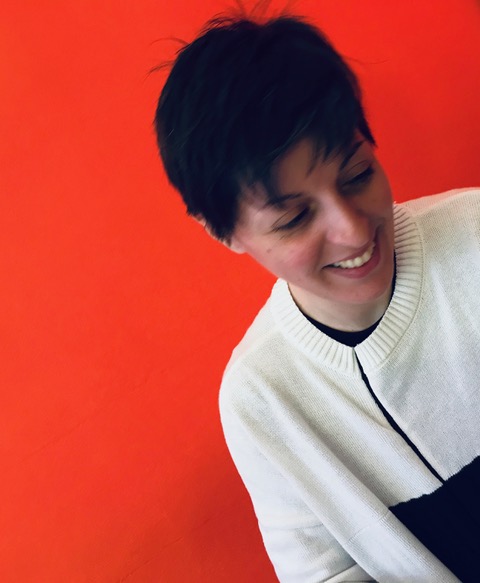
Photo courtesy of Revekka
In this interview, we were delighted to speak with Revekka Kefalea, a graduate of the CC Certificate for GLAM (galleries, libraries, archives and museums).
Revekka works as project manager at the civic, non-profit organization Inter Alia (Athens, Greece), conceptualizing, managing and monitoring the implementation of projects in relation to arts, (digital) cultural heritage, open access and civic engagement. She holds a BSc in Social Policy and Social Anthropology (Panteion University), a MSc in Urban and Regional Planning (National Technical University of Athens), and a MSc in Political Science and Sociology (National and Kapodistrian University of Athens). She is also certified in cultural management and social entrepreneurship, and closely follows the GLAM sector and its transformations, since her research interests focus on nationalism, material culture, cultural heritage, identity and memory politics. Here is the Q&A:
What inspired you to take the CC Certificate for GLAM?
I decided to take the CC Certificate for GLAM almost two years ago, when it was first announced on the CC website — that is when I started saving money for it. At that time, I was writing my Master’s thesis on the history of access to national museums, in light of the mass digitization projects of cultural heritage and the Open GLAM movement. But the story about my sources of inspiration and motivation goes way back in time.
It was around 2008-9 when I discovered the term “open access”, while involved in a research project (at a public university in Athens, Greece), and while mass digitization projects of cultural heritage were gaining momentum. Of course, I benefited from this development, because I was able to find materials necessary for my research in digital libraries and collections easily and for free. Everything was just one click away! At this time, Greece was facing a debt crisis in the aftermath of the financial crisis of 2007–2008; and there were major funding cuts to the public sector, including the funding of public universities and libraries. This situation got me thinking: Would I be able to continue my research without the existence of these mass digitization projects and open access, digital collections and libraries? Would I be able to afford it? And what about other people with lower income than mine? How could they equally get access to education and knowledge resources to overcome the inequalities and obstacles posed by the crisis?
Being in this situation and triggered by these questions, I started exploring the open culture / open GLAM movement more closely. In December 2018, I decided to launch a non-formal, self-funded initiative (GLAM Hack) to spread the word about the research, educational and creative possibilities of open access via workshops and other events. You can read more about the work on the blog post.
In this effort, I reached out to the founders of Inter Alia for support and feedback, and they proposed to hire me, providing me the opportunity, on the one hand, to go on with my initiative autonomously, and on the other, to advocate for open access within the context of Inter Alia’s projects. This development was very rewarding, but also very challenging for me, becauseadvocating for open access requires knowledge about copyright law and CC licenses, as well as considering various economical, ethical, and social-political issues that arise when digitizing and opening access to cultural heritage materials online. I had to read a lot about these topics on my own; and, at some point, I realized that I need to systematize my knowledge to articulate stronger arguments (and especially, arguments beyond the legal aspects of digital access). This is when the CC Certificate came to my attention. The timing was just perfect!
“Would I be able to continue my research without the existence of these mass digitization projects and open access, digital collections and libraries? Would I be able to afford it? And what about other people with lower income than mine? How could they equally get access to education and knowledge resources to overcome the inequalities and obstacles posed by the crisis?”
Tell us more about your current project and any challenges or early successes you’ve experienced:
Currently, I am involved in the Creative Europe project ECHO II: Traditions in Transition, advocating for its open access policy. Within its context, we invited artists to participate in five art residencies, and create original artworks inspired by selected local traditions from Greece, Bulgaria, North Macedonia, and Hungary. After each art residency, we digitized the artworks, and published the digital copies on the website under the CC BY-SA 4.0 license. Of course, we went through all the legal formalities to do so; and given the complexities of copyright laws and the (mis)understandings around CC licenses, that was a very demanding task for us. But we managed to go through this, because opening access to the project outcomes was our clear goal from the very beginning, and we were transparent about it along the way – we even included a specific section about it in all our open calls for artists.
Apart from publishing the digital collection of artworks openly, we went a step further, and included a section on the website (“Locations | Traditions” webpages) with information about the selected traditions, and illustrations from open access repositories and cultural heritage aggregation platforms. We did so, because we didn’t want to create just another project website that would showcase only its progress and outcomes, but a knowledge base that would be useful for and used by wider communities for any purpose. However, if you explore this section, you will find out that the “Locations | Traditions” webpages are unequally developed and illustrated. Due to language barriers — and also due to the restrictions resulting from COVID-19 — we had to rely heavily on open access digital platforms, and especially on resources and content with rich metadata in English. Of course, we consider this unequal representation of the selected traditions a problem. Personally, I think it is an indicator of the unequal development of mass digitization and open access to cultural heritage in European countries. But it is also something that highlights, on the one hand, the importance of rich, multilingual metadata, and on the other, the importance of open access to GLAMs, not only for research and education, but also for the creative and civil society sectors.
“Advocating for open access requires knowledge about copyright law and CC licenses, as well as considering various economical, ethical, and social-political issues that arise when digitizing and opening access to cultural heritage materials online.”
What do you aim to do next?
Inspired by the CC Certificate resources, the CC Toolkit for Business, and the publications Made with Creative Commons and The Power of Open, I prepared and just offered (in the context of the ECHO II project) a pilot workshop on (a) the history of copyright and CC licenses, and (b) open business models for artists, heritage professionals, cultural managers, and open culture / open GLAM activists. I would like to enrich the content of this workshop and offer it again in the near future, taking into consideration the developments in the so-called platform economy.
More broadly: if you had to guess, what is next for the open culture / open GLAM movement? What should we be looking for in the future?
Hm… This question is really difficult to answer, because we (need to) work simultaneously on many levels and towards various directions… Every aspect is equally important… In any case, based on my educational background, work experiences and research interests, I can suggest the following two issues:
The current discussions around digitizing and opening access to cultural heritage collections online stress the economic costs and risks that GLAMs (need to) take into consideration before adopting their own approaches and policies. Of course, economic resources play a fundamental role in these processes, and hence, GLAMs need to have funding for them. However, public and private funding varies greatly across institutions, national states, and even fiscal years (since it is tied to the general state of the economy, and usually is least available when it is most needed). But maybe, we can look at the situation from the reverse point of view, and -from the existence or lack of financial resources- we can draw conclusions about the role, status and importance of GLAM institutions in national cultural policies, histories and identities. I think that such an approach would help us, on the one hand, to explore the power relations and dynamics existing in the GLAM sector, along with the ideological, and socio-historical factors that (re)produce them; and on the other, to draw a more complete picture of the various influences in GLAMs’ processes and practices. In this light, present-day challenges might appear less puzzling and easier to overcome.
In the open culture / open GLAM movement, we usually highlight the benefits of open access for societies in general and GLAM audiences in particular (e.g. production of new knowledge, enhancement of creativity, generation of new business ideas, etc.), but we rarely discuss the premises for the audiences to be able to reuse and remix open content for their own purposes (research, education, entertainment, entrepreneurship, etc.). If the ultimate goal of open access is to encourage and ensure everyone’s active and equal participation in the transformation of knowledge and culture, then every reuser -apart from internet/web access- needs to have advanced digital skills and to be knowledgeable in many fields (e.g. research methodologies, classification systems, copyright laws, codes of ethics, social and cultural norms, programming etc.) to be able to do so. From the standpoint of a reuser, it seems to me that digital cultural heritage collections and aggregation platforms (including their creative functionalities) tend to be designed with an ideal internet user in mind, who is supposed to already have all the necessary knowledge and skills. However, this is rarely the case; and hence, along with building the capacities of GLAM institutions and professionals, we also need to respond to the audiences’ needs. And in this effort, apart from offering educational activities and helping GLAMs open their collections, we also need to encourage them to explain and open their internal processes and practices.
“From the standpoint of a reuser, it seems to me that digital cultural heritage collections and aggregation platforms (including their creative functionalities) tend to be designed with an ideal internet user in mind, who is supposed to already have all the necessary knowledge and skills. However, this is rarely the case.”
Thank you so much for your time with us, Revekka! Before we go, do you have any advice for open culture advocates?
Well, I can say what I repeatedly say to myself:
Opening access to knowledge and culture is a never-ending process for various reasons — first and foremost, because collecting and preserving knowledge and heritage materials for the present and future generations is a never-ending process itself. So, don’t get discouraged and don’t give up; be persistent and patient at the same time.
No one can be fully aware of all the issues that need to be considered when advocating for open access. Fortunately, though, the members of the open community are experts in a wide variety of topics, and, due to their mentality and values, they are always willing to share their knowledge and expertise. So, don’t be shy; just reach out and ask for help.
We celebrate Revekka’s excellent work, and we want to celebrate more of our CC Certificate alumni’s work! If you have a story about something you’ve tried or an open project you’ve accomplished at your institution, please let us know (email certificates@creativecommons.org).
Episode 35: Open Culture VOICES – Josée Plamondon
Welcome to episode 35 of Open Culture VOICES! VOICES is a vlog series of short interviews with open GLAM (galleries, libraries, archives, and museums) experts from around the world. The Open Culture Program at Creative Commons aims to promote better sharing of cultural heritage in GLAMs collections. With Open Culture VOICES, we’re thrilled to bring you various perspectives from dozens of experts speaking in many different languages on what it’s like to open up heritage content online. In this episode, we hear from librarian and digital information consultant, Josée Plamondon, from Québec, Canada. As a digital information consultant, Josée conducts diagnoses and proposes methods to improve the organization of information for digital environments, such as search engines, relational databases and semantic web.
Josée responds to the following questions:
What are the main benefits of open GLAM?
What are the barriers?
Could you share something someone else told you that opened up your eyes and mind about open GLAM?
Do you have a personal message to those hesitating to open up collections?
Closed captions are available for this video, you can turn them on by clicking the CC icon at the bottom of the video. A red line will appear under the icon when closed captions have been enabled. Closed captions may be affected by Internet connectivity — if you experience a lag, we recommend watching the videos directly on YouTube.
Episode 34: Open Culture VOICES – Kristina Petrasova
Welcome to episode 34 of Open Culture VOICES! VOICES is a vlog series of short interviews with open GLAM (galleries, libraries, archives, and museums) experts from around the world. The Open Culture Program at Creative Commons aims to promote better sharing of cultural heritage in GLAMs collections. With Open Culture VOICES, we’re thrilled to bring you various perspectives from dozens of experts speaking in many different languages on what it’s like to open up heritage content online. In this episode, we hear from Kristina Petrasova, Project Lead Digital Heritage & Public Media at the Netherlands Institute for Sound & Vision, a cultural archive and museum in Hilversum. Kristina has a deep passion for international art and culture, and has worked in the cultural heritage sectors for several years. After working as conservator of the National Numismatic Collection (NNC) in the Netherlands, she is now focusing on research and production of cultural and artistic projects, exhibitions and documentary films.
Kristina responds to the following questions:
What are the main benefits of open GLAM?
What are the barriers?
Could you share something someone else told you that opened up your eyes and mind about open GLAM?
Do you have a personal message to those hesitating to open up collections?
Closed captions are available for this video, you can turn them on by clicking the CC icon at the bottom of the video. A red line will appear under the icon when closed captions have been enabled. Closed captions may be affected by Internet connectivity — if you experience a lag, we recommend watching the videos directly on YouTube.
Could you share something someone else told you that opened up your eyes and mind about open GLAM?
Do you have a personal message to those hesitating to open up collections?
Closed captions are available for this video, you can turn them on by clicking the CC icon at the bottom of the video. A red line will appear under the icon when closed captions have been enabled. Closed captions may be affected by Internet connectivity — if you experience a lag, we recommend watching the videos directly on YouTube.
Announcing the winners of CC Open Culture Remix Art Contest 2022 #CCSharesCulture
In honor of the 20th anniversary of Creative Commons licenses, we launched our first ever Open Culture Remix Art Contest #CCSharesCulture in February 2022 to celebrate a better sharing of cultural heritage around the world.
Participants were tasked with creating original artworks in line with this year’s theme of “Love Culture? Share Culture!” by remixing public domain or CC BY-licensed images, paintings, photographs, drawings, etc., digitized in open collections.
We received close to 100 inspiring submissions, and are deeply grateful to everyone who participated in the contest. Your contributions underscore the creativity and transformative power that open access to cultural heritage can unleash, and we thank you for your gift to the commons.
The artworks, their descriptions and views expressed therein are those of the artists alone, and do not represent the views of Creative Commons.
Here are the prizes for #CCSharesCulture
1st place: cash award of US$1000 2nd place: cash award of US$500
3rd place: cash award of US$250
4th-7th: “honorable mention” – a copy of “Made with Creative Commons” signed by Larry Lessig, founder of Creative Commons
8th-10th place: “honorable mention” – a copy of “Made with Creative Commons”
Public choice award: Creative Commons merchandise
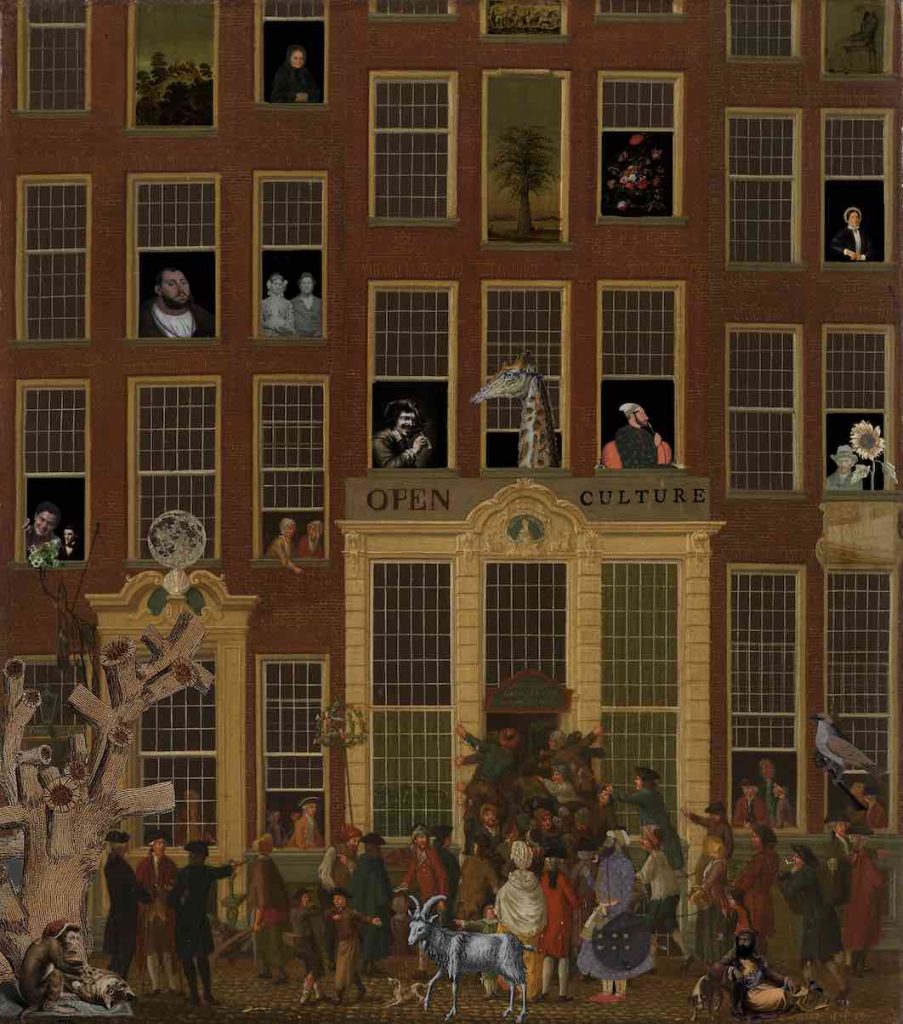
1st place: “Open Culture Salon – A Librarian’s Dream” by Alwaleed Khalid licensed under CC BY
Alwaleed on his work: “’Open Culture Salon’ reimagines digital repositories as a brick-and-mortar repository, in which openly licensed content comes alive and interacts with one another. The building brings together a collection from various sources, such as paintings, photographs, and landscapes. The windows of the building represent web browser windows. This remixed work, which uses 25 different openly licensed works, is inspired by 1980’s children’s puzzle books, as well as Dadaism and Surrealism – depicting perhaps a digital repository librarian’s dream.”
2nd place: “Lady with flowers” by Teresa Garcia licensed under CC BY
Teresa on her work: “One of the most famous works in history, created at a time when artistic appreciation was given by beauty, is transformed into a work for the 21st century, where artistic appreciation is the show. Because you have to ask yourself:
Where do those flowers come from?
Is she dressed like this?
Does she not have a body?
Or is her clothes fused with the background?
Is this work a second version of Leonardo da Vinci that has not been shown to the public?
I made this collage a day when I was a bit depressed. The darkness of the background of “The Lady and the Ermine” together with the black of “Still Life with Flowers and a Watch” gives me a somewhat dark but happy feeling. A light in the darkness.”
3rd place: “Nostalgia” by Florens Debora Patricia licensed under CC BY
Florens on her work: “Life is a loop, and Nietzsche considers a loop that occurs in our lives as a comedy. And named the concept Eternal Recurrence. And Nostalgia is one of the triggers for every human being to remember the repetitions that have occurred in their lives, both in terms of economic, cultural, and environmental psychology.”
4th place: “The Arts: Painting” by Robert Paul licensed under CC0
Robert on his work: “Creative Commons is integral to my approach to art, being both an enthusiastic user and creator of works licensed under Creative Commons. This work—a contemporary digital remix of Alphonse Mucha’s “La Peinture”—expresses my love for the creative potential that’s unleashed when art, culture, and media are shared freely and openly.”
5th place: “Metamorphosis UV-Map” by Carlos Travaini licensed under CC BY
Carlos on his work: “Metamorphosis UV-Map is a remix-work based on the 3D-digital scan of the neoclassical sculpture “Jason and the Golden Fleece” by Thorvaldsen, with the purpose of establishing a dialogue between past and present.
The scan of the original work was modified with the use of 3D-digital technology: the result is the 3D-Jason opened out onto a 2D-plane.”
6th place: “Disappearing” by Cristina Paveri licensed under CC BY
Cristina on her work: “‘It could happen to us’ was the Leitmotiv that made me select Ukraine culture heritage for this artwork. Here I remix a portrait of a young Ukrainian girl and an image of Ukrainian culture, in particular textiles and embroidery. The young girl’s portrait is fading as culture and people of Ukraine.”
7th place: “Frank against the Odd” by Chalas Jacques licensed under CC BY
Jacques on his work: “I was roaming on Numelyo, the Bibliothèque Numérique de Lyon, when I found this book. The original one is interesting, but it was this ugly numerisation which inspired me, with all its defaults. I don’t read nor speak Italian, so I just look at the drawings as a strange comic book of science-fiction. It reminds me of some stories like the ones we could find on Metal Hurlant crossed with pulp magazine. And the one I saw was really weird. A man, that I used to call Frank, ended up trapped in a strange world, fighting against unusual things, geometrical forms, flying hands with swords, robot guys, flying heads, etc…”
8th place + Public Choice Award: “East or West – Human stories are the best” by Arunesh Varade licensed under CC BY
Arunesh on his work: “Initially, I was influenced a lot by the western culture. However, over the years, I’ve developed a deep sense of appreciation for the culture of the east. Even though there’s a stark difference in the culture of the two regions, it’s the human emotion which drives us all. Expression of this emotion through music, paintings, sculpture, dance etc. provide us a medium to tell our story. That’s the best part about all these mediums of expression. It unites us all for the love of sharing our stories with no barrier of language. On a deeper level, it is these stories which form the basis for human connection.”
9th place: “Her Own Woman” by Danny Messing licensed under CC0
Danny on his work: “The original idea was to dress a famous nude (woman). How I was going to dress her was going to depend on the historical context of whatever piece I eventually used, but the ultimate goal was to challenge the history of the male gaze in art…As a child myself who played with paper-dolls, the first thing I would do is dress them as I’d dress myself (or how I wish I could dress). In that case, you have the viewer projecting themselves onto the goddess and how that can be rich with meaning. Dressing up is fun! Society oppresses women by reducing them to their looks! It’s everything. I loved making it. Funnily enough, the clothes were inspired by Sex and the City.”
10th place: “Justice for Johnny Depp” by OMARTCRAFT licensed under CC BY
Omartcraft on their work: “The modern world has evolved into a place where people are protected by law. Women enjoy the rights that years ago have not been in place, and generally, there is a constant positive dynamic in gaining rights for different groups of people. However, we witness the phenomenon when people abuse the law and transform it into a weapon for gaining credits. In 2022 Johnny Depp is becoming a symbol of this phenomenon.”
Episode 31: Open Culture VOICES – Buhle Mbambo-Thata
Welcome to episode 31 of Open Culture VOICES! VOICES is a vlog series of short interviews with open GLAM (galleries, libraries, archives, and museums) experts from around the world. The Open Culture Program at Creative Commons aims to promote better sharing of cultural heritage in GLAMs collections. With Open Culture VOICES, we’re thrilled to bring you various perspectives from dozens of experts speaking in many different languages on what it’s like to open up heritage content online. In this episode, we hear from Dr. Buhle Mbambo-Thata, University Librarian at the National University of Lesotho. Buhle is a distinguished librarian whose knowledge and expertise has been recognized with the following awards: the IFLA Medal for Distinguished Service to Libraries in Africa; the UNISA woman of the year award, as well as the Chancellor’s award for distinguished leadership. Her work spans international and continental work to advance the library sector as a key player in education and development.
Buhle responds to the following questions:
What are the main benefits of open GLAM?
What are the barriers?
Could you share something someone else told you that opened up your eyes and mind about open GLAM?
Do you have a personal message to those hesitating to open up collections?
Closed captions are available for this video, you can turn them on by clicking the CC icon at the bottom of the video. A red line will appear under the icon when closed captions have been enabled. Closed captions may be affected by Internet connectivity — if you experience a lag, we recommend watching the videos directly on YouTube.
Episodes will be released twice a week until June 2022. Have you missed the latest episodes of Open Culture VOICES?Catch up here >>
Episode 32: Open Culture VOICES – Martine Denoyelle
Welcome to episode 32 of Open Culture VOICES! VOICES is a vlog series of short interviews with open GLAM (galleries, libraries, archives, and museums) experts from around the world. The Open Culture Program at Creative Commons aims to promote better sharing of cultural heritage in GLAMs collections. With Open Culture VOICES, we’re thrilled to bring you various perspectives from dozens of experts speaking in many different languages on what it’s like to open up heritage content online. In this episode, we hear from Martine Denoyelle, Curator & Project Manager Digital Prospective at the Institut national d’Histoire de l’art. After having spent part of her career at the Department of Greek, Etruscan and Roman Antiquities of the Louvre Museum, she was scientific advisor at the National Institute of Art History from 2008 to 2016, then in charge of the digital prospective mission responsible for the Images / Usages project. She has organized in Paris several events on Digital Art History and the actuality of Open GLAMs.
Martine responds to the following questions:
What are the main benefits of open GLAM?
What are the barriers?
Could you share something someone else told you that opened up your eyes and mind about open GLAM?
Do you have a personal message to those hesitating to open up collections?
Closed captions are available for this video, you can turn them on by clicking the CC icon at the bottom of the video. A red line will appear under the icon when closed captions have been enabled. Closed captions may be affected by Internet connectivity — if you experience a lag, we recommend watching the videos directly on YouTube.
Episodes will be released twice a week until June 2022. Have you missed the latest episodes of Open Culture VOICES?Catch up here >>
Virtual Workshop Recap: Towards Better Sharing of Cultural Heritage
This paper calls for policies that support better sharing of cultural heritage in the public interest. And that’s exactly what we are planning to do. We are developing our first ever CC Open Culture Guide for Policymakers to address the copyright barriers to universal access and reuse of knowledge and culture faced by GLAMs. To initiate this process, we held an interactive virtual workshop for policy experts and open culture enthusiasts to explore key policy issues and gather insights into how to effectively engage policy makers in our work.
Workshop Recap
CC hosted a workshop on 10 May 2022, “Towards Better Sharing of Cultural Heritage,” which sought to bring together folks from the worlds of open culture and policy. The workshop started with a welcome address from Creative Commons CEO Catherine Stihler, followed by a brief overview of the main policy issues affecting better sharing of cultural heritage.
Our four panelists took to the stage to share their insights into ways to develop impactful and effective guidance to reshape policy. We were joined by:
Brigitte Vézina | Director of Policy and Open Culture at Creative Commons (Moderator)
Ramon Lugo, Legislative advisor, Senate of the Republic of Mexico
Maria Drabczyk, Head of Policy and Advocacy & Board Member, Centrum Cyfrowe
Mark Foster, Owner and Managing Director, Strategic Advisory Management
Shantal English | Copyright and Related Rights Manager, Jamaica Intellectual Property Office
Check out this Twitter thread with top tips from our panel ⬇️
1/ A ? of tips from our panel at CC’s ‘Towards Better Sharing of Cultural Heritage’ workshop. #OpenCulture
— Creative Commons (@creativecommons) May 10, 2022
After hearing from our panel of policy experts, we moved to the interactive part of the workshop. Attendees were divided into four breakout groups to co-create an initial roadmap for developing a guide for policymakers to support the public interest goals and mission of global cultural heritage institutions and their users. Please note that recordings are not available for the breakout sessions.
Our four breakout sessions were:
Open Culture in an Ideal World: Needs, goals and aspirations of the open culture movement | Led by Camille Francoise
Open Culture in our Current World: Problems, hurdles and challenges | Led by Shanna Hollich
Bridging the Gap between Current and Ideal: Exploring solutions: exceptions and limitations and safeguarding the public domain | Led by Maarten Zeinstra
New horizons: artificial intelligence, copyright and cultural heritage | Led by Emine Ozge Yildirim
The event probed several innovative and inspiring strategies for CC advocates to convey complex policy messages in simple and engaging ways. It also helped define our policy vision for better sharing of cultural heritage, according to the four horizons that shape it: (1) the challenging present; (2) the path forward; (3) the ideal future; and (4) the final frontier. Our learnings will feed into our guide development process, which will involve many opportunities to deepen the conversations and strengthen collaboration among experts in our dynamic global community.
We can’t develop this guide without your help—join us and get involved in developing a stable foundation for policy makers to further access to information, knowledge and culture. Join the CC Copyright Platform Mailing List >>
CC at SCCR 42: A Look Back at the WIPO Copyright Meeting
From 9 to 13 May 2022, Creative Commons (CC) participated in the 42nd session of the World Intellectual Property Organization (WIPO) Standing Committee on Copyright and Related Rights (SCCR) in Geneva, Switzerland. In this blog post, we look back on the highlights of the SCCR/42 week.
As part of its policy agenda, CC aims to drive copyright reform towards better sharing of copyright content in the public interest and in tune with the sharing possibilities unlocked in the digital environment. We promote open culture, a positive, global policy framework that fosters the public-interest mission of cultural institutions. Last month, we published a policy paper that details our views on copyright reform, and held a workshop last week to start the process to consolidate those views into a practical guide for policymakers. Stay tuned for next steps!
Exceptions and limitations
Open culture is conditioned upon strong, clear, and effective limitations and exceptions; they are the pillars on which cultural heritage institutions can rest to fulfill their mission. Global challenges such as climate change and the COVID-19 pandemic are causing unprecedented hardship to cultural institutions and the communities they serve. These challenges magnify the vital importance of limitations and exceptions to facilitate cultural heritage institutions’ digital presence. CC delivered a statement calling on WIPO member states to endorse the Proposal by the African Group (SCCR/42/4), which we support, as it is geared towards concrete and meaningful solutions to ensure there are effective and consistent exceptions and limitations to support institutions and their millions of users worldwide.
“Global challenges such as climate change and the COVID-19 pandemic are causing unprecedented hardship to LAMs… These challenges magnify the vital importance of limitations and exceptions to facilitate LAMs’ global digital presence.”
— Creative Commons (@creativecommons) May 12, 2022
Broadcasting
Regarding the discussions on a draft broadcasting treaty, CC remains firmly opposed to any new right for broadcasters. As we stated in the past, additional rights would add a layer of protection atop the underlying copyright in the works being broadcast. This new set of rights would permit broadcasters to restrict access to works already licensed under a Creative Commons license or in the public domain, and would unnecessarily complicate the rights-negotiation process that Creative Commons has attempted to simplify. For Creative Commons, the exceptions and limitations proposed in the draft treaty are insufficient to address uses for purposes of education, research and preservation of cultural heritage. Furthermore, regarding the use of digital rights management (DRM) and technological protection measures (TPMs) to enforce such rights, CC finds these antithetical to the “open” ethos and at odds with the values of better sharing that we support.
Looking ahead
Although we are disappointed that the African Group proposal was not supported in its entirety, we welcome the Committee’s commitment to continue to discuss a revised proposal at the next session, SCCR/43. We also welcome the meeting’s conclusions to (1) invite experts to give presentations on specific cross-borders problems in the online and cross-border environment, including on education and research; (2) for the Secretariat to develop, in consultations with experts and stakeholders from beneficiary communities and right holders, toolkits on technical assistance to support education, research and the preservation of cultural heritage.
We look forward to Member States taking active steps to build on this momentum and accelerate the work for a fairer and more balanced copyright system that supports better sharing in the public interest.
To stay informed about our copyright and policy work, join our mailing list!
 Teresa on her work: “One of the most famous works in history, created at a time when artistic appreciation was given by beauty, is transformed into a work for the 21st century, where artistic appreciation is the show. Because you have to ask yourself:
 Florens on her work: “Life is a loop, and Nietzsche considers a loop that occurs in our lives as a comedy. And named the concept Eternal Recurrence. And Nostalgia is one of the triggers for every human being to remember the repetitions that have occurred in their lives, both in terms of economic, cultural, and environmental psychology.”
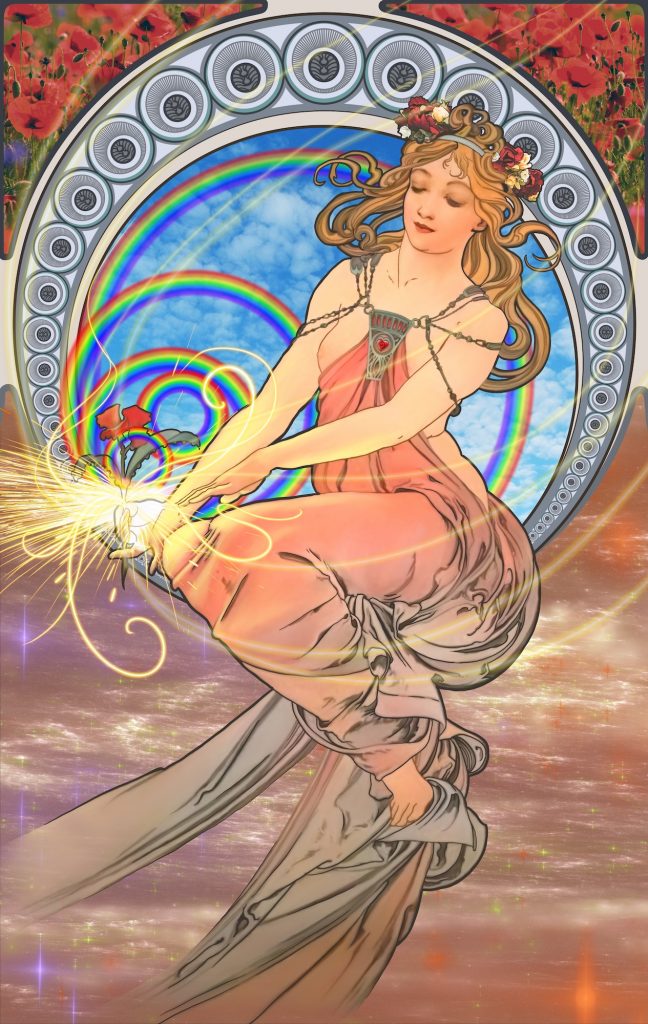 Robert on his work: “Creative Commons is integral to my approach to art, being both an enthusiastic user and creator of works licensed under Creative Commons. This work—a contemporary digital remix of Alphonse Mucha’s “La Peinture”—expresses my love for the creative potential that’s unleashed when art, culture, and media are shared freely and openly.”
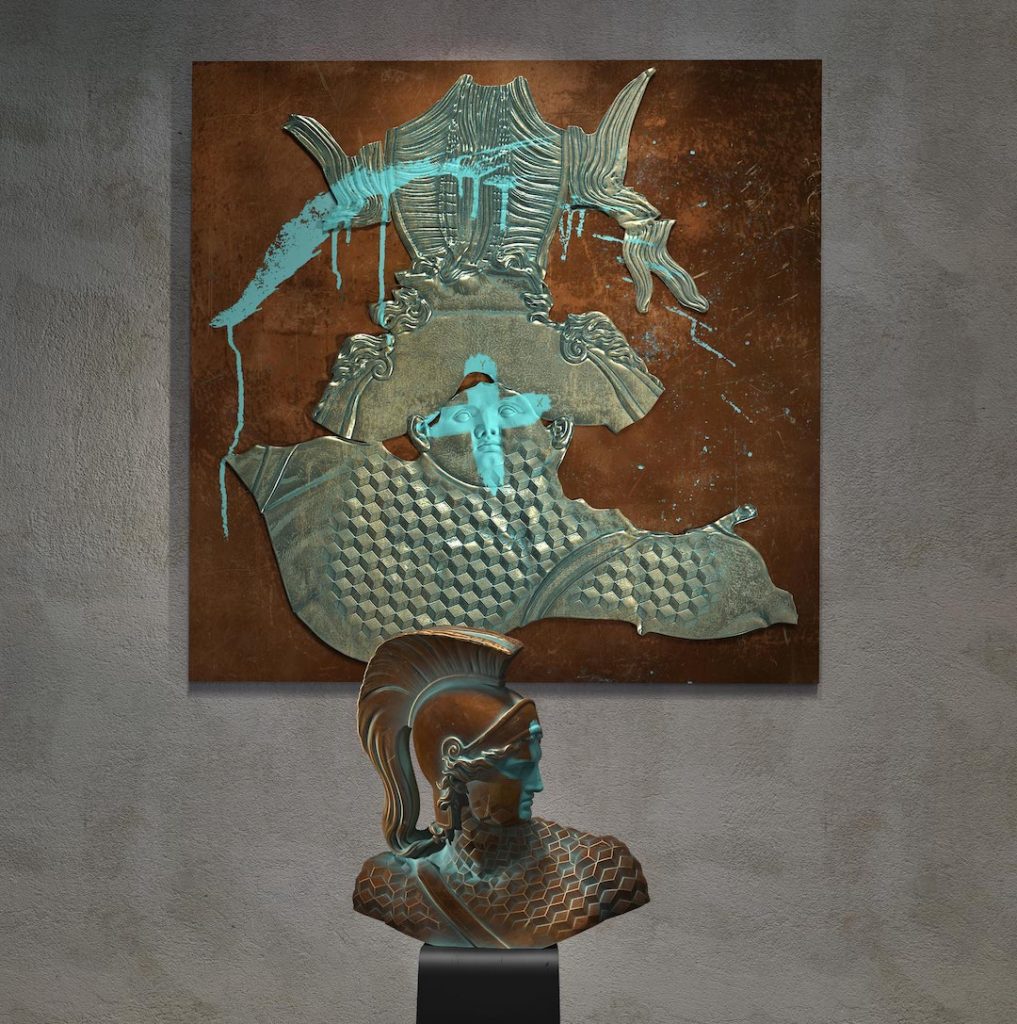 Carlos on his work: “Metamorphosis UV-Map is a remix-work based on the 3D-digital scan of the neoclassical sculpture “Jason and the Golden Fleece” by Thorvaldsen, with the purpose of establishing a dialogue between past and present.
 Cristina on her work: “‘It could happen to us’ was the Leitmotiv that made me select Ukraine culture heritage for this artwork. Here I remix a portrait of a young Ukrainian girl and an image of Ukrainian culture, in particular textiles and embroidery. The young girl’s portrait is fading as culture and people of Ukraine.”
 Jacques on his work: “I was roaming on Numelyo, the Bibliothèque Numérique de Lyon, when I found this book. The original one is interesting, but it was this ugly numerisation which inspired me, with all its defaults. I don’t read nor speak Italian, so I just look at the drawings as a strange comic book of science-fiction. It reminds me of some stories like the ones we could find on Metal Hurlant crossed with pulp magazine. And the one I saw was really weird. A man, that I used to call Frank, ended up trapped in a strange world, fighting against unusual things, geometrical forms, flying hands with swords, robot guys, flying heads, etc…”
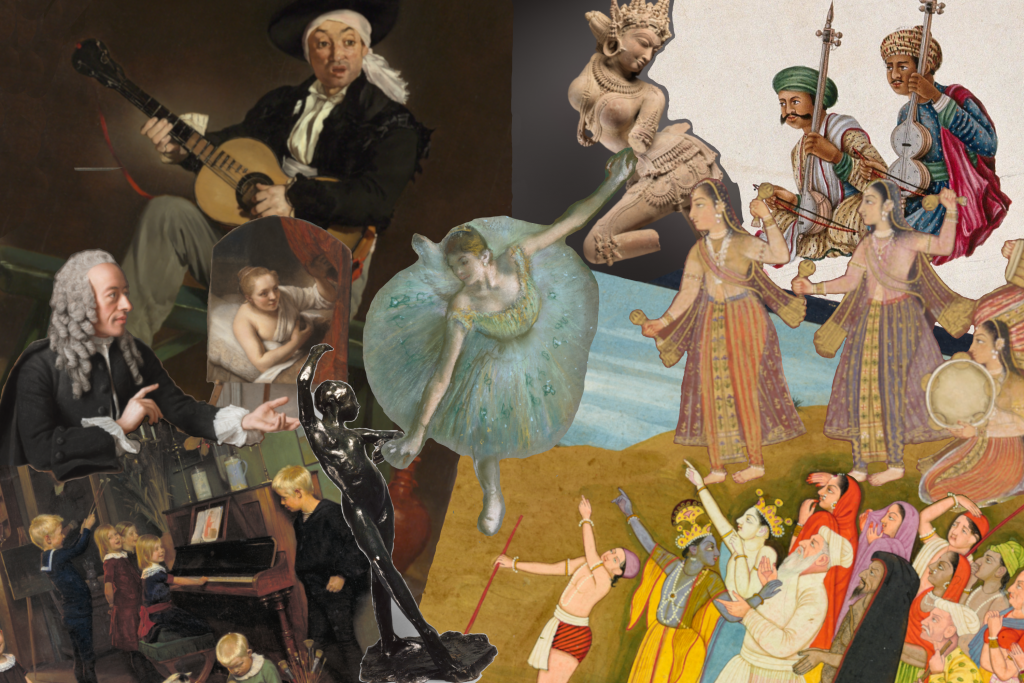 Arunesh on his work: “Initially, I was influenced a lot by the western culture. However, over the years, I’ve developed a deep sense of appreciation for the culture of the east. Even though there’s a stark difference in the culture of the two regions, it’s the human emotion which drives us all. Expression of this emotion through music, paintings, sculpture, dance etc. provide us a medium to tell our story. That’s the best part about all these mediums of expression. It unites us all for the love of sharing our stories with no barrier of language. On a deeper level, it is these stories which form the basis for human connection.”
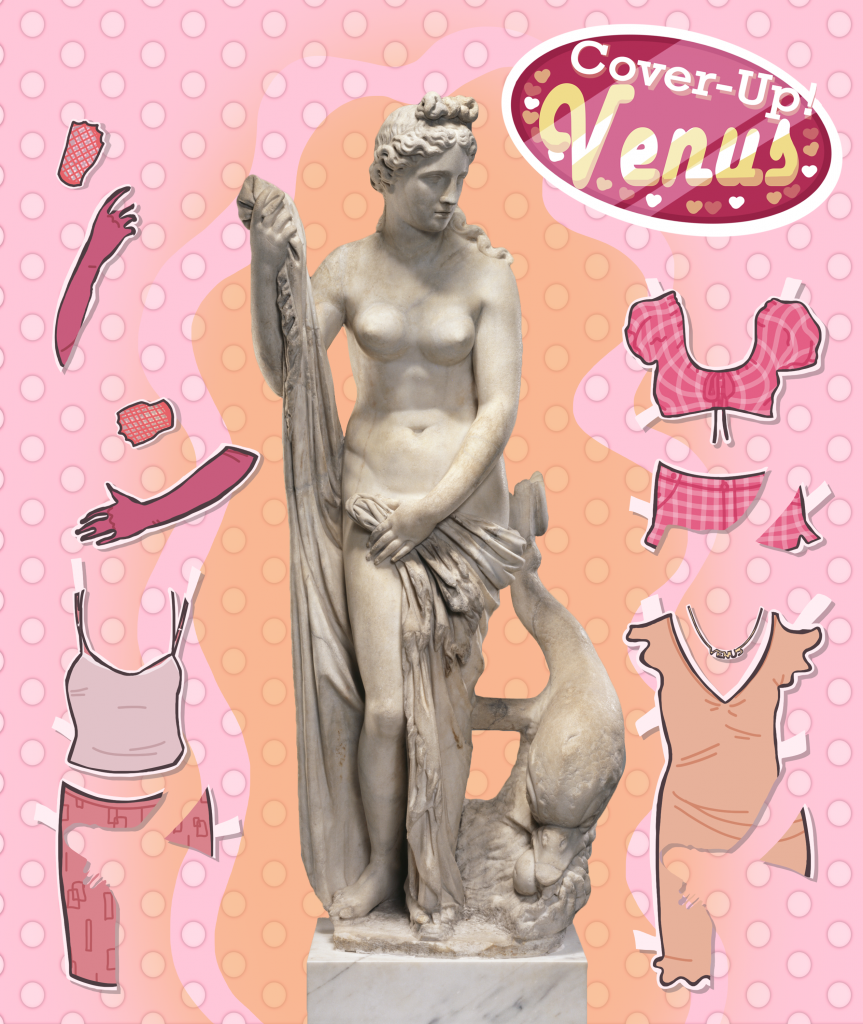 Danny on his work: “The original idea was to dress a famous nude (woman). How I was going to dress her was going to depend on the historical context of whatever piece I eventually used, but the ultimate goal was to challenge the history of the male gaze in art…As a child myself who played with paper-dolls, the first thing I would do is dress them as I’d dress myself (or how I wish I could dress). In that case, you have the viewer projecting themselves onto the goddess and how that can be rich with meaning. Dressing up is fun! Society oppresses women by reducing them to their looks! It’s everything. I loved making it. Funnily enough, the clothes were inspired by Sex and the City.”
 Omartcraft on their work: “The modern world has evolved into a place where people are protected by law. Women enjoy the rights that years ago have not been in place, and generally, there is a constant positive dynamic in gaining rights for different groups of people. However, we witness the phenomenon when people abuse the law and transform it into a weapon for gaining credits. In 2022 Johnny Depp is becoming a symbol of this phenomenon.”