As we’ve been talking about on the blog, we are intentionally seeking ways to reengage with the global community, which will likely entail making changes to the current CC Global Network (CCGN). We recently surveyed the CC global community to help inform next steps.
We received nearly 100 responses from over 40 countries, and we’re so grateful for the insights and ideas you shared. Here’s a snapshot of what we learned from you—and how we plan to respond.
What We Learned About You
We heard from respondents throughout the globe, though most were based in North America and Europe. This is not surprising, as most of our team is based in the U.S. and Canada, and CC has historically focused on U.S. and European copyright policy. We heard from respondents from outside of these areas that they would like to see CC diversify and deepen our engagement in other regions across the globe.
When we asked about the languages you use in your community organizing, Spanish, French, and Italian were the top non-English languages listed. Several respondents also mentioned working across all six official UN languages: Arabic, Chinese, English, French, Russian, and Spanish.
In terms of how you connect with Creative Commons, 80% of you identified as supporters or followers. The next most common affiliation was as CC Certificate alumni—an encouraging sign of ongoing engagement from those who’ve taken the course. Notably, nearly 1 in 5 respondents are new to the CC community, underscoring the importance of creating clear and accessible entry points for newcomers to CC and the open movement.
What You Value About the CC Community
One of the most valued ways CC supports the community is by providing clear, accessible information on open licensing, copyright, and CC’s licenses and tools. These resources help guide creators, students, and institutions in making ethical and legally sound decisions around sharing.
Beyond tools and resources, many of you highlighted the importance of a supportive global community of practice. Several also expressed nostalgia for earlier phases of the CC network, when coordination around localized license porting provided a clear structure for deeper engagement among legal and policy experts.
What Support You Need
When asked what CC should prioritize to support the open movement globally, your top request was for us to stay focused on our mission and maintain the core tools that power open sharing.
You also encouraged CC HQ to shift from leading community activities to enabling them. Rather than managing engagement from the top down, you asked us to provide the scaffolding—toolkits, engagement pathways, and meaningful opportunities to contribute both locally and globally. You want to see local chapters and communities revived, regional events supported, and leadership empowered at the grassroots.
What Role You Want CC to Play
You’ve called on us to play a stronger role in facilitating meaningful collaboration—locally, regionally, and globally.
Some of you also asked that we convene more communities of interest, and that we improve our communication with you through regular newsletters, events, and updates.
Transparency in governance and opportunities for participatory decision-making also came through as key priorities.
Finally, many of you expressed the desire for CC to take a more active stance in relation to AI.
How You Want to Connect
What we heard most clearly is your desire to be more connected with each other—to share stories, collaborate, and learn across regions. You’re interested in more events, both in person and virtual.
When asked what kind of non-financial support would be most helpful, the top response was “opportunities for training or skill sharing.” There’s strong interest in regional coordination, localized resources, and peer-to-peer mentorship opportunities.
Listening More, Engaging Meaningfully
Much of what we heard echoes feedback we’ve received in the past: frustration with top-down decision-making, and a desire for more meaningful listening and engagement. We know we have room to grow, and we’re committed to doing the work to build stronger, more equitable relationships across our global community.
We also know that when community members feel recognized, supported, and heard, they’re more likely to contribute actively. We’re excited to continue building mutual trust and collaboration—especially as we approach our 25th anniversary as an opportunity to reconnect.
On Funding
It’s not surprising to see continued requests for more financial support. The financial landscape is challenging for many nonprofits, and we continue to actively fundraise to support CC’s initiatives. At this time, our goal is to approach funding decisions on a year-by-year basis. We intend to be transparent about where funding may be available in the coming years and not over-promise where we aren’t able to deliver.
What’s Next
We’re thrilled to announce that we’ll be launching a new community chat platform to replace Slack very soon! Stay tuned for more details on how to join and engage—this chat space will be created for regional and thematic collaboration across our communities.
We’re continuing to work on plans for updating our membership and governance structures and creating new ways to engage with CC and other community members.
A new community newsletter is also on the way—sign up here to stay in the loop.
AI and the Commons: A Reading List
What effect are large AI models having on the digital commons and how should we respond? As part of our work to support creators and stewards of content to adapt to the unfolding AI future, we’re sharing some of the writing and ideas that are shaping our thinking.
Here at CC, we have the goal of defending and sustaining the digital commons in the face of developments in artificial intelligence.
We’ve recently introduced a new framework, CC signals, to offer a new way for stewards of large collections of content to indicate their preferences for how machines (and the humans controlling them) should contribute back to the commons.
As we develop our approach, we’re taking inspiration from the work of our partners, community, and other stakeholders. We’re particularly interested in efforts to understand:
How AI scrapers are reshaping the web
Copyright, labor, surveillance, and resistance
The effects of a new economy of data licensing
Emerging ideas for more ethical AI and consensual data governance
We’re reading (a lot!) on these topics, to help ensure that CC signals become part of a diverse set of solutions for protecting the commons in the unfolding AI future. Here’s some of the writing that’s shaping our thinking:
Legal frictions for data openness: Reflections from a case-study on re-use of the open web for AI training – Ramya Chandrasekhar https://hal.science/hal-05009616v1
We’d love for you to read and learn alongside us, share your thoughts, and contribute other articles and resources to this list! Connect with us on LinkedIn, Bluesky, or Mastodon.
We Asked, You Answered: How Your Feedback Shapes CC Signals
In June we kicked off a public feedback period on our proposal for CC signals. CC signals is a preference signals framework designed to sustain the commons and ensure the continued sharing of knowledge in the age of AI.
The goal is to give holders of large datasets a way to set criteria for how their data may be used within AI training models. To give an example, a dataset holder may wish to require that any AI training that uses their data gives credit back to the original source (e.g. attribution), or that the resulting AI model is open. Like the CC licenses, CC signals builds on the idea of ‘some rights reserved’ and that creators and knowledge holders deserve meaningful choices in how their work is used. You can learn more on our website.
Since our kickoff event, we have been listening closely to feedback. We heard from hundreds of creators, librarians, technologists, legal experts, and open advocates. We asked for feedback and you delivered! Your voices – supportive, skeptical, frustrated, or curious – are essential in shaping how CC signals develops. We’d like to summarize what we heard and how this feedback is being incorporated and addressed.
What We Heard
Across the conversations, several themes emerged:
Concerns that CC is prioritizing AI companies over creators. A recurring concern is that CC signals seem to give legitimacy to AI training without doing enough to protect creators.
Confusion and disagreement about the CC licenses and AI training. We heard frustration that the CC licenses are not being interpreted or enforced in ways that some creators expected.
Strong calls for opt-outs. Many wondered why the draft CC signals did not include an opt-out option.
Asking politely for AI developers to give back in exchange for datasets is not enough. We heard doubts that CC signals would work in practice, given the widespread evidence of AI companies ignoring copyright, licenses, and even technical protocols like robots.txt.
Broader critique of AI’s role in society. There is a spectrum of views on AI across the CC community. Many of you stand firmly at the anti-AI end. For these voices, no technical framework, like CC signals, feels adequate without stronger laws and regulations.
We haven’t been clear on who this tool is meant to serve and the use cases it is meant to address. Naturally, the needs of an individual creator, like an artist, are quite different from those operating at an institutional or collective level. We heard loud and clear that CC signals, as currently conceived, does not meet the diverse needs of individual creators.
Requests for clarity. Many asked for more details about implementation and interoperability, including our long-term vision for CC signals as part of our broader mission.
We understand how deeply personal these issues are for many of you, especially artists and creators who feel their work is being taken without consent and are looking for ways to fight back. That frustration is real, and we take it seriously.
What We’re Doing Next
✔️Improving clarity around CC’s position. We know many of you are worried that CC has “taken sides” or is being influenced by AI companies.We want to be clear: the driving motivation of CC signals is to defend and sustain the commons by developing practical tools for knowledge holders. Going forward, we will aim to clarify our guiding principles and positions in ways that translate to product decisions.
✔️Strengthening messaging and education. We are committed to expanding resources on how the CC licenses and CC signals could interact, examples of how signals could work in practice, and deeper dives into questions of copyright within the AI landscape. If you haven’t already, take a look at our legal primer on understanding the CC licenses and AI training. The better informed the CC community is about AI and the commons at large, the more effective we can be as a community to defend the commons.
✔️Clarifying the use cases for CC signals. This phase of CC signals is designed to serve large and open dataset holders, not the individual creator. Your feedback helped us recognize that this focus was not easy to square with our decision to leverage technical protocols used by anyone with a website. As a result, the target audience for CC signals was not clear. As we decide on next steps in product development, we plan to focus on specific use cases to put our goals and objectives into practice.
✔️Deepening global engagement and inviting stakeholders into product development. We plan to continue conversations with diverse audiences to inform the future of CC signals through an iterative process. The rest of this year will be focused on exploring and testing possible integrations of CC signals with pilot adopters. From this, we hope to extrapolate findings as we explore wider adoption of CC signals in the future.
✔️ Maintaining transparency in development. Our GitHub repository will stay open and up to date. We are creating a roadmap that will be shared publicly and will provide consistent updates (either on the blog or via a virtual town hall) on our progress. This feedback loop is not over; it will be built into how CC signals will evolve.
Looking Ahead
The future of the commons depends on tools that reflect shared values of openness, fairness, and agency. We know many of you remain skeptical.
CC signals is not final. It is an experiment in building a new layer of choice in an age where the rules are rapidly shifting. We will keep listening, adjusting, and collaborating until we arrive at something that genuinely serves the commons.
Thank you to everyone who took the time to write, question, challenge, and support us. Please stay engaged. Together, we can ensure that Creative Commons continues to stand where it always has: with the community, for the commons.
Creative Commons Becomes an Official UNESCO NGO Partner
We are proud to announce that we are now established as an official NGO partner to UNESCO (consultative status). UNESCO stands for “United Nations Educational, Scientific and Cultural Organization” and is the UN’s specialized agency that aims to foster international cooperation in the fields of education, science, culture, and communication.
This new, formal status is an important recognition of the synergies between our two organizations and of our shared commitment to openness as a means to benefit everyone worldwide. As an official NGO partner, Creative Commons (CC) will now have the opportunity to contribute to UNESCO’s program and to interact with other official partner NGOs with common goals. In particular, we look forward to:
Participating in UNESCO meetings and consultations on various subjects core to CC’s mission. This will give us a seat at the table to advocate for the communities we serve and share our expertise on openness, the commons, and access to knowledge.
Participating in UNESCO’s governing bodies in an observer capacity. This will enable us to deliver official statements on matters within our sphere of expertise and contribute to determining UNESCO’s policies and main lines of work, including its programs and budget.
Taking part in consultations about UNESCO’s strategy and program and being involved in UNESCO’s programming cycle. This will give us opportunities to communicate our views and suggestions on proposals by the Director-General.
Becoming an official partner is a testament to our rich and long-standing collaboration with UNESCO over the past 24 years. Over this time, CC and our community have developed trusted relationships with UNESCO staff and Member State representatives, yielding many opportunities to engage and collaborate effectively.
As we continue to advance TAROCH, we know that the role of open solutions in removing unfair economic, legal, technological, and sociocultural barriers to access heritage, while fostering creative reuse and telling the stories of our shared humanity, is more important than ever.
Looking Ahead
We look forward to the exciting new opportunities for strategic collaboration on the horizon.
With Mondiacult 2025, the world’s biggest cultural policy conference, taking place soon, we look forward to assisting UNESCO in delivering on its key priority of “ensuring equitable access to heritage,” as indicated in the Mondiacult 2025 concept note. CC’s efforts through TAROCH to remove barriers, support interoperability, and create and share heritage with open licenses and tools can strengthen equitable access to heritage. Once heritage is accessible, we collectively have the opportunity to build more connected, resilient, and sustainable societies. Make sure to join us at our Mondiacult virtual side event on September 17, 2025.
Recommended Licenses and Tools for Cultural Heritage Content
The CC licenses and public domain tools are a simple and effective way for CHIs, such as museums, libraries and archives, to make heritage materials (and associated metadata) open. Navigating the right license or tool can be tricky, but if you remember only one thing, it’s that faithful digital reproductions of public domain materials must stay in the public domain — no new copyright or related right applies to the digitized version.
Many people can benefit from open access to cultural heritage in a variety of ways and for a variety of purposes — from creators seeking inspiration to researchers discovering new interpretations, all the way to cultural heritage institutions (CHIs) connecting with more audiences, and the general public making sense of the world we live in. In our report What are the Benefits of Open Culture? A new CC Publication, we show how, by removing any distance between people and heritage, openness gives rise to a multitude of connections with, about, or through cultural heritage.
The CC licenses and public domain tools are a simple and effective way for CHIs, such as museums, libraries and archives, to make heritage materials (and associated metadata) open so that they can be shared widely for the broadest possible access, use and reuse (including commercial use and modification), free of charge, and with no or few copyright restrictions.
Navigating the right license or tool can be tricky, as CHIs may share a wide range of different types of materials. But if you remember only one thing, it’s that faithful digital reproductions of public domain materials must stay in the public domain — no new copyright or related right applies to the digitized version. Public domain materials are materials that are no longer or never were protected by copyright.
This is a position that Creative Commons (CC) has been championing for years as part of our Open Culture Program. In other words, no new copyright (or related right) should arise over the creation of a digitized “twin.” Europeana and the Communia Association, among many other open culture organizations, share this position. It is also aligns with Article 14 of the 2019 EU Directive on Copyright in the Digital Single Market, which states that: “when the term of protection of a work of visual art has expired, any material resulting from an act of reproduction of that work is not subject to copyright […]”.
It’s also important to remember that digital reproductions of public domain works cannot be CC-licensed, since CC licenses can only be used with in-copyright content. Instead, we recommend using a CC public domain tool, putting the digital reproductions squarely and unequivocally into the public domain. This not only conveys clear information about the public domain status of the materials, it also contributes to the thriving, blooming commons of knowledge and culture that we need to address the world’s most pressing problems.
Some CHIs might want to get credit for sharing heritage from their collections. It is not good practice to use a license in this case. Instead, there are different ways to encourage users to refer back to CHIs, as we explain in Nudging Users To Reference Institutions When Using Public Domain Materials. The guidelines offer a fresh and innovative approach to prompting users to reference the institution when using public domain materials and present various design ideas to instigate behavioral change. They address key questions, including:
How can institutions nudge users to reference them?
What information should be included in a reference statement?
What would a nudge look like in practice?
How to organize the data needed to implement these ideas?
Regarding metadata, we strongly encourage that it be dedicated to the public domain using the legal tool Creative Commons Public Domain Dedication (CC0). Data is largely made of highly factual content that is considered uncopyrightable, but uncertainties might remain. The CC0 waiver places all data squarely and unequivocally in the public domain worldwide and clarifies that data reuse is not restricted by copyright, related rights or database rights — those rights are all surrendered. CC0 can support maximizing the reuse of data, with benefits including:
enabling others to validate, replicate and put the data to new uses
facilitating enhanced collaboration and enrichment
increasing transparency
speeding the discovery and understanding of solutions to planetary and societal needs.
For materials created by the CHIs and protected by copyright, we recommend CC BY-SA 4.0, CC BY 4.0 or CC0 1.0 to enable maximum dissemination and reuse.
For different types of content, we recommend different CC tools or licenses to achieve optimal engagement and reuse, as summarized in this table:
Type of content
Recommended licenses or tools
Digital reproductions of public domain works (works that are no longer or never were protected by copyright)
Using CC licenses and public domain tools to share cultural heritage materials unlocks vast potential for open culture to blossom in the cultural heritage sector. By offering enhanced legal certainty, CHIs have the ability to engage more deeply in the open culture movement and make their vast collections openly accessible to everyone.
Thanks to everyone who attended our CC signals project kickoff last week. We’re receiving plenty of feedback, and we appreciate the insights. We are listening to all of it and hope that you continue to engage with us as we seek to make this framework fit for purpose.
Some of the input focuses on the specifics of the CC signals proposal, offering constructive questions and suggesting ideas for improving CC signals in practice. The most salient type of feedback, however, is touching on something far deeper than the CC signals themselves – the fact that so much about AI seems to be happening to us all, rather than with or for us all, and that the expectations of creators and communities are at risk of being overshadowed by powerful interests.
This sentiment is not a surprise to us. We feel it, too. In fact, it is why we are doing this project. CC’s goal has always been to grow and sustain the thriving commons of knowledge and culture. We want people to be able to share with and learn from each other, without being or feeling exploited. CC signals is an extension of that mission in this evolving AI landscape.
We believe that the current practices of AI companies pose a threat to the future of the commons. Many creators and knowledge communities are feeling betrayed by how AI is being developed and deployed. The result is that people are understandably turning to enclosure. Eventually, we fear that people will no longer want to share publicly at all.
CC signals are a first step to reduce this damage by giving more agency to those who create and hold content. Unlike the CC licenses, they are explicitly designed to signal expectations even where copyright law is silent or unclear, when it does not apply, and where it varies by jurisdiction. We have listened to creators who want to share their work but also have concerns about exploitation. CC signals provide a way for creators to express those nuances. The CC signals build on top of developing standards for expressing AI usage preferences (e.g., via robots.txt). Creators who want to fully opt out of machine reuse do not need to use a CC signal. CC signals are for those who want to keep sharing, but with some terms attached.
The challenge we’re all facing in this age of AI is how to protect the integrity and vitality of the commons. The listening we’ve been doing so far, across creator communities and open knowledge networks, has led us here, to CC signals. Our shared commitment is to protect the commons so that it remains a space for human creativity, collaboration, and innovation, and to make clear our expectation that those who draw from it give something in return.
Our goal is to advocate for reciprocity while upholding our values that knowledge and creativity should not be treated as commodities.
Our goal is to find a path between a free-for-all and an internet of paywalls.
Copyright will not get us there. Nor should it. And we don’t think the boundaries of copyright tell us everything we need to know about navigating this moment. Just this week, Open Future released a report that calls for going beyond copyright in this debate, on the path to a healthy knowledge commons.
This is the beginning of the conversation, not the end. We are listening. From what we have heard, CC signals, or something like it, is the best practical mechanism to avoid the dual traps of total exploitation or total enclosure, both of which damage the commons. We have shared our current progress because we want to learn how to design it to meet your needs. We invite you to continue sharing feedback so we can shape CC signals together in a way that works for diverse communities. In the months ahead, we’ll be providing more detail about how CC signals are developing, including key themes we are hearing, along with the questions we are exploring and our next steps.
Introducing CC Signals: A New Social Contract for the Age of AI
Creative Commons (CC) today announces the public kickoff of the CC signals project, a new preference signals framework designed to increase reciprocity and sustain a creative commons in the age of AI. The development of CC signals represents a major step forward in building a more equitable, sustainable AI ecosystem rooted in shared benefits. This step is the culmination of years of consultation and analysis. As we enter this new phase of work, we are actively seeking input from the public.
As artificial intelligence (AI) transforms how knowledge is created, shared, and reused, we are at a fork in the road that will define the future of access to knowledge and shared creativity. One path leads to data extraction and the erosion of openness; the other leads to a walled-off internet guarded by paywalls. CC signals offer another way, grounded in the nuanced values of the commons expressed by the collective.
Based on the same principles that gave rise to the CC licenses and tens of billions of works openly licensed online, CC signals will allow dataset holders to signal their preferences for how their content can be reused by machines based on a set of limited but meaningful options shaped in the public interest. They are both a technical and legal tool and a social proposition: a call for a new pact between those who share data and those who use it to train AI models.
“CC signals are designed to sustain the commons in the age of AI,” said Anna Tumadóttir, CEO, Creative Commons. “Just as the CC licenses helped build the open web, we believe CC signals will help shape an open AI ecosystem grounded in reciprocity.”
CC signals recognize that change requires systems-level coordination. They are tools that will be built for machine and human readability, and are flexible across legal, technical, and normative contexts. However, at their core CC signals are anchored in mobilizing the power of the collective. While CC signals may range in enforceability, legally binding in some cases and normative in others, their application will always carry ethical weight that says we give, we take, we give again, and we are all in this together.
“If we are committed to a future where knowledge remains open, we need to collectively insist on a new kind of give-and-take,” said Sarah Hinchliff Pearson, General Counsel, Creative Commons. “A single preference, uniquely expressed, is inconsequential in the machine age. But together, we can demand a different way.”
Now Ready for Feedback
More information about CC signals and early design decisions are available on the CC website. We are committed to developing CC signals transparently and alongside our partners and community. We are actively seeking public feedback and input over the next few months as we work toward an alpha launch in November 2025.
Get Involved
Join the discussion & share your feedback
To give feedback on the current CC signals proposal, hop over to the CC signals GitHub repository. You can engage in a few ways:
We invite our community to join us for a brief explanation of the CC signals framework, and then we will open the floor to you to share feedback and ask questions.
CC is a nonprofit. Help us build CC signals with a donation.
The age of AI demands new tools, new norms, and new forms of cooperation. With CC signals, we’re building a future where shared knowledge continues to thrive. Join us.
Understanding CC Licenses and AI Training: A Legal Primer
Whether you are a creator, researcher, or anyone licensing your work with a CC license, you might be wondering how it can be used to train AI. Many AI developers, who wish to comply with the CC license terms, are also seeking guidance.
The application of copyright law to AI training is complex. The CC licenses are copyright licenses, so it follows that applying CC licenses to AI training is just as complex.
The short answer is: AI training is often permitted by copyright. This means that the CC license conditions have limited application to machine reuse. This also means that using a more restrictive CC license in an effort to prevent AI training is not an effective approach. In fact, restrictive licensing may actually end up preventing the kind of sharing you want (like allowing for translation, for example), while not being effective to block AI training.
For the long answer, read our new guide that provides a legal analysis and overview of the considerations when using CC-licensed works for AI training.
If the CC licenses have limited application to machine reuse, what agency do creators have in the AI ecosystem?
This is an important question. As you’ve heard us talk about before, we’re actively developing a CC preference signals framework to help bridge this gap. The framework is designed to offer new choices for stewards of large collections of content to signal their preferences when sharing their works, using scaffolding inspired by the architecture of the CC licenses. This is not mediated through copyright or the CC licenses. It is governed by something that tends to be even more widely adopted: a social contract. Stand by for the release of the paper prototype of CC preference signals framework at the end of June 2025.
The Next Chapter: Strengthening the Creative Commons Community Together
We are excited to share more about our plan for the community this year, including a community consultation that starts with a survey. Tell us more about how you see CC’s community.
A thriving and connected community is key to building a stronger open movement. That’s why, as part of our 2025–2028 strategic plan, we’re placing community at the center of everything we do. Our vision is clear: a world where communities actively leverage CC’s open infrastructure to share knowledge in the public interest.
This year, we’re focusing on re-engaging with the CC community and building new relationships, especially as emerging technologies like AI reshape how people create and share. We want to ensure CC’s tools, training, and resources evolve to meet real community needs, and we’re committed to being transparent and realistic about what we can offer in support. This is happening during a period of economic uncertainty for organizations in the open movement, so we are focusing on delivering sustainable pathways for community engagement at CC.
From CC Global Summit to New Ways of Connecting
One big change you may have noticed is that we haven’t announced the next CC Global Summit. Unfortunately, CC’s budgets over the last two years have not allowed for such a significant expense, and most of the past Global Summits ran at a deficit. Without sufficient funding to support participant attendance, the Global Summits cannot be as inclusive as we aspire for them to be.
But this doesn’t mean we can’t spend time together – quite the opposite! We believe that supporting more regional gatherings for in-person engagement and virtual gatherings for increased inclusion will help to meet these challenges. Interested in exploring collaborating on an event in your region or in your community? Let’s chat.
In thinking about the future of our community, the shared sentiment is that the CC community is much more expansive than the formal structures of the CCGN; the CC community is anyone who uses, advocates for, or supports the infrastructure that enables open licensing or who supports and believes in the power of the commons.
To enable this broader community, we are evaluating the existing (though currently inactive) membership process of the CC Global Network and how we support country chapters. Our goal is to strengthen our community engagement spaces and create clearer, more accessible pathways for people to get involved with CC.
Let’s Get to Work!
We are excited to reconnect and hear about your experiences and vision for the future of the CC community. Your input will help shape future decisions around governance, community infrastructure, communication tools, and engagement spaces. Please fill out the CC Community Survey by May 30:
Our commitment is to make CC a space where collaboration thrives, knowledge flows freely, and communities feel empowered to shape the future of the commons. Stay tuned for opportunities to share your input, connect with others, and co-create what comes next.
CC @ SXSW: Protecting the Commons in the Age of AI
SXSW by Creative Commons is licensed under CC BY 4.0
If you’ve been following along on the blog this year, you’ll know that we’ve been thinking a lot about the future of open, particularly in this age of AI. With our 2025-2028 strategy to guide us, we’ve been louder about a renewed call for reciprocity to defend and protect the commons as well as the importance of openness in AI and open licensing to avoid an enclosure of the commons.
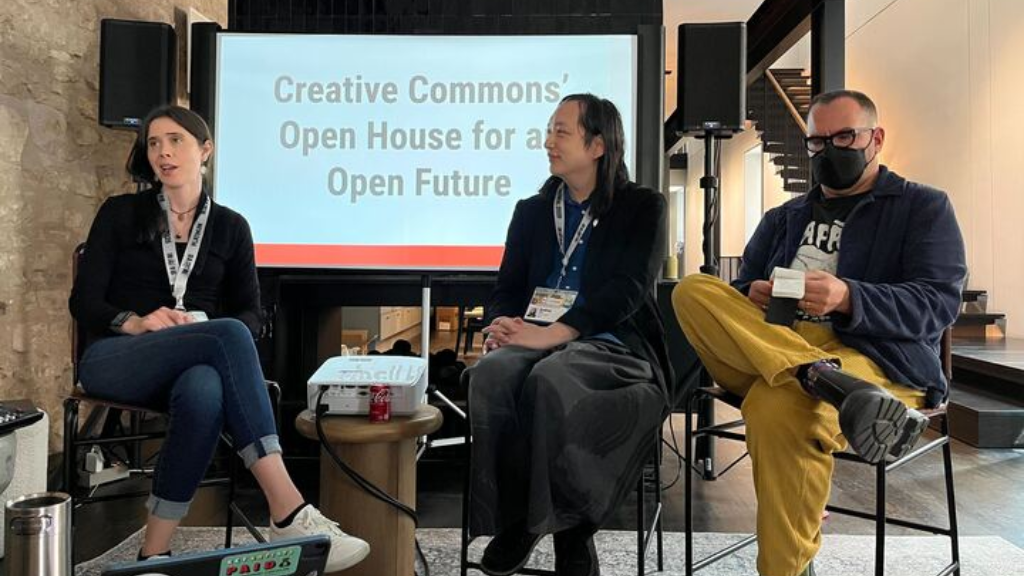
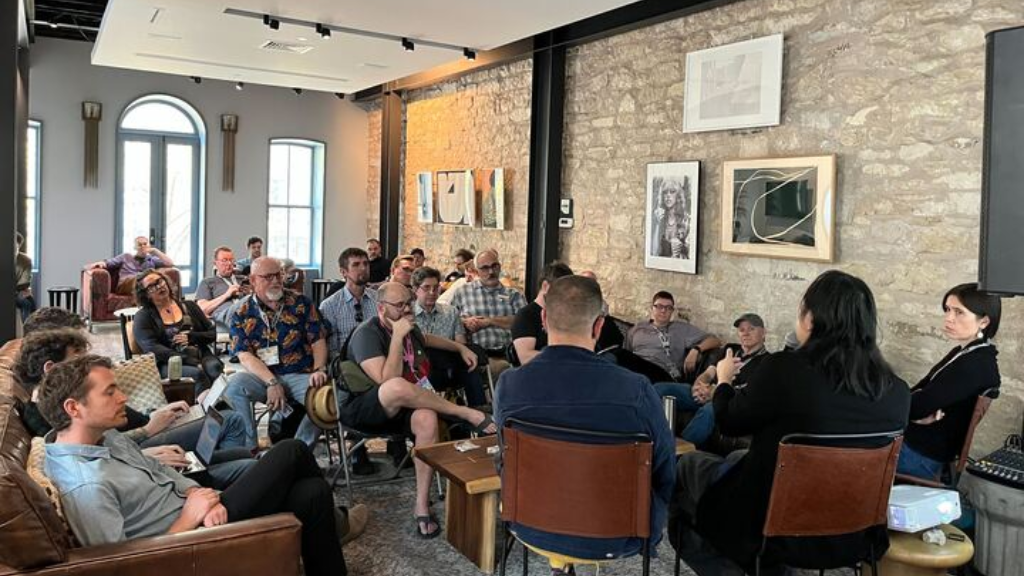
Last month, we took some of these conversations on the road and hosted the Open House for an Open Future during SXSW in Austin, TX, as part of a weekend-long Wiki Haus event with our friends at the Wikimedia Foundation.
During the event, we spoke with Audrey Tang and Cory Doctorow about the future of open, especially as we look towards CC’s 25th anniversary in 2026. In this wide-ranging conversation, a number of themes were reflected that capture both where we’ve been over the last 25 years and where we should be focusing for the next 25 years, including:
The Fight for Technological Self-Determination: Contractual restrictions are increasingly being used to lock down essential technologies, from printer ink to hospital ventilators. The push for openness and economic fairness must go beyond just content-sharing and extend to fighting for the rights of people to repair, modify, and use technology freely.
Shifting from Resistance to Building Alternatives: The open movement is not just about opposing corporate restrictions but also about creating viable, open alternatives. Initiatives like Gov Zero show that fostering decentralized, user-controlled platforms can help counteract monopolistic digital ecosystems.
The Power of Exit as a Lever for Change: Simply having the option to leave restrictive platforms can influence corporate behavior. Efforts like Free Our Feeds and Bluesky aim to create credible exit strategies that prevent users from being locked into exploitative digital environments.
Beyond Copyright: New Frameworks for Openness and Innovation: While Creative Commons began as a response to copyright limitations, the next phase should focus on broader issues like supporting an infrastructure for open sharing, ethical AI development, and open governance models that empower communities rather than just limiting corporate control.
Reclaiming the Ethos of Open Source and Free Software: The movement must reconnect with its ethical roots, focusing on freedom to create, share, and innovate—not just openness for the sake of efficiency. This includes resisting corporate capture of “openness” and ensuring technological advances serve public interest rather than private profit.
Since the proliferation of mainstream AI, we’ve been analyzing the limitations of copyright (and, by extension, the CC licenses since they are built atop copyright law) as the right lens to think about guardrails for AI training. This means we need new tools and approaches in this age of AI that complement open licensing, while also advancing the AI ecosystem toward the public interest. Preference signals are based on the idea that creators and dataset holders should be active participants in deciding how and/or if their content is used for AI training. Our friends at Bluesky, for example, have recently put forth a proposal on User Intents for Data Reuse, which is well worth a read to conceptualize how a preference signals approach could be considered on a social media platform. We’ve also been actively participating in the IETF’s AI Preferences Working Group, since submitting a position paper on the subject mid-2024 .
SXSW by Creative Commons is licensed under CC BY 4.0
As CC gets closer to launching a protocol based on prosocial preference signals—a simple pact between those stewarding the data and those reusing it for generative AI training—we had the opportunity during SXSW to chat with some great thought leaders about this very topic. Our panelists were Aubra Anthony, Senior Fellow, Technology and International Affairs Program at Carnegie Endowment for International Peace; Zachary J. McDowell, Phd, Assistant Professor, Department of Communication, University of Illinois at Chicago; Lane Becker, President, Wikimedia LLC at Wikimedia Foundation, and our very own Anna Tumadóttir, CEO, Creative Commons to explore sharing in the age of AI. A few key takeaways from this conversation included:
Balancing Norms and Legal Frameworks: There is a growing interest in developing normative approaches and civil structures that go beyond traditional legal frameworks to ensure equitable use and transparency.
Navigating AI Traffic and Commercial Use: Wikimedia is adapting to the influx of AI-driven bot traffic and exploring how to differentiate between commercial and non-commercial use. The idea of treating commercial traffic differently and finding ways to fundraise off bot traffic is becoming more prominent, raising important questions about sustainability in an open knowledge ecosystem. From CC’s perspective, we’ve found that as our open infrastructures mature they become increasingly taken for granted, a notion that is not conducive to a sustainable open ecosystem.
Openness in the Age of AI: There is growing reticence around openness, with creators becoming more cautious about sharing content due to the rise of generative AI (note, this is exactly what our preference signals framework is meant to address, so stay tuned!). We should emphasize the need for open initiatives to adapt to the broader social and economic context, balancing openness with creators’ concerns about protection and sustainability.
Making Participation Easy and Understandable: To encourage widespread participation in open knowledge systems and for preference signal adoption, tools will need to be simple and intuitive. Whether through collective benefit models or platform cooperativism, ease of use and clarity are essential to engaging the broader public in contributing to open initiatives.
Did you know that many social justice and public good organizations are unable to participate in influential and culture-making events like SXSW due to a lack of funding? CC is a nonprofit organization and all of our activities must be cost-recovery. We’d like to sincerely thank our event sponsor, the John S. and James L. Knight Foundation for making this event and these conversations possible. If you would like to contribute to our work, consider joining the Open Infrastructure Circle which will help to fund a framework that makes reciprocity actionable when shared knowledge is used to train generative AI.