We are proud to announce that Creative Commons (CC) will once again be participating as a mentoring organization for Google Summer of Code (GSoC) and Outreachy. GSoC and Outreachy are both programs focused on introducing open-source software development to a wider audience. They provide stipends to work on a 3-month project for the open source…
Over the weekend, news emerged that upset even the most ardent skeptics of open access. Under the headline, “Trump vs Berlin” the German newspaper Welt am Sonntag reported that President Trump offered $1 billion USD to the German biopharmaceutical company CureVac to secure their COVID-19 vaccine “only for the United States.” In response, Jens Spahn, the…
Last week, the Unicode Consortium released the latest version of the Unicode Standard—the universal character coding system used in computer processing (which includes the international emoji portfolio ?). We’re thrilled to announce that Creative Commons (CC) license symbols were included in this new release. The latest Unicode Standard adds 5,930 characters, including 4 new scripts,…
by
Alden PageTechnology
post CC Catalog API (V1), featuring icons by Icons by Mikicon (left) and Faisal (right) via Noun Project, CC BY
The Creative Commons Catalog Application Programming Interface (CC Catalog API) gives developers the ability to create custom applications that utilize CC Search, a rich collection of 330 million and counting openly licensed images. We have spent the last two years gathering this data from a diverse set of 28 sources, ranging from curated collections assembled…
Storytelling is a powerful tool because it can change perceptions and inspire action—and images are an essential component. As Depression-era American photojournalist and documentarian Dorothea Lange said, “The camera is an instrument that teaches people how to see without a camera.” Unfortunately, finding high-quality and diverse openly licensed images, particularly those of women, is a…
The Smithsonian—the world’s largest museum and research institution—announced yesterday Smithsonian Open Access, an initiative that removes copyright restrictions from 2.8 million digital collection 2D and 3D images and nearly two centuries of data. This major initiative uses CC0—Creative Commons’ public domain dedication tool—to make millions of images and data freely available to the public. “Our…
Public domain advocates celebrated on January 1 because, for the second year in a row, published works newly entered the public domain in the United States due to copyright expiration. To mark the occasion, Creative Commons (CC) collaborated with the Internet Archive, the Program on Information Justice and Intellectual Property, Creative Commons USA, the Institute…
On 14 February 2020, Creative Commons (CC) submitted its comments on the World Intellectual Property Organization (WIPO)’s Issues Paper* as part of WIPO’s consultation process on artificial intelligence (AI) and intellectual property (IP) policy. In this post, we briefly present our main arguments for a cautious approach to regulating AI through copyright or any new…
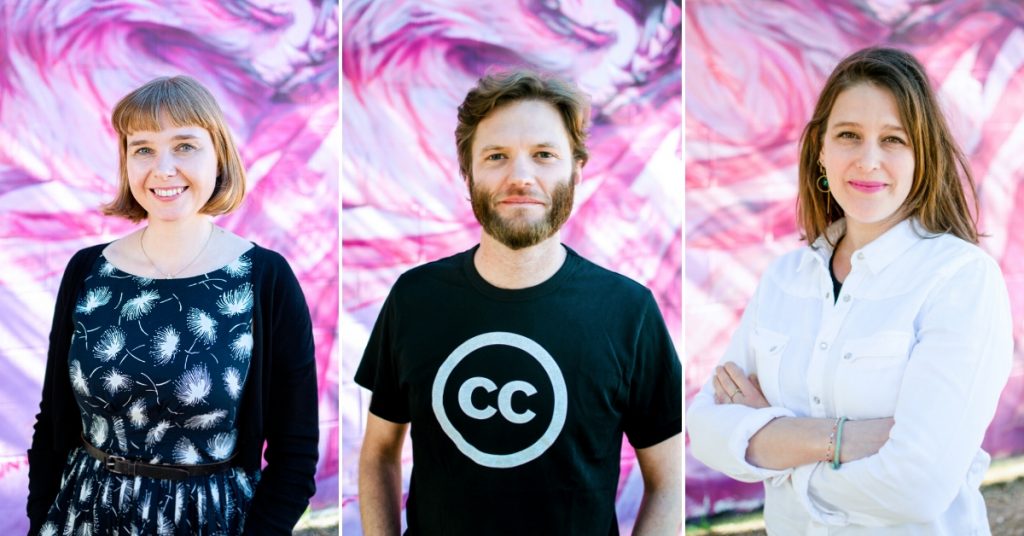
Over the past few months, we have added four new staff members to our team: Network Manager Julia Brungs; Development Manager Moumita C.; Data Engineer Brent Moran; and Open Policy Manager Brigitte Vézina. Learn more about our newest staff members below! Julia Brungs, Network Manager Prior to joining CC, Julia led the cultural heritage work…
Creative Commons is pleased to be a part of the second annual Public Domain Day (PDD) celebration held in Washington D.C. on January 30, in collaboration with the Internet Archive, the Institute for Intellectual Property & Social Justice, the Program on Information Justice and Intellectual Property, and SPARC. In order to celebrate the public domain…