Celebrate 25 Years of Creative Commons! As we mark a quarter-century of empowering creators and keeping knowledge free, your support helps us build the next 25 years of the global commons. Help us kick off our end-of-year giving campaign early! Donate today!
Introduction
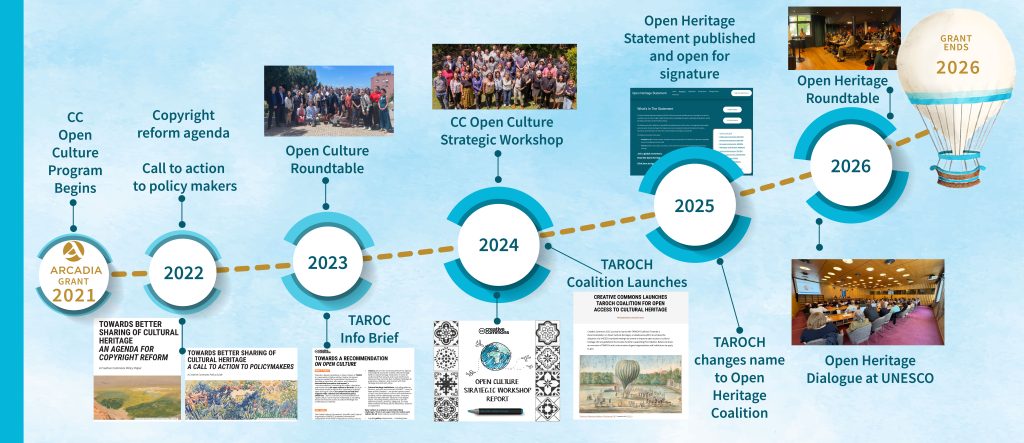
Five years ago, we set out to build a coordinated global effort to help cultural heritage institutions (libraries, museums, archives…) open up access to the knowledge and culture they steward in their collections for everyone, everywhere, to enjoy. Thanks to a $5 million grant from the Arcadia Fund, in 2021 we launched the Open Culture program to promote more equitable access to culture and heritage in the digital environment. From new practical resources for practitioners and policymakers, to opportunities for local action through community engagement, all the way to the co-creation of an ambitious manifesto—the Open Heritage Statement—we’ve built a solid foundation for open culture on a global scale. What started as a niche field in the open family evolved into one of CC’s largest programs in the organization’s 25-year history.
In this blog post, we first offer a retrospective of the key milestones we reached over half a decade of activity, share lessons learned, and end with reflections as one chapter closes and a new one opens.
Five Years of Open Culture in Numbers
Landmark achievements
While it is impossible to cover everything we achieved in five years in one blog post, we highlight some of the big wins and get real about the headwinds we faced.
The Open Heritage Initiative—From community building to policy action
The Open Heritage Coalition (formerly Towards a Recommendation on Open Cultural Heritage or TAROCH), launched in 2024, was the global initiative bringing together 74 organizational members that drafted and promoted the Open Heritage Statement. A dynamic infrastructure for community-driven action, the Coalition marked a shift from one-time campaigns to sustained community collaboration, where cross-border dialogue and localized advocacy continually strengthened global goals. The energy in this global initiative was catalytic in co-creating the Statement, which reflects shared values and speaks to diverse realities on the ground, while aiming to close the global policy gap. It was this community that we celebrated during the Open Heritage Dialogue at UNESCO House, a major event where we called upon UNESCO to develop an international standard-setting instrument: an Open Heritage Recommendation to erect the missing third pillar in the UNESCO open family, alongside OER and Open Science Recommendations.
The Open Culture Community—From grassroots to cross-border collaboration
The dynamism, expertise, and alignment over shared objectives were manifest in the Open Culture Platform, a space for practitioners, experts, and advocates to share resources and work together on common projects. Platform members ran activities and led working groups thanks to CC funding and technical support. Outputs include a glossary, a risk management toolkit, a data-driven multilingual study discussing digital community heritage and open access, an open policy template, and so much more, which you can discover on CC’s Medium publication. It’s also the community we listened to and whose voices we amplified when we developed Open Culture Capsules, the Open Heritage Companion, our Open Culture Live webinar series and the widely popular Open Culture Voices interviews with world experts—historians, researchers, activists, curators, academics—on the benefits, challenges, and transformative power of open access to cultural heritage for institutions and the public alike, which inspired two major publications on the benefits of open culture and the unfair, unjustified socio-economic barriers that stand in the way.
The Open Culture Dimensions—From technical to ethical and more
When approaching open culture and heritage on a global scale, it became imperative to account for considerations beyond copyright and clarify what CC licenses and tools can and cannot do. By introducing issues on the margins of the open movement, we expanded open’s horizons and brought in new, nuanced perspectives to deepen our understanding of what open can achieve. We saw the urgent need to center peripheral voices and foreground the issues facing non-Western communities and Indigenous peoples, ensuring a respectful approach to opening up heritage. For example, with Local Contexts, we published Guidance on Open Heritage and Indigenous Data. We also highlighted our community’s reflections on topical issues encompassing economic aspects, ethical questions (including the invention of an ethical sharing card game), and sourcing design hacks for nudging users into referring to institutions, addressing a need identified in the needs assessment of the CC public domain tools.
The Open Culture People—Pioneers, practitioners, and policymakers
None of this would have been possible had it not been for a group of pioneering institutions that paved the way for others to follow. We looked at the factors that impacted the success of early open access programs launched by the National Gallery of Art (United States), Statens Museum for Kunst (Denmark), and New York Public Library (United States) and published our findings in the Pioneers of Open Culture report. These early accomplishments in the history of open culture laid the groundwork for the creation of the CC Certificate for Open Culture/GLAM to support open culture-specific skills development in copyright and open licensing, rounding out CC’s training offerings for academic librarians and educators. On 31 January 2022, CC welcomed its first cohort of the new certificate, and by the end of the grant we had trained 255 professionals engaged in cultural or documentary heritage.
We were also active on the policy front at the international, regional, and national levels to ensure the copyright system was conducive to the activities of institutions in all jurisdictions. We collectively developed a policy paper titled Towards Better Sharing of Cultural Heritage—An Agenda for Copyright Reform, a comprehensive overview of the main policy issues impacting the open sharing of cultural heritage. This was followed by a leaner, more targeted Call to action to policymakers on copyright reform to support libraries, archives, and museums in fulfilling their mission. Those resources informed our engagement with the World Intellectual Property Organization’s Standing Committee on Copyright and Related Rights and the European Union institutions; it also supported the CC community in their policy reform endeavors during the whole grant period—from Italy to Mexico all the way to South Africa and Brazil, among others.
Challenges and obstacles
Implementing CC’s Open Culture Program was not always plain sailing. As the world around us underwent profound transformations, from the COVID pandemic to the stormy advent of AI and its effects on the open ecosystem (including cultural data sharing), we learned to adapt our approach in the face of new realities.
The COVID pandemic raged through the first years of the grant. It made connecting with our community on the ground very hard (Zoom fatigue was real), but once travel restrictions were lifted, we were able to meet in person and exchange face-to-face, with much more tangible impact. For instance, our two convenings in Lisbon in 2023 and 2024 were stepping stones on the way to the Open Heritage Coalition.
We are still in the midst of the AI revolution, and it is having a profound impact on the commons. Needless to say, it severely shook the fragile scaffolding of openness for cultural heritage. AI certainly added a layer of challenges to convince institutions to open up their collections, but we seized the moment to show why conversations about openness in the age of AI matter more than ever. Reframing open heritage for the AI era offered an opportunity to solidify and modernize existing practices.
Multilateral policymaking would not be what it is without the (at times frustratingly protracted) negotiation timelines and arcane consensus-building processes. Getting global alignment is in itself a monumental challenge. We know that civil society-led advocacy to drive new international policy from the ground up is a long-term game. We are immensely proud to have become an NGO in official partnership with UNESCO and to have published the article Ensuring Equitable Access to Heritage: The Need for an International Standard under the Auspices of UNESCO in the International Journal of Documentary Heritage, an open-access, peer-reviewed academic journal focused on global documentary heritage and UNESCO’s Memory of the World Program. Recognitions like this establish credibility, a valuable currency in international policymaking.
Lessons learned
Five years of the Open Culture Program gave us the opportunity to garner (at least) five learnings:
- Take a small issue and make it big. We went from trying to fix all copyright problems to our laser-focused priority of ensuring equitable access to public domain heritage in the digital environment and went deep into all of its beautiful complexities.
- Collaborate across cultures, countries, and languages. From the get-go, we knew the community had most of the answers to the questions we needed to address. So we were not afraid to ask and consistently worked to bridge linguistic divides with community-powered translations in dozens of languages.
- Celebrate the benefits but understand the barriers. We raved about all the great things openness can make possible, but we also strived to understand why sharing openly can be so daunting. Our takeaway: meet people where they are and invite them to join the journey wherever their starting point is.
- Nomen est omen (Latin for “the name is a sign”). From “open GLAM” to “open culture” to “open heritage,” we played with lots of different terms to capture our vision. When we have a shared vocabulary to talk about the issues we face together, we can find agreement on the solutions we need to solve common problems.
- Never give up! We know we are still some way away from UNESCO adopting a Recommendation on Open Heritage, but we are also convinced that the long-term impact of our collective action will outgrow the duration of the grant. Meet again in five years?
Legacy, looking ahead, and saying thanks
Looking back is a powerful way to imagine what lies ahead. Of course, the end of the grant and the program does not mark the end of the Open Heritage Statement. We continue to welcome and celebrate signatures as we know that growing the number of signatories will continue to demonstrate broad sector alignment and will make this issue impossible for the international community to ignore. The real impact of our work may thus only become visible in the coming years, as the relationships, intelligence, and infrastructure we have built begin to yield results.
We also know that the impact of AI on open heritage means we need to make room for something more in sync with the emerging challenges of sharing in the commons. What the open culture and heritage communities need at this point is clarity and confidence to create the legal, social, and ethical frameworks they need to share cultural heritage on terms that align with their values and sustain their infrastructures. Stay tuned as we start to build support for the heritage commons in the age of AI.
To everyone who was involved in this endeavor, from all corners of the world, thank you for your unrelenting support, kind encouragement, uplifting energy, passionate work, and for believing in our shared vision of ensuring equitable access to heritage. We accomplished this together. If you were involved in the program one way or another, you can share your experience or memory by writing to info@creativecommons.org, and we’ll make sure to stay in touch! And do continue to advocate for institutions, organizations, and governments to sign the Open Heritage Statement to ensure the full potential of open heritage can be realized to solve the urgent, global problems we all face.
Posted 18 November 2026