Stay informed. Sign up for CC’s newsletter.


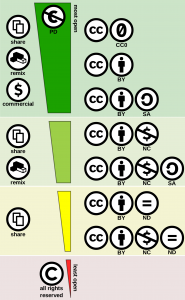
“Creative Commons License Spectrum” by Shaddim (CC BY)
Creative Commons provides a range of licenses, each of which grants different rights to use the materials licensed under them. All of these licenses offer more permissions than “all rights reserved.”
To help show more clearly what the different CC licenses let people do, CC marks the most permissive of its licenses as “Approved for Free Cultural Works.” When you apply these licenses to material you create, it meets the Freedom Defined definition of a “Free Cultural Work.” Free cultural works are the ones that can be most readily used, shared, and remixed by others, and go furthest toward creating a commons of freely reusable materials.
What does “Approved for Free Cultural Works” mean?
CC uses the definition of free cultural works at Freedom Defined to categorize the CC licenses. (Freedom Defined is an open organization of free culture advocates and researchers; the definition was developed by its community as a parallel to efforts such as the Free Software Definition, to have a standard for defining Free Culture.) Using that definition, material licensed under CC BY or BY-SA is a free cultural work. (So is anything in the worldwide public domain marked with CC0 or the Public Domain Mark.) CC’s other licenses– BY-NC, BY-ND, BY-NC-SA, and BY-NC-ND–only allow more limited uses, and material under these licenses is not considered a free cultural work.
The following graphics appear in our license chooser to distinguish these two categories of licenses:
This graphic means that a license is “approved for free cultural works” under this definition. (These licenses are sometimes referred to as “free licenses.”)

This graphic means that a license is not approved for free cultural works.
What is a Free Cultural Work?
Freedom Defined names four necessary characteristics of a free cultural work:
- Freedom to use the work itself. This is the most basic thing a free content license allows: when you get a copy of a work under one of these licenses, you can use it however you want. This means without restrictions based on the kind of use: you may use it for commercial, political, or religious purposes, for example, or make unlimited copies in different formats to use on different devices. (This is why the NC licenses aren’t considered licenses for Free Cultural Works.)
- Freedom to use the information in the work for any purpose. In addition to being able to simply share a free cultural work, you should also be able to use the information it contains. For example, if it’s a research paper or educational course, you should be able to build on it for your own research and teaching. If you are using something functional, such as a hardware design, you should be able to reverse-engineer it to figure out exactly how it works.
- Freedom to share copies of the work for any purpose. When you get a copy of a free cultural work, you can make and share as many copies as you want, wherever you want. This means you can put it on your blog or website, include it in books, share it on file-trading networks, sell it in stores, give it away on CDs–there is no limit on how many copies you can make or where you can copy them, and you can use them for any purpose, even commercially.
- Freedom to make and share remixes and other derivatives for any purpose. You can edit, remix, and transform a work under a free culture license however you want, and share those remixed copies as freely as the original. For example, you can build upon the original by making translations, mashups, fanfiction, and any other kind of derivative work you want, and share those remixed works freely, or even sell them. (This is why ND-licensed work isn’t considered a Free Cultural Work.)
Why does Creative Commons make a distinction between “free” and “non-free” licenses? Aren’t they all better than “all rights reserved”?
They are better than “all rights reserved”, which is why Creative Commons supports them; we hope to encourage licensors to choose one of these licenses where it is possible and appropriate for them. But Creative Commons exists not just to create copyright licenses, but also to encourage the creation of a thriving commons through sharing knowledge. We think that in many contexts, this is best accomplished by using one of the free licenses, which place minimal restrictions on reuse.
Does the term “cultural works” mean only art, or does it also include things like educational text and databases?
“Cultural works” is simply the term chosen by Freedom Defined to distinguish non-software works that should be under a free content license rather than a free software license. (Free software licenses often include terms designed specifically for functional works that free content licenses don’t contain, such as source code requirements and patent grants.)
Any copyrightable work or database that is not software should be considered to be a “cultural work”. (Educational and factual work is, after all, very much a part of culture!)
Why does CC support “non-free” licenses at all? Isn’t that against its mission?
CC hopes to promote a more open culture than “all rights reserved”. Some creators want to allow very broad use of their works. Some wish to allow some uses but restrict others. We believe that all levels of openness are worth encouraging and supporting as an alternative to “all rights reserved.” While we hope that some creators will use the non-free licenses as a stepping stone to greater openness in the future, CC encourages sharing under any of its licenses as a way to create a more open culture.
Why isn’t a license that restricts commercial use considered a free culture license?
The NC condition means that certain kinds of uses are prohibited by the license, limiting what kind of reuses can be made from the work. Since one of the Freedom Defined requirements is that a free cultural work must not restrict any particular kind of use, even commercial use, the NC license is not considered a free culture license. Freedom Defined has a longer explanation of the arguments against using NC licenses.
Why isn’t a license that restricts derivative works considered a free culture license?
The ND license prevents others from remixing and building upon your work. This violates the fourth Freedom Defined requirement.
Why is the Share-Alike license a free culture license?
ShareAlike doesn’t place any restrictions on the type of use–its only difference from the BY license is that it requires works that build upon it to be released freely. (Usually, under the same license, but there may be other compatible licenses in the future.)
This is different from the NC and ND licenses, which restrict some types of uses entirely, regardless of whether those users would contribute their work back to the commons.
What about other definitions?
Freedom Defined maintains the main definition CC uses to determine which licenses are suitable for free cultural works. However, there are several other definitions that you may also be interested in.
- The Open Knowledge Foundation (OKFN) maintains the Open Definition. Its list of conformant licenses includes CC0, CC-BY, and CC-BY-SA.
- The Free Software Foundation maintains a definition of Free Software and a list of acceptable licenses.
- David Wiley maintains the Open Content definition.
- Debian maintains a list of guidelines for free software licensing within their project.
(Do you know of a widely used definition we’ve left out? Please let us know!)