It’s been a long time since we last wrote about the ongoing discussion of the NonCommercial and NoDerivatives licenses. Recall that last year CC heard suggestions that it should stop offering NC and ND licenses in future versions of our license suite because these licenses do not create a true commons of open content that…
Today marks the start of Open Access Week 2013. Open Access Week is a global event for the academic and research community to continue to learn about the potential benefits of Open Access, to share what they’ve learned with colleagues, and to help inspire wider participation in helping to make Open Access a new norm…
Today Creative Commons released a policy statement expressing its support for copyright reform efforts around the world. Creative Commons (CC) has enabled a new approach to copyright licensing over the last ten years. CC licenses facilitate novel social, educational, technological, and business practices, and support productive relationships around networked knowledge and culture. We are dedicated…
This post was written by Alek Tarkowski and originally posted on the European OER Policy Project site. A week ago, the European Commission launched the “Opening Up Education” initiative, a proposal for modernizing the European educational system. The proposal contains a strong “open” component. We’re using this opportunity to strengthen open educational policies in Europe,…
European Commission Vice President Neelie Kroes and Commission Member Androulla Vassiliou today announced Opening Up Education, an initiative that looks to increase the use of digital technologies for learning and spur the development of Open Educational Resources and policies across the European Union. The Opening Up Education communication (PDF) indicates a strong support for Open…
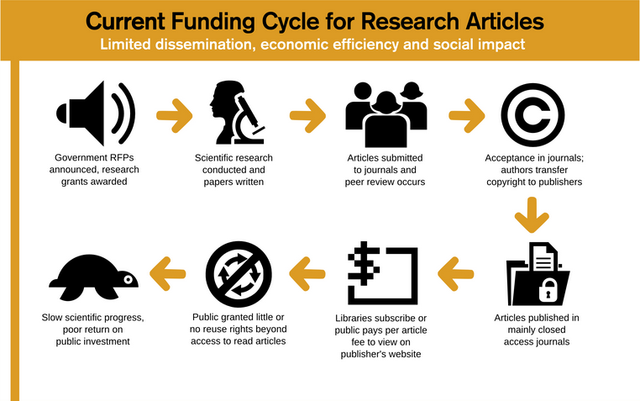
This blog post was written by Teresa Sempere García, CC’s Community Support Intern June-August, 2013. The cycle graphics below were designed by Timothy Vollmer and Teresa Sempere García. The current system for public access to research articles and educational materials is broken: ownership is often unclear, and the reuse of knowledge is limited by policies…
Today the University of California (UC) Academic Senate announced the adoption of a system-wide open access policy for future research articles generated by UC faculty. The articles will be made publicly available for free via UC’s eScholarship repository. According to the press release, the University of California open access policy will cover 8,000 faculty who…
Last week the Association of American Universities (AAU), Association of Public and Land-grant Universities (APLU), and the Association of Research Libraries (ARL) released a draft plan on how they’d support public access to federally funded research aligned with the February 22 White House public access directive. The SHared Access Research Ecosystem, or SHARE, is a…
After passing through the Assembly Appropriations Committee last week (with bipartisan support), California’s Taxpayer Access to Publicly Funded Research Act (AB 609) will now reach the Assembly floor for a vote this week. If the proposed bill passes the Assembly, it will move to the California State Senate. To recap, AB 609 would require that…
Two weeks ago we wrote about the U.S. Executive Order and announcement of Project Open Data, an open source project (managed on Github) that lays out the implementation details behind behind the President’s Executive Order and memo. The project offers more information on open licenses, and gives examples of acceptable licenses for U.S. federal data.…