Commons Stories: Part 1
Commons Stories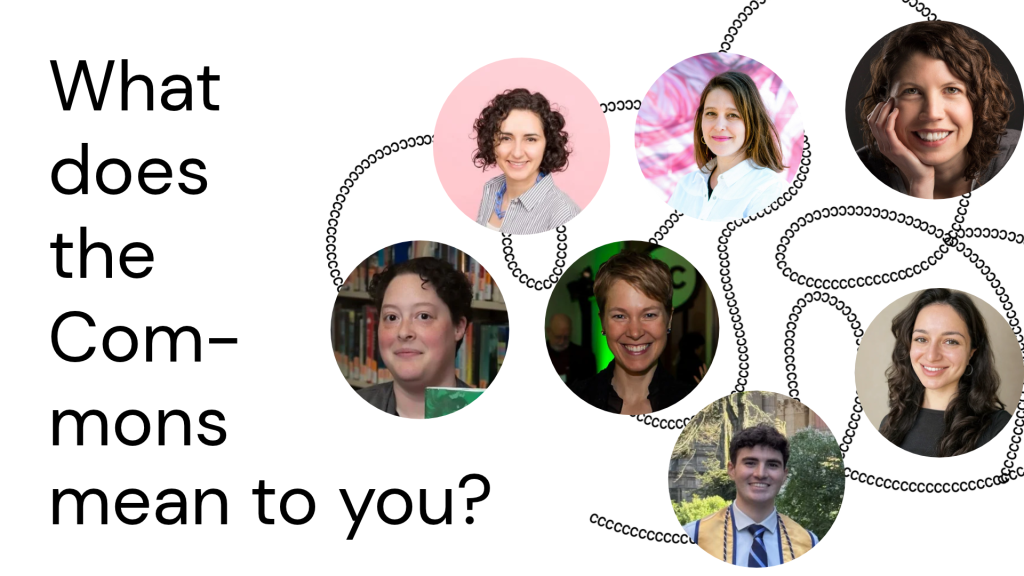
Celebrate 25 Years of Creative Commons! As we mark a quarter-century of empowering creators and keeping knowledge free, your support helps us build the next 25 years of the global commons. Help us kick off our end-of-year giving campaign early. Donate today.
Five years ago, we set out to build a coordinated global effort to help cultural heritage institutions (libraries, museums, archives…) open up access to the knowledge and culture they steward in their collections for everyone, everywhere, to enjoy. Thanks to a $5 million grant from the Arcadia Fund, in 2021 we launched the Open Culture program to promote more equitable access to culture and heritage in the digital environment. From new practical resources for practitioners and policymakers, to opportunities for local action through community engagement, all the way to the co-creation of an ambitious manifesto—the Open Heritage Statement—we’ve built a solid foundation for open culture on a global scale. What started as a niche field in the open family evolved into one of CC’s largest programs in the organization’s 25-year history.
In this blog post, we first offer a retrospective of the key milestones we reached over half a decade of activity, share lessons learned, and end with reflections as one chapter closes and a new one opens.
Five Years of Open Culture in Numbers
While it is impossible to cover everything we achieved in five years in one blog post, we highlight some of the big wins and get real about the headwinds we faced.
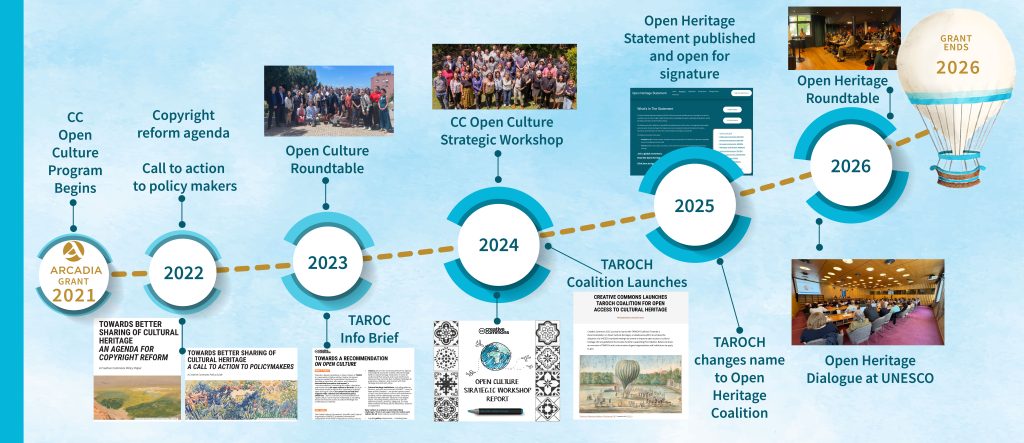
The Open Heritage Coalition (formerly Towards a Recommendation on Open Cultural Heritage or TAROCH), launched in 2024, was the global initiative bringing together 74 organizational members that drafted and promoted the Open Heritage Statement. A dynamic infrastructure for community-driven action, the Coalition marked a shift from one-time campaigns to sustained community collaboration, where cross-border dialogue and localized advocacy continually strengthened global goals. The energy in this global initiative was catalytic in co-creating the Statement, which reflects shared values and speaks to diverse realities on the ground, while aiming to close the global policy gap. It was this community that we celebrated during the Open Heritage Dialogue at UNESCO House, a major event where we called upon UNESCO to develop an international standard-setting instrument: an Open Heritage Recommendation to erect the missing third pillar in the UNESCO open family, alongside OER and Open Science Recommendations.
The dynamism, expertise, and alignment over shared objectives were manifest in the Open Culture Platform, a space for practitioners, experts, and advocates to share resources and work together on common projects. Platform members ran activities and led working groups thanks to CC funding and technical support. Outputs include a glossary, a risk management toolkit, a data-driven multilingual study discussing digital community heritage and open access, an open policy template, and so much more, which you can discover on CC’s Medium publication. It’s also the community we listened to and whose voices we amplified when we developed Open Culture Capsules, the Open Heritage Companion, our Open Culture Live webinar series and the widely popular Open Culture Voices interviews with world experts—historians, researchers, activists, curators, academics—on the benefits, challenges, and transformative power of open access to cultural heritage for institutions and the public alike, which inspired two major publications on the benefits of open culture and the unfair, unjustified socio-economic barriers that stand in the way.
When approaching open culture and heritage on a global scale, it became imperative to account for considerations beyond copyright and clarify what CC licenses and tools can and cannot do. By introducing issues on the margins of the open movement, we expanded open’s horizons and brought in new, nuanced perspectives to deepen our understanding of what open can achieve. We saw the urgent need to center peripheral voices and foreground the issues facing non-Western communities and Indigenous peoples, ensuring a respectful approach to opening up heritage. For example, with Local Contexts, we published Guidance on Open Heritage and Indigenous Data. We also highlighted our community’s reflections on topical issues encompassing economic aspects, ethical questions (including the invention of an ethical sharing card game), and sourcing design hacks for nudging users into referring to institutions, addressing a need identified in the needs assessment of the CC public domain tools.
None of this would have been possible had it not been for a group of pioneering institutions that paved the way for others to follow. We looked at the factors that impacted the success of early open access programs launched by the National Gallery of Art (United States), Statens Museum for Kunst (Denmark), and New York Public Library (United States) and published our findings in the Pioneers of Open Culture report. These early accomplishments in the history of open culture laid the groundwork for the creation of the CC Certificate for Open Culture/GLAM to support open culture-specific skills development in copyright and open licensing, rounding out CC’s training offerings for academic librarians and educators. On 31 January 2022, CC welcomed its first cohort of the new certificate, and by the end of the grant we had trained 255 professionals engaged in cultural or documentary heritage.
We were also active on the policy front at the international, regional, and national levels to ensure the copyright system was conducive to the activities of institutions in all jurisdictions. We collectively developed a policy paper titled Towards Better Sharing of Cultural Heritage—An Agenda for Copyright Reform, a comprehensive overview of the main policy issues impacting the open sharing of cultural heritage. This was followed by a leaner, more targeted Call to action to policymakers on copyright reform to support libraries, archives, and museums in fulfilling their mission. Those resources informed our engagement with the World Intellectual Property Organization’s Standing Committee on Copyright and Related Rights and the European Union institutions; it also supported the CC community in their policy reform endeavors during the whole grant period—from Italy to Mexico all the way to South Africa and Brazil, among others.
Implementing CC’s Open Culture Program was not always plain sailing. As the world around us underwent profound transformations, from the COVID pandemic to the stormy advent of AI and its effects on the open ecosystem (including cultural data sharing), we learned to adapt our approach in the face of new realities.
The COVID pandemic raged through the first years of the grant. It made connecting with our community on the ground very hard (Zoom fatigue was real), but once travel restrictions were lifted, we were able to meet in person and exchange face-to-face, with much more tangible impact. For instance, our two convenings in Lisbon in 2023 and 2024 were stepping stones on the way to the Open Heritage Coalition.
We are still in the midst of the AI revolution, and it is having a profound impact on the commons. Needless to say, it severely shook the fragile scaffolding of openness for cultural heritage. AI certainly added a layer of challenges to convince institutions to open up their collections, but we seized the moment to show why conversations about openness in the age of AI matter more than ever. Reframing open heritage for the AI era offered an opportunity to solidify and modernize existing practices.
Multilateral policymaking would not be what it is without the (at times frustratingly protracted) negotiation timelines and arcane consensus-building processes. Getting global alignment is in itself a monumental challenge. We know that civil society-led advocacy to drive new international policy from the ground up is a long-term game. We are immensely proud to have become an NGO in official partnership with UNESCO and to have published the article Ensuring Equitable Access to Heritage: The Need for an International Standard under the Auspices of UNESCO in the International Journal of Documentary Heritage, an open-access, peer-reviewed academic journal focused on global documentary heritage and UNESCO’s Memory of the World Program. Recognitions like this establish credibility, a valuable currency in international policymaking.
Five years of the Open Culture Program gave us the opportunity to garner (at least) five learnings:
Looking back is a powerful way to imagine what lies ahead. Of course, the end of the grant and the program does not mark the end of the Open Heritage Statement. We continue to welcome and celebrate signatures as we know that growing the number of signatories will continue to demonstrate broad sector alignment and will make this issue impossible for the international community to ignore. The real impact of our work may thus only become visible in the coming years, as the relationships, intelligence, and infrastructure we have built begin to yield results.
We also know that the impact of AI on open heritage means we need to make room for something more in sync with the emerging challenges of sharing in the commons. What the open culture and heritage communities need at this point is clarity and confidence to create the legal, social, and ethical frameworks they need to share cultural heritage on terms that align with their values and sustain their infrastructures. Stay tuned as we start to build support for the heritage commons in the age of AI.
To everyone who was involved in this endeavor, from all corners of the world, thank you for your unrelenting support, kind encouragement, uplifting energy, passionate work, and for believing in our shared vision of ensuring equitable access to heritage. We accomplished this together. If you were involved in the program one way or another, you can share your experience or memory by writing to info@creativecommons.org, and we’ll make sure to stay in touch! And do continue to advocate for institutions, organizations, and governments to sign the Open Heritage Statement to ensure the full potential of open heritage can be realized to solve the urgent, global problems we all face.
How can we give the people and organizations that share and make collections of knowledge and creativity available in the commons a meaningful way to encourage reciprocity from AI developers?
This question is central to Creative Commons’ ongoing development of CC Signals, a framework of legal tools and guiding norms designed to encourage reciprocity in how AI systems use shared knowledge.
On November 2-3, Creative Commons convened a group of open knowledge organizations in Chicago to advance this work. Building on earlier conversations and workshops with legal, policy, and technical experts, the two-day gathering focused on refining the first CC Signals legal tool and preparing for the release of an alpha version in early 2027.
The gathering brought together several organizations exploring early adoption of CC Signals, bringing perspectives from open journalism, scholarly publishing, education, and cultural heritage. Participants included representatives from the Wikimedia Foundation, The Conversation, Cambridge University Press and Assessment, MIT Open Learning, Munch Museum, and Civic News Company.
We are grateful to these organizations and others helping shape the first iteration of CC Signals. Their participation and feedback will be essential as we move toward testing the public alpha version and explore how the tool can support organizations providing bulk access to their collections. We also thank the MacArthur Foundation for its generous support of the Chicago convening.
Over the past few years, Creative Commons has engaged with experts and the open community around the world to explore how sharing can continue to serve the public interest as AI changes the ways knowledge is accessed and used. As the technology has advanced and our understanding has deepened, we’ve adapted our approach while remaining steadfast in our commitment to protecting and growing the commons.
In July, we shared takeaways from a workshop in London, where participants examined how CC Signals could evolve from a framework expressing preferences into legally enforceable tools. Those discussions explored a possible middle ground between unrestricted machine access and complete enclosure, aiming for approaches that would introduce guardrails on AI systems in ways that support and sustain the commons.
Since then, CC has conducted the first phase of an ongoing needs assessment with stewards of large, openly shared collections to better understand the challenges they face and what they need from a new tool. These organizations invest time and resources in maintaining collections and the infrastructure that makes knowledge accessible, and high-quality collections are critical for AI to be useful. Large-scale automated access—mostly by commercial AI developers—places unsustainable demands on those resources, raising questions about how to support open sharing.
These findings are helping shape our approach to CC Signals: a standardized contract that organizations can use when offering bulk access to their collections, such as through an API or a dataset download. While our initial work focuses on stewards of CC-licensed and public domain materials, CC Signals could be used by any organization providing bulk access, regardless of how the underlying content is licensed. Starting with these stewards allows us to test and refine the approach, understand its impacts, and apply what we learn more broadly.
The commons has always been built on reciprocity. People share knowledge, creativity, and resources so that others can learn from them, build upon them, and contribute something in return. This cycle of sharing creates benefits that extend far beyond any individual contribution.
But the commons doesn’t sustain itself. Behind the knowledge we access freely are people and institutions investing time, expertise, and resources to create, organize, preserve, and make it available to others.
AI is changing that relationship. Developers can draw on enormous amounts of shared knowledge, often without maintaining visible connections to sources or contributing to the people and infrastructure that make them available. The large-scale access also imposes significant costs on the institutions stewarding these collections. Over time, this risks weakening the trust, incentives, and capacity that make open sharing possible.
A central theme in Chicago was how to preserve that cycle of reciprocity in an AI ecosystem. How can we ensure that the benefits of shared knowledge accrue to everyone, with particular care taken for the people, communities, and institutions that contribute to it?
One important part of that conversation was rethinking how we use the word “attribution” in the context of AI.
Attribution has always been fundamental to Creative Commons licenses. It recognizes the people behind creative works and helps others discover and build upon them in ways that acknowledge existing works and their creators. But AI systems work differently. With current large language models operating as “black boxes,” it generally isn’t possible to trace a particular training source to a specific generated response.
We’ve explored these challenges in greater depth in our March 2026 Attribution and AI Outputs issue brief and our July article, Attribution in the Age of AI.
That’s why we’re introducing the concept of SourceConnection, a CC Signals component that builds on the principle of attribution as a form of reciprocity, helping maintain connections between AI systems and the collections they use.
Rather than treating attribution in AI as equivalent to attribution under CC licenses or to the moral right of attribution (or right of paternity) under copyright law, SourceConnection takes a different approach. As part of the CC Signals contract, it would require participating AI developers to disclose, transparently, which collections they used for training and provide references to sources when AI systems use outside sources to help answer questions, even in situations where copyright law may not require attribution from the underlying license.
Alongside SourceConnection, the concept of ShareBack explores how commercial AI developers in particular can give back to the commons they benefit from. As Anna Tumadóttir explored in her recent post, A Principled Approach as the Sands Shift, reciprocity can take many forms. We have contemplated possible conditions for a future version of this tool that stewards could choose to include, such as requiring scoped-in users to share back access metrics, modified datasets, and/or financial contribution.
Together, these ideas reflect a larger ambition for CC Signals: to encourage AI development that recognizes the sources of shared knowledge, supports continued participation in knowledge production and sharing, and contributes to the commons from which it benefits.
For Creative Commons, the challenge is to make these expectations legally enforceable without undermining the openness that has allowed knowledge to be shared and reused around the world.
As our thinking has evolved in response to challenges brought about by AI, we’ve recognized that openness and meaningful conditions are both important to sustaining the commons. The task is how we can give people and institutions greater confidence in sharing and how to protect the public-interest uses that make the commons valuable.
CC licenses remain essential, but copyright licensing alone cannot address every question AI raises about transparency, reciprocity, and sustaining access to knowledge and the commons.
That’s why we’re developing a separate, contract-based legal tool for organizations providing a service to facilitate bulk access to collections. This approach will allow stewards to establish certain conditions for access at scale without changing existing CC licenses.
The Chicago discussions helped us examine how those conditions might work in practice, including how to avoid unintended consequences for research, preservation, accessibility, and other public-interest uses. These considerations will remain central as we refine the tool with early adopters.
The Chicago convening marked an important step in moving CC Signals from concept toward practical implementation. Building on the conversations in London early this year and the first phase of the needs assessment that followed, participants helped identify opportunities and challenges that will inform the alpha version of the legal tool. The public alpha will initially focus on SourceConnection, while ShareBack requirements remain under consideration for future iterations.
CC is continuing to invite early adopters to test implementation of a public alpha version of the CC Signals legal tool in 2027. Alongside this work, the next phase of the needs assessment will involve broader research and analysis, including in-depth interviews and feedback from more stewards in the commons. It will also include vetting the legal tool with experts in law and policy.
If you’re an organization that stewards CC-licensed or public domain collections and want to participate in early adoption and/or the needs assessment process, please get in touch by emailing info@creativecommons.org.
The work is still evolving, but our principles guiding it remain consistent. We want to give people and institutions greater agency over how they share knowledge and participate in the AI ecosystem, engrain reciprocity in those who benefit from the commons, and continue to safeguard public access to knowledge. Together, these commitments help create the conditions for a thriving commons.
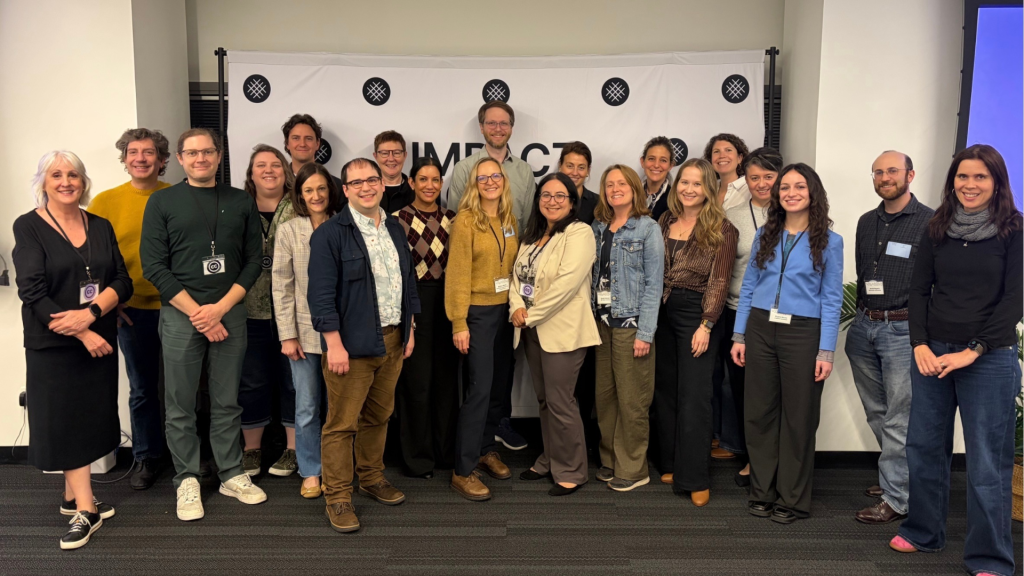
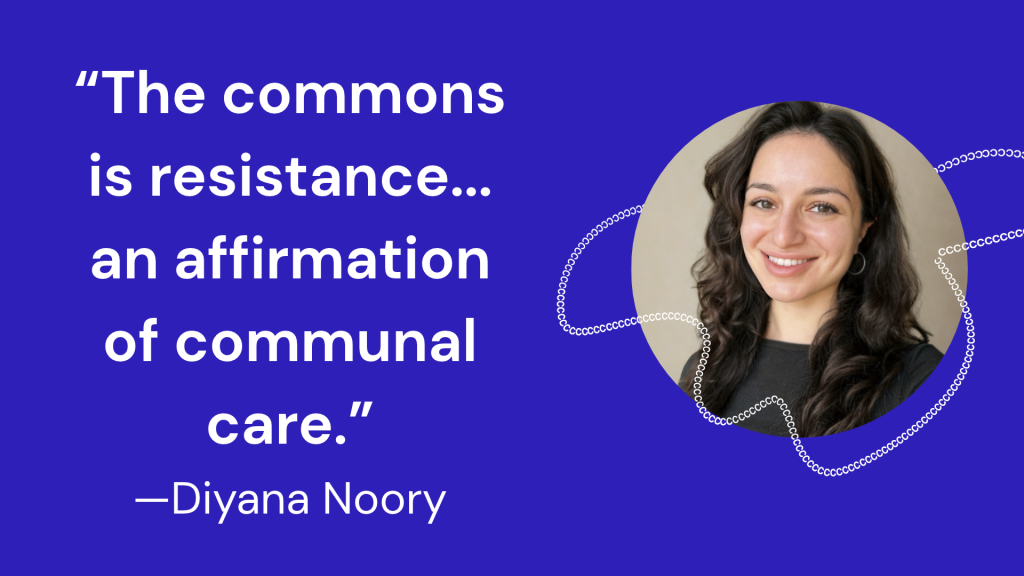
What does the commons mean to you? For Creative Commons’ 25th anniversary, we posed this question to some of the people behind CC. In the final installment of our four-part series, Diyana Noory reflects on the commons as both an act of resistance and a practice of communal care. Catch up on Part 1, Part 2, and Part 3. The authors of this series write in a personal capacity. The views expressed do not necessarily reflect CC’s positions.
The commons belongs to everyone and no one.
It is composed of the gifts of nature, including the coalescence of human creations. The knowledge commons is the amalgamation of our creative instincts, a shimmering web of art and discovery. Every work we make is superimposed atop those that came before it, using tools that our ancestors made possible. What a beautiful thing it is to make visible the gardens of our inner worlds, to witness those of others, and to care for them all together.
At some point in history, powerful people decided to build walls around the gardens in our physical and intellectual realms of perception, using the Law to guard them. These gardens that were fed by public and natural resources then became the domain of the ruling class. The Law eventually named this theft of public resources “property”; “intellectual property”, even. Property-centric legal systems justify their existence in part with arguments of justice and collective welfare, all the while impeding those aims by prioritizing the interests of people with the most “property rights”. The Law is a part of what many refer to as “the system”: an interwoven collection of oppressive institutional powers that shape how society operates and how we perceive it, and that cause alienation and division.

The commons is resistance.
It is reclaiming our power, community, and dignity. Creative Commons (CC) exists because of a history of pushing against unfair intellectual property policies. The resulting CC licenses illustrated how to build and sustain alternative modes of sharing centered on the common good, enabling creators to grant usage permission while retaining some control.
The Law makes examples out of those who push back against unfair enclosure. Namely, Aaron Swartz—a brilliant young activist** and an early architect of CC—faced severe federal prosecution for downloading paywalled academic articles at scale. Public resources are drained by such cases and subsequently used to line the pockets of the prison industrial complex instead of ensuring our neighbours’ needs are met. And yet, at the same time as the law vigorously upholds its purported ideals of property protection, it also subverts them for systemic gains.
Take, for example, policymakers’ hand-waving around creators’ concerns about their work (CC-licensed or otherwise) being used by tech giants for generative AI without permission, attribution, or reciprocity. Large-scale copying by major tech companies has met far less institutional resistance than it did for Swartz; in a twist of tragic irony, Swartz was in the same Y combinator class as OpenAI CEO Sam Altman. Amidst the chaos of the AI arms race, the tech industry has been treated as more valuable than creative and knowledge ecosystems, with nary a tech CEO being apprehended by federal prosecutors.
The commons is not about unfettered access alone; it is about ensuring we can all benefit from its fruits, and that can’t happen if they are spun into poison. For some to win it all, others must lose everything and then some. I believe a crucial element of openness is ensuring that everyone can access this wonderful pool of knowledge, no matter their sociopolitical situation–this means more privileged people should not use the commons in ways that worsen the circumstances of those with less.
AI companies have used works in ways that many creatives concerned with the public interest do not support. For example, in 2019, reporting revealed that IBM had used CC-licensed photos from Flickr in a facial recognition dataset. Facial recognition and related biometric databases have been documented in Israel’s surveillance and targeting of Palestinians, and many creators who share openly did not intend for their work to contribute to that. I certainly don’t, and it pains me to see works of beauty and joy warped into evil. To say naught of other well–documented concerns about generative AI in particular, including its environmental impact, labour exploitation, cultural and cognitive erosion, privacy violations, inextricable performance issues, inflated hype*** detracting from socially beneficial research, and its reinforcement of systemic bias.

The commons is an affirmation of communal care.
It is a conscious decision to push back against enclosure and extraction. When we contribute our works to the commons, we’re doing it for the love of the game; opening the doors to our worlds such that we may expand our collective horizons. Translating our experiences into different mediums, collecting our observations and allowing others to build on them, leading to wondrous new creations in turn. It is to say: “Hey, check out this cool thing that I made. You can use it to make something cool too. Just let people know that I made it, and maybe also let them do the same with your work, so we can uphold this magnificent swirling cycle of creativity.”
While the term “the commons” doesn’t translate neatly into every language, conceptually, it is universal. I’ve always cared a lot about creativity and about equity, and so for me, working to protect the commons means ensuring that its contents and benefits reflect as many communities as possible. Given the predominance of English-language and Global North content, our digital commons is far from representative of the whole world. I believe that uses of the commons should be considerate of how to improve the lives of people globally, enabling more people to learn from and contribute to it.
I am a creative person working in service of the public good, and every fork I’ve turned onto in life has shaped my approach to the commons. Through my position as Copyright and AI Counsel at CC, I’ve been blessed to focus on the kind of lawyering I find most interesting; not simply implementing the law as it is, but rather, shaping its functions into something new. Beyond my job, I’m a writer, photographer, performance artist, and community organizer/facilitator. These pursuits all fold into my identity as a cultural worker, echoing the following ethos from Toni Cade Bambara: “As a culture worker who belongs to an oppressed people, my job is to make revolution irresistible”. My family is from the Kurdistan region of Iraq, so I grew up with an innate sense of the unfairness of borders, imperialism, and cultural erasure. I do not–and cannot–limit myself to one particular place to provide my skills, nor do I shy away from critiquing the status quo. I do cultural work everywhere I can, and it all stems from the core impulse of bettering the world around me.
My dream is to see more intersectional uses of the commons and subsequent developments of technology that serve people over profit. I love art, technology, and everything they have to offer, especially the way they connect us more deeply to each other. I am consistently awestruck by feats of human imagination and collaboration that merge ideas and inventions into novel spectacles and tools. We are constantly in a state of becoming and undoing, with creation moving through and around us, a flow far more powerful than anything people can do to stop it. Every bit of the commons is a piece of the universe finding a way to express itself, ever expanding and glimmering.
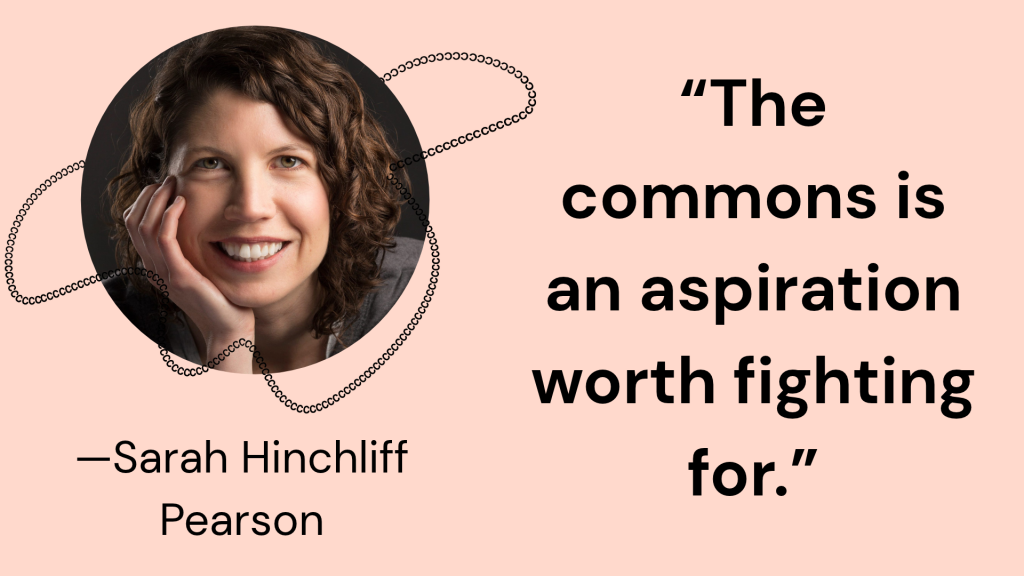
What does the commons mean to you? For Creative Commons’ 25th anniversary, we posed this question to some of the people behind CC. In our third posting in this four-part series, Sarah Hinchliff Pearson explores the commons as a commitment to shared resources, mutual responsibility, and a public web where contributors have a say and everyone who benefits plays by shared rules. Read Part 1, Part 2, and Part 4 now. The authors of this series write in a personal capacity. The views expressed do not necessarily reflect CC’s positions.
The commons is a way of structuring relationships to our resources. Instead of a property mindset, where the only question is: does someone own it? The questions in a commons are: how do we ensure this resource can be shared by all of us? What is our mutual commitment?
Too often, I think the commons has become shorthand for “no one owns it, so no rules apply.” That is not a commons, it is a free-for-all. And in a way, it is the mirror image of the property focus of copyright maximalism because it begins and ends with whether or not the resources are or can be private property.
It is utterly idealistic to believe that we can have spaces with shared rules, where everyone who partakes commits to the common good. Right now, on the public web, it feels like an aspiration more than a reality. It is an open question whether the internet will evolve to support and sustain public spaces that truly operate like a commons, where everyone who contributes has some say, and everyone who benefits plays by the rules.
It is an aspiration worth fighting for.
Next, we’ll explore the commons as resistance and the relationships that help it thrive in the final two installments of Commons Stories.
Then we’ll turn from reflection to imagination with “I’m dreaming of an open future …”, a new invitation for you to share your own hopes for what comes next.
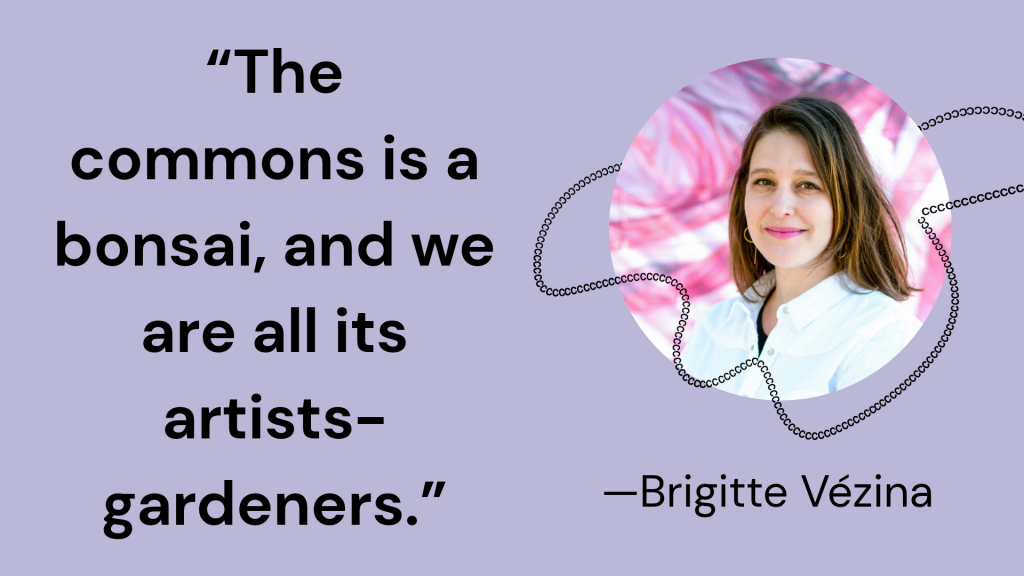
What does the commons mean to you? For Creative Commons’ 25th anniversary, we posed this question to some of the people behind CC. In the second installment of our four-part series, Brigitte Vézina imagines the commons as a bonsai, shaped by collective care, creativity, and a little pruning. Read Part 1, Part 3, and Part 4 now!
The commons is a bonsai, and we are all its artists-gardeners.
Sure, we could let it grow wild and unruly: it could be abandoned to the law of the jungle—left as a free-for-all—or fall victim to the tragedy of the commons, and shrivel due to overexploitation.
But because we, as a collective, prune it from time to time, give it shape, direct and guide it according to common values and principles, placing intentional constraints, co-creating community-led boundaries (both explicit and implicit, written and unwritten) and shared governance structures, we will produce a healthy organism, one that can thrive for centuries.
It is not a bonsai because of its diminutive size. On the contrary, the commons can be as ever expanding as the universe. It is a bonsai in the sense that it reflects the instinctive care humans often display towards our environment, our ingenuity, creativity and innovation in defining and supporting its underlying structure and deep network of contributors, and the respect for the shared, delicate ecosystem in which we all live, in harmony with the surrounding landscape.
The commons is a community-owned bonsai that we nurture for the public good, for collective benefit and equitable sharing of its resources. When defining its shape, we make decisions together, in a spirit of collaboration; we engage in community stewardship. Its long-term management requires active, deliberate, sensitive, and continuous care and cultivation that combines natural, organic development balanced with thoughtful limitations to ensure its sustainability for future generations.
We can take cuttings to plant new ideas and grow our shared knowledge. We can pluck its leaves, here and there, because we know others will grow, contributing to a (re)generative cycle. We all benefit when, guided by a collective sense of human dignity, we contribute to shaping and vivifying the commons.
Next in the Commons Stories, we’ll explore the commons as a commitment and finally as a resistance. Then we’ll turn from reflection to imagination with “I’m dreaming of an open future …”, a new invitation for you to share your own hopes for what comes next.
What does the Commons mean to you? Glad you asked!
For Creative Commons’ 25th anniversary, we asked some of the people behind CC: What does the commons mean to you? Their answers became this four-part series of personal reflections. We’re kicking things off with four perspectives.
by Molly Van Houweling
The serendipity and delight of connecting with fellow humans across time and space through acts of creativity and sharing.
by Vito Quaglia
To me, the commons means democracy. The commons nurtures the sharing of ideas, solutions, and creativity. It allows for information to be accessed by anyone and everyone. At its core, the commons is nondiscriminatory; it ensures that knowledge, art, and culture are enjoyed by an ecosystem that doesn’t depend on location, social capital, or economic status. Its main features are cooperation and cohabitation. At the current moment, the commons is vulnerable to rapid changes to its ecosystem. It is more important than ever that the commons foster the sharing of solutions that will ultimately save itself.
by Jocelyn Miyara
The commons is a collective and collaborative space where knowledge can be shared openly & freely. In today’s internet age, it is an important counterbalance to the increasingly commercial and controlled spaces in which information is shared. Open sharing is an antidote to that.
by Shanna Hollich
What does the commons mean to you?
(a haiku)
Walled gardens? No way!Spring light through the open gate.How? CC license!
We have shared longer reflections on tending the commons, challenging the forces that constrain it, and building relationships that help it thrive. Read Part 2, Part 3, and Part 4 now.
And soon we’ll turn from reflection to imagination with “I’m dreaming of an open future …”, a new invitation for you to share your own hopes for what comes next. Stay tuned for more!
Five months after Creative Commons hosted an Exploratory Dialogue on Open Heritage at UNESCO House that brought the international community together to discuss the importance of equitable access to heritage, we returned to Paris with a smaller group of UNESCO Member State representatives and open heritage champions. This time, the conversation moved from why open heritage matters to what comes next: how Member States can help advance action at UNESCO and begin building the missing third pillar—after Open Educational Resources (OERs) and Open Science, the time has now come to establish a UNESCO Recommendation on Open Heritage.
At our Open Heritage Dialogue held at UNESCO House last April, we had convened to find answers to an important question: How can equitable access to heritage help solve global challenges? What we heard was that it can in a diversity of ways: from supporting access to education to strengthening social inclusion and spurring artistic creativity, all the way to helping find concrete solutions to fight climate change.
Five months later, on 29 September, we returned to Paris ready to move the conversation forward. Together with the Representation of Québec within the Permanent Delegation of Canada to UNESCO, we brought together around 30 participants to our Open Heritage Roundtable to discuss possible ways forward at UNESCO, with whom CC is an NGO in official partnership (consultative status). Participants hailed from UNESCO permanent delegations, UNESCO national commissions, national government and ministries of culture, national libraries and archives, international NGOs from the open heritage community, including the Open Heritage Coalition, among others, and their interventions were made in French and English.
Concretely, our goal was to explore the feasibility of elaborating a new UNESCO Open Heritage Recommendation that would ensure heritage is protected, preserved and equitably shared as a means to address global challenges. The welcome remarks clearly set the tone for the discussion: “Fin des réflexions, début de l’action.” (“The end of reflection. The beginning of action.”). The program was structured in two parts, allowing for high-level contributions to set the stage for a roundtable discussion inviting all participants to chime in with questions, comments and new perspectives.
In this blog post, we share eight hot takes from the Roundtable discussions, which centered on the urgent need to start the process for the development of a UNESCO Recommendation on Open Heritage.
One thing became clear over the course of the event: open heritage is not an abstract idea waiting to be tested. It is already happening in institutions and communities around the world. Qatar National Library, for example, has digitized more than 15 million pages of books, manuscripts, newspapers, maps, archival documents, photographs, and other materials. Open access is one of its core values, and the Library does not assert new copyright over reproductions of public domain works. At the same time, its experience demonstrates some of the challenges that make international alignment so important. This includes complex copyright rules, inconsistent institutional practices, dispersed collections, differences in metadata, and the cost and capacity required to build and maintain digital infrastructure. Open heritage is already embedded in thousands of institutions, as identified in the OpenGLAM survey. Institutions around the world are already showing what becomes possible when heritage is opened for people to discover, study, interrogate, reuse, and create with. Yet they still make up only about 1% of all cultural heritage institutions worldwide. The question is no longer whether open heritage can work. It is how we create the conditions for more institutions, communities, and countries to participate.
The roundtable also pushed the conversation beyond simple access as a technical exercise. Cultural heritage institutions provide access to more than artefacts and documents. They are gateways to understanding our world and ourselves as humans. They provide context and make it possible for people to compare sources, question received narratives, understand how histories have been constructed, and recognize what (or who) may be missing from the record. This is something that is top of mind in Luxembourg’s national cultural policy. Access to source material and its metadata can give people greater agency to form their own judgements and reach their own conclusions about the past, rather than relying solely on the narratives presented to them in the present. This need takes on greater urgency at a time of democratic fragility, growing misinformation, and technological upheaval.
The possibilities really expand when people can engage with heritage in participatory, interactive ways. One example shared during the Roundtable came from Germany, where high school students used an openly available digital reproduction of a Renaissance portrait held at Frankfurt’s Städel Museum to reinterpret the work in ways that reflected their own experience with the centuries-old painting. It was a small but powerful example of “living heritage” i.e. heritage that remains relevant not simply because we preserve it, but because new generations can encounter it, use it, question it, and make new meaning from it. (UNESCO uses “living heritage” as a quasi synonym for “intangible cultural heritage”—in the example, it was used as a way to illustrate the value of heritage when it comes alive via remixes and re-interpretations, moving beyond its wall-decorating function to deepen human connections). These practices are increasingly becoming part of institutional infrastructure. Major German museums have already made hundreds of thousands of public domain objects openly available online, alongside broader national investments in research data infrastructure and cultural data spaces.
From Aruba came another dimension. For small island developing states (SIDS) shaped by colonial histories, heritage may be dispersed across institutions and borders. Digital access can help reconnect people with cultural memory while supporting research, education, and new cultural creation. Global access goes hand in hand with local cultural strengthening. And as artificial intelligence increasingly relies on what is discoverable in the digital knowledge environment, the need to clarify what equitable access and responsible use mean take on heightened urgency: cultures and smaller languages such as Papiamento risk being underrepresented in the AI-mediated cultural discourse when heritage is not discoverable in the digital environment.
From experiences in Québec, we heard that the rise of AI confers a new responsibility on CHIs: making heritage accessible while ensuring that its cultural, social and economic values are preserved. AI is forcing the sector to move beyond the well-trodden debate opposing open and closed data as absolutes—neither offer lasting solutions and neither are “equitable.” New realities call for an “ouverture raisonnée” (a thoughtful openness approach), which supports innovation while protecting authors’ rights, collective interests and the value of heritage data.
The Roundtable allowed for a fruitful exchange spotlighting different places and different institutional contexts, but they point toward a shared challenge: how can we ensure responsible and ethical access to heritage in the age of AI? The development of a future Recommendation would offer the discussion space that is direly needed to address these fundamental questions together, in line with the work undertaken under the 2021 Recommendation on the Ethics of AI.
UNESCO has already shown what international alignment around openness can accomplish. The 2019 Recommendation on Open Educational Resources and the 2021 Recommendation on Open Science established shared international frameworks for advancing openness in education and science. They give Member States common approaches to addressing challenges and translating principles into policy and practice. For example, in the Netherlands, experiences with the implementation of these Recommendations met resounding success, according to a participant. When considered alongside education and science, heritage is conspicuous by its absence. It is the missing part of the triptych, the glaringly missing third pillar.
The opportunity now is to build on UNESCO’s successful experience and bring heritage, as a transversal issue, more fully into the “open” normative family, at a moment when equitable access to reliable, trustworthy information is becoming more important than ever. A UNESCO Recommendation on Open Heritage could fill the policy gap at UNESCO and erect that missing third pillar, by providing a shared international framework for equitable access to public domain heritage in the digital environment.
The Roundtable further surfaced connections between open heritage and work already underway across UNESCO’s diverse areas of its mandate: cultural diversity, heritage preservation, digital infrastructure, education, artificial intelligence, and respect for cultural rights, including participation in cultural life.
Some of those connections are already visible in Member States’ implementation of existing UNESCO instruments. Germany’s Culture Data Space (Datenraum Kultur) and Art Doc Archive in Berlin, for example, feature in its reporting under the 2005 Convention on the Protection and Promotion of the Diversity of Cultural Expressions. Open heritage and many of UNESCO’s activities are already intersecting in practice. Let us recall that the Preamble of UNESCO’s Constitution affirms “that the wide diffusion of culture (…) [is] indispensable to the dignity of man and constitute[s] a sacred duty.” (para. 4).
This was an important thread in the broader discussion: rather than launching a separate policy conversation, a future Recommendation on Open Heritage would crystallize the existing connections in place and bring increased intersectoral coherence to the work UNESCO and its Member States are already doing in the context of heritage’s rapid digital transformation and in ensuring that culture can be enjoyed at a global public good.Simply put, open heritage aligns with UNESCO objectives and approaches.
Importantly, drafting a Recommendation would not mean starting from scratch. The case for open heritage has been building for years and we know that despite many advances, unnecessary barriers continue to unduly limit access to public domain heritage. Those undue barriers take many forms. Institutions may place restrictive website terms of use or technological restrictions on heritage material in the public domain. Unreasonable access or licensing fees can prevent legitimate uses of the public domain. National laws can create new layers of “pseudo-copyright” restrictions. Unfounded copyright claims and incorrect labeling of the public domain generate confusion and can have a chilling effect on creativity and knowledge generation. And inconsistent approaches across institutions and jurisdictions can leave users, and institutions themselves, uncertain about what is possible, leaving the promise of open heritage largely unrealized.
We also know what more equitable access can make possible: new opportunities for education, research, creativity, cultural participation, and connection across communities and borders. Interventions during the Roundtable made compelling pleas: “donnez-nous de la donnée” (“give us data”), especially to ensure people with disabilities as well as marginalized and vulnerable groups can participate in cultural life and shape their own narrative.
Recognizing these benefits and documenting these barriers—in addition to offering co-created, clear policy solutions to them—are some of the great achievements of the Open Heritage Statement. Developed through years of research, consultation, and collaboration within the Open Heritage Coalition, and boasting 116 signatories from all continents to date, it represents a global community coming together around a shared aspiration that public domain heritage should be as broadly accessible and reusable as possible, while respecting cultural governance frameworks. The foundation is there. The Open Heritage Statement offers UNESCO Member States a tangible starting point to deepen understanding and enrich the dialogue.
Heritage is brimming with connections—between people and places, past and present, memory and identity, evidence and understanding. More equitable sharing of heritage can be the source of intercultural, transborder and mutually enriching collaborations. Open heritage can create the conditions for people to connect with heritage as a shared resource and, vitally, with each other. But only if unnecessary, unfair barriers do not stand in the way.
The need to protect those conditions is becoming more urgent, not less. As our cultural record increasingly moves into digital environments—and as those environments increasingly shape how people learn, create, and understand the world—questions about who can access heritage, whose heritage is visible, and what people can do with it carry growing consequences. A shared understanding of these questions, and a multilateral dialogue about how to answer them, are one of the many outcomes of a potential Recommendation.
The Roundtable was an eye-opening exercise in that it grounded the urgency to develop a Recommendation in practical, evidenced, real-life needs. It also surfaced the positive energy that the Open Heritage Coalition generated and that continues to fuel policy action on many fronts, from grassroots advocacy initiatives in the Wikimedia community to civil servant foresightedness and ability to mobilize entire countries at all levels of leadership.
What the Roundtable also made clear is that the conversation is no longer only about whether equitable access to heritage is valuable—116 (and counting) influential organizations have voiced this in no uncertain terms. It is increasingly about how UNESCO Member States can work together now to make open heritage possible on a global scale and how a UNESCO Recommendation could provide a framework for sustained international cooperation in the face of global challenges.
With the 2029 UNESCO General Conference in view as our desired finish line, the time to move that critical conversation forward is now. The next step is for a Member State to make a proposal to the UNESCO Executive Board in the spring of 2027. Building on what is already well underway, Member States now have the opportunity to erect the missing “open” third pillar. And where there’s a (political) will, there’s a way.
It’s a question we ask ourselves regularly at CC—and one we recently brought directly to our community through our annual Community Survey. This year, 62 community members from 23 countries shared their experiences, priorities, ideas, and hopes for the future of the Commons.
What we heard most clearly is that you want to participate. You want to learn from one another, contribute your skills, build relationships across regions and areas of practice, and help shape the future of the open movement.
The survey gave us a clear picture of what meaningful participation means to you, what the barriers are, and what CC can do to help. Here’s what we heard and how it’s shaping our plans for the year ahead.
A community that wants to participate
Overall satisfaction with the CC community increased this year, reaching 3.8 out of 5—up 19% from 2025. Sixty-four percent of respondents rated their engagement with the community a 4 or 5, and 60% said you would recommend the CC community to others.
Perhaps most encouragingly, half of you said you were interested in participating in self-led activities like ad-hoc working groups.
And the open-ended responses made the sentiment behind those numbers especially clear:
These responses are a reminder that our community is not simply an audience for CC’s work. You see yourselves as part of the work—and many of you are looking for more opportunities to contribute.
The question is: how?
The clearest gap in this year’s responses was not a lack of interest. It was a lack of clarity about how to participate.
Thirty-three of you specifically asked for clearer ways to get involved. You wanted better information about chapters and regional groups, clearer direction about what volunteers can do, easier ways to find peers and mentors, structured opportunities to work on projects, and greater visibility and recognition for community contributions.
This is an important distinction. If you want to participate but can’t figure out where your skills, interests, or time fit, the problem isn’t necessarily motivation. Sometimes the infrastructure for participation simply isn’t visible enough.
The survey also gave us a clearer picture of what you need from CC as a community resource.
You asked for practical licensing guidance, FAQs, case studies, examples, short videos, factsheets, customizable templates, toolkits, asynchronous training, and translated materials.
Importantly, you don’t just want resources from CC. You want resources you can remix and reuse with your own communities. Our role can be much more powerful when we act as infrastructure, connector, facilitator, and amplifier—helping you take what you need and adapt it to your own contexts.
That means community engagement isn’t only about creating more events or sending more communications. It is also about creating more options for participation and building pathways between levels of engagement. We have started thinking about those pathways:
LEARN → CONNECT → CONTRIBUTE → ORGANIZE → LEAD
That’s also why we are working toward more “train-the-trainer” approaches as we roll out new guidance. Our resources become much more valuable when you can adapt and tailor them to your own contexts, and then share that knowledge with others.
It’s no surprise that AI is an important topic for our community right now. When we asked what topics you wanted training and information about, AI and the Commons received the most selections, with 37 respondents choosing it.
But the responses also made something else clear: your interests remain broad. Open Education, CC licenses and tools, and Copyright each received 30 selections. Open Culture and Heritage received 26, while Open Science and Contemporary Culture and Independent Creators each received 22.
AI is reshaping the information ecosystem, but is only one part of the work our community cares about. The principles of sharing, access, collaboration, attribution, and community governance continue to matter across education, science, culture, heritage, and creative practice.
Our community engagement needs to reflect that whole ecosystem.
The survey also reinforced the importance of regional and local engagement.
You asked for local-language resources, regional training, mentorship, stronger cross-regional networks, support for chapters and regional groups, local ambassadors and trainers, and greater recognition for local contributors.
You also identified practical infrastructure needs: more translation and better ways to discover activities happening in different places.
One particularly useful reminder was that some of you did not know that local chapters existed at all. This tells us that regionalization is not simply about creating more regional activity. It’s also about making the activity that already exists easier to find, connect to, and participate in.
A global community cannot function as a single centralized conversation. You need opportunities to build relationships and solve problems in your own languages, regions, and contexts—and then bring those experiences into conversation with the wider Commons.
While you certainly asked for additional support, you’ve also offered to contribute your own skills and support to the movement.
You told us you would like to run workshops and trainings, translate and localize resources, promote CC and recruit new members, host events, support local chapters, share knowledge and research, contribute images and networks, and collaborate on projects and advocacy.
That creates an exciting opportunity: with the right frameworks, resources, and infrastructure in place, we can make it easier for community members to contribute while amplifying the grassroots work already happening across the CC community.
The findings from this year’s survey are already shaping our community strategy for the year ahead. Here are some of the focuses we plan to bring into our 2027 planning:
1. Creating clearer pathways to participation
We’ll be working to improve engagement on Zulip, create more meaningful ways to participate in ongoing work, support distributed projects, and strengthen volunteer translation and regional events.
2. Building community capacity
We’ll expand “train-the-trainer” approaches, particularly around licensing guidance and other practical resources that you can use in your own contexts.
3. Creating resources you can remix
We’ll develop more short, reusable, localizable resources—from simple license comparison guides to CC FAQs, short videos, translated resources, and adaptable presentation materials.
4. Creating meaningful opportunities to contribute to AI work
We’re exploring new ways for our community to contribute to CC’s AI work— from regional consultations, and working groups to roundtables, case studies, translations, and opportunities to share your expertise and experience.
One of the things I find most exciting about this year’s survey is that you aren’t asking us simply to do more. You’re asking us to make more possible.
Clearer pathways. Better tools. More opportunities to learn from one another. Stronger regional connections. Resources you can take home and adapt. And meaningful ways to contribute your own expertise.
That gives us a powerful direction for the work ahead.
CC has always been about building the conditions for people to share, collaborate, and create. Our approach to community engagement should be no different.
The future of the commons won’t be built by CC alone. It will be built by the people who use these tools, teach them, translate them, adapt them, organize around them, challenge them, and carry them into new contexts.
Our role is to help make that possible. And, based on what we heard this year, you’re ready.
We are in a critical moment for the open web, and must raise the issues of openness and the commons to the level of public dialogue as we try to steer AI development to serve the public interest. We are also in a moment when open is being hailed as a panacea for digital sovereignty. This warrants interrogation.
On September 21st, Creative Commons convened leading experts, practitioners, and builders for a day of conversation about the collaborative underpinnings of openness, investigating all the layers of the stack for a better, shared understanding of what openness can—and cannot—do to help communities and nations drive towards digital sovereignty.
This event was made possible through the generous support of the Siegel Family Endowment. We are grateful to our co-hosts at the NYU Engelberg Center for making the space for a conversation like this.
Clear throughlines from the convening were:
As we prepare for the AI Summit in Geneva next year, we see it as our responsibility to convene conversations, to collaborate with aligned organizations, and, ultimately, to build tools that enable the future we want to see.
We started the day with a simple proposition: that openness and digital sovereignty are deeply intertwined, but openness alone is not a sovereignty strategy. Digital sovereignty is all about our ability to make meaningful choices about the digital systems on which we depend. And yes, openness can help create those choices through the freedom to inspect, adapt, share, collaborate, and—perhaps most importantly—move away from systems that no longer serve us when that’s necessary.
These freedoms only translate into sovereignty, though, when we have the capacity to exercise them. Infrastructure, skills, governance, resources—these are all things we need to make those choices real.
When discussing openness, collaboration and digital sovereignty, a conversation led by Vidisha Mishra from Global Solutions Initiative, panelists explored how countries and communities can build capacity together rather than assuming sovereignty means doing everything alone. We heard about the possibilities for middle-power collaboration, and the role that shared resources can play in expanding our options. Paul Samson from CIGI described this as “strategic interdependence.” This is a mindset we can lean into while leveraging the heightened awareness that openness has. It is also critical to moving forward on initiatives like 50 in 5—advancing DPI in 50 countries in 5 years, an important effort to share learnings, best practices and technologies to advance global digital public infrastructure. Mitchell Baker, co-founder of the Mozilla project, pointed to the counterintuitive fact that “instability might drive openness” and that it is up to us to leverage this opportunity, especially because, as Liv Marte Nordhaug from the DPGA summarized, “we have to move fast, because things are being broken.”
It was with that provocation that the conversation shifted to open infrastructure. My brilliant colleague Monica Granados brought in an ecology metaphor to her framing of the infrastructure of commons, which allowed for both some humorous metaphor-building and, ultimately, a greater understanding of the moment that faces us. When the wolves in Yellowstone were extirpated due to unregulated hunting practices, there were a number of negative knock-on effects in the ecosystem: their prey grew in population, which led to overgrazing, erosion, and a negative impact on smaller mammals that otherwise relied on a careful balance in the natural habitat.
What would happen to the commons if the wolves of open infrastructure—open organizations like us—were to disappear? (P.S. careful reintroduction of and support of wolves, through intervention and regulation, has rebalanced conditions in Yellowstone.)
The conversation focused on bridging policies and practice. What is the flexibility afforded by working in the open? What are some of the commercial realities and challenges of building and maintaining infrastructure that can endure? And how do our definitions need to shift in this moment? Kaitlin Thaney from Invest in Open Infrastructure discussed that the definitions landscape is shifting from “ideological to pragmatic.” Instead of getting stuck in strict definitions, we’re better served by thinking about bigger picture challenges and what broader conceptions of openness can enable.
Yael Elmatad of OpenAthena reflected that there is a certain “safety in openness,” while Ellie Bertani of GitLab Foundation said that one perspective is to consider “value captured from, versus value delivered to” when we think about how new tools are built. If we build on open foundations, we stand the best chance of democratized access and shared innovation. At the same time, builders have to remain competitive, and open infrastructure must be acknowledged. Jan Gerlach from the Wikimedia Foundation spoke in-depth about a “crisis of attribution” in this moment. This lack of recognition for open foundations was repeated as a concern throughout the day. As Jan says, “This is what a sustainability crisis looks like.”
Creative Commons is focused deeply on attribution work at the moment. Read our issue brief and blog article to learn more.
In fact, matters of attribution were echoed in the panel on open data, led by Angela Oduor Lungati of Ushahidi. Here, we were reminded that openness is never just a technical question but rather about the communities, contexts, and people behind the data. These realities on the ground are frequently overlooked but must be considered if we are to build holistic data governance policies at any level.
E.M. Lewis-Jong of the Mozilla Data Collective spoke of the need for “a stack of interventions to guard public benefit of data,” as Chris Lewis of Public Knowledge lamented that “people are locking down every way they can.” Jane Anderson of Local Contexts spoke of uses of Indigenous data that showed a complete disregard for provenance and respectful reuse, because “what gets built has consequences.” Promisingly, there are efforts underway in the community to rebalance power.
From CC’s perspective, we continue to believe that we must balance meaningful access and reuse rights with responsible stewardship and public benefit. There is no single solution that will suit all data sharing because not all needs are the same. The importance of grounding the open infrastructure we build in local languages, cultural contexts, and open practices, all of which enable genuine participation, are not optional add-ons to our digital infrastructure—they must be considered a core part of it. Open practices can help us resist digital homogenization and make space for a digital future that reflects the diversity of the people who inhabit it.
I would like to believe that we can all agree that we should not have to translate ourselves into someone else’s language, culture, or worldview to participate in a digital future.
The open source panel reminded attendees how we’re collectively beholden to market forces that shape the systems we use every day but also, conversely, how open source can help shape markets and shift the types of systems we use as part of our daily public infrastructure. The biggest hindrance may simply be usability and preference for simplicity, but panelists reflected that this may come at the expense of privacy considerations and shared benefit. Amanda Cesari from Google Open Source reframed the challenges of an influx of low-effort contributions faced by moderators of Github for example as “low quality contributions at scale,” which could just be called spam, plus the observation about the growing burden this puts on maintainers who lack proper review tooling. The line of the day from Duane O’Brien of the Open Source Initiative summed up a consistent undercurrent: “Open by itself does very little but enables a lot.”
These conversations reinforced something that as a movement we need to carry forward in our case for openness: digital sovereignty is not achieved by owning more of the technology we depend on but rather by having meaningful agency over it and the capacity to exercise that agency over time. I recently finished reading Cory Doctorow’s latest book, The Reverse Centaur’s Guide to Life After AI. In it, he repeats the following question several times (paraphrased): When it comes to technology, we need to ask who is it doing things for and who is it doing things to?
For us, as a movement, as a patchwork quilt of communities with overlapping belief structures, we have to keep publicly asking the question until there’s a good answer: Who sustains the commons? If openness is one of the building blocks of digital sovereignty, then we have to build the conditions that allow open resources to exist, evolve, and endure. While we have made gains, one of the reasons that open alternatives haven’t become a more substantial part of our digital infrastructure is that openness does not automatically come with a sustainability model for support. All of us benefit enormously from shared resources, but collectively, and as societies, we have not built the institutions, financing, or public commitments that are needed to sustain them.
We cannot expect voluntary efforts alone to sustain openness while treating it as a basic principle of digital sovereignty.
The open web is incredible, but its vulnerabilities are increasingly clear. Open source software is rightly celebrated as a foundation of digital sovereignty, but we still fail to properly reward maintainers. The people who maintain open source software are still too often expected to do so without the resources or recognition their work requires. Open infrastructure projects can become dependent on philanthropic funding or on the priorities of a particular government or administration. And the open knowledge movement shows that even the most valuable public goods—the actual critical knowledge infrastructure of the web—are vulnerable when the people and institutions behind them are not recognized and cannot be sustained.
Projects like Wikipedia reveal fragile dependencies. They demonstrate the extraordinary value of shared knowledge, but that value depends on communities of contributors, editors, and donors and on the continued ability to support the work that keeps such resources alive. The conversations during our event showed that these are not peripheral concerns but rather the key questions about the resilience of our digital foundations.
Our uncritical dependence on these under-resourced open communities deserves just as much attention as our dependence on centralized technology providers. If we want open systems to provide durable alternatives, then maintainers, shared infrastructure, and open knowledge need to be part of our policy discussions and particularly our public funding strategies. We cannot talk about digital sovereignty as a matter of choice and control without also talking about the responsibility to sustain the resources that make those choices possible.
This event was part of the Road to Geneva, and a more deliberate effort amongst organizations with shared priorities to collaborate on a larger stage. This time around, we brought together advocates, technologists, and civil society leaders. We need to expand the forum to include builders, policymakers, and funders.
We want a future where openness is not simply an aspiration, but a sustainable practice. Where collaboration expands our choices rather than creating new dependencies. And where digital sovereignty is measured not just by what a country can control but by the meaningful choices available to people, communities, and institutions.
If we can build better alignment amongst our shared agendas, we stand to have greater collective impact. As we head into the Geneva AI Summit next June, the team at CC will be doing what we can to help build a more unified agenda for openness and the commons.
TL;DR: Our thinking about AI and the commons has evolved over the years as the technology, its impacts, and what we’ve learned from communities have evolved. What hasn’t changed are the principles guiding us. We believe a thriving commons in the age of AI requires meaningful agency for those who share and steward knowledge, strong protections for public-interest uses, and reciprocity from those who benefit from shared knowledge. We’ve also come to recognize that copyright alone cannot provide the balance we need. That is why we are exploring approaches beyond copyright. We want a path between the extremes of a free-for-all and enclosure. We are actively researching, testing, and developing new approaches through CC Signals and in partnership with communities across the commons. As we learn, our approaches may continue to evolve, but our goal remains the same: a commons where openness, agency, reciprocity, and public interest can coexist.
Creative Commons has been exploring questions around artificial intelligence for a long time: how this profound technological shift might affect people’s motivations to share, whether the intentions behind sharing work before AI became mainstream still hold when we consider how those works are being used now, and how we sustain a thriving commons when the fundamental bargain of the open web has shifted.
Throughout these changes, we have been guided by a commitment to balance creator agency in how people participate in the commons, while preserving the public’s right to reuse. CC licenses operate through copyright, and in many jurisdictions, copyright exceptions and limitations may permit certain AI development and training uses. That can leave people who want to share openly with limited ways to impose conditions, leading some to resort to restricting access instead. This risks pushing us towards an all-or-nothing binary between a free-for-all or enclosure. We fear the end result will be a retracted knowledge commons.
So we’ve been revisiting some fundamental questions:
The answers to these questions have evolved as we have continued to listen and learn from communities and leaders, and as the technology and its impacts have changed.
These tensions aren’t new.
In 2019, a story broke about an IBM dataset, built largely on CC-licensed images gathered from Flickr, being used to train facial recognition technology. Creative Commons responded in a concerned and balanced manner, restating what we’ve echoed since: “copyright is not a good tool to protect individual privacy, to address research ethics in AI development, or to regulate the use of surveillance tools employed online.”
In short: copyright isn’t a governance framework.
But for two decades, CC licenses have created new possibilities for sharing and reuse, unlocking overly restrictive copyright in prosocial ways. This is a classic example of a flashpoint between Creative Commons licenses as legal tools and the motivations and intentions people bring to participating in the commons—the broader social contract around open sharing. It was not the first time, and it certainly wouldn’t be the last.
At that juncture, and many times since, Creative Commons has reaffirmed its commitment to the commons, holding in balance that creators deserve meaningful agency while we preserve important limits on the scope of copyright.
We continue to believe that both things can be true.
The challenge is finding ways to preserve agency and choice without sacrificing the public-interest uses that open knowledge makes possible. Should individuals and communities have a say in how shared knowledge projects, like Wikipedia, are governed? Yes. Should the public interest be prioritized while protecting lawful reuse, such as transformation of copyrighted works into accessible formats? Also, yes.
I won’t go into too much detail on our journey of the past few years with AI—both as an organization and a community—but there are a few key points that are worth reminding us all of.
In 2020, we explored what works can benefit from copyright protection, as image generation by AI systems was gaining more traction. There are still discussions on this subject today, but ultimately we continue to believe in the concept of authorship as something distinctly human. This is not to say that a human cannot use said technology, but rather that a human must be at the creative helm in order to benefit from copyright protection.
We also restated that copyright is not the appropriate regulation mechanism for AI: “Any attempt at regulation is premature, especially through an already over-taxed copyright system that has been commandeered for purposes that extend well beyond its original intended purposes. AI needs to be properly explored and understood before copyright or any intellectual property issues can be seriously considered.”
In early 2023, not long after ChatGPT’s public release in November 2022, we continued our public reflections on the tensions that were rising more acutely to the surface: specifically, the use of the open web as training material for large language models. Given our long-held belief in the virtuous cycle of creativity—that all creativity builds on past creativity, that all knowledge builds on past knowledge—how could we see this as anything other than building on the past?
But once again, that belief had to be held in balance with other considerations:
As Catherine Stihler, then CEO of Creative Commons, wrote at the time, “Copyright, and intellectual property law in general, are only one lens to think about AI.” She went on to ask how AI trained on the commons could contribute back to the commons, support creators, and maintain human oversight and responsibility.
As AI took over all conversations, news feeds, and much of our intellectual capacity, the technology—or family of technologies—was advancing at a rapid rate. We took our conversations to the community through webinars, workshops, one-on-ones, and by making this subject the theme of the CC Global Summit in late 2023.
An alignment assembly of participants indicated the same split within the community that we’ve seen echoed over and over again: lean back and let it happen, or lean in and steer it. Today, as we did then, we are guided by the messy middle, trying to find common ground and balanced solutions in a world of either/or.
One of the guiding principles of our work is reciprocity.
As we ideated last year, there are many ways to potentially give back. Reciprocity can mean attribution, contributing new knowledge or resources back to the commons, supporting the infrastructure that makes sharing possible, or creating clear public benefit. That last piece matters. If people have confidence that what they contribute is helping create something that benefits others, there is a greater reason to keep participating in the cycle of sharing.
If major AI development had been infused with this kind of reciprocity from the beginning, we might not find ourselves where we do today. Calling for credit for creators? Turns out it’s reasonably possible, and there are advances every day. Cooperative dataset development? The New Commons Incubator is a recent example of civil society and industry collaborating. Developers sharing things back into the commons? Non-profit labs like OpenMined and OpenAthena are strong examples of this, not to mention for-profit entities like Nvidia and Hugging Face.
And then there is support for open infrastructure itself. If the major labs were to reciprocate with the open web, it might help us get back to the happy work of creating and sharing knowledge. They don’t seem likely to get there without a nudge, which is why we find policy proposals around approaches such as levies (e.g., this one from Open Future Foundation) worth tracking and considering.
Last year, we released a paper, From Human Content to Machine Data, to ground the work we were doing on CC Signals.
We envisioned a world of gradients, of choice, that would continue to power open sharing while balancing creator agency with public-interest uses. We believed it could be possible, but we knew it would require a mutual commitment. Across technical, legal, and philosophical strata, we heard then, and still hear today, from our community that there are deep and real concerns about the future sustainability of the commons.
As the saying typically attributed to Heraclitus goes, no one ever steps in the same river twice, and that may be the truest description of CC’s work for the last several years. Each time we put a foot down, we find ourselves in a new reality.
This happened very distinctly not long after we sought public feedback on CC Signals in 2025. At the time, CC Signals was ideated as a preference signals framework.
First, the work of the Internet Engineering Task Force (IETF) AI Preferences group was perceived as moving too slowly for us to rely on a standardized system through which everyone could communicate preferences evenly. At that same time, commons-based projects were increasingly facing real technical costs and impacts, largely as a result of real-time use of data for inference or grounding. In some cases, we’ve heard of projects blocking all bot traffic as their only perceived recourse.
These efforts are in tension with the missions of some commons-based projects, from open access repositories to cultural heritage institutions and everything in between: to share openly for public benefit.
Second, there was clear pushback on the idea that the major AI labs would do anything that was remotely voluntary. What we heard directly from representatives of the labs during workshops was that they might take anything framed as a “yes, if…” or “no, unless…” as a blanket “no.” Open knowledge that was being shared with a simple request for, say, attribution, would simply be treated as unavailable.
That is not the future we want either.
Why is it not common sense to give credit where credit is due? Why is it not simply better for all of us if we know where our knowledge comes from? Why should we not give people a choice on whether and how they participate in the AI ecosystem? And what is the future of the commons if we do not adopt some commons sense about all these things?
Earlier this year, my colleague, Sarah Hinchliff Pearson, wrote that this moment requires us to update some of our mental models about open knowledge. AI did not create all of the vulnerabilities we are facing, but it has accelerated and amplified them, forcing us to reconsider some long-held assumptions about what openness requires.
One of those assumptions is about boundaries: whether openness can include conditions around reuse, such as attribution, reciprocity, or protections intended to address harmful or inequitable uses, without becoming enclosure. For a movement that has spent decades pushing against unnecessary restrictions, even talking about boundaries can be uncomfortable. But Sarah makes an important distinction. Boundaries are not necessarily barriers to openness. They can also help create the mutual commitment that makes people willing to share in the first place.
Our work on CC Signals has continued to evolve, and we’re tackling multiple considerations in parallel, including exploring approaches beyond copyright that could provide new ways to support agency and reciprocity while protecting public-interest uses.
Importantly, we’re still working to uphold attribution as a design principle for AI systems, understanding it will look different at different levels of the stack, and show up differently depending on how systems are built.
In tandem, we’re going deep with a handful of commons-based knowledge projects that actively want to continue to share openly, but are feeling constrained by a multitude of factors. In some cases, these are financial pressures. In others, it’s loss of community contribution or pushback against these technologies. In still others, it’s the deep sense of unfairness that many are significantly benefiting from the commons without contributing enough back. We are working on these projects to better understand their needs and assess potential approaches alongside broader surveys about CC licensor sentiment. We want to ensure our work is grounded in real-world needs.
We’re also looking at what it would mean to condition bulk access to large collections of data through an experimental legal tool. Can this restore reciprocity to the ecosystem? Can this encourage contributors to continue sharing? Can we gently nudge the new world order in the direction of attribution as a standard expectation? Furthermore, what opportunities does this open up for research and open source developers globally, who all operate in varied and uncertain legal environments with regard to reuse of data for AI development?
In April and in May, we talked through this shift in experimentation, from a normative framework (which is still being considered!) to a legal tool that would balance public-interest uses with agency.
That brings us back to the questions we started with, that guide our work.
We believe in a thriving commons above all else. We believe that for a thriving commons to exist, reciprocity is required to sustain it. We believe that to encourage people to continue a full and sincere embrace of open sharing practices in this new world order, they have to have some agency. We continue to believe that copyright is not the hammer for every nail, and that new tools are needed. And we continue to believe that none of the experiments should come at the expense of public-interest uses, which must be strongly protected.
These principles do not always point neatly in the same direction. That is why this work takes time and many considerations. The challenge is not to choose one principle over another but rather to find ways for openness, agency, reciprocity, and public interest to coexist.
We believe that it is possible to give meaningful agency to those who create and steward open knowledge projects while preserving openness and public-interest uses that make the commons so valuable. So we’ll continue to move carefully—at the speed of the many communities of the commons—while we try to build new structures that help the commons not just survive, but thrive, in this new world order.